
The Short Answer
High-precision brass laser cutting requires a 1 µm fiber laser with back-reflection isolation, high-pressure nitrogen assist gas, and strict scratch and tarnish control from sheet staging through export packing. When sourcing custom brass shims, electrical contacts, decorative panels, or instrument bezels, specify your brass alloy (such as C26000 cartridge brass), edge burr limits, surface finish (mill, brushed, polished, or clear-lacquered), and anti-tarnish packaging on the drawing.
Explore this guide
01 / Reflective Metal Cutting Physics
Why fiber lasers with nitrogen assist gas outperform legacy CO2 systems on brass.
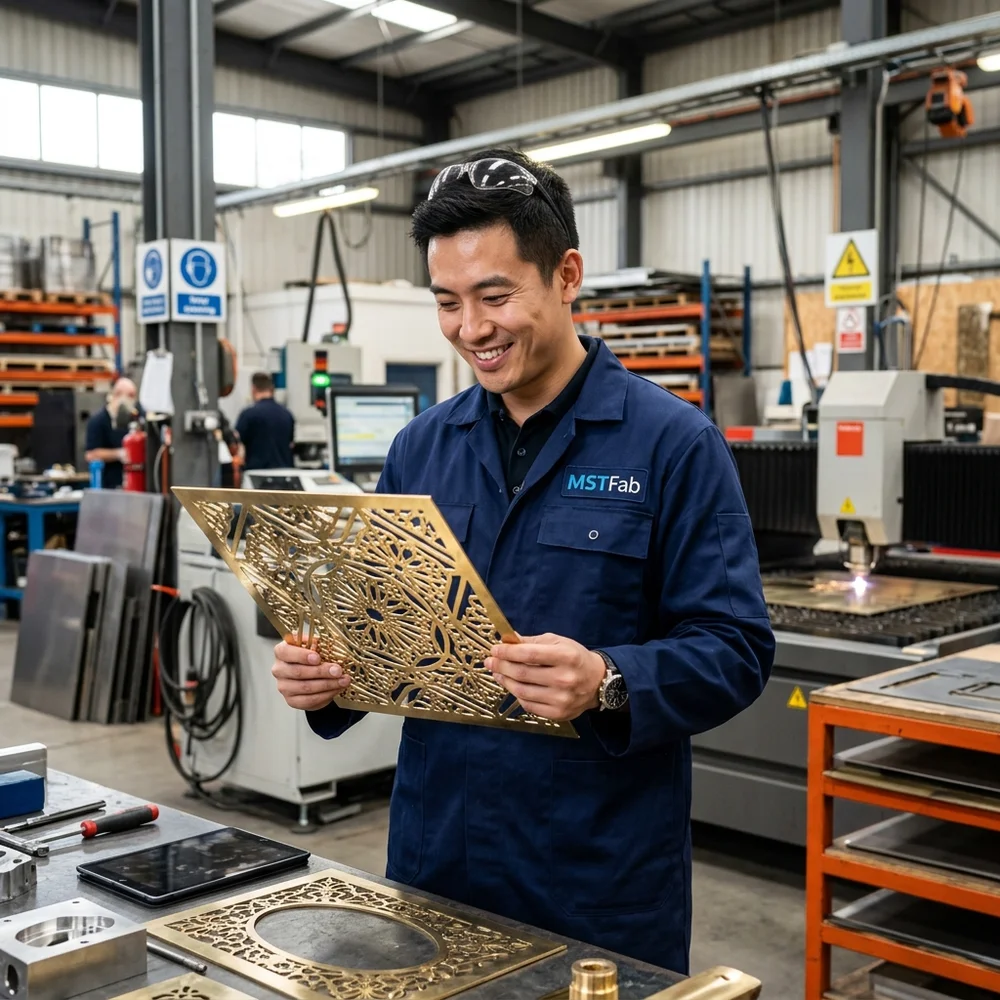
Copper-zinc alloys (brass) combine high thermal conductivity with strong infrared reflectivity. Older 10.6 µm CO₂ lasers reflect off bare brass and risk optical back-reflection damage, while poorly tuned lasers leave heavy bottom dross and dark, heat-oxidized edges.
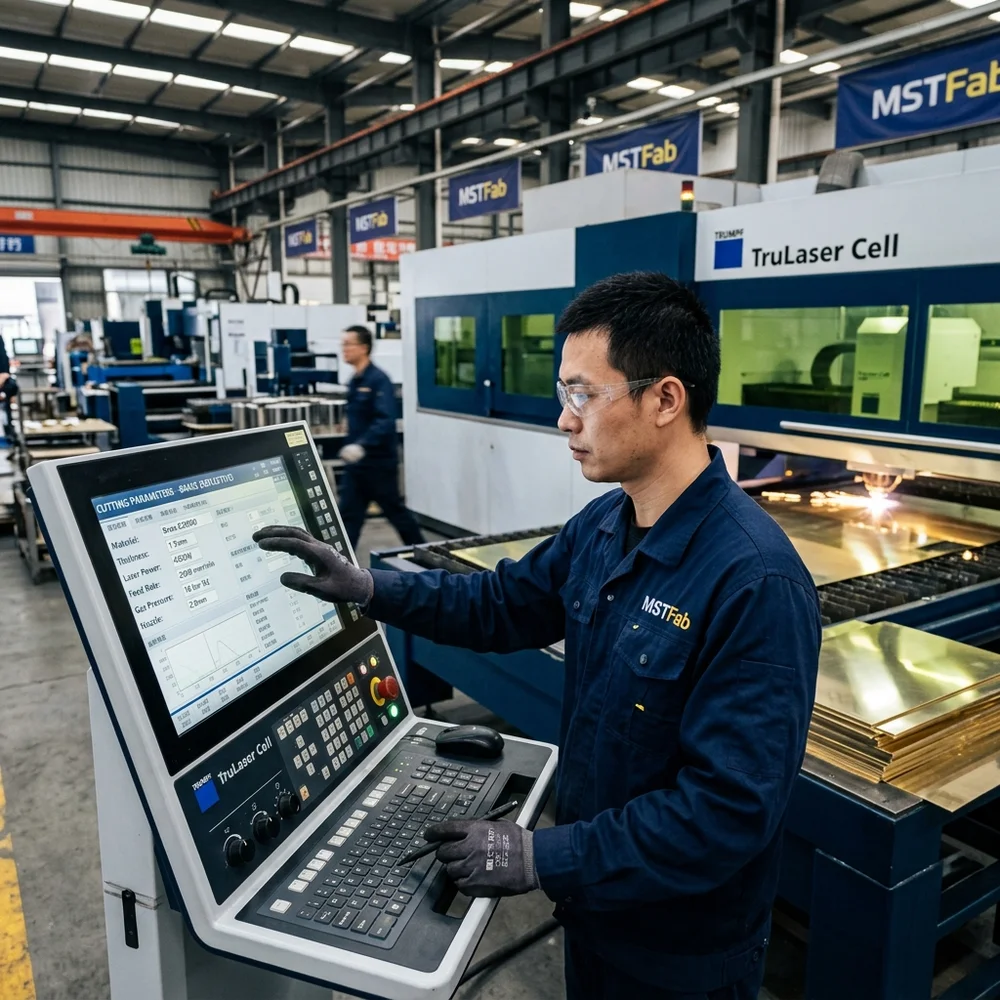
Modern 1.06 µm solid-state fiber laser cutting services coupling high peak pierce energy with optical back-reflection isolators establish a stable keyhole melt pool in milliseconds, cutting brass cleanly from 0.5 mm shims up to 10.0 mm+ plates.
High-pressure nitrogen assist
14–20 bar nitrogen blows molten brass cleanly out of the kerf before it can solidify as bottom burr or oxidize the cut edge.
Micro-joint tab retention
Small brass contacts and shims are held with 0.3 mm micro-tabs so parts never tip on the slats or get scarred by the laser nozzle.
Controlled heat-affected zone
High cutting speeds keep heat out of narrow bridges, preserving brass temper and flatness on delicate gaskets and grilles.
Thickness and tolerance range: We routinely laser cut brass sheet from 0.5 mm to 8.0 mm (and up to 12 mm on heavy plates) with flat profile tolerances of ±0.05 mm to ±0.10 mm depending on gauge.
02 / Brass Alloy & Temper Selection
Match the brass grade to your forming, machining or decorative requirements.
Specifying “generic brass” on a drawing can cause cracked bends if the mill supplies a high-zinc or leaded alloy when your part actually needs a ductile 90-degree flange.
- C26000 (Cartridge Brass 70/30 — CuZn30): The premier sheet metal brass with 70% copper and 30% zinc; offers the highest ductility for cold CNC bending, stamping, deep drawing, and electrical terminals.
- C28000 (Muntz Metal 60/40 — CuZn40): Higher strength and economical pricing with a warm golden tone; widely used for flat architectural panels, signage, decorative screens, and rigid mounting plates.
- C36000 (Free-Cutting Brass): Contains lead for high-speed machining and thread turning, but exhibits poor cold-forming ductility—avoid specifying C36000 if your sheet metal part has tight press-brake bends.
When building from laser cutting services from CAD drawings, our engineers verify both the alloy designation (ASTM / EN / JIS equivalent) and temper (such as H01 quarter-hard or H02 half-hard) before cutting.
03 / Surface Scratch & Tarnish Control
Protect soft brass faces from slat scratches, fingerprints and oxidation.
Brass is significantly softer than stainless or carbon steel (typically 55–85 HRB in half-hard sheet) and reacts rapidly with skin oils, humidity, and sulfur compounds in the air to form dark tarnish spots.
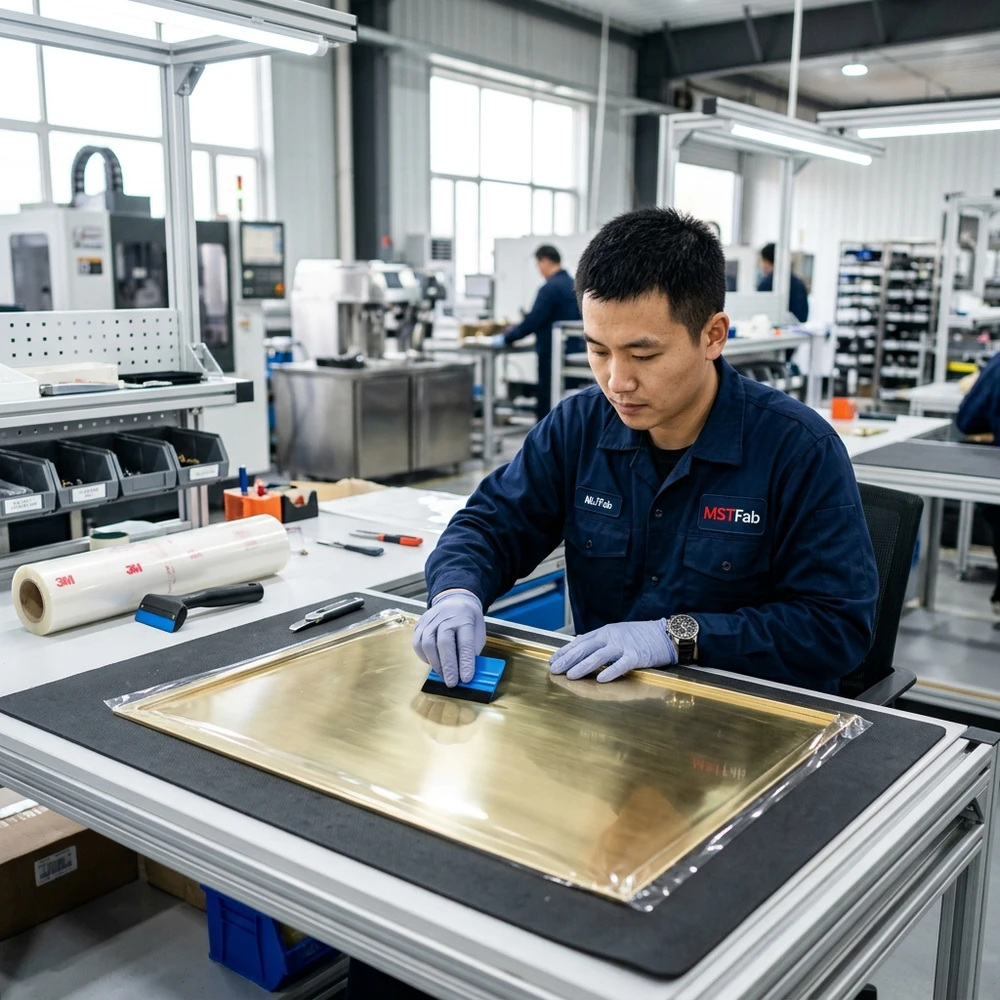
- Apply fiber-laser-compatible protective PVC/PE film to both sides of the brass sheet prior to loading onto cleaned copper/slat beds.
- Require operators to wear clean nitrile gloves whenever handling bare deburred or brushed brass parts—bare-hand fingerprints will etch into dark smudges within days.
- Specify clear acrylic/polyurethane baking lacquer, passivation dip, or electroplating (nickel, chrome, or antique bronze) if the brass must retain its exact appearance in service.
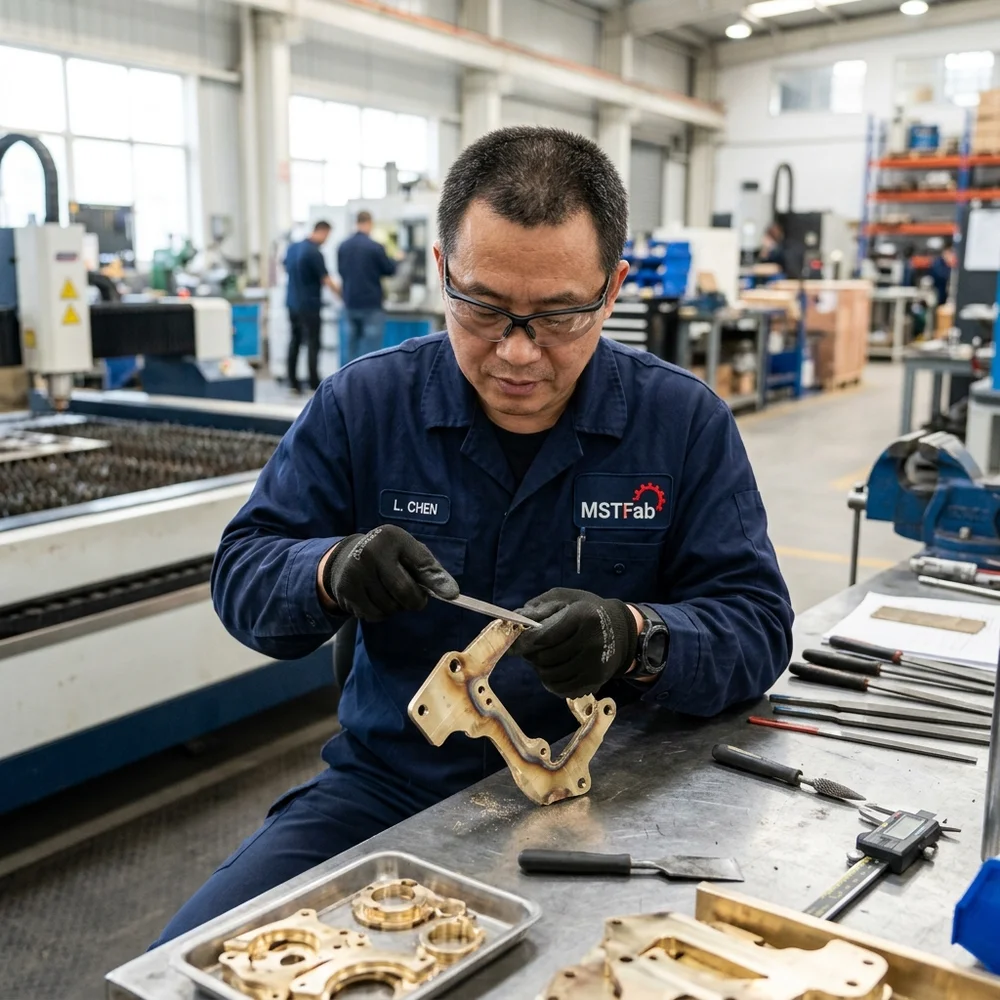
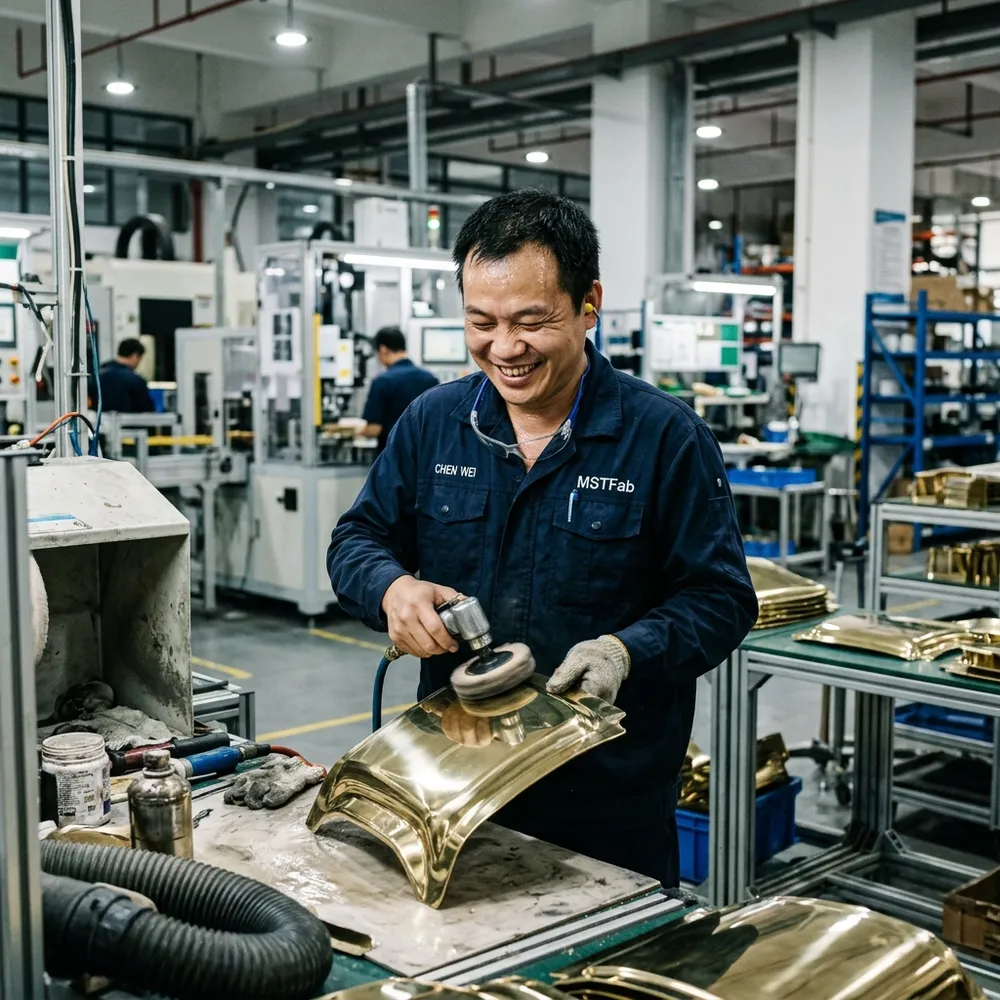
For mechanical assemblies where micro-burrs cannot be tolerated, we use dedicated non-ferrous abrasive brushes and ceramic tumbling media so steel particles never contaminate the brass surface.
04 / Secondary Forming & Finishing
Deliver complete bent, tapped and finished brass components.
Most OEM buyers need more than flat laser-cut brass blanks. Moving soft brass blanks between a laser job shop, a bending vendor, and a polisher almost always results in dented corners and tarnished surfaces.
- Non-marring CNC Press Brake Bending: Brass flanges are formed over urethane V-die inserts so steel tooling shoulders never leave shiny die marks on brushed or polished faces.
- Countersinking, Tapping & Hardware Insertion: We execute CNC countersinking for flush flat-head brass screws, precision tapping, and self-clinching fastener installation.
- Custom Surface Finishing: Choose from raw mill finish, directional hairline satin brushing, mirror buffing, vibrational tumbling, antique chemical patination, or clear protective coating.
Every multi-operation order is backed by sheet metal fabrication with first article inspection so hole locations, bend angles, and surface finish are signed off before batch delivery.
05 / Buyer Control Matrix
Five quality checkpoints for laser-cut brass parts.
Use this matrix to lock down alloy, edge condition, and surface protection on your brass drawings.
06 / Drawing Review & Dimensional QC
Verify delicate slot widths, hole diameters and flatness before shipping.
Brass laser cutting is frequently specified for precision electrical busbars, switch contacts, musical/acoustic components, luxury architectural hardware, and shim packs where a 0.1 mm burr or warped tab prevents assembly.
During our upfront DFM review, we verify that minimum hole diameters and slot widths are at least 1.0x material thickness (down to 0.8x on thin foils) and check grain orientation relative to any tight bends.
Finished parts are inspected with optical 2D vision measuring machines, pin gauges, and micrometers to verify full compliance with your CAD print.
See how our build-to-print laser cutting workflow operates →
07 / Anti-Tarnish Packaging & Scope
Seal brass shipments against sea-freight humidity and salt air.
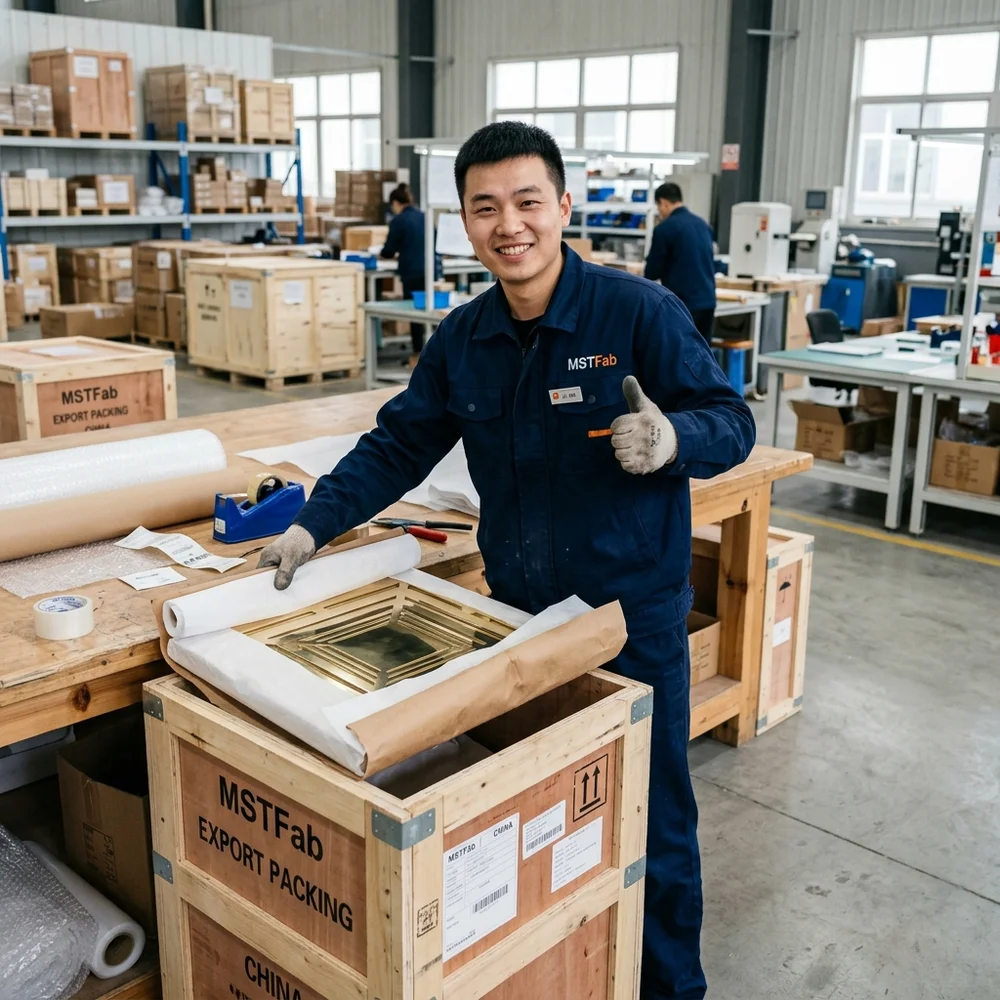
Unprotected brass shipped across the ocean in humid containers will arrive spotted with brown oxidation. As a sheet metal fabrication factory with export packaging expertise, we leave protective film on flat faces, wrap parts in sulfur-free VCI anti-tarnish paper, seal bundles inside polyethylene bags with silica gel desiccants, and pack them into rigid wooden crates.
MSTFAB operates under an ISO 9001 quality management system with full lot traceability from raw brass mill coil through final inspection.
Manufacturing scope: MSTFAB manufactures custom build-to-print brass and sheet metal components to customer drawings; final electrical/system integration and end-product certifications remain with the OEM.
08 / RFQ Checklist
Eight details to include when requesting a brass laser cutting quote.
- CAD files (DXF/DWG/STEP)1:1 flat DXF for 2D profiles, or 3D STEP model if the brass part includes bends or countersinks.
- 2D PDF engineering drawingCall out critical hole/slot tolerances, flatness requirements, and thread specifications.
- Brass alloy and temperSpecify C26000 (CuZn30 / H68-H70), C28000 (CuZn40 / H62), and temper (e.g., H02 half-hard).
- Exact sheet thicknessState nominal thickness in millimeters (e.g., 0.8 mm, 1.5 mm, 2.0 mm, 3.0 mm, or 5.0 mm).
- Cosmetic surface finishIndicate standard mill finish, directional satin brush, mirror polish, or bead-blasted matte.
- Clear coat or bare metalNote whether parts require clear anti-tarnish lacquer, electroplating, or bare conductive metal.
- Protective film preferenceConfirm if you want protective PVC/PE film left applied on the A-surface for your assembly line.
- Order quantity and deliveryPrototype sample quantity, production batch size, and air vs. sea shipping preference.
Letting us know whether your brass part is an internal conductive electrical contact (requiring bare, unlacquered metal) or an exterior decorative bezel (requiring brushed + clear-coated protection) ensures we quote the exact right process.
Brass laser cutting FAQ for engineers and buyers
What is the maximum thickness of brass you can laser cut cleanly?
Using high-power fiber lasers with high-pressure nitrogen assist gas, we cleanly cut brass sheet and plate from 0.5 mm up to 10.0 mm–12.0 mm. For thicknesses between 0.5 mm and 5.0 mm, edge quality and perpendicularity are exceptionally sharp.
Which brass alloy should I choose if my part requires 90-degree press brake bends?
Specify C26000 (70/30 Cartridge Brass, equivalent to CuZn30 or H68/H70) in quarter-hard (H01) or half-hard (H02) temper. It has superior cold-working ductility compared to 60/40 brass (C28000) and bends cleanly without outer-radius orange-peel or cracking.
How do you prevent laser-cut brass edges from turning black or dark brown?
Dark edges occur when brass is cut with compressed air or oxygen, which oxidizes the copper and zinc along the kerf. We cut brass exclusively with high-purity, high-pressure nitrogen assist gas so the cut edge retains its bright golden metallic color.
Can you laser cut thin brass shims and gaskets without warping them?
Yes. For 0.5 mm to 1.0 mm brass shims, we use high-speed fiber laser parameters, distributed pierce sequencing, and micro-tabs so thin rings and slotted shims remain flat and unstressed.
How do you keep brass parts from tarnishing during international shipping?
For bare brass parts that cannot be lacquered (such as electrical contacts or parts to be soldered), we handle parts with nitrile gloves after ultrasonic/solvent cleaning, wrap them in sulfur-free VCI anti-tarnish paper, and vacuum-seal or bag them with desiccant packs.
What is the smallest hole or slot width you can laser cut in brass sheet?
As a general DFM rule, keep hole diameters and slot widths at least 1.0x the brass sheet thickness (for example, a ≥2.0 mm hole in 2.0 mm brass). On thin brass under 1.5 mm, features down to 0.8–1.0 mm are achievable.
Technical references
These material and thermal cutting standards cover copper-zinc brass sheet specifications and laser-cut geometrical tolerances.
- ASTM B36 / B36M — Standard Specification for Brass Plate, Sheet, Strip, And Rolled Bar (UNS C26000, C28000)
- ISO 9013 — Thermal cutting: Classification of thermal cuts, geometrical product specification and quality tolerances
- ISO 2768-1 — General tolerances for linear and angular dimensions without individual tolerance indications
Upload your brass CAD drawings for a fast laser cutting and forming quote.
Send your DXF, STEP, and PDF files along with alloy, thickness, and finish requirements. MSTFAB will review your design and provide an accurate quote.
Request a Brass Cutting Quote →
Have a question first? caroline@mstfab.com
 WeChat Contact
 WhatsApp Me Directly