
Electronics enclosure sourcing guide / buyer-built scorecard
Quick answer: the five best metal enclosure manufacturers for electronics companies are not the five names shouted loudest by a directory. They are the suppliers that pass a buyer-built scorecard: real factory evidence, electronics-aware DFM, EMC/EMI shielding interfaces, IP sealing geometry, grounding paths, thermal features, precision thin-sheet fabrication, first-article inspection, material traceability and a commercial model that fits your product stage.
Scope boundary
What MSTFAB can support, and what stays with the electronics company
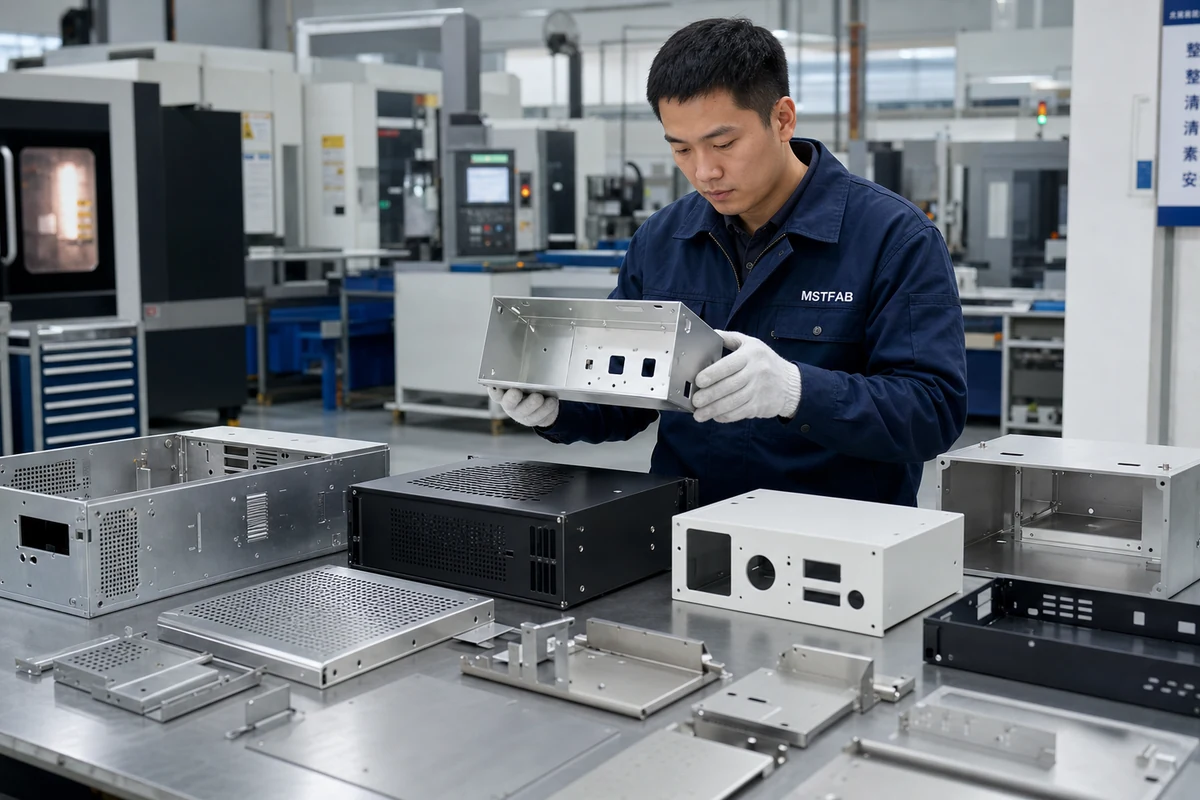
MSTFAB fabricates empty metal electronics enclosure shells and mechanical sheet metal parts from buyer drawings. Typical work includes laser-cut aluminum or stainless panels, CNC-bent chassis shells, welded enclosure bodies, vented lids, removable covers, shielding partitions, bracket rails, grounding studs, PEM hardware locations, surface finishing, dimensional inspection and export packaging.
MSTFAB does not supply complete electronic products, PCBs, wiring, firmware, software, energized testing, EMC chamber validation, IP certification, UL/CE/FCC approvals or final assembly validation. The buyer, electronics OEM, system integrator or approved laboratory remains responsible for circuit design, electrical function, thermal simulation, board layout, compliance testing and final product certification.
- Empty metal electronics enclosure shells, chassis, covers and panels
- Laser-cut connector openings, vent patterns, screw holes and mounting plates
- CNC-bent thin-gauge flanges, returns, lids, partitions and bracket rails
- Fixture-welded shielded bodies, frames and support structures
- Grounding studs, masked bonding zones and PEM hardware locations when specified
- Powder coating, brushing, anodize-compatible masking notes and deburring
- First-article dimensional inspection for buyer-defined critical dimensions
- Export packing with separators, protective film, hardware bags and photos
- PCBs, components, wiring, firmware, software and powered assembly
- EMC pre-scan, shielding effectiveness testing and final compliance route
- IP, NEMA, UL, CE, FCC, RoHS, REACH or market certification of the complete product
- Thermal design, heatsink performance, airflow, derating and board-level risk review
- Electrical safety, grounding validation and energized testing
- Approved labels, manuals, service instructions and warranty obligations
- Critical dimensions, acceptance criteria and revision release
- Final decision on whether the enclosure supports product-level validation
Why “best” is the wrong word until you score the supplier
Electronics companies do not buy a metal box in isolation. They buy mechanical protection for a board layout, shielding strategy, heat path, cable entry, service access, mounting interface and product brand. A supplier can make a beautiful rectangular shell and still fail your project if the gasket groove is wrong, a grounding pad gets powder coated, a vent pattern distorts after bending or a front-panel opening wanders just enough to make assembly awkward.
That is why a generic “top 5” list is dangerous. It usually ranks marketing presence, not supplier fit. A radio product, an edge-compute gateway, a solar inverter enclosure, a medical electronics console and a lab instrument chassis do not need the same supplier archetype. The honest approach is to define what your enclosure must do, score candidates against that requirement and run a paid trial order before production. Very glamorous? No. Better than learning about EMI at the test lab with everyone staring at the chamber door? Absolutely.
How to Use This Procurement Guide
This article is designed as a supplier-selection framework for electronics companies building an evidence-based shortlist. If you already have completed drawings and require immediate production capability review, you can skip directly to our custom metal parts for electronics enclosures fabrication scope. Alternatively, if your product is still in early development, our electronics startup enclosure manufacturer guide provides targeted NPI advice.
The distinction is deliberate: standard service pages describe what a factory can build; this guide explains how a purchasing team should evaluate the mechanical competence of any supplier, including MSTFAB. Our goal is to provide actionable engineering criteria that separate true mechanical partners from generic metal workshops.
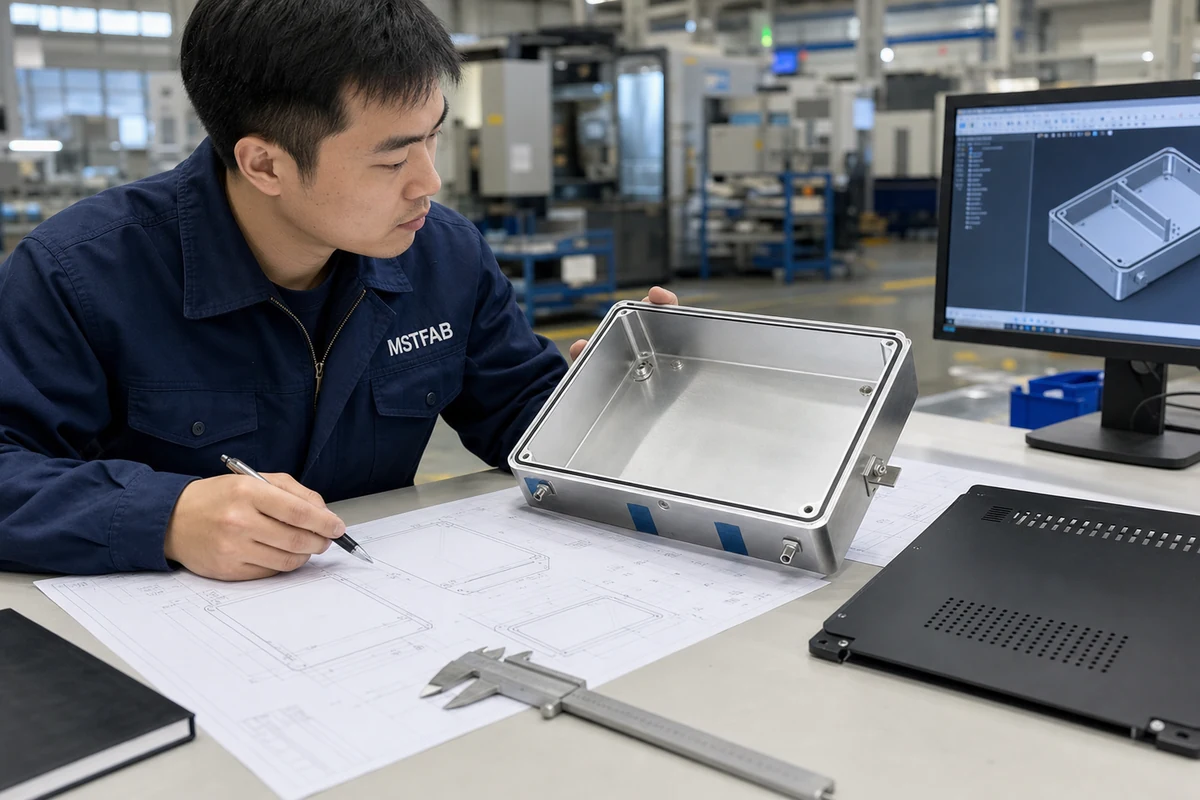
Before contacting suppliers, prepare a complete drawing package. Our guide on what files are needed for a sheet metal fabrication quote explains why STEP files, 2D drawings, material notes, finish requirements, critical dimensions and quantity breaks should travel together.
The seven-dimension scorecard for electronics enclosure suppliers
Use this as your RFQ scoring sheet. Weight it to the product. A sealed outdoor gateway may weight D2 and D6 heavily. A benchtop lab instrument may weight cosmetics and panel alignment more heavily. A cost-driven mature product may weight commercial scale higher. D1 and D5 are HARD GATE / mandatory items. D2 is the defining fit gate for electronics enclosures.
| Dimension | Weight | What to verify | Pass or fail signal |
|---|---|---|---|
| D1 Real factory identity and video audit | HARD GATE / mandatory | Owned or controlled laser cutting, bending, welding, finish handling, inspection and packing workflow; similar empty electronics enclosure shells on the floor | Fail if the supplier cannot prove it fabricates the metal parts it quotes |
| D2 EMC/EMI shielding, IP sealing, grounding and thermal fit | Defining fit gate | Gasket channels, conductive paths, masked bonding zones, grounding studs, venting, heatsink flats, airflow openings and enclosure partitions from buyer drawings | Fail if the supplier talks only about making a rectangular box |
| D3 Capability match for thin sheet metal electronics parts | 20% | Laser-cut openings, tight small flanges, repeatable CNC bending, thin-gauge welding, micro-deburring, cosmetic panels and PEM hardware | Fail if the supplier has no examples near your material thickness or feature density |
| D4 Quality system and First Article Inspection | 20% | FAI report, measured critical dimensions, GD&T where specified, panel openings, flatness, bend angle, weld distortion, finish checks and CoC where required | Fail if the supplier ships what looks right without measured evidence |
| D5 Material certification, PMI and heat or batch traceability | HARD GATE / mandatory | Material grade, thickness, mill certificate when required, heat number or batch identity, PMI where specified and lot separation | Fail if a buyer-defined material cannot be supported with evidence |
| D6 Market and certification support scope | 15% | RoHS/REACH declarations, coating data, plating or anodize notes, UL/CE/FCC lab support documents and clear separation of supplier vs buyer responsibility | Fail if the supplier claims the empty metal shell is automatically product-certified |
| D7 Commercial and overseas fit | 25% | NPI lead time, low-volume flexibility, engineering communication, DFM feedback, Incoterms, packing plan, revision cost and true landed cost | Fail if the commercial model does not match your product stage |
D1: verify the real factory before sharing the serious drawings
Start with identity. Ask for a live video walkthrough of sheet storage, laser cutting, CNC bending, welding, hardware insertion, deburring, surface treatment, inspection and packing. Ask to see empty electronics enclosure shells, not only polished finished devices. Finished device photos may impress a marketing team, but they do not prove who cut, bent or inspected the metal.
Useful suppliers ask detailed questions: material grade, thickness, bend radius, visible faces, grain direction, conductive zones, gasket groove, PEM hardware, grounding studs, hole tolerance, front-panel flatness, vent pattern, surface finish and packaging. If a supplier takes your complex electronics enclosure drawing and says “yes, no problem” in twelve seconds, congratulations: you have received a quotation and possibly a weather forecast.
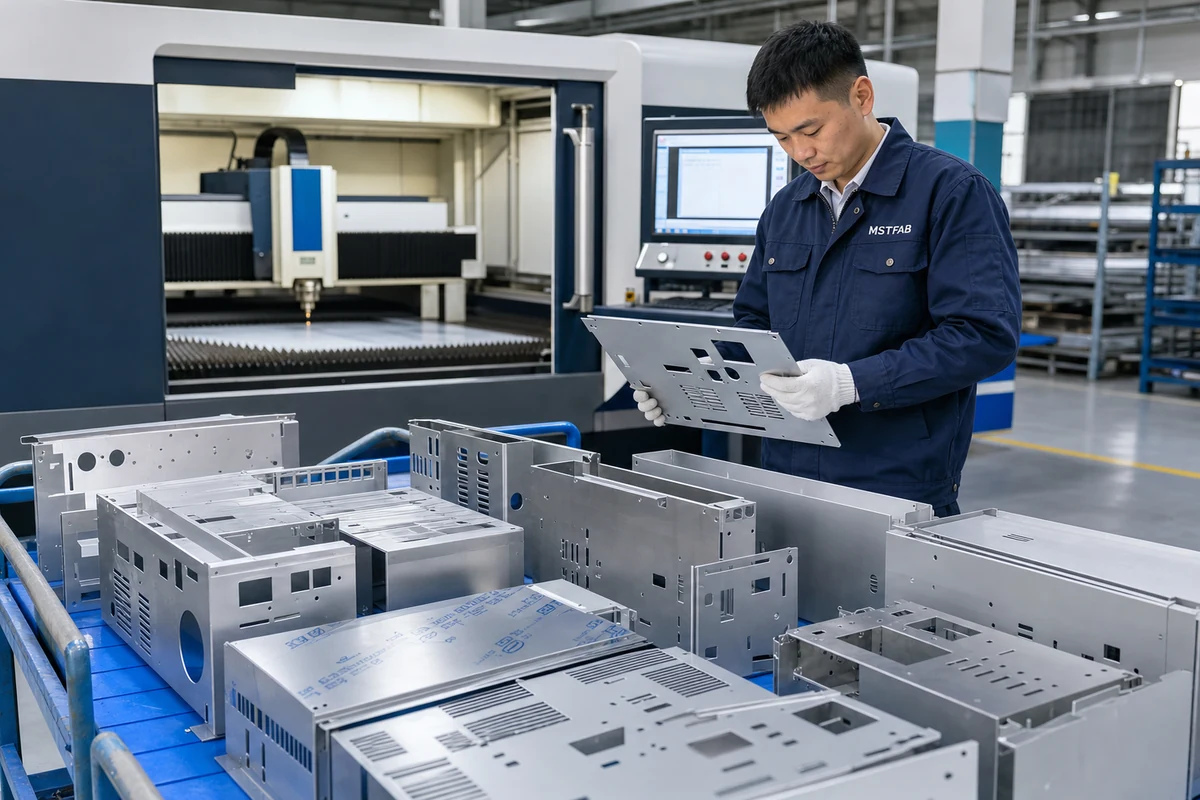
For process depth behind panels, slots, vents and cutouts, review MSTFAB’s laser cutting services. Laser accuracy matters most when later processes keep the features where the drawing expects them.
D2: electronics enclosures need more than a metal box
This is the dimension that separates an electronics enclosure specialist from a general box maker. The supplier does not need to design your circuit, but it should understand the mechanical features that support electronics performance. That includes shielded seams, conductive gasket interfaces, masked ground paths, cable-entry plates, heat-transfer flats, airflow openings, vent patterns, separated compartments and serviceable covers.
For IP-rated products, the empty metal shell can provide gasket grooves, door returns, rain lips, screw spacing and compression surfaces. The buyer or approved lab still validates the complete product with its gasket, fasteners, cables, vents, labels and assembly torque. For EMC and EMI, the fabricator can build conductive paths, welded seams and masking zones from the drawing, but the electronics company owns product-level testing and compliance. An enclosure can help the test. It cannot take the test for you while wearing safety glasses.
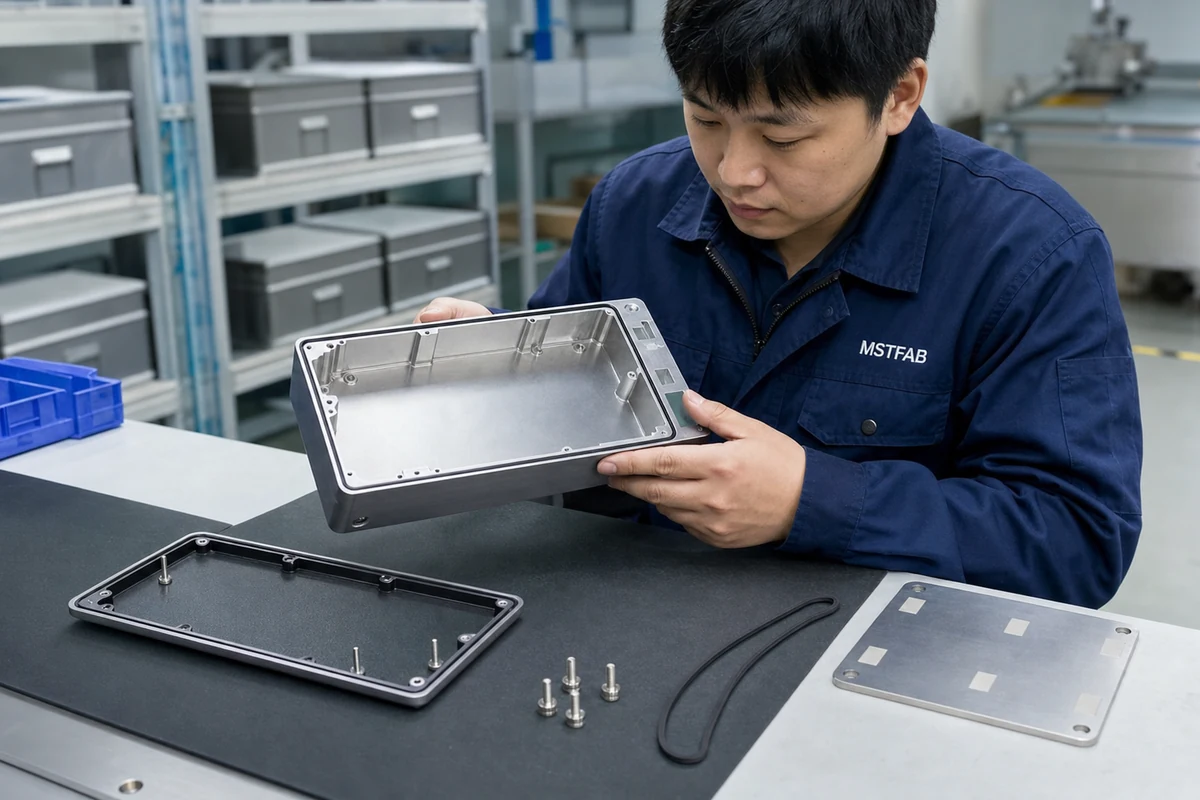
For related enclosure-shell thinking, see OEM enclosure shell fabrication checklist and fabricated metal box manufacturer for electronics.
D3: capability match for thin sheet metal electronics parts
Electronics enclosure parts are often smaller and more feature-dense than industrial cabinets. Thin aluminum covers, stainless shields, black powder-coated lids, front panels, card guides, brackets and vented sidewalls may sit close to boards, connectors and display openings. A supplier must control cutting burrs, bend distortion, flange length, panel flatness, hole alignment and cosmetic handling.
Ask for examples close to your material thickness and geometry. If your design uses 1.0 mm aluminum with a row of narrow vents and tiny returns, a sample of a 4 mm welded bracket does not answer the question. If your front panel has cosmetic requirements, ask how the supplier protects it through bending, welding, coating and packing. The part that everyone touches should not be treated like the hidden bracket nobody invites to meetings.
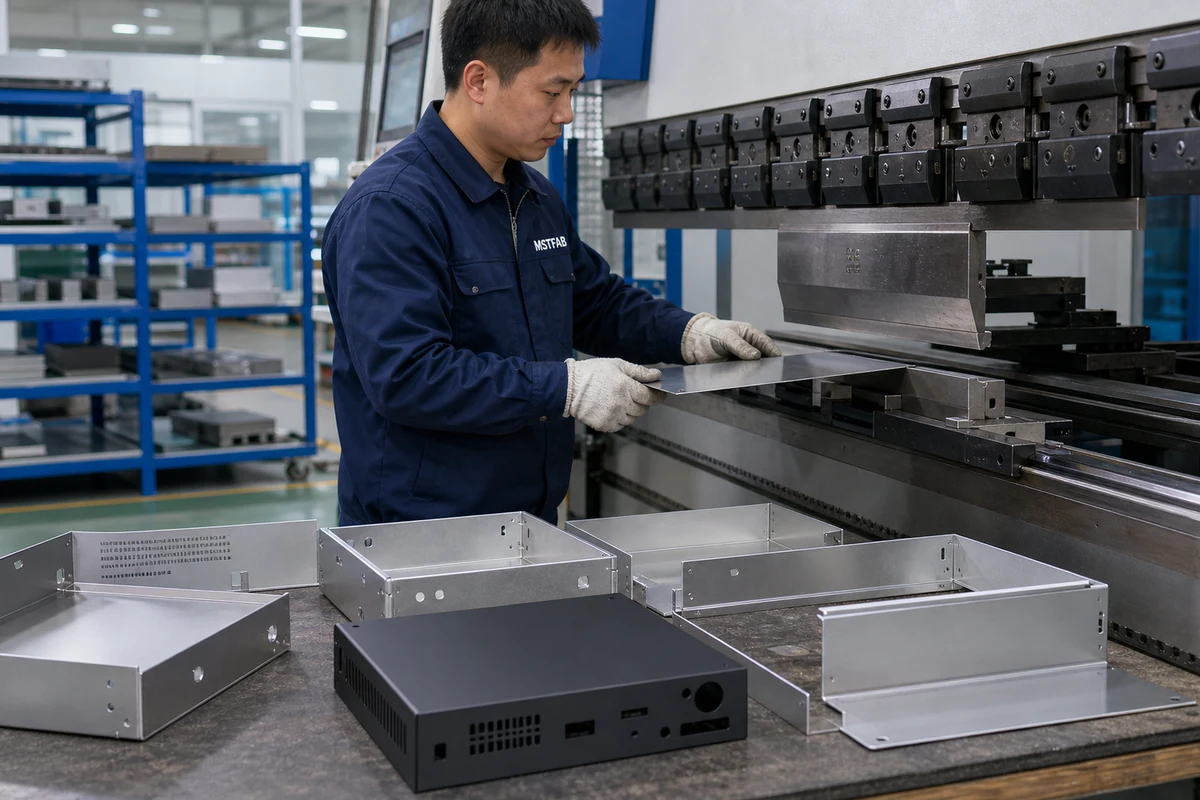
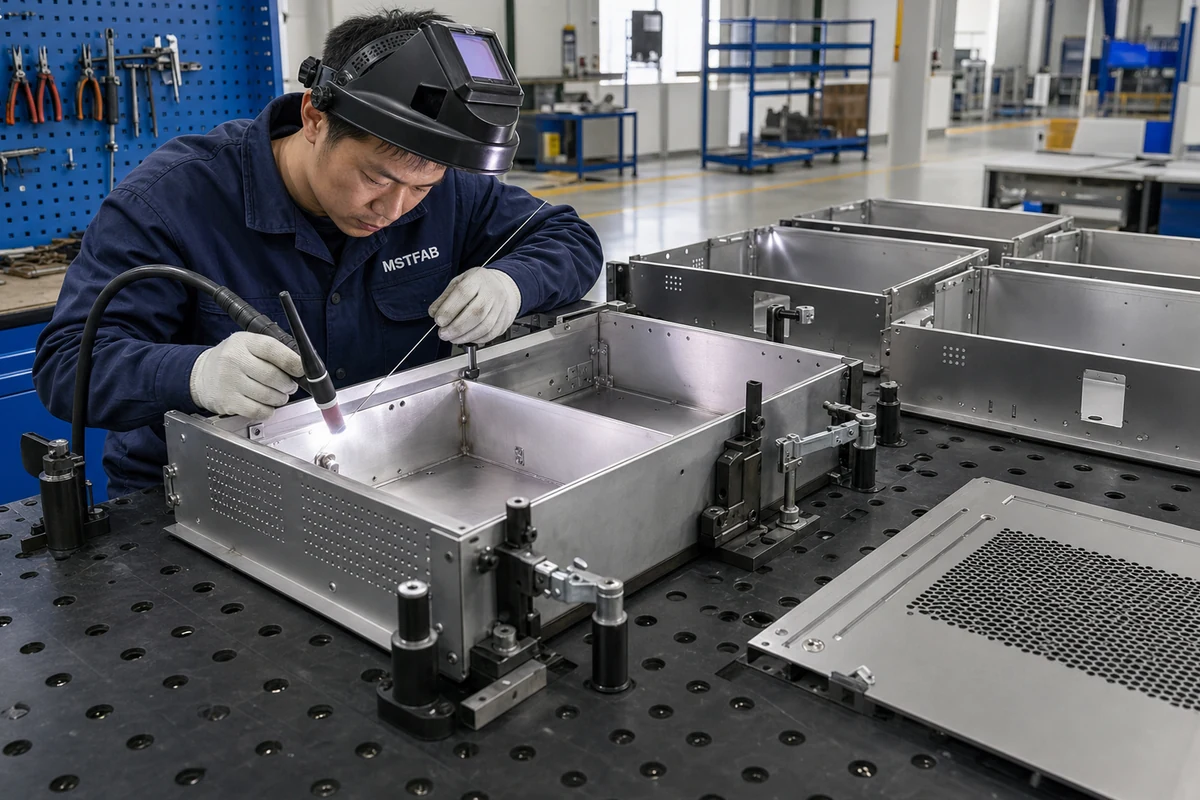
For forming and welded structures, review sheet metal bending and welding services.
D4: First Article Inspection makes the supplier prove it
A trial order without FAI is just a sample with optimism attached. A useful first-article package should measure the features that affect the electronics assembly: board mounting holes, standoffs, front-panel openings, connector cutouts, thermal interface flats, gasket groove, cover fit, screw spacing, bend angles, welded seam distortion, flatness and visible-surface condition.
The FAI does not certify the finished electronic product. It answers a narrower but vital question: did the supplier build the drawing-defined metalwork correctly enough for your engineering team to move forward? For NPI teams, that evidence is worth more than a supplier saying “we checked everything” while mysteriously avoiding numbers.
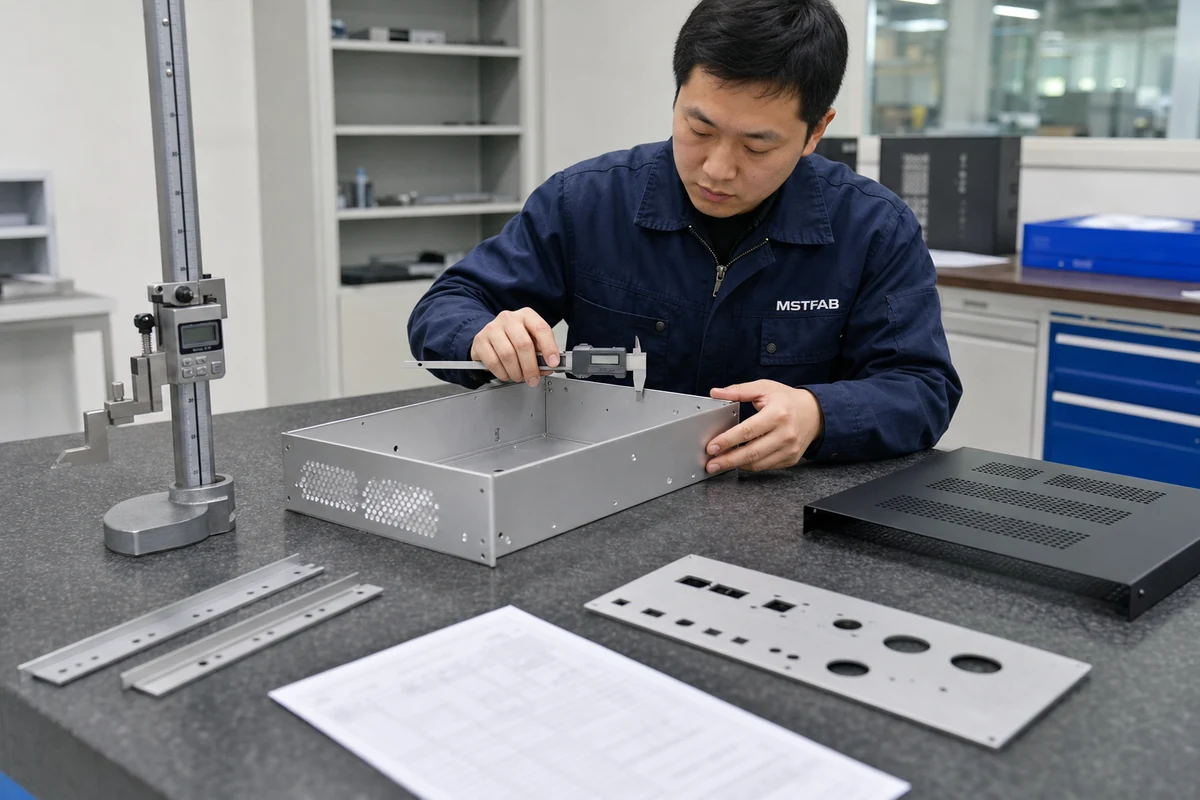
For measured evidence, compare MSTFAB resources on dimensional inspection reports and first article inspection.
D5: material certification, PMI and traceability are mandatory when specified
Electronics enclosures use aluminum, stainless steel, galvanized steel, cold rolled steel and sometimes coated or plated materials depending on shielding, corrosion, heat, weight and cosmetics. A substituted alloy can bend differently, weld differently, corrode faster or interrupt the planned conductive path. The metal may look the same; the test result may not be as friendly.
When required by the buyer, ask for EN 10204 3.1 material certificates, heat or batch identity, PMI verification, coating data, RoHS/REACH declarations and lot separation. Not every simple lab bracket needs a thick evidence package, but the buyer should decide the risk level before production. A serious supplier should support the requirement rather than treating material evidence as paperwork confetti.
For material selection, see common materials used in sheet metal fabrication, stainless steel sheet metal fabrication and aluminum sheet metal fabrication.
D6: match compliance support to the destination market
Electronics companies may need RoHS, REACH, CE, FCC, UL, EMC, LVD, IP or NEMA evidence depending on the product and destination market. The fabricator should be clear about its scope. It can provide mechanical fabrication evidence, material documents, coating information, masking instructions, inspection records and photos of the empty shell. It should not imply that a sheet metal enclosure alone is automatically compliant as a complete electronic product.
This boundary is a trust signal. Good suppliers are comfortable saying what they can prove and what belongs to the buyer or lab. Weak suppliers often overclaim because it sounds easier during sales. Unfortunately, test labs are famously unimpressed by sales enthusiasm.
D7: commercial fit depends on product stage
An electronics startup in NPI needs quick DFM, prototype flexibility and clear revision costs. A field device maker may prioritize gasket geometry, outdoor finish and packing evidence. A mature electronics company with stable drawings may prioritize volume pricing, repeatability and logistics. These are different supplier shapes. Do not force a cost-driven mass-production house to behave like a prototype partner, and do not ask a fast NPI shop to win a million-piece price war by smiling harder.
For overseas buyers, commercial fit also includes English engineering communication, quote clarity, Incoterms, payment terms, lead time, change control, packing photos and a realistic plan for repeat orders. The right supplier makes tradeoffs visible. The wrong supplier hides them until your project schedule starts making interesting noises.
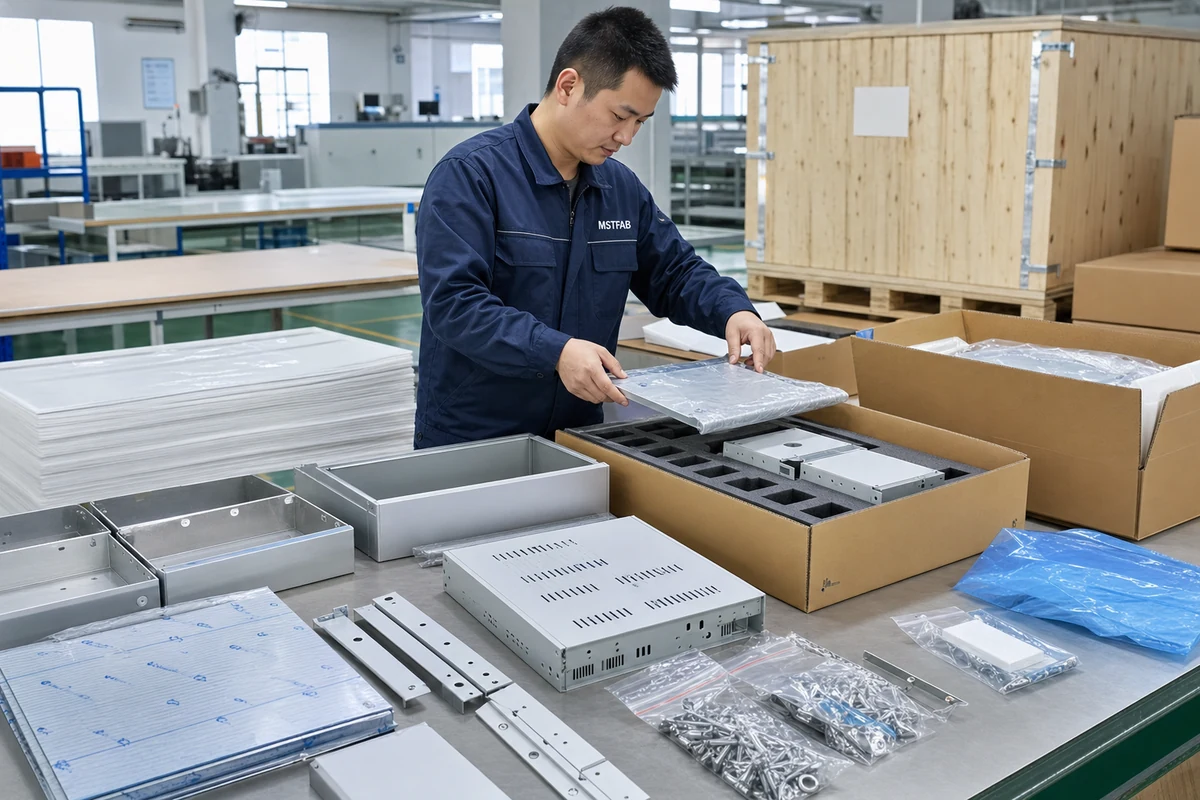
For shipping and buyer confidence, review MSTFAB’s export packaging guide and factory photos.
The trial-order-with-FAI threshold
A supplier becomes a serious candidate only after it passes a paid trial order. Use a representative enclosure, not a harmless flat coupon that avoids the real risks. Send the same drawing package to each shortlisted supplier, then compare the same evidence package.
| Trial evidence | Why electronics buyers need it | Who owns it | When to request it |
|---|---|---|---|
| Same STEP and 2D drawing pack | Prevents one quote from ignoring critical openings, grounding zones, finish notes or hardware | Buyer engineering | Before quotation |
| DFM notes | Shows whether the supplier understands bend risk, gasket surfaces, EMI interfaces, thermal flats and PEM hardware | Supplier engineering and buyer engineer | Before purchase order |
| Material evidence where required | Confirms buyer-defined aluminum, stainless or coated steel grade and supports traceability | Supplier quality team | Before or during first article |
| First Article Inspection | Verifies holes, cutouts, flatness, bend angles, weld distortion, cover fit, hardware and critical dimensions | Supplier quality team | Before batch release |
| Finish and masking photos | Documents visible surfaces, conductive zones, grounding pads, coating edges and protected faces | Supplier finishing and quality team | Before shipment |
| Buyer lab test plan | Confirms which EMC, IP, thermal, safety or market tests remain outside the fabricator’s scope | Buyer or approved laboratory | Before product validation |
| Packing photos and package list | Protects cosmetic panels, lids, brackets, hardware and short-run launch parts in international shipping | Supplier shipping team | Before shipment |
Five candidate archetypes to build your own top five
These are not five named companies. They are five supplier shapes that can be right depending on the electronics product stage. Map your candidates to these archetypes, then score them with D1 to D7.
Where MSTFAB fits, with disclosure
MSTFAB is a sheet metal fabrication supplier, so this article is not pretending to be a neutral academic ranking. Our strongest fit is drawing-defined metalwork: empty electronics enclosure shells, chassis, panels, covers, brackets, mounting plates, shield partitions, welded frames and buyer-specified hardware locations. We are typically a better fit for prototype-to-production, low-volume, mid-volume and ruggedized enclosure-shell projects than for a pure million-unit commodity box program.
That disclosure matters. A useful supplier should know when it is a good fit and when it is not. If your project needs final electronics design, firmware, complete device certification or EMC chamber validation, that remains with your electronics team or approved lab. If your project needs laser cutting, bending, welding, surface treatment, mechanical inspection and export packing for the empty metal enclosure scope, MSTFAB can review the drawing pack and quote that scope clearly.
Red flags that disqualify an electronics enclosure supplier
Eight-step workflow to build your own shortlist
- Define the electronics product type. Separate indoor instrument, RF gateway, outdoor sensor, inverter housing, edge-compute chassis, medical electronics cover or control enclosure.
- Separate fabrication scope from product scope. List what belongs to the metal supplier and what remains with electronics engineering or the test lab.
- Prepare the RFQ pack. Include STEP, 2D drawings, revision level, material, thickness, finish, grounding zones, gasket surfaces, critical dimensions and quantities.
- Verify real factories. Use video audits, process photos, sample evidence and machine lists before sending sensitive CAD.
- Score D1 to D7. Treat factory evidence and material evidence as mandatory, and D2 as the electronics fit gate.
- Run a paid trial order. Use representative geometry, not a simplified sample that avoids the hard features.
- Compare evidence, not promises. Review DFM, FAI, finish, masking, packing, communication and landed cost.
- Choose by product stage. Use NPI partners early, ruggedized or EMC specialists when needed, and high-volume houses after the design stabilizes.
What MSTFAB can manufacture for electronics enclosure projects
MSTFAB supports sheet metal fabrication for empty electronics enclosure shells, RF-style housings, control boxes, interface panels, vented covers, card guides, bracket rails, welded chassis frames, mounting plates, internal shields, cable-entry plates and powder-coated or brushed metal covers. We manufacture from buyer drawings and support DFM review, laser cutting, CNC bending, welding, hardware insertion, surface treatment, inspection and export packing.
For process and service pages, review sheet metal fabrication, metal enclosure box fabrication, laser cutting services, sheet metal bending, welding services, surface treatment, low-volume sheet metal enclosure fabrication and drawing upload support.
Key takeaways
- A real “best five” is a scorecard result, not a public ranking copied from a supplier directory.
- For electronics companies, D2 is the defining gate: EMC/EMI shielding interfaces, IP sealing geometry, grounding paths and thermal features must be treated as mechanical design requirements.
- D1 factory verification and D5 material evidence are HARD GATE / mandatory items.
- MSTFAB fabricates empty metal electronics enclosure shells and mechanical sheet metal parts from buyer drawings; we do not supply complete electronic products, PCBs, wiring, firmware, software, energized testing, EMC chamber validation or final certification.
- The best filter is a paid representative trial order with DFM notes, material evidence, FAI, finish/masking photos and packing evidence.
Related fabrication resources
FAQ
Can you name the actual 5 best metal enclosure manufacturers for electronics companies?
No. A universal public ranking would be less useful than a buyer-built scorecard. The right supplier depends on enclosure size, material, board layout, EMC risk, IP requirement, thermal path, finish, quantity, destination market and product stage. Use this guide to build a shortlist that fits your own enclosure.
Does MSTFAB make complete electronic products?
No. MSTFAB fabricates empty metal electronics enclosure shells and mechanical sheet metal parts from buyer drawings. MSTFAB does not supply complete electronic products, PCBs, wiring, firmware, software, energized testing, EMC chamber validation, IP certification, UL/CE/FCC approvals or final assembly validation.
What makes an electronics enclosure manufacturer different from a general metal box maker?
An electronics enclosure supplier should understand gasket channels, grounding pads, conductive paths, heat-transfer surfaces, vent patterns, connector openings, PEM hardware, front-panel flatness and cosmetic handling. A general box maker may cut and bend metal well but miss the interfaces that affect electronics assembly and compliance testing.
Do I need material certificates and PMI for an electronics enclosure?
Use them when material grade affects shielding, corrosion, strength, finish, export compliance or product validation. A simple prototype may not need a full evidence package, but a buyer-defined aluminum, stainless or coated steel requirement should be supported with certificates, batch identity and PMI where specified.
Can a sheet metal supplier certify my enclosure for EMC or IP?
A sheet metal supplier can fabricate features that support EMC or IP goals, such as seams, gasket grooves, bonding zones, vent openings and cable-entry plates. Final EMC, IP, UL, CE or FCC validation belongs to the complete assembled product and the buyer’s approved test route.
What should I send for an electronics enclosure RFQ?
Send STEP files, 2D drawings, revision level, material grade, thickness, finish, visible faces, critical dimensions, gasket surfaces, grounding zones, PEM hardware, quantity breaks, annual demand, packing requirements and any inspection-report format you need.
Electronics enclosure RFQ review
Need a drawing-defined metal enclosure shell supplier?
Send your STEP file, 2D drawing, material, thickness, finish, critical dimensions, gasket or grounding notes, hardware locations, quantity breaks and packing requirements. MSTFAB will review the sheet metal fabrication route clearly, without pretending to be your PCB designer, software team, EMC lab or certification department.
 WeChat Contact
 WhatsApp Me Directly