
304 stainless steel is easy to put on a quotation and surprisingly easy to get wrong in production. Two parts can share the same alloy name while arriving with different grain, gloss, weld color, corner shape, scratches, and hardware fit. Buyers rarely lose sleep over the periodic table. They lose sleep when the first cabinet door looks different from the second.
304 is a stainless steel grade, not a corrosion warranty, surface-finish specification, hygiene claim, enclosure rating, or finished-product approval. The drawing and purchase order still need to define the exact material standard, 304 or 304L choice, sheet thickness, finish, visible faces, grain direction, weld treatment, passivation when required, inspection evidence, and service environment.
The Quick Answer
Use 304 stainless steel sheet metal fabrication when a buyer-owned design needs good general corrosion resistance, clean appearance, formability, and weldability in a suitable environment. Before RFQ, state the material designation and governing specification, sheet thickness, mill finish, cosmetic class, grain direction, bend radii, weld appearance, critical tolerances, hardware, contamination controls, post-fabrication treatment, protective film, and packing method.
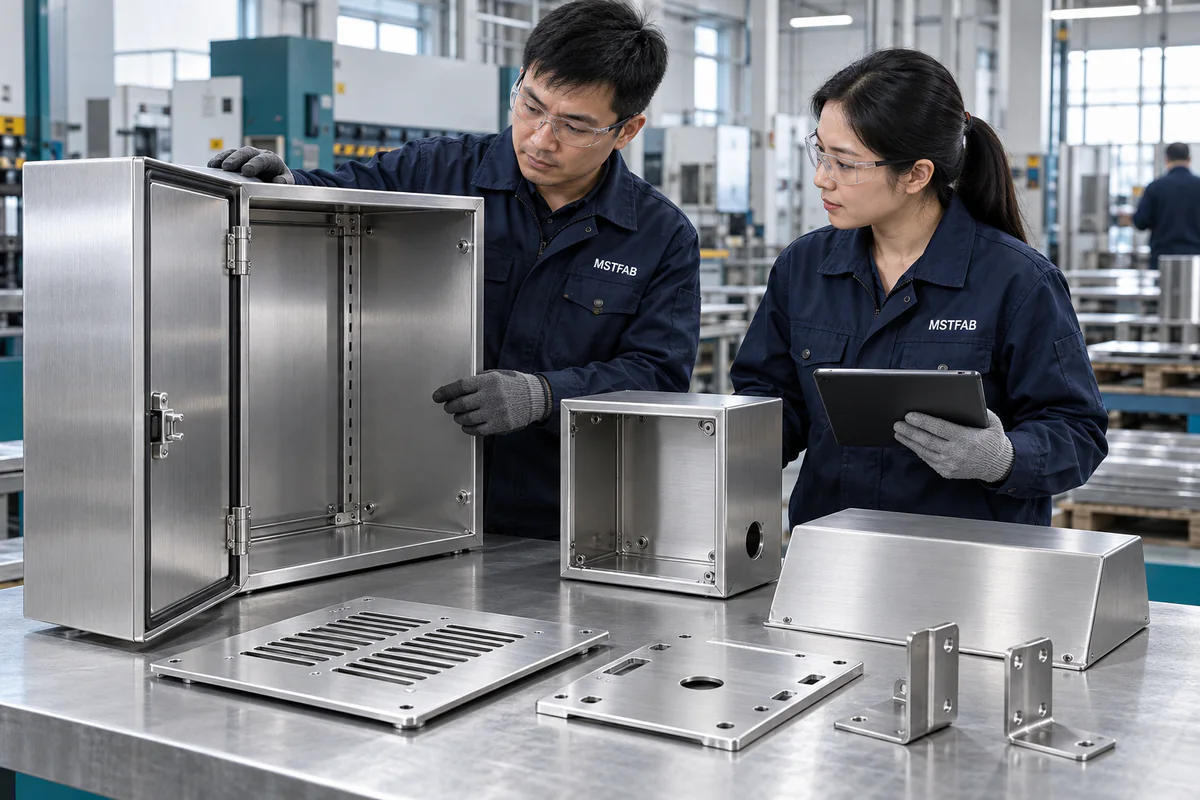
MSTFAB’s scope is custom empty sheet metal work made to buyer drawings: panels, covers, brackets, frames, doors, cabinets, housings, mounting plates, mechanical hardware, finish, dimensional inspection, and export packing. Electronics, food-contact validation, medical-device compliance, pressure service, sanitation design, electrical certification, and final product approval remain with the buyer or responsible product manufacturer unless a signed scope says otherwise.
First Decide Whether 304 Is Actually the Right Grade
Type 304, UNS S30400, is a widely used austenitic chromium-nickel stainless steel. It is available in many sheet forms and finishes and is commonly selected when general corrosion resistance, formability, weldability, and appearance matter. Type 304L, UNS S30403, is the lower-carbon alternative often considered for welded construction because its lower carbon content reduces the risk of carbide precipitation from welding heat.
That does not make either grade universal. Chloride exposure, coastal salt, washdown chemistry, hot solutions, crevices, dissimilar metals, and cleaning practice can change the corrosion decision. 316 or another alloy may be more suitable in a harsher environment, but the responsible materials engineer should decide from the actual exposure rather than from the friendly word “stainless.” Stainless resists staining. It did not sign a lifelong immunity agreement.
Put the requested grade in a recognized designation, then identify the governing material specification and any project-specific chemistry, mechanical-property, or certificate requirement. ASTM A240/A240M covers chromium and chromium-nickel stainless plate, sheet, and strip for pressure vessels and general applications, but a drawing should use the standard and edition that the responsible team has selected. Do not mix ASTM, EN, JIS, or informal supplier names as if they were automatically interchangeable.
Choose 304, 304L, 316, or another alloy from the environment, fabrication route, and product requirements.
Define mill finish, texture, grain direction, visible faces, weld cleanup, and acceptable cosmetic variation.
Name who owns sanitation, corrosion validation, certification, assembly, installation, and final approval.
Material Identity Needs More Than a Magnet
A material-control plan can include the purchase specification, supplier certificate or mill test report when required, heat or batch traceability, receiving identification, segregation, and positive material identification for projects that justify it. The required evidence should match the risk. A decorative indoor cover and a regulated process component do not need identical paperwork just because both are shiny.
Ask how sheet remnants are identified after the original label is removed. Define whether traceability is per heat, batch, sheet, lot, or finished part. If a certificate is required, name the fields the buyer expects and how it will be linked to the shipped parts. A certificate stored in a folder is useful only when the team can tell which metal it belongs to.
Also decide whether 304 and 304L may be substituted. They can overlap in many purchasing situations, but the buyer should not let the workshop make that engineering decision silently. State allowed alternates on the drawing or PO and require approval for anything outside them.

Finish Is a Drawing Requirement, Not a Mood
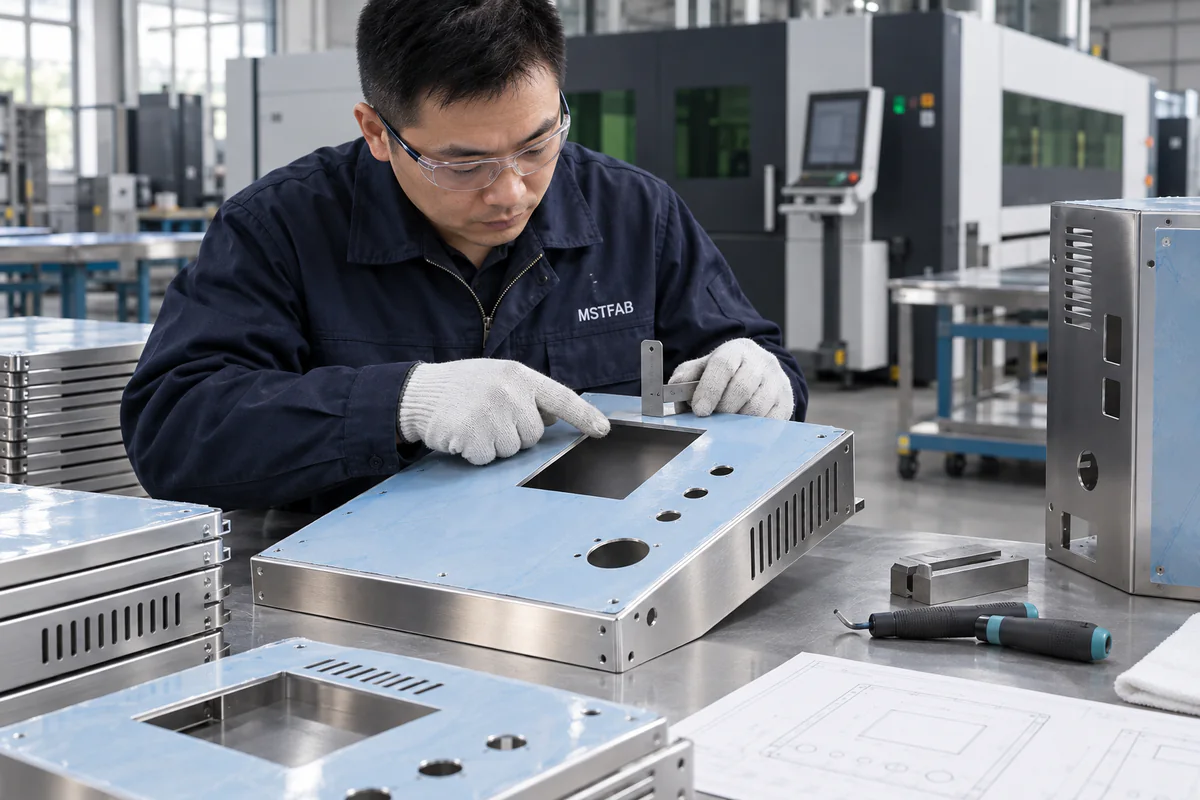
“Brushed stainless” is not complete enough for repeat production. Define the starting finish, such as 2B, BA, No. 4, or another agreed designation; the target texture or roughness when relevant; grain direction; visible faces; weld blending; corner transitions; acceptable shade variation; and sample or limit standard used for cosmetic approval.
Grain direction should appear on the flat pattern and assembly drawing. Adjacent door and frame surfaces can look mismatched when one grain runs vertically and the other horizontally. Replacement panels need the same rule. If the customer will add branding or adhesive labels, identify the required surface and protective-film removal sequence.
Separate cosmetic zones. Class A faces may need tighter scratch, dent, weld-print, and color controls than hidden mounting surfaces. The entire cabinet does not need jewelry-store treatment if only the front door is visible, and the hidden bracket should not consume the same polishing budget as the customer-facing panel. Our sheet metal surface finishing guide explains how to convert finish language into inspectable requirements.
Cutting and Deburring Set Up Every Later Operation
Laser cutting establishes openings, slots, vents, connector patterns, and bend references. Review hole-to-edge and hole-to-bend distances, narrow webs, corner radii, micro-joints, protective film, heat-sensitive cosmetic areas, and the direction from which parts will be removed and handled.
Define the edge condition. A general “deburr all edges” note may leave disagreement about burr height, sharpness, edge break, countersinks, laser dross, internal slots, and surfaces that meet a gasket, cable, operator, or user. Mark safety-critical and sealing-critical edges separately.
Stainless should be protected from iron contamination during fabrication. Industry guidance identifies carbon-steel dust, shared tools, grinding media, clamps, hooks, forming equipment, and wire brushes as common contamination sources. The practical controls are clean storage, identified tools and abrasives, suitable contact surfaces, housekeeping, and post-fabrication remediation appropriate to the project.
Bending Changes Size, Shape, and Appearance Together
304 work-hardens more than mild steel and springs back differently, so the bend plan needs the real grade, temper, thickness, grain orientation, tooling, inside radius, and bend sequence. A flat pattern copied from a carbon-steel part may not produce the same finished dimensions.
Identify critical finished dimensions from functional datums. Hole positions close to bends, narrow flanges, hems, offset forms, large doors, and closely spaced return flanges need early review. If a tolerance applies only after welding or hardware installation, say so. A press-brake operator cannot protect an assembly dimension that exists only in the buyer’s imagination.
Tooling contact can mark stainless. Protective film, clean tooling, non-marking inserts, suitable die openings, and a sensible handling sequence can help, but they also affect bend performance and cost. Agree which surfaces may show normal tooling witness and which need cosmetic protection. The sheet metal bending capability page gives buyers a practical list of geometry inputs for RFQ review.

Welding Is Where Flat, Square, and Pretty Start Negotiating
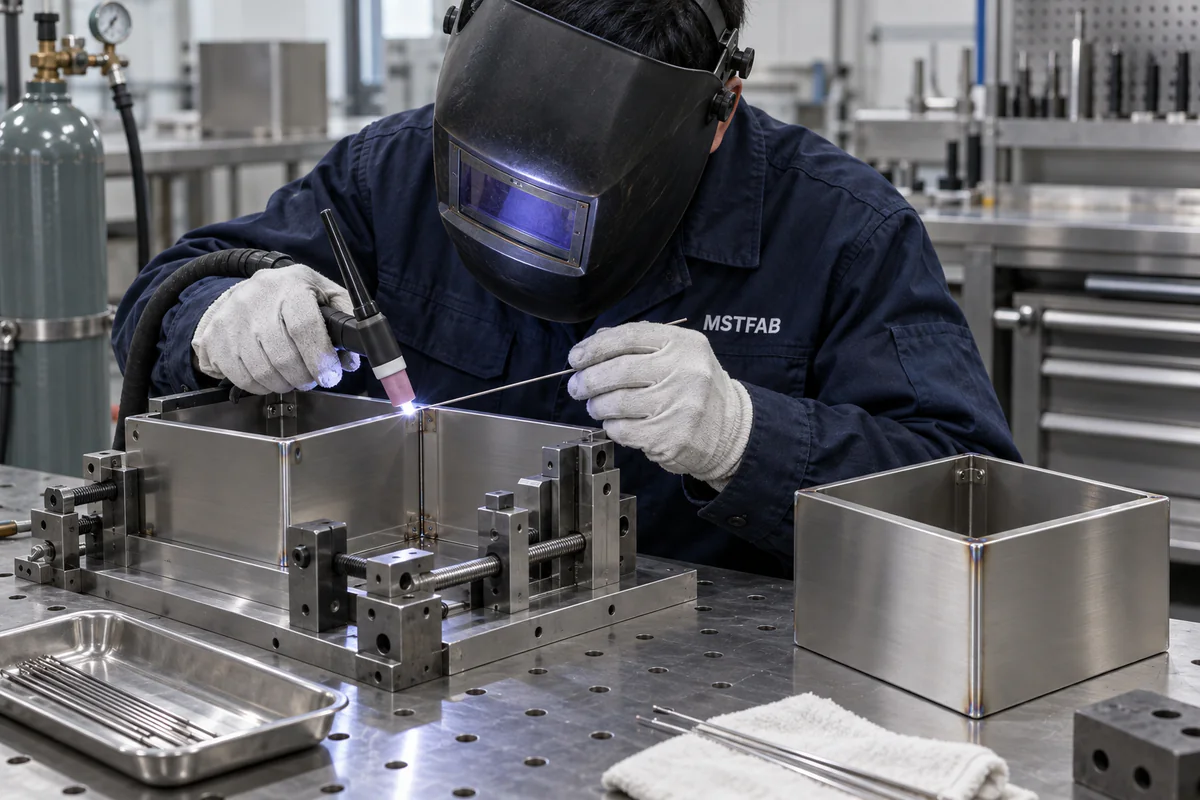
Define the joint, weld process, length, size, spacing, penetration or fusion expectation, cosmetic face, distortion limit, leak or seal requirement, and post-weld treatment. Continuous welding can improve closure in some designs but adds heat and distortion. Intermittent welding may reduce heat input but may not suit every hygiene, sealing, strength, or appearance requirement.
304L may be considered for welded parts, but the material choice does not replace weld procedure, cleanliness, fit-up, filler selection, heat control, or qualified workmanship when those are required. Heat tint and oxide can reduce corrosion performance if left untreated. Appropriate cleaning, pickling, passivation, mechanical finishing, or another specified restoration route should be selected by the responsible team for the service condition.
Blended welds also affect appearance. State whether the buyer expects an as-welded bead, cleaned bead, flush blend, directional brush restoration, or an approved sample. Over-grinding can thin corners and create visible waves. The goal is not to erase the history of manufacturing at any cost; it is to meet the drawing without turning the corner into foil. See the welding services overview for process-level RFQ inputs.
Hardware and Gaskets Need Finished-Condition Checks
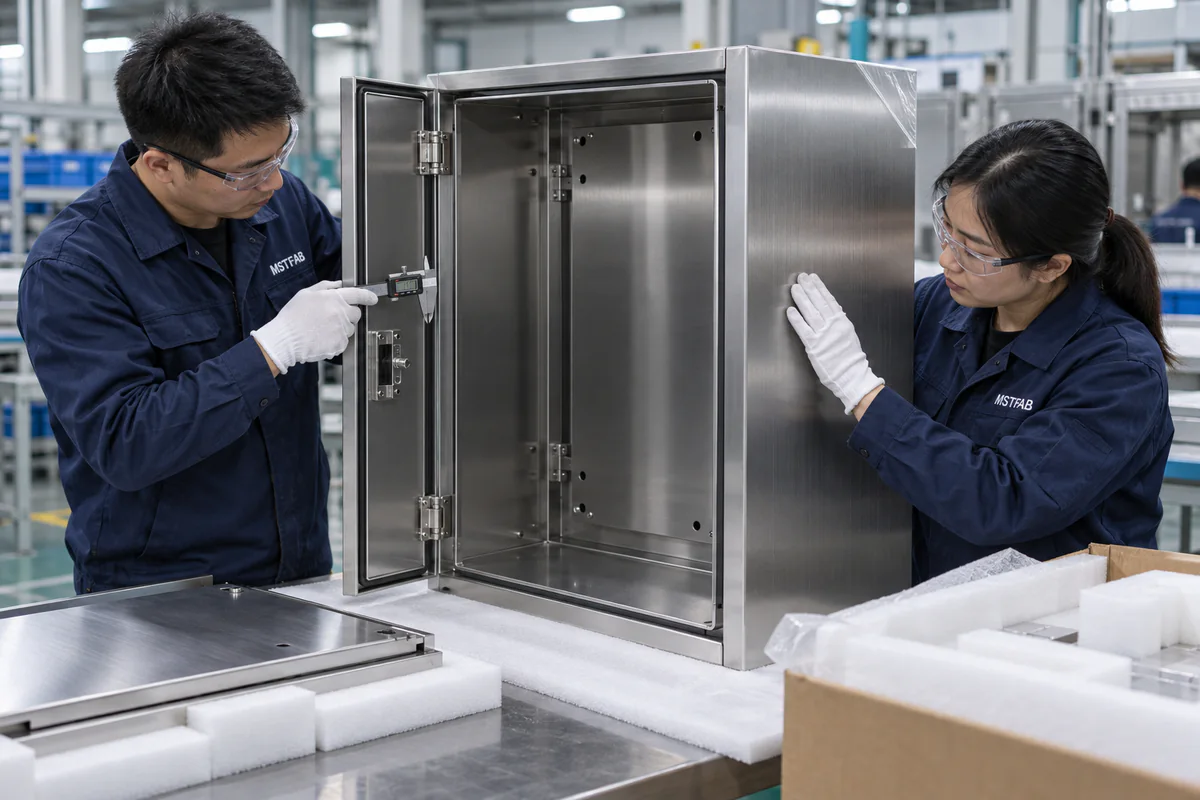
PEM hardware, weld studs, hinges, latches, handles, feet, mounting plates, gasket lands, and removable panels should be checked after forming, welding, and surface finishing. Their geometry is connected: a distorted door changes latch engagement, gasket compression, gap uniformity, and the visual line around the cabinet.
Specify hardware manufacturer and part number where interchangeability matters. Identify stainless grade, thread, installation direction, torque or push-out requirements when relevant, masking, grounding contact areas, and approved substitutions. If a gasket or seal is installed, the buyer should define its material, cross-section, joint, compression target, adhesive, corner treatment, and functional validation route.
First-article evidence should follow critical-to-quality features, not a random tour of easy dimensions. Useful records may include overall geometry, door gap, mounting pattern, critical openings, hardware location, flatness, fit checks, surface condition, weld appearance, grain direction, accessory count, and packing photographs.
Buyer Trust Table: Seven Checks Before Approval
A credible supplier turns broad claims into part-specific evidence. Use the table before approving the quote, material, finish sample, first article, or repeat order.
| Check | Evidence to request | Buyer value | Weak answer |
|---|---|---|---|
| D1 Grade identity | Material designation, governing specification, approved alternates, certificate requirement, and traceability level. | Connects the quoted alloy to the received sheet and shipped parts. | “It is stainless; they all look the same.” |
| D2 Service environment | Temperature, humidity, chloride, chemicals, washdown, crevices, cleaning method, indoor or outdoor exposure, and life target. | Lets the responsible team decide whether 304 is suitable or another grade is needed. | “304 is immune to every environment.” |
| D3 Surface standard | Starting finish, texture, grain direction, visible-face map, cosmetic zones, sample, and acceptance lighting. | Keeps doors, frames, and replacement panels visually consistent. | “Normal brushed finish.” |
| D4 Fabrication controls | Cut edge, deburring, bend radii, tooling contact, contamination controls, weld details, distortion limits, and cleanup route. | Protects fit and corrosion performance through the real production sequence. | A process list with no part-specific controls. |
| D5 Functional interfaces | Datums, critical openings, hardware models, mounting plate, door gap, gasket land, flatness, and fit-check method. | Finds assembly conflicts before electronics or equipment are installed. | Only overall width, height, and depth. |
| D6 First article and change | Released revision, CTQ results, finish photos or sample, deviations, approved substitutions, and repeat-order baseline. | Makes the second batch repeat the approved part rather than the supplier’s memory. | “Same as last time” with no revision. |
| D7 Protection and delivery | Film type and removal timing, separators, foam, hardware count, carton or crate, lifting points, destination, and damage route. | Preserves stainless appearance and geometry through export handling. | A finished door sliding directly against another finished door. |
Protect Stainless Through Packing and Installation
Finished stainless is good at remembering careless handling. Decide when protective film is applied and removed, whether the film suits later laser or bending operations, how long it may remain, and whether adhesive residue is acceptable. Separate visible surfaces, bag loose hardware, protect corners, secure doors, and support large panels so they do not oil-can in transit.
Installation teams also need handling instructions. Carbon-steel chains, dirty benches, shared abrasives, and site grinding dust can undo factory cleanliness quickly. If post-installation cleaning or passivation is required, the responsible team should specify compatible chemicals, rinsing, and verification rather than improvising with whatever bottle is closest.
For broader enclosure design decisions, see our custom stainless steel enclosure fabrication overview. It covers structure and sourcing beyond the 304-specific material and appearance checks on this page.
MSTFAB Scope and the Product Handoff
MSTFAB can supply to the written scope
- Drawing-based 304 or 304L stainless panels, brackets, covers, doors, frames, cabinets, housings, and mounting parts.
- Laser cutting, deburring, forming, welding, hardware installation, mechanical surface work, inspection, and packing.
- Material and lot records, dimensional reports, finish photographs, samples, or first-article evidence when quoted.
- DFM feedback on bends, openings, weld access, cosmetic surfaces, assembly interfaces, and export protection.
The buyer or product owner defines
- Service environment, grade suitability, governing standards, regulatory route, safety, hygiene, and corrosion validation.
- Electronics, controls, plumbing, food or medical contact, pressure service, sealing performance, ratings, and certification.
- Critical dimensions, mating components, loads, installation, cleaning chemicals, maintenance, and final acceptance.
- Approved drawing, revision, material alternates, finish standard, inspection scope, destination, and change authority.
Key Takeaways
- Choose 304, 304L, 316, or another grade from the real environment and fabrication route.
- Specify material identity, standard, thickness, approved alternates, and traceability before quoting.
- Define finish, grain, visible faces, weld cleanup, and cosmetic acceptance in inspectable language.
- Protect stainless from iron contamination, damaging tooling contact, scratches, heat tint, and uncontrolled cleanup.
- Connect bends, welds, hardware, doors, gaskets, and critical openings to finished-condition datums.
- Approve a measured first article, control changes, and protect the finish through packing and installation.
- Keep custom empty metalwork separate from the buyer’s finished product, certification, and application approval.
Frequently Asked Questions
What is the difference between 304 and 304L for sheet metal fabrication?
304L is the lower-carbon alternative to 304 and is often considered for welded construction because the lower carbon content reduces the risk of carbide precipitation from welding heat. The responsible engineer should select the grade and governing material specification for the application; the fabricator should not substitute silently.
Is 304 stainless steel suitable for outdoor or coastal cabinets?
It depends on chloride, humidity, crevices, temperature, cleaning, finish, maintenance, and life target. 304 may serve in some mild or protected conditions, while 316 or another alloy may be more suitable for coastal, salty, chemical, or aggressive washdown exposure. Grade selection requires the actual environment.
How should a buyer specify a brushed stainless finish?
Name the starting finish or agreed reference, target texture or roughness when relevant, grain direction, visible faces, cosmetic zones, weld blending, corner transitions, acceptable variation, protective film, inspection lighting, and approved sample or limit standard.
Why can stainless parts show rust stains after fabrication?
Iron contamination from shared carbon-steel tools, dust, brushes, grinding media, clamps, benches, or handling equipment can create rust staining. Heat tint, rough damage, deposits, and unsuitable cleaning can also reduce local corrosion performance. Use suitable segregation, cleaning, tools, and specified post-fabrication treatment.
What should be included in a 304 stainless steel RFQ?
Send 2D and 3D files, revision, material designation and standard, thickness, quantity, finish and grain map, visible faces, bend radii, weld details, critical tolerances, hardware, contamination controls, post-fabrication treatment, first-article evidence, packing rules, destination, and application environment.
Send the Grade, Finish, and Drawing Together
Share the 2D drawing and STEP file, revision, 304 or 304L requirement, governing material specification, sheet thickness, finish and grain direction, cosmetic zones, weld details, critical dimensions, hardware, inspection scope, quantity, packing rules, destination, and timing. MSTFAB will review the custom empty sheet metal scope before quotation.
Technical references: ASTM A240/A240M stainless plate, sheet, and strip specification; Outokumpu 304L/4307 technical overview; Nickel Institute fabrication guidance for austenitic stainless steels; worldstainless corrosion properties resources. The released drawing, contract, selected standards and editions, material certificate requirements, application assessment, local rules, and responsible professionals take precedence.
 WeChat Contact
 WhatsApp Me Directly