
The Truth About Lead Times
In custom sheet metal fabrication, a supplier who casually promises to deliver a complex, IP55-rated EV charger housing in 3 days is not performing a miracle—they are skipping critical engineering steps. True procurement security requires a timeline that mathematically aligns with mandatory DFM audits, multi-axis bending setups, welding fixture creation, and powder coat curing cycles.
Realistic Lead Times for OEM Sheet Metal Fabrication
When sourcing managers and procurement teams launch a new product, delivery speed is critical. However, speed without structural predictability is supply chain sabotage. A fabricated part that arrives two days early but fails assembly due to warped welding or misaligned flanges will cost you weeks in rework.
A heavy-duty telecom enclosure or industrial control chassis cannot be willed into existence. It demands rigorous engineering review, calibrated CNC forming, controlled thermal joining, and precise surface finishing. At MSTFAB, we do not issue fake “lightning fast” promises to win a PO; we issue realistic, mathematically sound lead times that guarantee a flawless product upon unboxing.
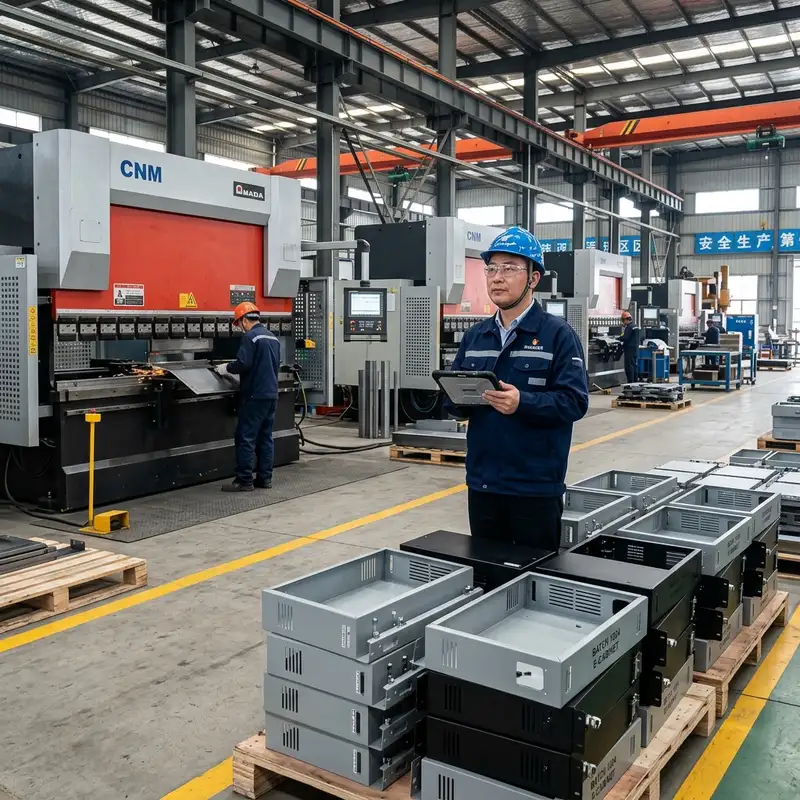
Why “Fast” is the Enemy of “Precise”
The first question from an OEM is often: “How fast can you deliver the prototype?”
If you are procuring a simple flat bracket, the timeline is minimal. But if you are commissioning an outdoor battery storage enclosure, a rapid prototype that bypasses DFM (Design for Manufacturability) is a liability.
Before metal is even cut, our engineering matrix must execute:
- Bend Deduction Calculations: Ensuring the flat pattern aligns with actual CNC press brake tooling.
- Weld Distortion Analysis: Designing fixtures to prevent heat warpage.
- Coating Tolerance Checks: Ensuring powder coating thickness won’t bind hinge assemblies.
If a factory skips these steps to hit a 48-hour deadline, they are merely shipping you their first physical mistake. We engineer prototypes to be perfect representations of mass production.
Typical Prototype Lead Time: 2–3 Weeks
For custom sheet metal enclosures, a mathematically sound prototype timeline is 14 to 21 days. This allows for the complete, uncompromised execution of the manufacturing cycle:
| Production Phase | Time Allocation | Critical Function for OEM Success |
|---|---|---|
| DFM & Tooling Setup | 2 – 4 Days | Verifies bend radii, collision risks, and raw material certifications. |
| Laser & CNC Bending | 3 – 5 Days | Executing the flat pattern and calibrating press-brake backgauges for high tolerances. |
| Welding & Grinding | 3 – 5 Days | TIG/MIG welding structural frames, grinding seams for aesthetic perfection. |
| Surface Finishing | 3 – 5 Days | Chemical pre-treatment, powder coating, baking, and curing. |
| Assembly & FAI | 2 – 3 Days | Installing PEM hardware, hinges, and executing First-Article Inspection (FAI). |
Mass Production Lead Time: 4–6 Weeks
Once the prototype is validated and signed off by your engineering team, mass production shifts into focus. A standard batch production run requires 4 to 6 weeks.
Mass production is not simply running the machines faster. It is the implementation of Statistical Process Control (SPC) to ensure the 500th cabinet is dimensionally identical to the 1st. This timeline absorbs raw material bulk procurement, fixture manufacturing for rapid welding, and the deployment of systematic QA checkpoints.
Variables That Disrupt the Timeline
Certain engineering requirements naturally inject additional lead time into a project. Procurement managers must factor these into their supply chain planning:
- Exotic Surface Finishes: Standard powder coating is rapid. However, heavy-duty hot-dip galvanizing, marine-grade passivation, or specific architectural anodizing adds 5–7 days due to chemical processing cycles.
- Continuous Seam Welding: High IP-rated EV charger enclosures require continuous, leak-proof TIG welding and subsequent grinding, which is exponentially more labor-intensive than spot welding.
- Custom Hardware Procurement: If your design specifies non-standard PEM fasteners or proprietary locking mechanisms not stocked domestically, lead times are entirely dependent on hardware supply chains.
- Drawing Ambiguity: Submitting a STEP file without an accompanying 2D PDF drawing stalls the project immediately. We cannot guess your tolerances or material grades.
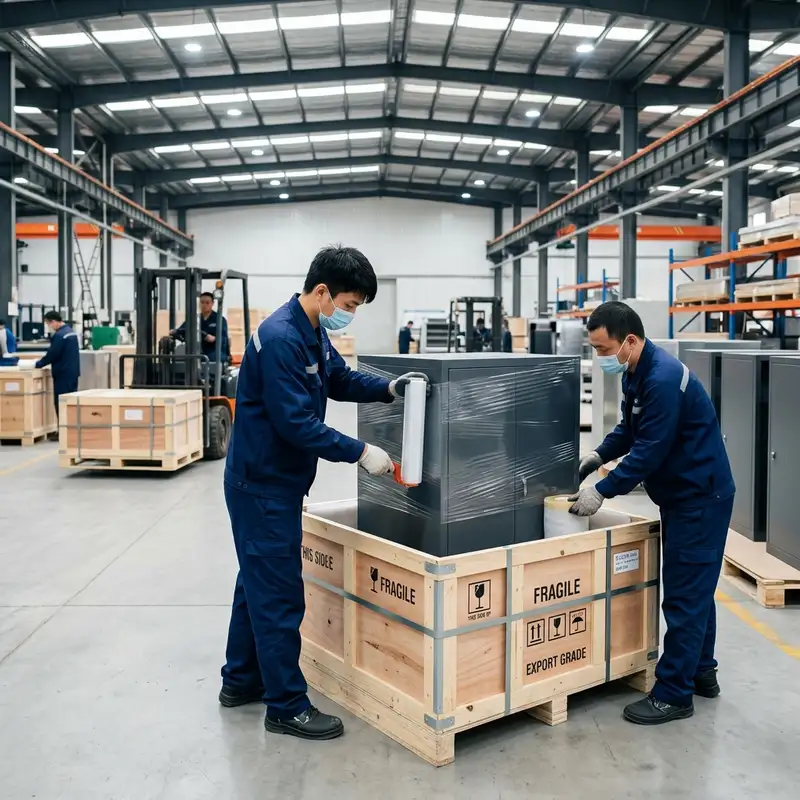
Export Logistics and Packaging Integrity
A product is only successfully delivered if it arrives undamaged. Heavy-duty enclosures require robust export packaging, which is factored into our overall timeline. We engineer custom wooden crates, heavy pallet structures, and deploy shock-absorbing foam isolation to guarantee your chassis survives international sea freight.
Stop Guessing on Delivery Dates
Unrealistic timelines destroy supply chains. Partner with a manufacturer who engineers predictability into the production schedule. Submit your 3D STEP and 2D PDF drawings today for a rock-solid, factory-direct quotation and a reliable manufacturing timeline.
Related engineering guide: Before releasing a drawing for quotation, review our guide to reading sheet metal drawings for thickness, bend notes, hole dimensions, tolerance callouts, and manufacturability checkpoints.
FAQ: Sheet Metal Fabrication Lead Times
What is a realistic lead time for a custom sheet metal prototype?
A professional, fully-inspected prototype for a custom enclosure typically requires 2 to 3 weeks to allow for DFM review, precise CNC fabrication, welding, and surface finishing.
How long does batch mass production take?
Once the prototype is approved, standard mass production lead times range from 4 to 6 weeks, depending on volume, surface treatment requirements, and material availability.
What is the most common cause of delayed sheet metal projects?
Ambiguous engineering data. Missing 2D PDF drawings, undefined material grades, or unstated tolerance requirements force the factory into a cycle of clarification questions, immediately stalling production.
sheet metal welding services
MSTFAB provides TIG and MIG sheet metal welding services for structural assemblies, cabinets, frames and OEM metal components.
 WeChat Contact
 WhatsApp Me Directly