
A practical guide for OEM buyers sourcing drawing-based sheet metal cabinets, doors, mounting plates and mechanical enclosure parts for automotive automation equipment.
Quick Answer
An automotive automation project does not automatically require every sheet metal enclosure supplier to hold IATF 16949 certification.
That requirement depends on what the enclosure becomes, which automotive customer owns the project, whether the part is eligible for IATF certification, the customer-specific supplier requirements and the quality agreement between the automation OEM and the metal fabricator.
For tooling and production equipment, ISO 9001 may be the more appropriate supplier certification. Ford’s customer-specific requirements effective June 15, 2026 explicitly state that Tooling & Equipment suppliers are not eligible for IATF 16949 certification and that ISO 9001 registration is acceptable.
An automotive automation OEM can still require selected automotive-style quality records from its sheet metal supplier:
- Approved design records and drawing revision control
- Process flow, fabrication risk review and control plan
- First-article dimensional results
- Material, hardware and finish records
- Change notification, part identification and traceability
- Packaging approval for export shipment
The important distinction: requiring a controlled submission package does not automatically mean the enclosure supplier must be IATF 16949 certified.
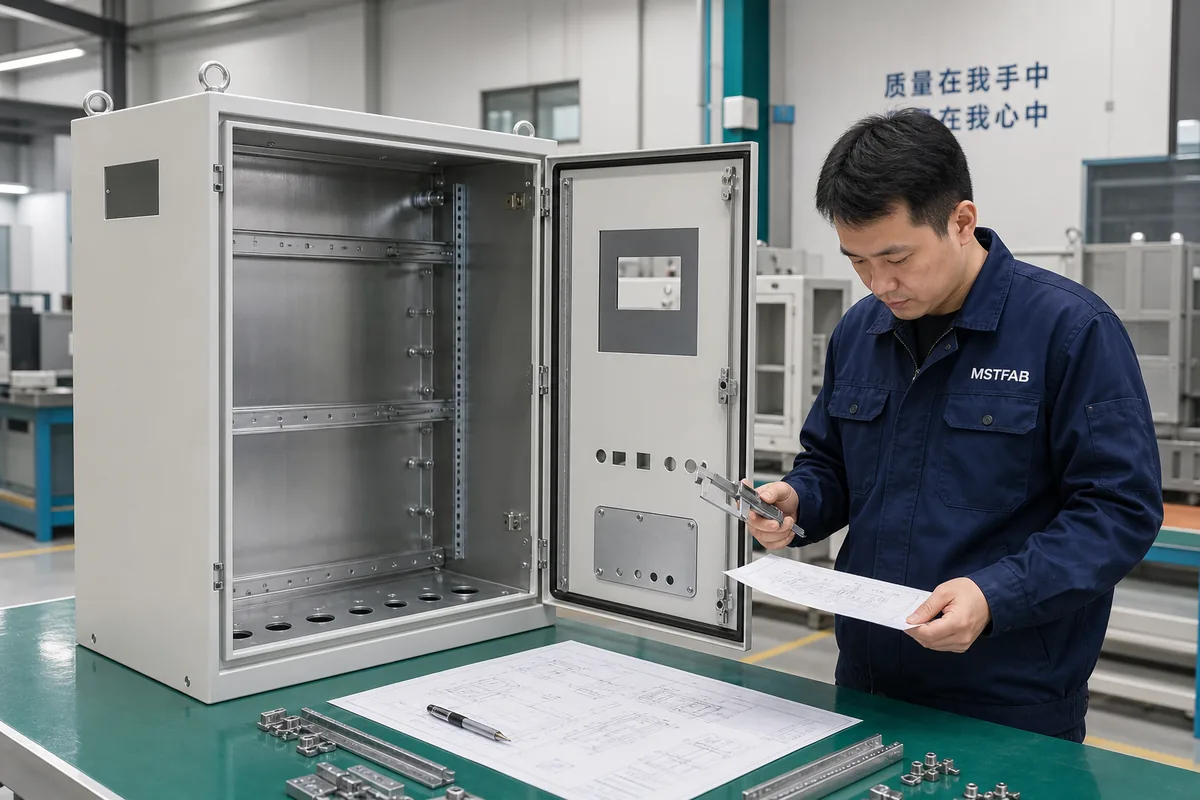
We Manufacture the Shell
MSTFAB’s normal scope is the physical metalwork: enclosure bodies, doors and removable panels, mounting plates, gland plates, DIN-rail brackets, grounding studs, internal partitions, HMI and connector openings, cooling-unit cutouts, mechanical hardware, surface finishing, dimensional inspection and export packaging.
MSTFAB does not provide PLC programming, electrical design, breakers, drives, wiring, energized testing, UL panel labels or complete automation equipment.
We manufacture the shell. The buyer supplies the brain, nerves and electricity.
Why Automotive Automation Buyers Ask for PPAP
Automotive production lines are expensive places for small mistakes. A mounting plate installed 4 mm too high can interfere with a drive. A gland plate with the wrong hole pattern can stop electrical assembly. A door that twists after welding may look acceptable on a table, then refuse to seal after the HMI is installed.
A grounding stud hidden beneath powder coating may be dimensionally perfect and electrically decorative. That is not a compliment.
For this reason, automotive automation buyers often apply stronger supplier controls to robotic-cell cabinets, conveyor control enclosures, battery-line equipment housings, inspection-station cabinets, welding-cell panels, leak-test equipment enclosures, vision-system housings, machine electrical cabinets and local junction-box shells.
The objective is not to collect the largest possible pile of documents. The objective is to prove that the approved enclosure can be manufactured repeatedly without creating assembly problems, unapproved substitutions or late surprises.
First Decide Whether This Is a True Automotive Part
IATF certification eligibility is primarily associated with manufacturing sites producing automotive production parts, service parts or eligible accessory parts supplied to automotive customers. Current IATF certification rules focus on products that become part of the eligible automotive supply chain.
A sheet metal enclosure used on a production machine normally stays in the factory. It does not become part of the vehicle.
The correct requirement follows the product and customer contract. It should not be selected because “IATF” looks stronger in a website banner.
PPAP or PPAP-Style Submission?
Formal Automotive PPAP
A formal PPAP is normally tied to an automotive customer’s production-part approval process. The required level, forms, submission system, approval authority and records should be defined by the automotive customer.
Do not casually promise a “full PPAP” without identifying the automotive customer, required submission level, applicable manual, part classification, approval authority, sample quantity, submission date, record-retention requirement and resubmission triggers.
“Full PPAP included” may sound generous during quotation. It becomes less charming when nobody agrees what “full” means.
Buyer-Defined PPAP-Style Package
For an automation enclosure shell, the OEM may instead request selected controls modeled on automotive quality practice: approved drawing and revision, process-flow diagram, fabrication risk review, control plan, first-article dimensional report, material and finish evidence, approved sample photographs, change-control agreement and packaging approval.
This gives strong control without pretending that the enclosure is a vehicle production part.

What the Sheet Metal Supplier Should Submit
1. Approved Design Record
The supplier should manufacture only from a controlled drawing package. That package may include the STEP model, dimensioned 2D PDF, DXF or DWG profiles, drawing number, revision, BOM, hardware specification, finish specification, critical-to-assembly dimensions and customer-approved deviations.
The 3D model helps explain shape. The 2D drawing should define what must actually be inspected. A beautiful STEP file without tolerances is still a beautiful source of arguments.
Before production, freeze material, thickness, bend radius, weld locations, grinding requirements, door gaps, hardware, grounding features, finish, masking, packaging and inspection points. Do not release production while the drawing and email conversation disagree. The laser will not know which one was “really meant.”
2. Process-Flow Diagram
The process flow should show the actual manufacturing route: contract and drawing review, material receipt, material identification, laser cutting or punching, deburring, CNC bending, hardware insertion, welding, grinding, trial assembly, pretreatment, powder coating, final mechanical assembly, dimensional inspection, packing and shipment.
The flow should identify subcontracted operations. Subcontracting is not automatically a problem. Undisclosed subcontracting is.
3. Fabrication Risk Review
A Process FMEA-style review can be useful for repeat automotive automation projects, but it should focus on actual sheet metal failure modes.
Copying a PFMEA from an automotive bracket and replacing “bracket” with “cabinet” is not risk management. It is office software.
4. Control Plan
The control plan should convert risks into production checks. For enclosure shells, useful checkpoints include material grade and thickness, critical laser-cut holes, bend angles, weld fit, hardware position, coating thickness, door fit, removable-panel function, labels and packing condition.
The buyer should define which characteristics are critical. Do not mark every dimension as critical. When everything is critical, nothing receives useful priority.
First-Article Inspection for an Automation Enclosure Shell
A first-article inspection should prove that the metalwork supports the buyer’s later assembly. It should not attempt to certify the finished electrical panel.
Prioritize overall enclosure dimensions, door openings, door-to-body gaps, mounting-plate position, DIN-rail bracket position, HMI cutouts, push-button cutouts, connector openings, cable-gland plates, cooling-unit cutouts, grounding studs, base holes, internal component clearances and removable-panel fit.
Mechanical checks should confirm that the door opens without interference, hinges remain aligned, latches engage consistently, the gasket land is continuous, the mounting plate can be removed, hardware matches the BOM, threads remain usable after coating and packaging protects visible surfaces.

The automation OEM should install representative components into the first article: PLC chassis, drives, power supplies, terminal blocks, cable duct, DIN-mounted devices, cooling equipment, HMI and cable glands. MSTFAB can verify the mechanical dimensions. The buyer should confirm that real components fit and can be serviced.
A hole can be in the correct position and still leave no room for a screwdriver. Geometry is allowed to be technically correct and operationally irritating.
What MSTFAB Does Not Include in FAI
Because MSTFAB supplies empty metal shells, a standard enclosure FAI should not claim to verify PLC function, electrical architecture, breaker selection, drive configuration, wiring, SCCR, protective-device coordination, software, control logic, machine safety, energized temperature rise, finished-panel UL certification or complete machine CE compliance.
The enclosure can support compliance. It cannot complete compliance while empty.
Drawing Details That Prevent Assembly Delays
Mounting plate, DIN-rail bracket and HMI layout decisions should be frozen before fabrication, especially when the cabinet will receive PLCs, drives, terminal blocks and cable duct later. For a deeper mechanical layout checklist, see our PLC enclosure design guide.
Mounting Plate
Define material, thickness, position, stand-off distance, functional flatness, hole pattern, grounding method, removal direction and maximum installed load where relevant.
DIN-Rail Brackets
Define rail type, length, position, fastening method, device depth, wiring clearance, door clearance and grounding or isolation intent. Do not use one universal positional tolerance for every design. The tolerance should follow the component layout and assembly requirement.
HMI and Push-Button Cutouts
Define exact cutout dimensions, corner radii, stud or fastener pattern, door reinforcement, surface-flatness requirement, gasket land and cable clearance behind the device.
Cooling Openings and Grounding Features
For fans, heat exchangers and filters, define model, orientation, cutout, hole pattern, reinforcement, gasket surface, drainage and service clearance. For grounding, define stud location, thread, material, welding or insertion method, masked area, hardware stack, marking and inspection.
A grounding stud underneath powder coating is still a stud. It is merely taking a break from grounding.

Material Documentation: Match Evidence to Risk
The original RFQ should define which material records are genuinely required. Depending on the project, possible evidence includes certificate of conformance, supplier material certificate, mill certificate, material grade and coating designation, thickness record, batch or lot identification, surface-treatment certificate, RoHS or REACH declaration, approved material-source list, PMI results where justified and EN 10204 3.1.
A 3.1 certificate may be appropriate when the automotive customer requires it, material traceability is contractually specified, the selected mill can supply it, the document can be connected to the delivered material batch and material properties are significant to the project.
It should not be treated as a universal condition for every zinc-coated carbon-steel enclosure. Quality is not measured by how many acronyms fit into the receiving report.
Pre-Galvanized Sheet or Galvanizing After Fabrication?
The RFQ should not simply say “galvanized steel.” Zinc-coated sheet before fabrication usually supports efficient enclosure fabrication, close-fitting panels and consistent powder coating. Galvanizing after fabrication may be excellent for heavy outdoor structures, but it can affect door flatness, fine tolerances, threads, hinges, surface appearance and later coating preparation.
A process that works well on a staircase may become unnecessarily adventurous on an HMI door.
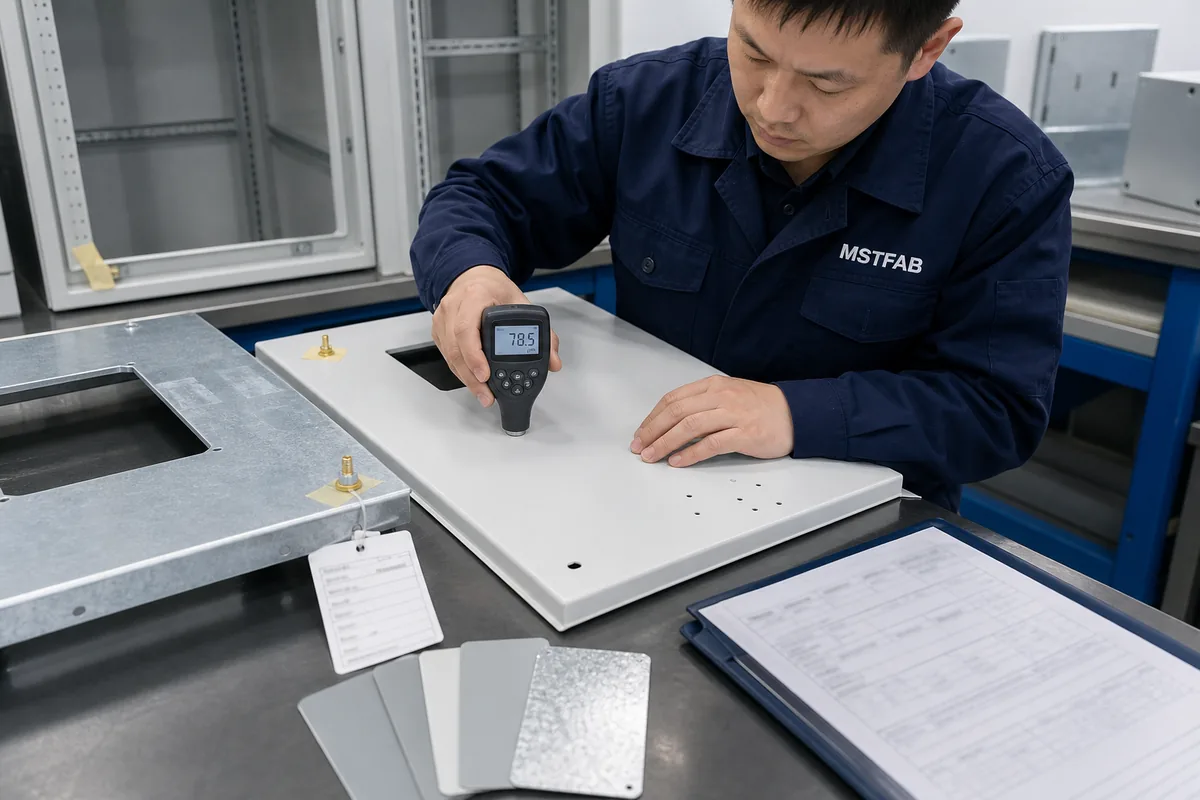
Change Control: The Part of Automotive Quality That Really Matters
Custom automation projects change. A drive becomes larger. The customer changes the HMI. The electrician requests another cable gland. The mounting plate moves.
None of these changes are unusual. Uncontrolled changes are the problem.
Require written approval before changing the drawing revision, material grade, thickness, zinc coating, powder supplier, color or texture, hardware, hinge, latch, gasket, grounding stud, welding route, finishing subcontractor, manufacturing location, inspection method or packaging.
Define when the supplier must submit a new first article or updated records: design revision, material change, new tooling or fixture, manufacturing-process change, long production interruption, factory transfer, supplier change or corrective action affecting the process.
A thumbs-up emoji is a pleasant response. It is not an engineering-change authorization.
Packaging Is Part of Product Quality
Automation enclosure shells often have large flat doors, visible powder-coated surfaces, projecting hinges, locks, grounding studs, removable mounting plates and loose hardware kits. Poor packaging can undo accurate fabrication before the customer opens the crate.
Useful packaging controls include protective film on cosmetic surfaces, foam or soft dividers, edge protection, door restraint, internal panel restraint, separate labelled hardware bags, moisture protection, strong export carton or crate, part-number and revision labels and packing photographs.
The enclosure should arrive ready for assembly, not ready for panel beating.
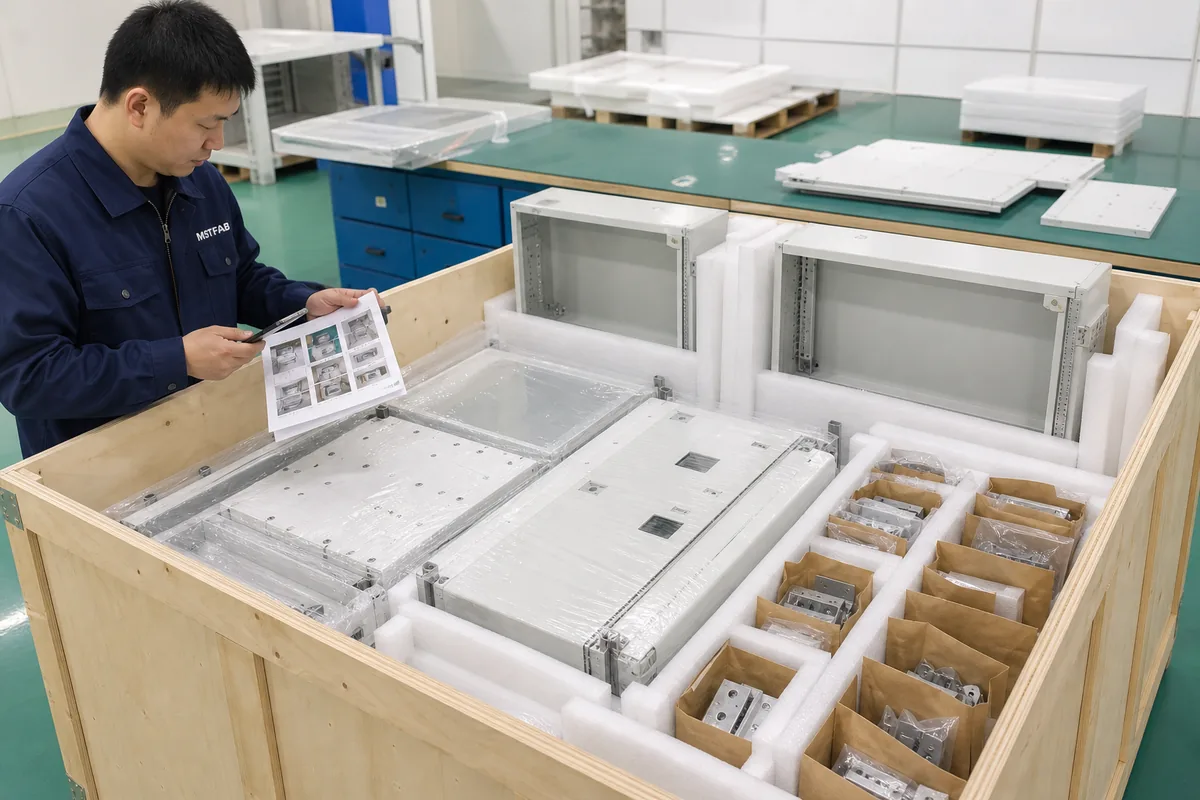
A Practical Supplier Submission Package
Do not request every possible record on every project. Use more control where failure creates more risk. Use less paperwork where the feature can be verified simply and reliably.
Supplier Responsibility Matrix
This is the trust table buyers should complete before quotation. It keeps a shell-only metal fabricator, automation OEM, electrical integrator and certification owner in their proper lanes.
| Responsibility | Sheet Metal Supplier | Automation OEM | Electrical Integrator / Certification Owner |
|---|---|---|---|
| Enclosure body, doors and panels | Manufactures to approved drawing | Approves design and revisions | Checks fit during final build |
| Mounting plate and DIN-rail brackets | Manufactures and installs mechanical supports when specified | Defines layout, clearances and load assumptions | Installs components and confirms access |
| HMI, connector and gland-plate cutouts | Cuts, deburrs and finishes openings | Defines device models, gasket lands and dimensions | Installs devices and confirms sealing path |
| Grounding studs and masked areas | Fabricates, masks and inspects mechanical features | Defines locations and hardware stack | Connects and tests electrical continuity |
| PLCs, drives, breakers and wiring | Excluded unless separately agreed in writing | Selects and approves architecture | Installs, wires and tests |
| UL 508A, IEC 60204-1 and final machine compliance | Supports with controlled mechanical parts | Owns product requirement and certification path | Applies qualified panel or machine compliance process |
The blank responsibility called “everyone assumed somebody else handled it” is usually the most expensive line.
Ten Questions to Ask the Enclosure Supplier
- Which drawing revision will control production?
- Is the project a vehicle part or a production-equipment component?
- Which customer-specific quality requirements apply?
- Is formal PPAP required, or a buyer-defined first-article package?
- Which dimensions are critical to assembly?
- Which materials, finishes and hardware require buyer approval?
- Which operations are subcontracted?
- What changes trigger a new submission?
- What inspection records accompany each batch?
- How will finished doors and panels be protected during export?
A serious supplier may ask several questions in return. That is usually a good sign. The supplier who understands every project from one sentence has either achieved enlightenment or has not opened the drawing.
Warning Signs
How MSTFAB Describes Its Scope
MSTFAB manufactures drawing-based sheet metal enclosure shells and mechanical parts for industrial automation equipment. Our scope can include enclosure bodies, doors, mounting plates, gland plates, DIN-rail brackets, grounding studs, internal partitions, HMI openings, cooling-unit cutouts, mechanical hardware, surface finishing, dimensional inspection and export packaging for custom fabricated metal enclosures.
PLCs, drives, breakers, wiring, electrical design, control programming, energized testing, UL panel marking and final automation-equipment certification remain with the buyer, qualified electrical integrator or certification owner.
When an automotive quality requirement is specified, the buyer should verify the current certificate, legal entity, manufacturing site, validity and relevant scope rather than relying only on a website logo.
MSTFAB should not describe an empty shell as a complete PLC panel, a UL 508A control panel, an electrically tested automation system or a finished automotive production machine. We make the metal parts that help those systems assemble correctly. That is already an important job. There is no need to borrow someone else’s.
Before building the purchasing package, use this sheet metal enclosure fabrication RFQ guide to align drawings, tolerances, materials, finish evidence and packing expectations.
RFQ Checklist
Send the STEP model, dimensioned PDF drawing, drawing number and revision, enclosure application, automotive customer where applicable, formal PPAP or selected submission requirements, material and thickness, zinc-coating specification, surface finish, color, gloss and texture.
Also define door and panel requirements, mounting plate, DIN-rail bracket layout, grounding studs and masking, HMI and push-button cutouts, cable-entry plate, cooling-unit model and cutout, hardware list, critical dimensions, cosmetic acceptance standard, first-article requirements, change-notification requirements, packing method, prototype quantity, annual forecast and delivery destination.
Scope statement to include: the supplier shall manufacture only the mechanical sheet metal scope defined by the approved drawing. Electrical design, wiring, components, programming, energized testing and final product certification are excluded unless separately agreed in writing.
That sentence will not win a copywriting award. It may prevent several expensive purchase-order disputes.
Key Takeaways
- An automation enclosure installed in an automotive factory does not automatically require its sheet metal supplier to hold IATF 16949.
- For Tooling & Equipment suppliers, ISO 9001 may be the accepted certification starting point, supplemented by customer-specific quality controls.
- Automotive automation buyers can still require controlled drawings, process flow, fabrication risk analysis, control plans, first-article inspection, material records, change notification, traceability, packaging approval and selected PPAP documentation.
- MSTFAB manufactures empty enclosure shells and mechanical components, not PLC panels, wiring or finished automation systems.
The most important purchasing question is: are we requiring a formal automotive PPAP, or a project-specific sheet metal approval package designed to control the enclosure risks?
Need an enclosure shell approval package?
Send STEP files, 2D drawings, material and finish requirements. MSTFAB will review the mechanical shell scope before quoting.
Frequently Asked Questions
Does an automotive automation enclosure supplier need IATF 16949?
Not automatically. The answer depends on whether the product is eligible for IATF certification and on the automotive customer’s specific requirements. Some automotive OEM requirements classify Tooling & Equipment suppliers separately and accept ISO 9001.
Can an ISO 9001 sheet metal supplier provide PPAP-style documents?
Yes. A buyer can contractually request selected records such as process flow, control plan, dimensional results, material records and change notification. This does not make the supplier IATF certified.
Does MSTFAB manufacture complete PLC control panels?
No. MSTFAB manufactures the physical sheet metal enclosure shell and related mechanical parts. PLCs, drives, breakers, wiring, programming and energized testing are outside the normal scope.
What should be included in the first-article inspection?
Prioritize dimensions and features affecting assembly: door fit, mounting plate, DIN-rail brackets, HMI cutouts, cable entries, cooling openings, grounding studs, hardware, surface finish and packaging.
Does every enclosure need EN 10204 3.1 certification?
No. The required material documents should follow the customer contract, material risk and traceability requirement.
Is PMI mandatory for galvanized carbon steel?
No. PMI may be appropriate in selected high-risk material-control situations, but controlled purchasing, material records, coating designation and lot identification may be more useful for ordinary zinc-coated carbon steel.
Should every dimension be marked critical?
No. Critical characteristics should focus on dimensions and features that affect assembly, sealing, safety interfaces, component clearance and customer-visible quality.
Who owns UL 508A certification?
A qualified control-panel manufacturer participating in the applicable certification program controls the completed panel construction and marking. A shell-only sheet metal fabricator does not automatically own that certification.
Who owns IEC 60204-1 compliance?
The machine builder or responsible electrical-equipment manufacturer owns the completed machine’s electrical-safety architecture and validation. The enclosure supplier provides drawing-controlled mechanical parts supporting that design.
What is the most important scope statement?
The supplier provides unpopulated mechanical sheet metal enclosure parts only. Electrical components, wiring, software, energized testing and final equipment certification are buyer-controlled.
Source Notes
This guide was written for purchasing scope control, not as legal or certification advice. Buyers should verify the latest customer-specific requirements and standards before issuing a purchase order.
For a component-specific example, use the IATF 16949 junction box shell PPAP guide to define the evidence handoff.
 WeChat Contact
 WhatsApp Me Directly