
By: Frank, General Manager
Technical Review: Michael Chen, Manufacturing Engineer
Last Updated: July 23, 2026

Quick answer: before sending an RFQ for custom sheet metal enclosures, OEM buyers should audit the factory’s real process control: DFM review, material traceability, laser cutting and bending capability, welding fixtures, PEM/hardware assembly, surface finish control, first-article inspection, packing method and revision control. A good audit does not ask, “Do you have machines?” It asks, “Can you prove this enclosure will fit, finish, repeat and arrive undamaged?”
Scope note: MSTFAB manufactures sheet metal enclosure shells, cabinets, panels, brackets, covers, machine guards, mounting plates and welded structures. We do not supply finished electrical equipment, complete machines, motors, batteries, wiring, PCB assembly, control systems, software or certified end products. Keep the factory audit focused on the metalwork. Otherwise the audit becomes a sightseeing tour with a clipboard.
Factory audits often go wrong because buyers look for shiny equipment and tidy slogans. Those are nice, but they do not stop a cabinet door from rubbing after powder coat, a PEM nut from spinning, or a welded frame from arriving out of square. This guide shows what OEM buyers should verify before RFQ, especially when the project involves custom sheet metal enclosures and mechanical subassemblies.
What this factory audit is actually for
This is not a general finished-product audit. It is a manufacturing audit for drawing-based sheet metal enclosure work. The goal is to know whether the supplier can turn your drawing into repeatable metal parts without quietly moving the risk to your incoming inspection team.
| Audit focus | Relevant to MSTFAB | Outside this scope |
|---|---|---|
| Fabrication process | Laser cutting, punching, bending, welding, grinding and mechanical assembly | Final electrical integration or machine commissioning |
| Enclosure structure | Empty cabinets, shells, doors, panels, brackets, frames and guards | Loaded electrical cabinets or finished systems |
| Hardware and fit | Hinges, locks, handles, gasket paths, PEM inserts, studs and mounting rails | Motors, PCBs, batteries, firmware, wiring and user interfaces |
| Quality evidence | FAI photos, key dimensions, coating checks, assembly photos and packing photos | End-product certification for a complete device |
That boundary matters for SEO, but it matters even more for sourcing. A focused supplier can be judged cleanly. A supplier claiming to do everything is harder to audit because the risky parts get foggy fast.
Audit checkpoint 1: process route, not just machine list
A factory can own a laser cutter and still fail your enclosure. Machines are tools; the route is the plan. Before RFQ, ask how your enclosure would move from drawing review to cutting, bending, welding, finish, assembly and packing.
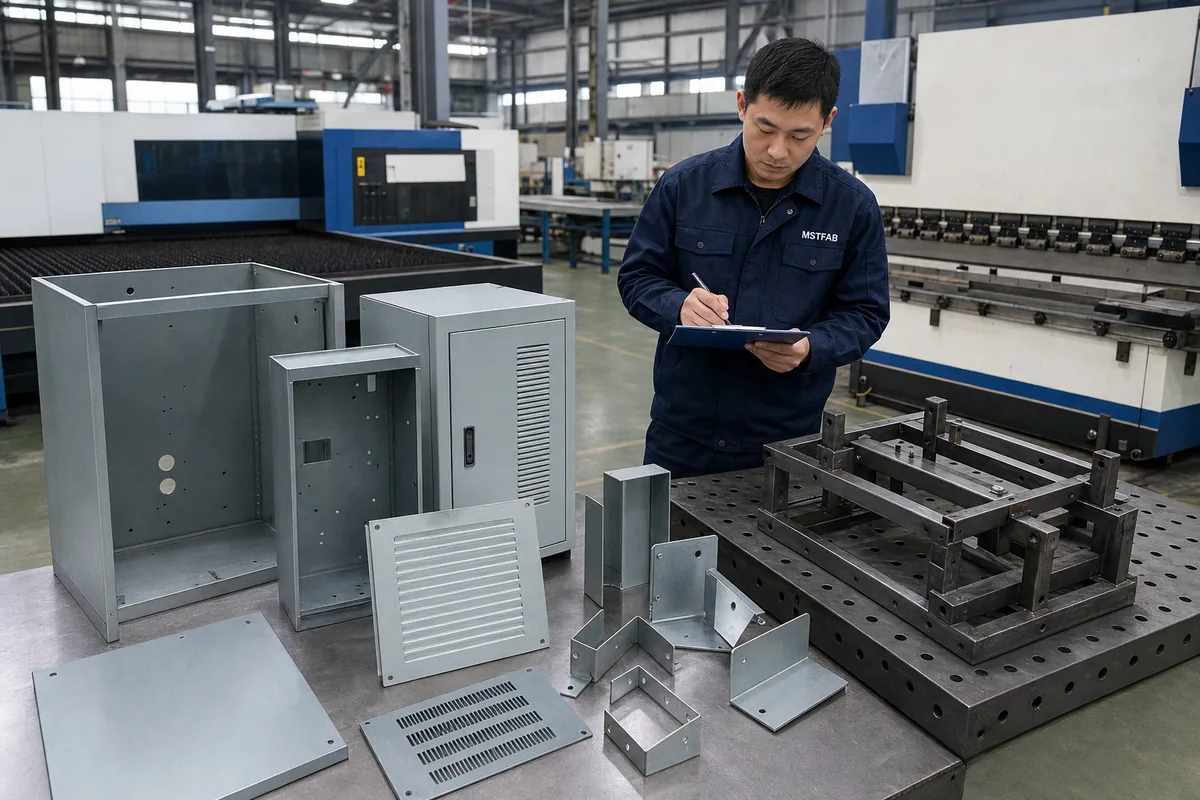
- Laser or punching: check whether the factory understands hole size, slot shape, burr control and nesting.
- CNC bending: check bend radius, tooling limits, bend sequence and whether holes near bends will distort.
- Welding and fixtures: check whether frames and cabinet bodies are held square with fixtures, not hope.
- Hardware insertion: check PEM nut/stud process, pull-out control and thread protection.
- Finish sequence: check whether threads, grounding zones and gasket surfaces are masked before coating.
- Packing: check how doors, corners, visible faces and accessories are protected for export.
The best RFQ conversations sound a little boring: material, thickness, bends, fixtures, coating, inspection, packing. Boring here is good. Exciting usually means someone discovered the problem too late.
Audit checkpoint 2: DFM review before pricing
DFM is where a factory proves it is thinking, not just quoting. A responsible sheet metal enclosure supplier should review the drawing before promising price and lead time. The buyer should want comments, not silence. Silence is comfortable right up until the first article fails.
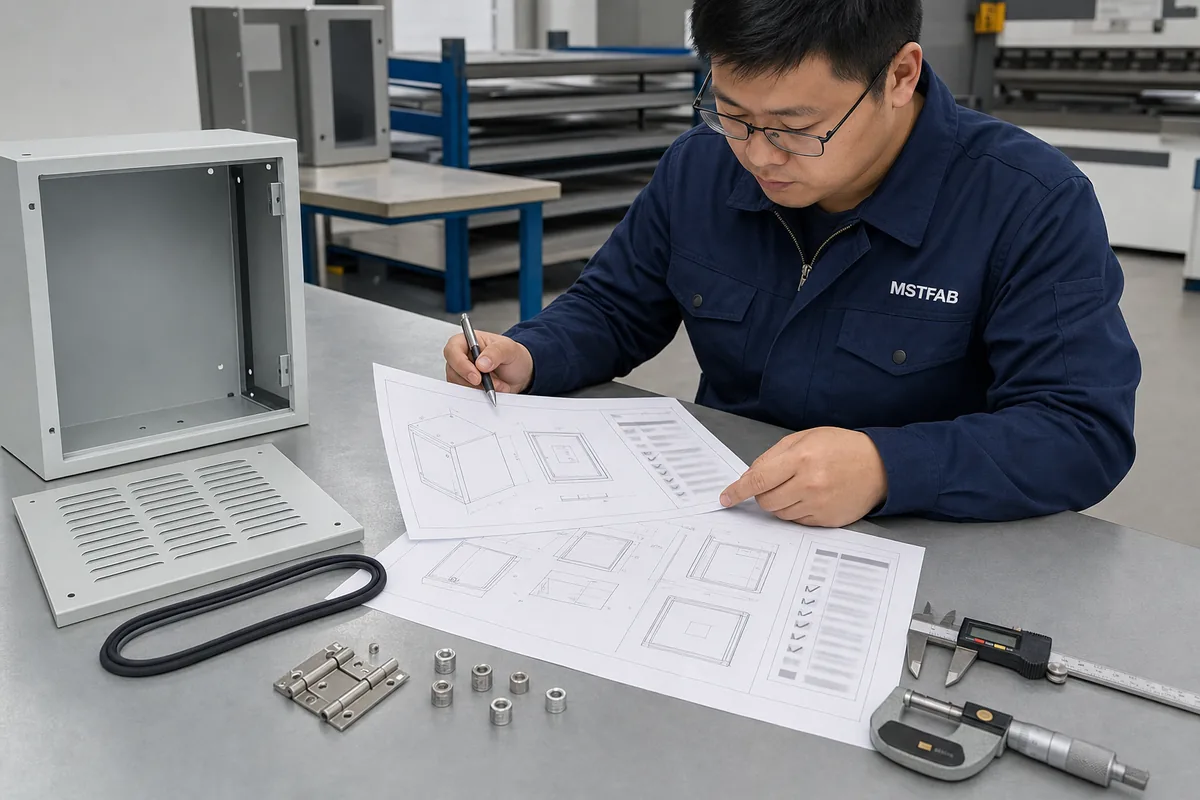
| DFM item | What to ask | Why it matters |
|---|---|---|
| Bend radius | Does the radius match material thickness and tooling? | Prevents cracks, bad angles and avoidable rework |
| Hole-to-bend distance | Are holes too close to bend lines? | Stops stretched holes and misaligned hardware |
| Weld distortion | Will large panels or frames need fixtures? | Protects door fit, flatness and mating dimensions |
| PEM and hardware | Are hole sizes and insert specs controlled? | Prevents spinning inserts and mismatched threads |
| Finish masking | Which areas must stay uncoated? | Protects threads, grounding points and gasket compression |
For deeper design rules, read DFM Design Rules for Sheet Metal Parts. The short version: the cheapest place to fix a bad hole is still in CAD, not after powder coating.
Audit checkpoint 3: material and revision control
Factory trust starts with knowing what material is actually being cut. “Steel” is not enough. “Stainless” is not enough. “Same as last time” is where repeat orders quietly go to misbehave.
- Confirm exact material grade and thickness: SPCC, SGCC, 304, 316, 5052, 6061 or another specified grade.
- Ask how the factory separates revisions and prevents outdated drawings from reaching production.
- Check whether material thickness is verified before cutting for critical enclosure parts.
- Confirm substitute material rules: no substitution without written approval.
- Ask how samples are locked before repeat production.
If a supplier can quote fast but cannot tell you how revision control works, the fast quote may just be a fast way to buy confusion.
Audit checkpoint 4: first article inspection and measurement evidence
Quality is not a vibe. It is a record. Before RFQ, ask what the factory checks on the first article and what evidence you can receive before shipment.
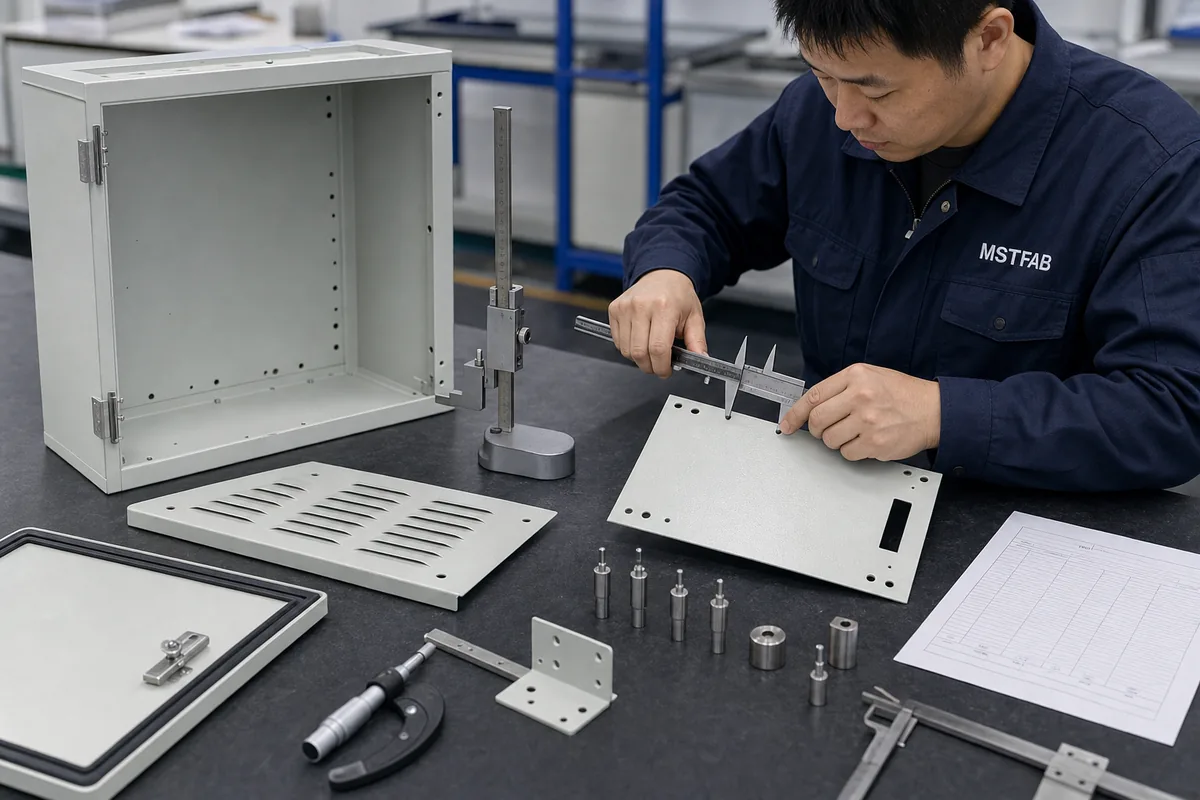
| Buyer concern | Audit evidence to request | What it proves |
|---|---|---|
| Will mating holes align? | Key dimension record, caliper photos, fixture photos if applicable | Hole position and tolerance assumptions are under control |
| Will doors and panels fit? | Door close/open photos, hinge and latch operation checks | Assembly fit is checked after fabrication and finish |
| Will inserts and studs hold? | PEM installation photos, thread checks, pull-out test if required | Hardware will survive your assembly process |
| Will repeat batches match? | Approved sample record, revision record, inspection checklist | Production is controlled beyond the first lucky sample |
| Will finish and packing survive export? | Coating readings, masking photos, packing photos | The part will arrive usable, not merely shipped |
For inspection terms like FAI and CMM, see Sheet Metal Quality Control: FAI, CMM and SPC Explained. Not every enclosure needs a full CMM report, but critical fit features need a clear plan.
Audit checkpoint 5: welding fixtures and enclosure squareness
Welding is where nice flat panels learn new shapes. Heat moves metal. The audit question is not whether the factory can weld; it is whether the factory controls distortion.
- Ask whether welded frames and cabinets use fixtures for squareness.
- Check how the factory controls heat sequence on thin panels.
- Ask which dimensions are checked after welding and grinding.
- Confirm cosmetic grinding requirements before finish.
- For large enclosures, ask for pre-finish sample photos before coating hides useful clues.
A welded enclosure can look fine in a photo and still fight your assembly line. Doors, mounting plates and gasket paths are where distortion usually sends its invoice.
Audit checkpoint 6: surface finish control
Powder coating, plating, brushing and passivation can make a part durable and good-looking. They can also ruin threads, block grounding points and change fit if nobody planned the masking. Finish is not decoration; it is a manufacturing step with consequences.
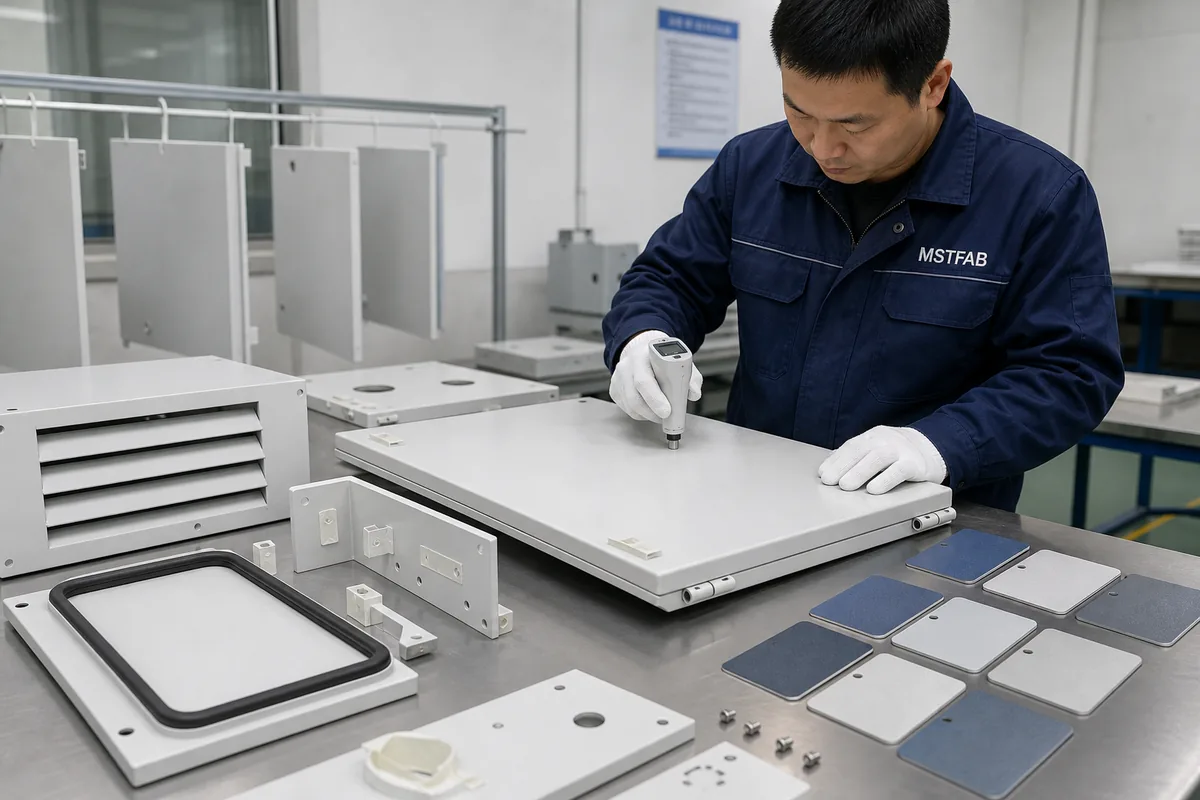
- Confirm finish type, color code, texture and target thickness.
- Ask which threads, PEM hardware, gasket surfaces and grounding areas must be masked.
- Check whether hardware is installed before or after finish.
- Ask how the factory handles coating scratches during assembly and packing.
- Request coating thickness readings for outdoor or visible enclosure parts.
For finish selection, use Sheet Metal Surface Finishing Guide. The practical rule: pick finish by material, environment and fit risk, not by which sample card looked friendly under office lights.
Audit checkpoint 7: packing and export protection
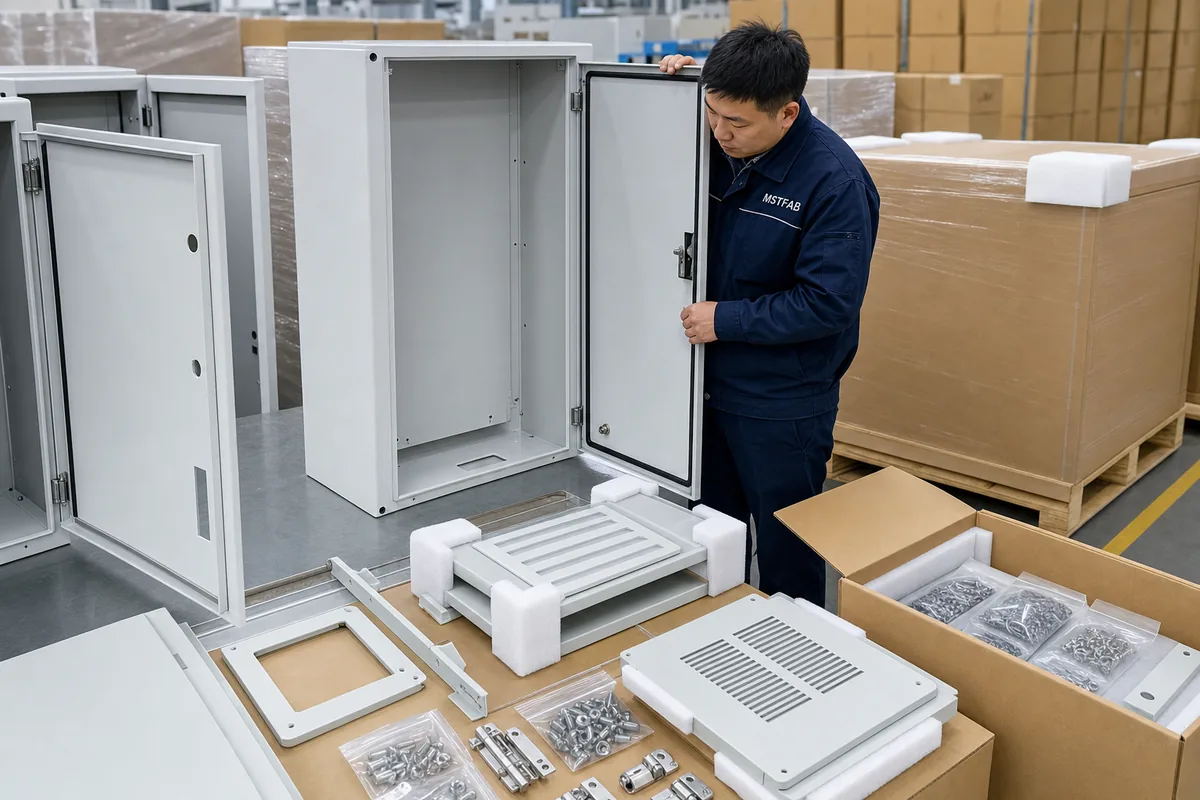
Packing is part of quality. A perfect enclosure that arrives scratched, bent or missing hardware is not a successful shipment. It is a quality problem that took a scenic route.
| Packing risk | What to verify before RFQ | Evidence to request |
|---|---|---|
| Scratched visible surfaces | Film, foam, separators and handling instructions | Packing photos before shipment |
| Bent doors or corners | Corner protection, pallet support and carton/crate strength | Photos of protected corners and pallet layout |
| Loose hardware missing | Accessory bagging, labels and BOM checks | Packed hardware photos and checklist |
| Transit movement | Internal blocking and carton/pallet dimensions | Final packed unit photos |
Cheap packing is only cheap until the buyer has to explain why a container of painted panels arrived as modern art. Ask about packing before RFQ, not after the goods are ready.
Red flags during a factory audit
- “No problem” before reviewing your drawing.
- Machine list with no process route for your actual enclosure.
- Vague material names like “steel” or “stainless” without grade.
- No answer for revision control.
- DFM feedback treated as an inconvenience instead of risk prevention.
- No first-article evidence for critical dimensions.
- Finish quote with no masking plan.
- Export order with no packing photos.
- Supplier claims to make the complete finished equipment when your RFQ only needs the metal enclosure shell.
What to send before RFQ
A factory audit becomes much more useful when the supplier sees a real project package. Send enough information to let the factory identify process risk instead of guessing.
- 2D drawings with material, thickness, tolerances and critical dimensions.
- STEP files for enclosure shells, doors, panels, brackets and welded structures.
- Finish requirements: powder coat, plating, brushing, passivation, masking and color code.
- Hardware BOM: hinges, locks, PEM nuts, studs, handles, gaskets and fasteners.
- Annual volume, prototype quantity, target batch size and expected repeat-order schedule.
- Inspection requirements: FAI, key dimensions, photos, CMM if needed.
- Packing expectations: individual protection, cartons, pallets, labels and shipment method.
To compare supplier quotes line by line after the audit, use How to Read a Sheet Metal Quote and Spot Hidden Costs. It helps reveal what the cheap quote forgot to include.
Need MSTFAB to Review Your Enclosure RFQ?
Send drawings, STEP files, material, finish, quantity and hardware scope. We will review the sheet metal enclosure process route, DFM risks, QC evidence and packing needs before pricing.
Key takeaways
- Audit the factory’s process route, not just its machine list.
- Keep the scope focused on sheet metal enclosures, cabinets, panels, brackets and welded structures.
- MSTFAB does not supply finished electrical equipment or complete machines.
- Ask for DFM feedback, material control, first-article evidence, finish masking and packing photos before RFQ.
- A good factory audit reduces quote surprises, rework and shipment drama.
Frequently asked questions
What should OEM buyers audit before sending an RFQ?
Audit the factory’s DFM process, equipment route, material control, welding fixtures, hardware installation, finish masking, first-article inspection and export packing method. The goal is to verify process control before price negotiation starts.
Does MSTFAB make finished electrical products?
No. MSTFAB manufactures sheet metal enclosure shells, cabinets, panels, brackets, guards and welded structures. We do not make finished electrical equipment, motors, batteries, PCB assemblies, wiring, software or complete machines.
Why is DFM important before RFQ?
DFM catches problems while they are still digital: holes too close to bends, tight radii, weld distortion, hardware clearance, coating masking and gasket fit. Fixing these before RFQ makes the quote more accurate and production less exciting.
What evidence should a sheet metal enclosure factory provide?
Useful evidence includes sample photos, inspection records, key dimension checks, PEM installation photos, coating thickness readings, assembly photos and packing photos. Evidence beats slogans every time.
Should the cheapest factory pass the audit?
Only if the scope is complete. A low quote that excludes finish masking, inspection, packing or hardware installation can become expensive after rework. Compare total manufacturing scope, not just the headline unit price.
Can MSTFAB support prototype and repeat production?
Yes. Prototype and first-article runs help lock the enclosure design, fit, finish and packing method before repeat production. Revision control and approved samples are key for consistent batches.
 WeChat Contact
 WhatsApp Me Directly