
What OEM buyers should check before releasing imported sheet metal cabinets to electrical assembly
Written by: Frank, Sheet Metal Manufacturing Specialist
Technical Review: David Lin, Quality Engineer
Last Reviewed: August 2026
Scope: Unpopulated sheet metal enclosure shells and mechanical parts only
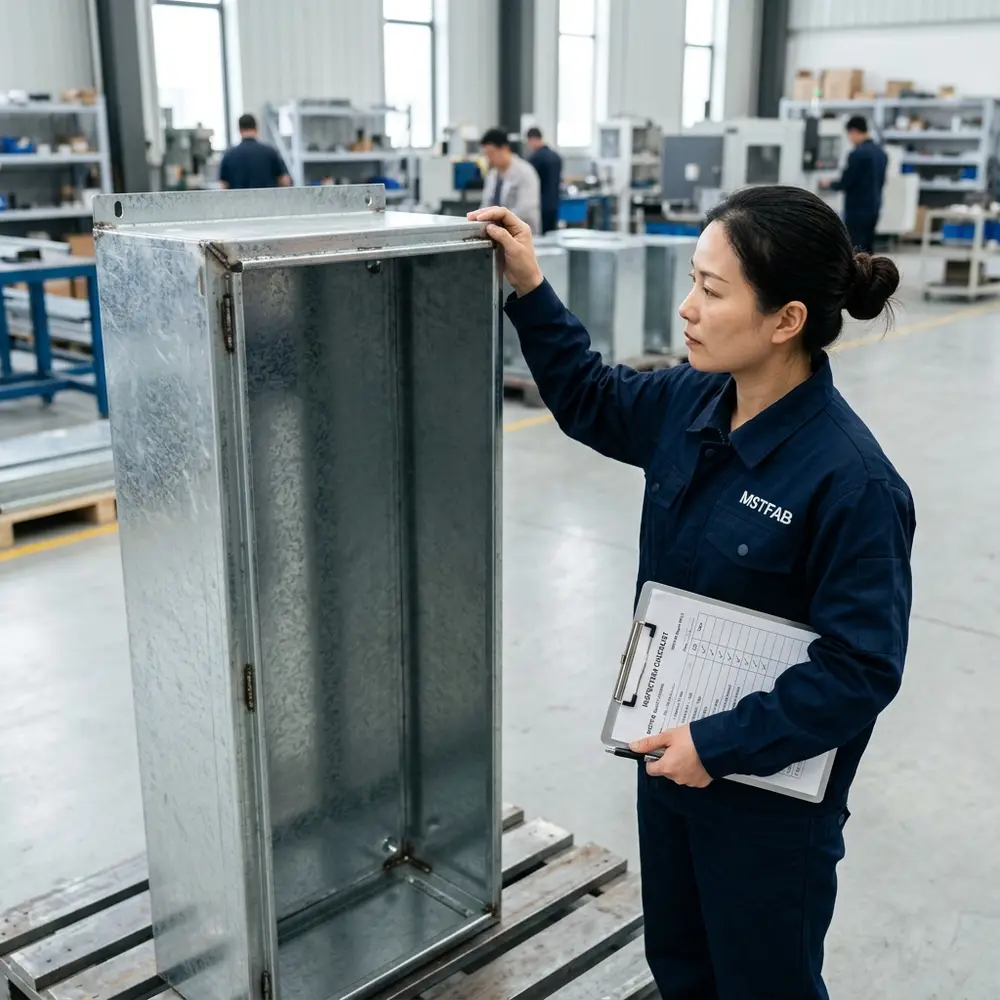
Quick Answer
When a batch of custom galvanized electrical enclosure shells arrives at your factory, do not send everything straight to the electrical assembly line just because the cartons look healthy.
Incoming inspection should confirm that the metalwork you received still matches the approved mechanical specification.
For most OEM enclosure projects, check at least:
- ✓ Drawing revision: Confirm correct version.
- ✓ Packaging condition: Check for transit damage.
- ✓ Material thickness: Verify against spec.
- ✓ Cabinet squareness: Measure diagonals.
- ✓ Door & hinge fit: Test operation and alignment.
- ✓ Mounting plate: Verify position and clearances.
- ✓ Cutouts: Check HMI and connector openings.
- ✓ Hardware & threads: Ensure inserts are clean.
- ✓ Grounding features: Inspect masked areas/studs.
- ✓ Gasket surfaces: Check for flat contact lands.
- ✓ Surface finish: Verify coating and corrosion protection.
- ✓ Mechanical fit test: Use representative components.
This inspection is about the empty metal enclosure.
MSTFAB manufactures drawing-based sheet metal parts such as:
- Enclosure bodies
- Doors & Covers
- Mounting plates
- Gland plates
- DIN-rail brackets
- Internal partitions
- Grounding studs
- HMI cutouts
- Mechanical hardware
- Export packaging
We do not manufacture the finished electrical distribution product.
The buyer or qualified electrical integrator remains responsible for: Breakers, Busbars, Contactors, PLCs, Relays, Wiring, Electrical schematics, Electrical testing, Energized operation, Final panel certification.
We build the metal house. You decide who moves in, where the furniture goes, and whether the electricity behaves itself.
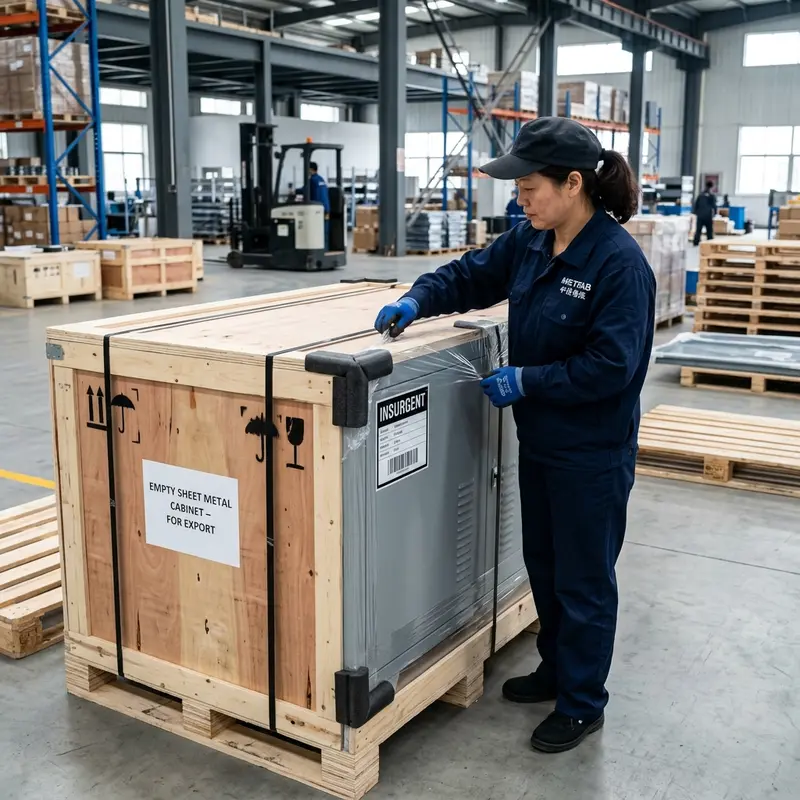
Why Incoming Inspection Deserves More Attention
OEM buyers spend a lot of energy qualifying suppliers before purchase. They review ISO certificates, factory photographs, equipment lists, samples, inspection reports, quotation terms, and material specifications.
Then the production batch arrives and somebody opens one carton, looks at the paint and says: “Looks good. Send it to assembly.”
That is where an expensive project can become interesting.
The enclosure may look perfectly acceptable while hiding problems such as:
- A mounting plate shifted several millimetres
- A door that rubs after installation
- A cable-gland opening made to an old revision
- Powder coating inside a threaded hole
- Missing grounding masks
- A different latch model
- Distortion around a welded panel
- A gland plate that cannot be removed after assembly
- A slightly different coating texture across batches
- Shipping damage hidden behind protective film
None of these problems requires a dramatic failure. Most enclosure problems are boring. That is exactly why they are expensive. They survive long enough to reach your assembly team.
ISO 9001 Helps—but It Does Not Replace Incoming Inspection
ISO 9001 is a quality-management-system standard. It helps manufacturers establish and control processes. But ISO 9001 does not mean every shipped dimension is automatically correct or immune to freight damage.
A QMS controls the manufacturing system. Your incoming inspection controls what actually reached your loading dock. Both matter. A driving licence is useful. You still look before crossing the road.
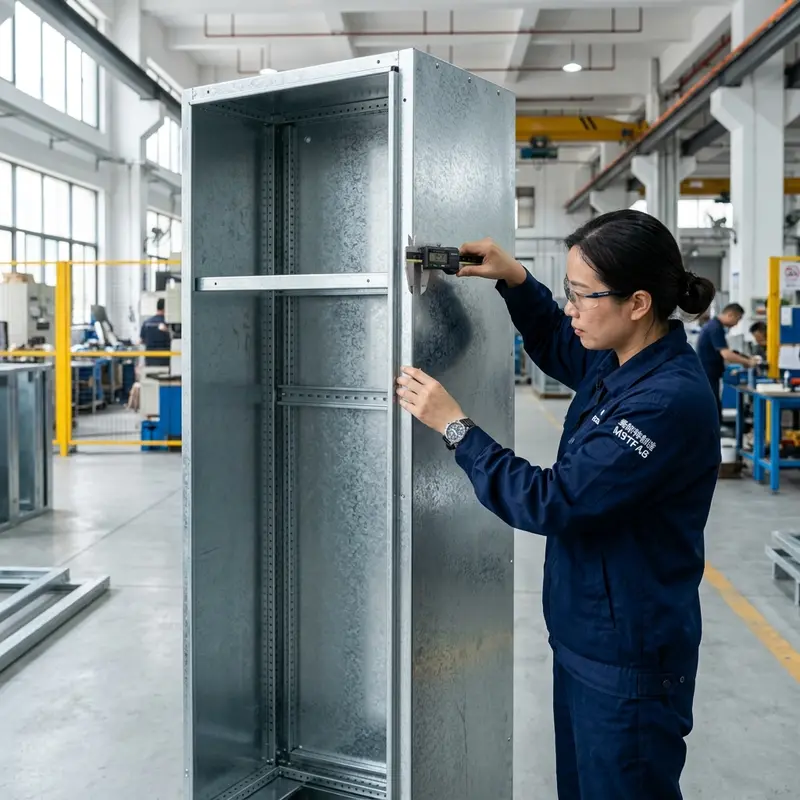
Check 1: Verify the Drawing Revision Before Measuring Anything
Before pulling out a caliper, confirm the drawing number, revision, and STEP-model revision.
Imagine receiving a cabinet that is manufactured perfectly to Revision C. Unfortunately, your team released Revision D three weeks ago. You can measure Revision C for two hours. It will remain perfectly wrong.
For repeat orders, do not write: “Same as last order.” Write the actual revision. “Same as before” is very efficient until nobody remembers exactly what “before” was.
Check 2: Inspect Packaging Before Removing the Parts
Packaging condition can tell you whether a defect came from manufacturing or transportation. Photograph the shipment before unpacking. Check carton condition, crate condition, pallet damage, and protective film.
A cabinet does not care whether a dent was created in Guangzhou or Los Angeles. Your claim process certainly does.
Check 3: Confirm Material and Sheet Thickness
“Galvanized steel” is not a complete material specification. Depending on the enclosure, this might involve zinc-coated sheet before fabrication, electro-galvanized sheet, or hot-dip galvanized material.
Do not automatically require PMI or EN 10204 3.1 for every ordinary galvanized carbon-steel cabinet. Use them when the contract requires them or material substitution would create serious risk. The largest paperwork package is not automatically the best material-control plan. Sometimes it is simply the heaviest PDF.
Check 4: Measure Cabinet Geometry and Squareness
Do not check only width, height, and depth. Also consider diagonal difference, base flatness, and frame twist.
A welded enclosure may meet its outside dimensions but still be twisted. Use the drawing datums that control the assembly. When every dimension is marked ±0.1 mm, you have not necessarily created a precision enclosure. You may have created an expensive quotation.
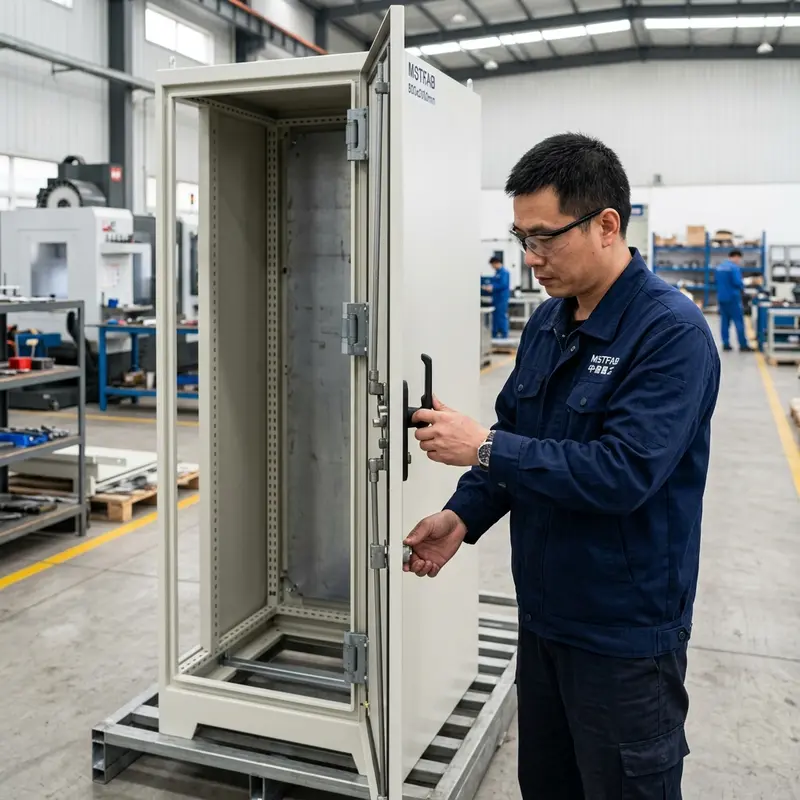
Check 5: Test Every Important Door Function
Check door gap, flushness, hinge alignment, opening angle, and latch engagement. Test in the intended orientation. A door that behaves beautifully while the cabinet lies flat may become more ambitious when gravity joins the meeting.
Check 6: Verify the Mounting Plate Before Electrical Assembly
The internal mounting plate is where many seemingly minor sheet metal errors become major electrical-assembly problems. Ask: Can we actually remove this mounting plate after the enclosure is assembled?
CAD enjoys infinitely thin tools and extremely flexible technicians. Your assembly team does not.
Check 7: Measure Critical Cutouts
Electrical enclosure cutouts interact directly with bought-in components. Check HMI openings, connector cutouts, and cable entries against the real component drawing.
The hole can match the drawing perfectly and still introduce the component to a bracket it was never supposed to meet.
Check 8: Inspect Threads and Installed Hardware
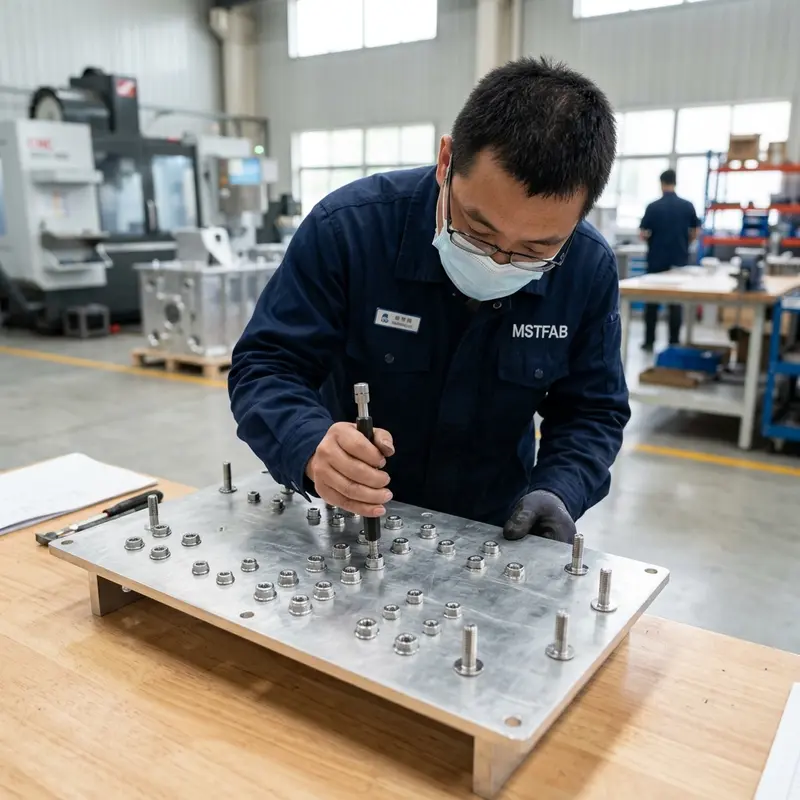
Check all supplied mechanical hardware such as PEM nuts, studs, hinges, and locks. Powder coating and other finishing processes can partially close threaded features.
A beautiful M6 thread filled with powder is no longer really an M6 thread. It is modern sculpture with a pitch.
Check 9: Inspect Grounding and Bonding Features
MSTFAB can manufacture drawing-defined mechanical grounding features including welded grounding studs and masked metal areas.
Do not assume hinges provide protective bonding or zinc coating guarantees suitable conductivity. We make the stud. Your electrical engineer decides what the electrons are supposed to do with it.
Check 10: Inspect Gasket Contact Areas
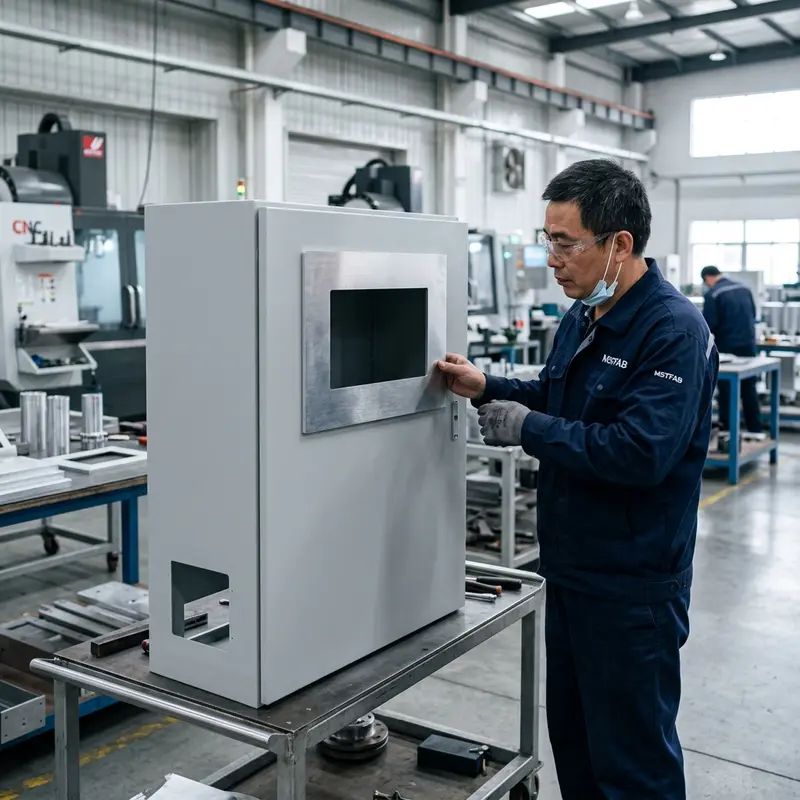
Even when MSTFAB supplies only an empty shell, the sheet metal geometry can affect the buyer’s intended sealing performance.
An enclosure with a gasket, a lock, and galvanized steel does not automatically become IP65 or NEMA 4X. A rubber strip around a door is useful. It is not a weatherproofing diploma.
Check 11: Inspect Surface Finish Under Controlled Conditions
Surface complaints become difficult when the buyer and supplier have never agreed on what “good” looks like. Define color, texture, and acceptable scratches before production.
A heavy structural galvanized frame and a customer-facing electrical cabinet live very different social lives.
Check 12: Perform a Mechanical Fit Test Before Batch Release
This is one of the highest-value incoming checks. Use representative mechanical components or templates to check the HMI opening, DIN devices, and cable glands.
A physical fit test catches mechanical mistakes before those expensive electrical parts enter the picture.
Supplier Reliability Scorecard: Receiving Inspection Reality
| Inspection Focus | Generic Job Shop Expectation | MSTFAB (Professional OEM Partner) |
|---|---|---|
| Revision Control | Mixes old DXF files with new emails; unpredictable results. | Strict STEP/PDF version tracking; manufactures only approved revisions. |
| Packaging Integrity | Thin cardboard; cabinets arrive scratched or dented by forklifts. | Multi-layer export packing and solid crates; zero shipping damage. |
| Hardware Threads | Clogged with powder coating; requires re-tapping during assembly. | Properly masked before finishing; ready for immediate hardware installation. |
| Squareness & Fit | Twisted frames and sagging doors that bind upon opening. | Rigid welded structure and precision CNC bending; perfect diagonal alignment. |
What to Do When You Find a Nonconforming Enclosure
Identify part number, revision, and defect type. For recurring problems, ask the supplier for root-cause analysis and corrective action.
“Worker will pay more attention” is not particularly ambitious root-cause analysis.
Clear Scope: What MSTFAB Manufactures
MSTFAB focuses on drawing-based custom sheet metal fabrication. Typical electrical enclosure scope includes galvanized steel cabinet bodies, powder-coated steel shells, mounting plates, internal partitions, and inserted hardware.
We do not manufacture the completed electrical distribution system. This distinction matters when comparing quotations. One supplier is manufacturing the house. The other supplier may be furnishing it, wiring it and obtaining approvals. Those are not the same shopping basket.
Request a Precision Sheet Metal Quote
For mass production of blank metal cabinets, see our Custom Sheet Metal Enclosure Fabrication services.
Key Takeaways
For galvanized electrical enclosure shells, incoming inspection should focus on what will affect the buyer’s next manufacturing step: Correct drawing revision, shipping condition, cabinet geometry, hardware, grounding features, and mechanical component fit.
For overseas buyers, the best receiving inspection is not the one with the most measurements. It is the one that catches the expensive mechanical problems before the enclosure reaches electrical assembly.
“Finding a wrong HMI hole at incoming inspection is inconvenient. Finding it after the technician has installed half the cabinet is an educational experience nobody requested.”
 WeChat Contact
 WhatsApp Me Directly