
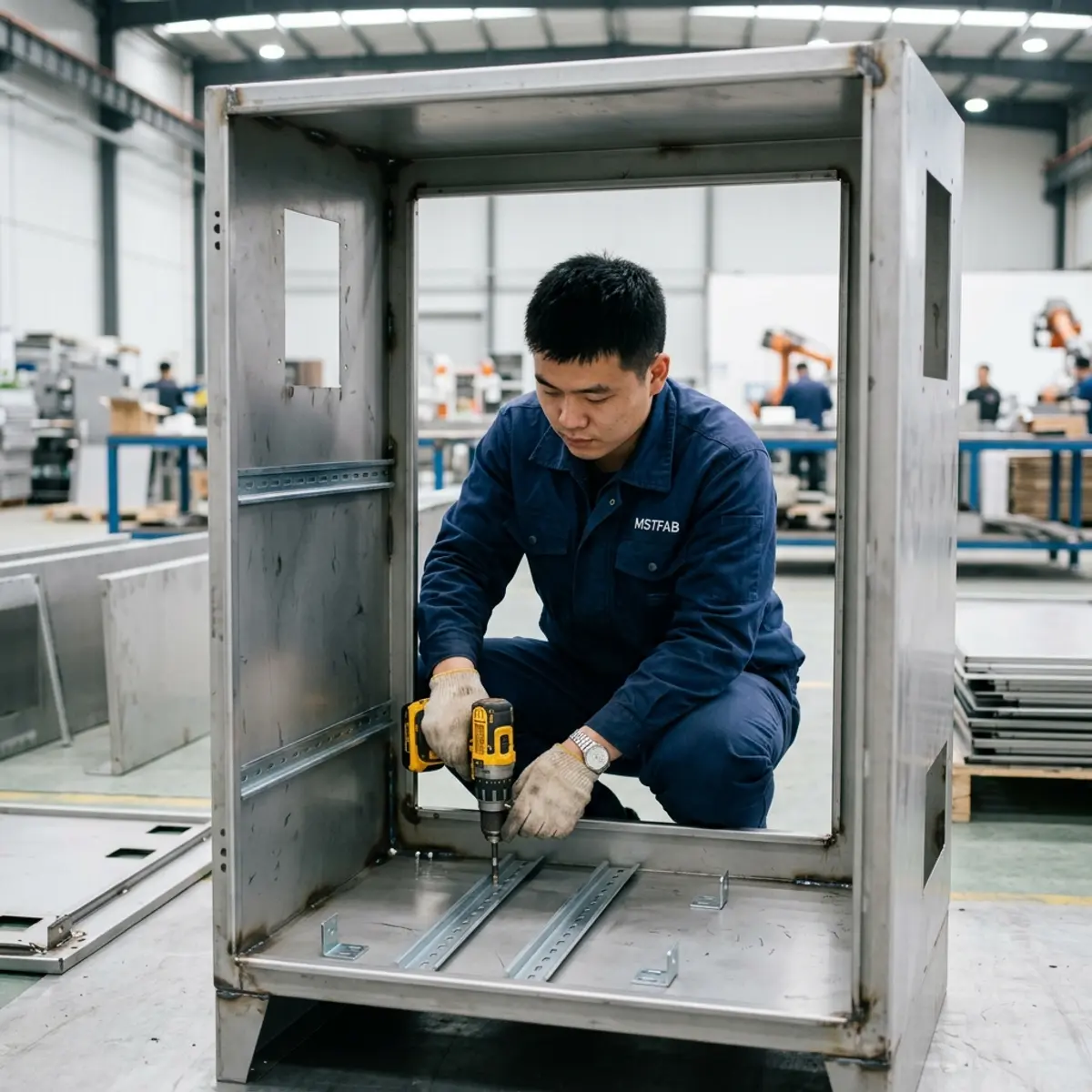
Evaluate an EVSE cabinet supplier by how clearly it controls drawing revisions, mechanical interfaces, first-article evidence and changes between batches. A gallery of shiny boxes proves that a camera worked. It does not prove that your door, gasket, connector panel or mounting plate will fit.
This checklist is for OEM buyers sourcing build-to-print empty cabinets for AC chargers, DC fast charging equipment and related power-conversion systems. It separates the sheet metal scope from the completed charging equipment and turns supplier selection into questions that can be answered with records.
Seven checks before approving an EVSE cabinet supplier
| Check | Question to ask | Useful evidence |
|---|---|---|
| 1. Supply boundary | Which shells, panels, brackets, hardware and finishes are included, and which electrical parts remain buyer-supplied? | Itemized quotation and bill of materials |
| 2. Revision control | How are the STEP model, 2D drawing and purchase-order revision matched before release? | Controlled job traveler, released drawing or revision record |
| 3. Interface review | Which datums control displays, connectors, rails, power modules, cable entry and service access? | Marked DFM review and approved responses |
| 4. Door and sealing geometry | How will frame shape, door gap, latch position and gasket land be checked? | Finished-assembly measurements and operating check |
| 5. Thermal and cable openings | Who defines fans, heat exchangers, filters, louvers, gland plates and clearance? | Buyer-approved interface drawing and component data |
| 6. First article and production inspection | Which dimensions, hardware, finish and fit conditions require records? | Agreed FAI or inspection report scope |
| 7. Change and packing control | What happens when material, hardware, coating, process or packing changes? | Approval workflow, updated revision and shipment evidence |
1. Begin with a clean supply boundary
MSTFAB fabricates drawing-defined mechanical parts and empty enclosure shells. Charger modules, switchgear, busbars, wiring, cables, connectors, software, completed-equipment testing and market certification remain with the OEM or integrator unless an approved quotation says otherwise.
This boundary is not a disclaimer tucked behind the invoice. It is a purchasing control. When each party knows what it owns, missing brackets and surprise integration work are less likely to arrive together.
2. Ask how the supplier controls revisions
A 3D model is excellent for geometry. A 2D drawing is better for material, finish, datums, tolerances, welds, hardware and acceptance notes. The supplier should confirm that both files share the same revision before work begins.
For repeat orders, the released package should also control approved engineering changes. “Same as last time, except for the new connector” is not a revision system. It is the opening line of an expensive meeting.
3. Review functional interfaces, not isolated dimensions
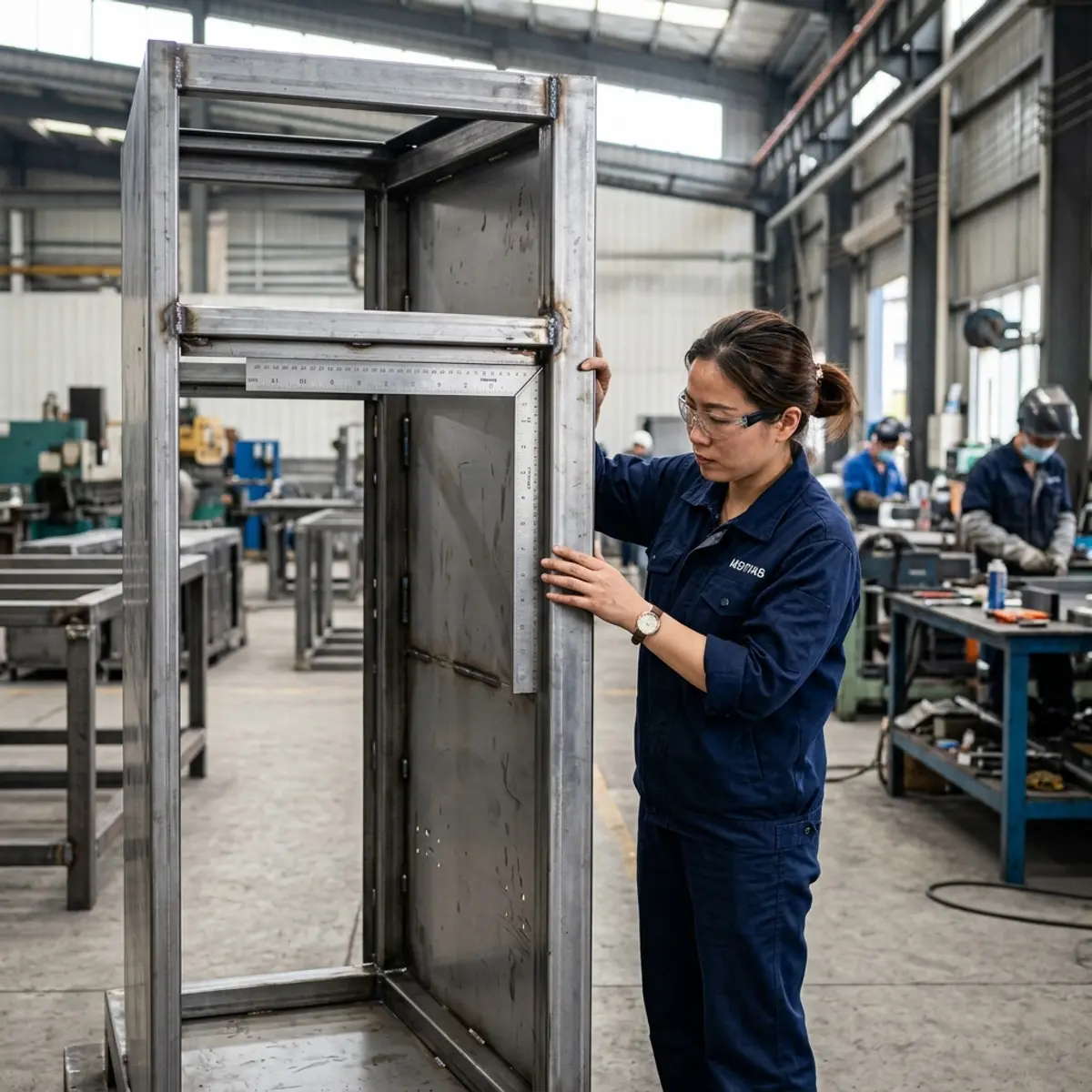
Connector cutouts, displays, rails, brackets and gland plates must align with buyer-selected components. Important features should be dimensioned from stable functional datums and checked in the finished condition where coating, bending, welding or assembly can affect fit.
If the cabinet includes separate machined or thermal parts, define the shared interface in one controlled drawing. The EV charger machining versus sheet metal guide explains where those process boundaries usually belong.
4. Treat sealing as geometry
A gasket cannot correct a distorted opening, weak latch pull or broken compression path. Ask how the supplier will verify door operation, gap, flushness, hinge position, latch engagement and usable gasket land. The buyer still owns the completed-equipment protection target and validation method.
Do not accept a generic protection rating as a substitute for a drawing. The cabinet geometry, installed components, seals and final test condition all matter.
5. Keep thermal responsibility visible
The equipment designer should define heat load, airflow, fan or heat-exchanger selection, filter requirements and environmental limits. The sheet metal supplier translates those decisions into cutouts, mounting patterns, partitions, louvers, brackets and service access.
The EV charger enclosure thermal interface guide helps convert cooling choices into metal geometry without pretending that a vent pattern is a thermal calculation.
6. Agree the first-article evidence before the first article
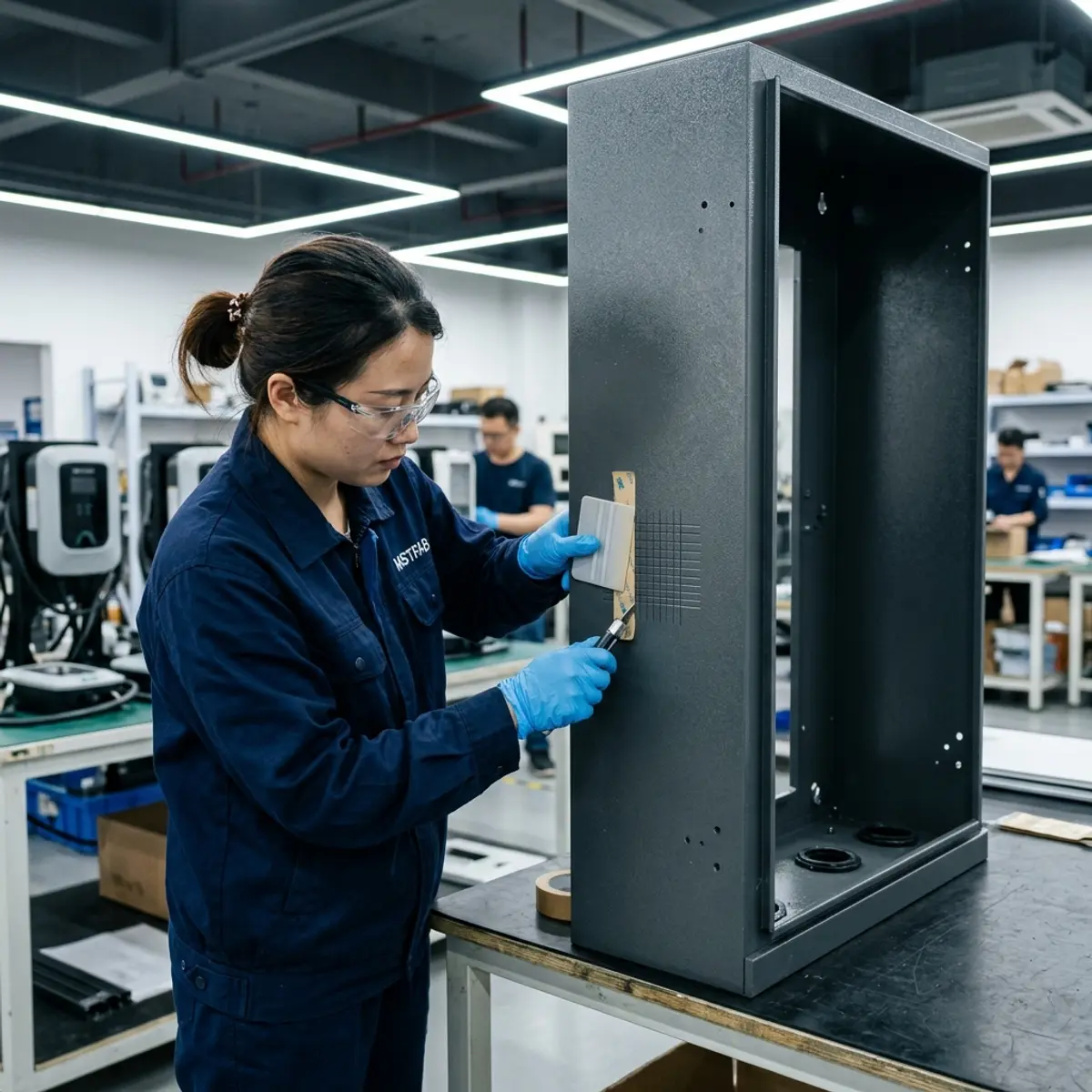
Inspection is much easier when both parties know what the report must contain. Identify critical dimensions, mating-part fit checks, hardware verification, finish acceptance and any photographs required for packing or shipment release.
Not every dimension needs a ceremonial spreadsheet. Concentrate evidence on the features that control assembly, service, sealing, appearance and safe mechanical installation. Use the OEM sheet metal inspection checklist to define a practical report scope.
7. Evaluate the change process, not only the sample
A good first article can be followed by a poor repeat batch if hardware, material, tooling, coating or packing changes without review. Ask which changes require buyer approval and which measurements will be repeated after an affected change.
Also define protection for finished surfaces, removable panels and loose hardware during export packing. The cabinet should reach the assembly line as a cabinet, not as a lesson in freight physics.
Buyer trust table: who owns the decision?
| Decision | OEM or buyer | Cabinet supplier | Record |
|---|---|---|---|
| Product function and safety | Defines requirements and approves the design | Reviews mechanical manufacturability | Approved drawing package |
| Component selection | Selects electrical, thermal and user-interface components | Builds the specified mechanical interfaces | Component data and interface drawing |
| Fabrication route | States restricted or required processes | Plans cutting, forming, joining, finishing and inspection | Quotation and agreed control plan |
| Shipment release | Defines required evidence and approval authority | Completes the agreed checks and records | FAI, inspection or packing report |
| Completed charger | Owns integration, validation, certification and release | Supplies the approved mechanical scope | OEM compliance records |
Guangzhou Maisituo Sheet Metal Manufacturing Co., Ltd., operating as MSTFAB, supports drawing-based cabinet fabrication from prototype and pilot quantities through repeat orders. The exact route and inspection scope are reviewed against the submitted files and approved quotation.
What to include in the supplier RFQ
- Matching STEP or STP file and revision-controlled 2D PDF drawing
- Material, thickness, finish, color and visible-surface requirements
- Critical datums, tolerances and finished-part acceptance condition
- Buyer-supplied components or gauges needed for representative fit checks
- Prototype and annual quantities, destination and required schedule
- First-article, inspection, packing and change-approval expectations
Frequently asked questions
What is the difference between an EVSE cabinet supplier and a charger manufacturer?
A cabinet supplier fabricates the drawing-defined mechanical enclosure and related parts. The charger manufacturer or OEM owns the electrical system, controls, completed-equipment validation and market release.
Should a supplier promise an ingress rating for an empty cabinet?
The supplier can manufacture the specified sealing geometry and provide agreed evidence. The responsible OEM should define and validate the protection target for the completed configuration.
What should be checked on the first article?
Check the features that control fit and function: datums, critical cutouts, door and panel operation, hardware, finish, gasket interfaces and any buyer-defined mating-part checks.
Review MSTFAB’s custom EV charger enclosure manufacturing scope, then send the matching model, drawing, material, finish, quantity and inspection requirements.
 WeChat Contact
 WhatsApp Me Directly