
OEM EMPTY EV CHARGING ENCLOSURE SHELL GUIDE
Answer: MSTFAB converts a customer-approved thermal plan into manufacturable sheet metal geometry: louvers, perforations, fan or heat-exchanger cutouts, baffles, partitions, rain hoods, gasket channels and mounting interfaces. MSTFAB does not design or validate the cooling system.
This EV charging enclosure shell thermal interface checklist applies to empty build-to-print housings. The charger manufacturer owns heat load, airflow, device selection, controls and finished-system testing.
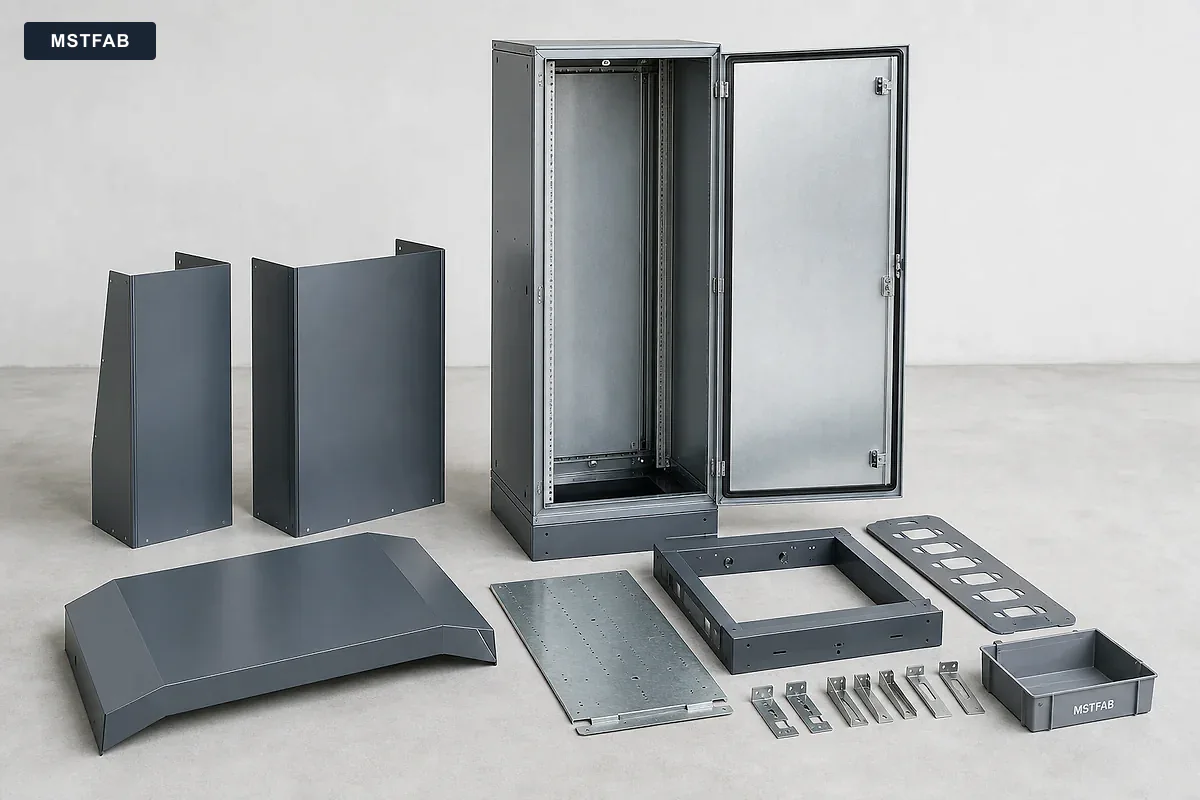
1. Separate the enclosure shell from the thermal system
Before quotation, define exactly what the metal supplier delivers. “Thermal-ready cabinet” is not enough. It should mean an empty shell with controlled openings, brackets, baffles and mounting patterns for devices selected by the customer.
| MSTFAB can supply | Outside MSTFAB scope | Customer owns |
|---|---|---|
| Body, doors, panels, partitions, baffles, louvers, perforations, rain hoods, drip edges and gland plates | Fans, filters, heat exchangers, enclosure AC, liquid cooling, sensors, controls and wiring | Heat load, temperature limits, airflow, pressure drop, device selection and control logic |
| Customer-defined cutouts, studs, brackets, gasket channels, coating and mechanical inspection | CFD, thermal performance testing, charger electronics, commissioning and complete-system certification | Ambient conditions, solar load, altitude, condensation, ingress, safety and finished-product validation |
2. Release complete thermal-interface inputs
A useful drawing package identifies every customer-selected device and the metal interface around it. For a fan, define cutout size, mounting holes, orientation, guard clearance and service access. For a heat exchanger or AC unit, provide the supplier interface drawing, weight, center of gravity, seal land and fastener pattern.
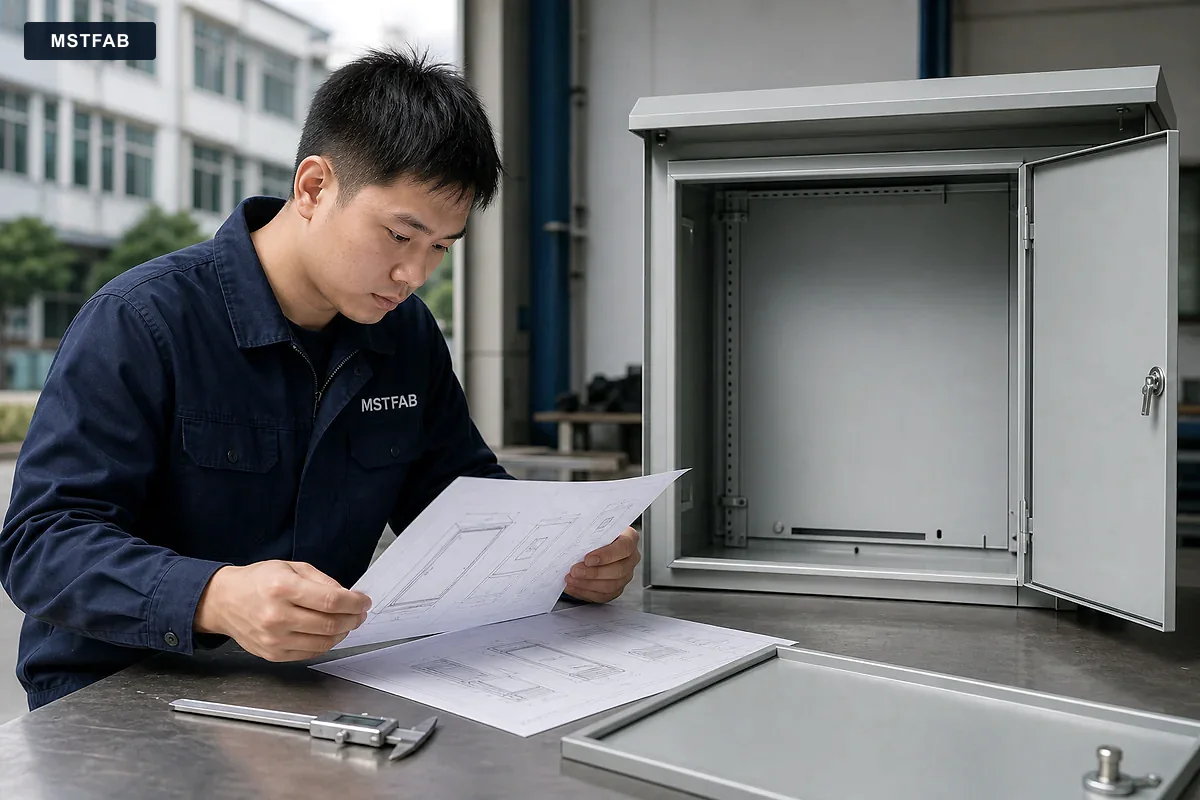
“Keep the power module below 70 C” is a system requirement. “Cut this opening from datum A, install these studs and mask this seal land” is a manufacturable metal requirement.
3. Design louvers and perforations as controlled metal features
Passive openings affect free area, pressure drop, rain entry, tool access and panel stiffness. The customer defines required airflow and allowable pressure loss. MSTFAB translates the approved pattern into laser cutting or CNC punching.

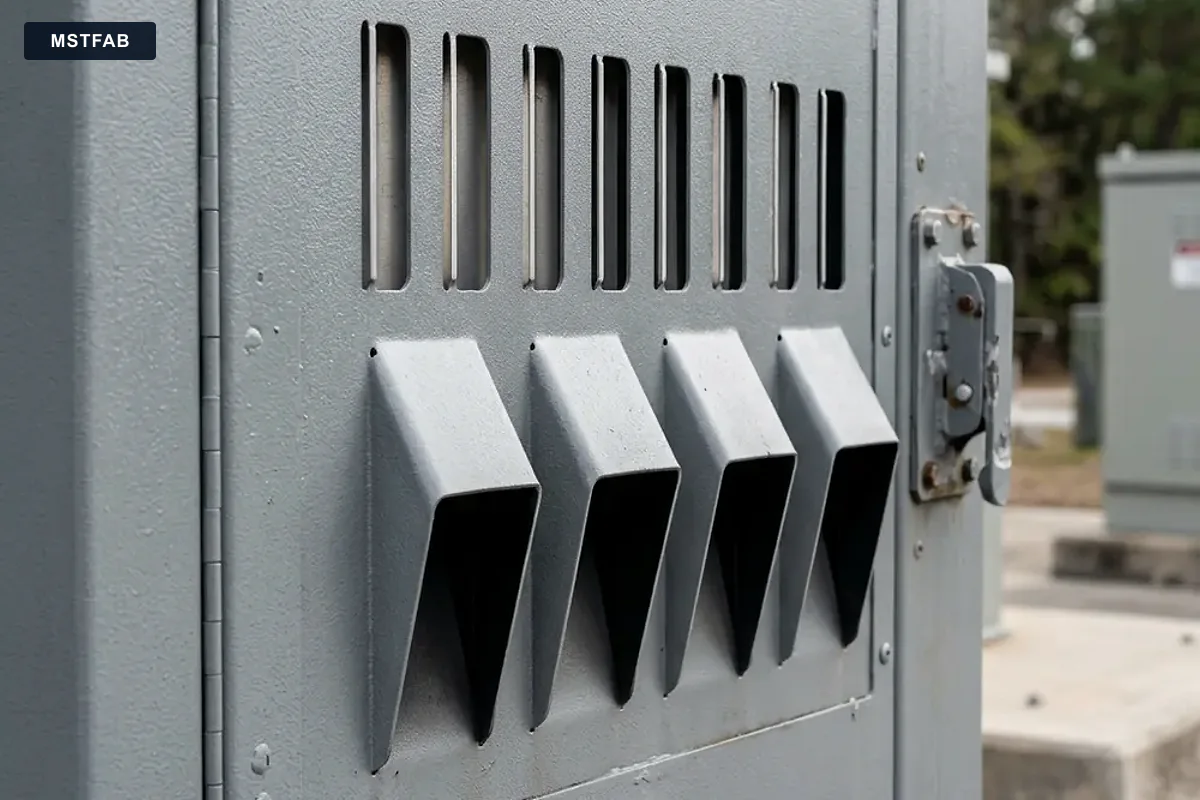
For louvers, specify opening size, blade direction, pitch, quantity and orientation after bending. Upward-facing geometry on an outdoor door can turn ventilation into a small rain collection program. Edge distance and spacing must suit the louver tool and preserve panel strength.

4. Control fan, exchanger and duct interfaces without installing devices
MSTFAB can fabricate blank fan openings, heat-exchanger cutouts, AC apertures, duct flanges and support brackets from customer-controlled drawings. The panel must be stiff enough for the device load and gasket compression, with tool access for installation and maintenance.
Internal baffles and partitions can separate inlet and outlet zones or guide air past customer-defined equipment. Air takes the easiest route, including the route nobody intended. The buyer owns airflow performance; MSTFAB controls the approved baffle geometry and attachment points.
Cutout position, hole pattern, bracket fit, panel geometry and specified hardware.
Air volume, pressure, temperature, recirculation, noise and device life.
5. Combine airflow openings with outdoor rain geometry
Outdoor EV charging housings often need both airflow and environmental protection. Those goals compete. Open airflow and a high ingress target are not roommates unless the complete architecture reconciles them.

Mechanical options include rain hoods, downward-facing louvers, labyrinth paths, drip edges, sloped roofs, drain holes and protected door returns. The drawing should define direction, overlaps, gaps, welds and inspection points.
Gasket channels, hinge positions and latch compression affect door sealing. MSTFAB can fabricate and inspect these features, but installed cooling devices, cable glands, filters and service doors affect the final result. An empty shell alone does not guarantee an IP or NEMA rating.

6. Review the fabrication sequence around thermal interfaces
Laser cutting creates profiles and device openings; CNC punching forms repeated louvers; bending creates ducts, rain hoods and returns. Welding joins frames, brackets and partitions. Each process can move the feature coordinate system, so critical interfaces should be dimensioned from functional datums.

Fixtures and intermediate checks help control door openings, cutout relationships and panel squareness after welding. If the device fit is critical, provide a sample, gauge or approved mating frame for first-article trial fit.
- Cutout and mounting datum
- Minimum edge and bend distance
- Tool and fastener access
- Bracket and panel stiffness
- Weld sequence and distortion
- Trial-fit sample or gauge
7. Treat material, coating and condensation as interface inputs
The customer selects cold-rolled or galvanized steel, stainless steel 304/316, or aluminum 5052/6061 from structural, corrosion, thermal and cost requirements.
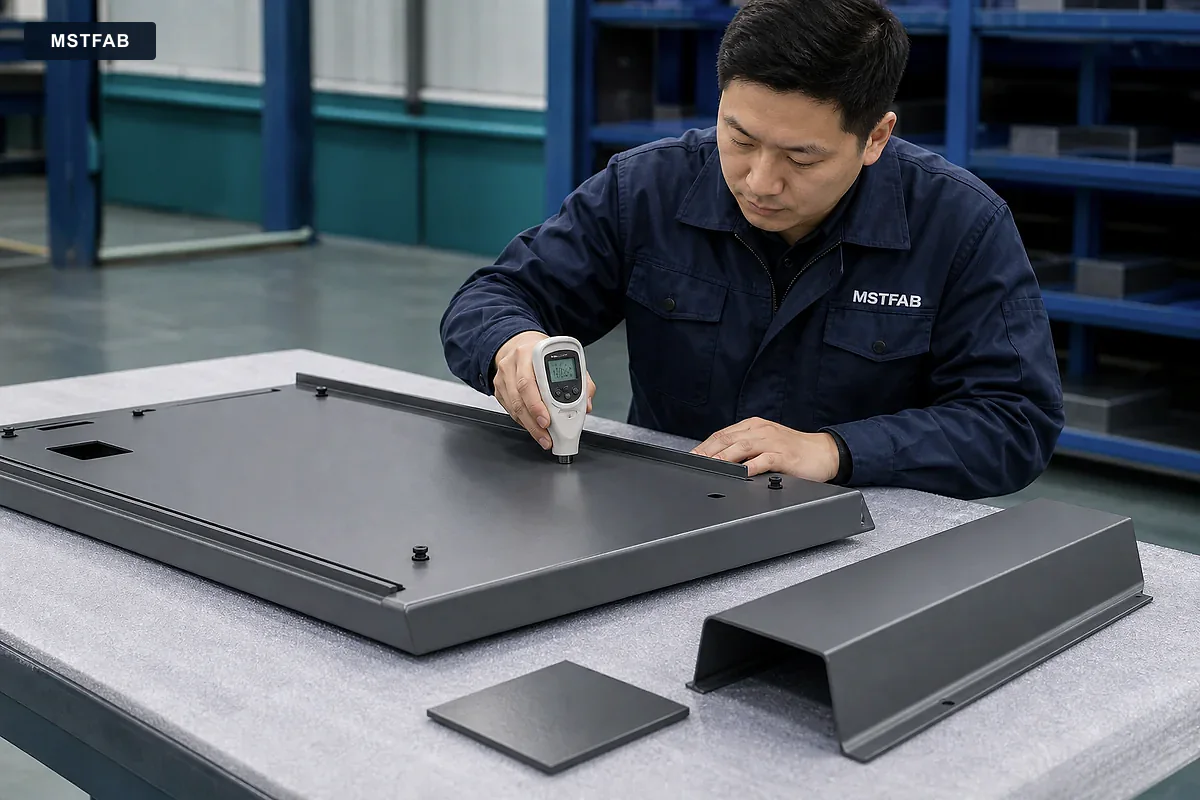
Powder coating needs pretreatment, color, texture, visible faces, masking and cosmetic limits. Mask gasket lands, threads, grounding zones and tight-fitting device interfaces when specified. Coating on both sides of a close-fitting opening can turn an easy assembly into a rubber-mallet meeting.
Condensation depends on ambient humidity, internal temperature, heat cycles and ventilation strategy. The customer defines heaters, drains, membranes or controls. MSTFAB can fabricate their approved mounting and drainage features but does not validate dew-point performance.
8. Define mechanical inspection and RFQ evidence
First-article inspection should focus on features that govern integration: enclosure squareness, door opening, louver direction, cutout position, hole pattern, bracket fit, seal land, rain hood, drain geometry and coated clearances.

| Characteristic | Possible evidence | Responsibility boundary |
|---|---|---|
| Cutout and hole pattern | Datum-based dimensional report or fixture | MSTFAB verifies geometry |
| Louver and rain feature | Direction, count, size and visual record | Customer validates airflow and ingress |
| Bracket and device fit | Approved sample or mating gauge | MSTFAB checks agreed mechanical fit |
| Finish and masking | Film thickness, color sample and masked-zone check | Customer validates complete product |
For quotation, send STEP models, controlled drawings, interface drawings, material, thickness, device weights, vent patterns, baffles, rain geometry, coating, quantities, inspection records and destination. Identify prototype and repeat-production quantities separately.
A complete EV charging enclosure shell thermal interface checklist lets MSTFAB quote and manufacture the metal accurately without claiming ownership of the charger thermal system.
Frequently asked questions
Does MSTFAB design the EV charger cooling system?
No. The customer supplies the approved thermal architecture and device interfaces. MSTFAB fabricates the empty shell geometry.
Can MSTFAB make fan and heat-exchanger openings?
Yes, from customer-controlled cutout, hole-pattern, seal and bracket drawings. MSTFAB does not select or install the devices.
Can MSTFAB perform CFD or thermal validation?
No. CFD, heat-load calculations, airflow performance and completed-system thermal testing remain with the customer.
Can an empty shell guarantee an IP or NEMA rating?
No. Installed devices, filters, glands, seals and final assembly affect ingress performance. The finished-product owner validates the rating.
What files are needed for quotation?
Send 3D models, controlled drawings, thermal-interface drawings, material, finish, quantities, inspection needs and destination.
Send the approved thermal-interface package
Share the shell model, controlled drawings, cutouts, louvers, baffles, rain features, finish, quantity and inspection requirements.
 WeChat Contact
 WhatsApp Me Directly