
OEM Pricing & Cost Engineering Guide · Bottom-Up Factory Cost Breakdown
Understanding custom rackmount chassis manufacturing cost enables procurement managers and hardware engineers to strip 20% to 40% of hidden non-value-added cost out of their enclosure bill of materials (BOM) before freezing Revision A. At an ISO-certified sheet metal factory, custom 1U–4U chassis pricing is not guessed by weight alone—it is calculated bottom-up across eight measurable drivers: alloy & sheet nesting yield, overall U-height/depth, ventilation hole pierce counts, CNC bend setups & tolerances, PEM hardware count, coating & masking labor, batch volume amortization, and anti-crush export packaging.
- Zero Hard-Tooling Advantage: CNC laser cutting and press brake bending eliminate $15,000–$45,000+ progressive stamping or extrusion dies on prototype and 50–3,000 unit runs.
- Hidden Cost #1 — Masking & Welding: Excessive hand-ground cosmetic TIG welds and 25+ tiny manual masking spots can double labor cost compared with folded tab-and-slot SGCC designs.
- Hidden Cost #2 — Dense Laser Pierces: Switching 1,500 laser-pierced round holes to a standardized turret cluster-punch pattern cuts machine time by up to 60% in batch runs.
- Volume Break Leverage: Moving from a 5-piece prototype to a 100-piece or 500-piece production lot typically lowers unit cost by 45% to 68% through setup amortization.
How Custom Rackmount Chassis Pricing Works
Standard Enclosures vs Fully Custom Designs
When launching a new networking switch, industrial computer, or power-supply product line, engineering teams often begin by pricing off-the-shelf catalog 19-inch boxes—only to discover that once they pay a local machine shop to post-mill 35 rear connector cutouts, cut custom front display apertures, install 18 internal PCB standoffs, strip paint around grounding points, and silkscreen custom logos onto a catalog box, the “modified off-the-shelf” enclosure ends up costing more per unit than a purpose-built custom sheet metal chassis fabricated directly from flat sheet! Full build-to-print custom fabrication eliminates secondary fixturing completely: every cutout, ventilation grid, and PEM hole is cut cleanly in the flat blank before the first bend.
Prototype Pricing vs Production Pricing
New B2B buyers are occasionally surprised when a 2-piece rackmount chassis prototype quotes significantly higher per unit than the projected 200-piece production price. That spread reflects fixed Non-Recurring Engineering (NRE) and machine changeover time shared across every custom fabrication order:
- Fixed Setup Overhead per Release: Unfolding 3D STEP assemblies (body, cover, front panel, rear plate, rack ears, internal brackets), nesting flat blanks, programming multi-axis press brake tool stations, calibrating PEM press anvil pressure, mixing powder-coat booths or silkscreen mesh screens, and executing a full ballooned First Article Inspection Report (FAIR) takes 4 to 8 hours of skilled engineering and technician labor—whether the batch is 2 pieces or 500 pieces.
- Batch Amortization Curve: On a 2-piece prototype, those 6 hours of setup sit on just 2 units. On a 100-piece or 500-piece production release, fixed setup per chassis shrinks to pennies, bulk steel/aluminium sheets nest at 85%+ utilization, and multi-station powder-coating racks operate at full continuous density.
Eight Factors Affecting Manufacturing Costs
1. Material Grade and Thickness
As detailed in our aluminum vs steel rackmount chassis comparison, alloy selection establishes baseline material and conversion costs. Standard 1.0 mm–1.2 mm cold-rolled steel (SPCC/DC01) and pre-galvanized steel (SGCC/SECC) represent the most economical structural baseline. Upgrading to 1.5 mm–2.0 mm 5052-H32 aluminium increases raw sheet cost and requires slower TIG welding and chemical conversion prep, while specifying SUS304 or SUS316L stainless steel raises both material cost (2.2×–3.0×) and nitrogen cutting / specialized stainless PEM fastener expenses. Over-specifying sheet thickness (for instance, calling out 2.0 mm steel on a lightweight 1U top lid where 1.0 mm–1.2 mm steel is standard) adds unnecessary steel weight, bending tonnage, and international freight cost.
2. Chassis Height and Depth
Chassis dimensions govern raw sheet nesting yield on standard mill sheets (1,219 × 2,438 mm or 1,500 × 3,000 mm). A deep 4U chassis body unfolded as a single giant cruciform flat blank (e.g., 1,050 mm × 820 mm) leaves massive empty corner squares of scrap metal on the laser table! Splitting a deep 3U/4U chassis into a compact U-shaped base pan paired with detachable front/rear panels and screw-on rack ears cuts flat-pattern scrap waste from 38% down to under 14%—immediately saving raw material dollars on every enclosure.
3. Ventilation Patterns and Connector Cutouts
Every standalone hole or slot cut by a fiber laser requires an individual piercing dwell cycle plus cut perimeter time. A front and rear bezel containing 1,400 tiny Ø3.0 mm ventilation holes can spend 6 to 9 minutes on a fiber laser table—costing more in machine time than the steel sheet itself! For production quantities above 50–100 units, aligning round or hexagonal vent patterns with standard CNC turret multi-hole cluster punch tools—or increasing hole diameter slightly from Ø3.0 mm to Ø4.5 mm to halve total pierce count while preserving open area (see our ventilation design guide)—slashes cutting cycle time dramatically.
4. Bending Complexity and Tolerances
Each unique press brake tool setup (changing gooseneck punches, narrow V-dies, or offset joggle dies) adds changeover cost. Standardizing all sheet metal inside bend radii to Ri = 1.0t across every sub-component lets operators fold the entire chassis kit in a single press brake setup. Similarly, keeping general sheet metal tolerances aligned with DIN EN ISO 2768-mK (±0.15 mm–±0.25 mm on laser-cut hole pitches; ±0.3–±0.5 mm across bent flanges) avoids expensive post-bend CNC secondary machining or hand-shimming required when drawings mistakenly apply ±0.02 mm machined-billet tolerances to folded sheet metal.
5. PEM Hardware and Mechanical Assembly
Self-clinching fasteners (PEM nuts, blind/through PCB standoffs, flush studs, captive thumbscrews) are priced individually plus per-press-stroke insertion labor. Cost escalates rapidly when a single chassis mixes 9 different non-standard imperial and metric fastener sizes (requiring 9 separate anvil setups and purchase MOQs), or specifies custom-length blind standoffs not carried in standard stock. Standardizing on 2 or 3 common metric sizes (for example, M3×6 mm PCB standoffs, M4 clinch nuts, and M4 grounding studs) cuts hardware procurement and press-setup costs by 35%–50%.
6. Surface Finishing and Printing
Surface treatment frequently accounts for 18% to 35% of total custom chassis fabrication cost—driven primarily by masking labor and colour changeovers:
- Standard vs. Custom Powder Colours: High-volume data-centre powders like matte/fine-texture RAL 9005 Jet Black and RAL 7035 Light Grey run daily on industrial lines with zero booth-purge surcharges, whereas custom low-volume metallic or non-standard RAL shades trigger minimum powder-lot and booth-cleaning fees.
- Masking Complexity: Manually applying silicone plugs and die-cut tapes to 35 scattered standoffs and 6 perimeter EMC flanges takes skilled labor before coating and peeling labor after oven curing. Switching internal chassis pans to bare conductive SGCC/SECC galvanized steel and powder-coating only the visible front panel eliminates 90% of manual masking cost!
- Silkscreen vs. Fiber Laser Marking: Multi-colour front-panel silkscreening requires separate screen-film setups per colour (most cost-effective in batches of 50+ units), whereas crisp 1-colour silkscreening or permanent fiber-laser etching on anodised aluminium offers zero screen setup cost on prototypes and small runs.
7. Production Quantity and Inspection
Order quantity per release dictates raw sheet bundle discounts, turret-punch vs. laser allocation, and QA sampling amortization. While 100% dimensional inspection is executed on prototypes and First Articles, moving into stable repeat batches allows structured AQL patrol metrology backed by physical go/no-go mating check fixtures—maintaining zero-defect consistency at lower inspection cost per unit. Review our full rack mount chassis fabrication & QC workflow for inspection checkpoints.
8. Export Packaging and Freight
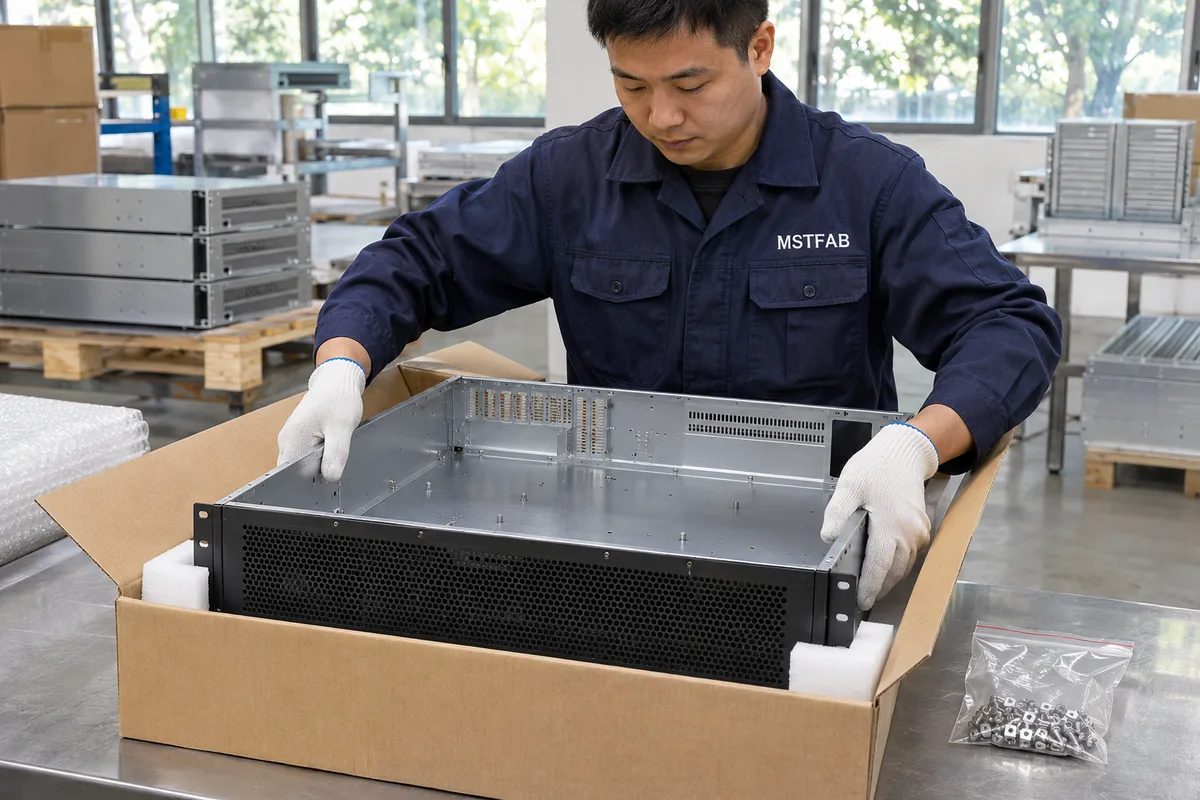
Empty 2U–4U rackmount chassis are volumetric cargo—meaning international air and LCL ocean freight charge by cubic volume rather than metal weight. Shipping fully assembled empty 4U boxes wastes freight dollars moving enclosed air, while inadequate cardboard packing bends protruding 19-inch rack ears during handling. Packing detachable rack ears flat inside the chassis cavity, nesting custom EPE foam trays inside heavy-duty double-wall export cartons, and palletizing onto ISPM 15 stamped export pallets/crates protects cosmetic finishes while maximizing container density to Australia (Sydney, Melbourne, Brisbane, Perth) and Germany (Hamburg, Duisburg, Frankfurt).
| Cost Optimization Lever | High-Cost Design Pitfall | DFM Cost-Reduced OEM Design | Typical Unit Cost Saving |
|---|---|---|---|
| Chassis Blank Architecture | Deep 3U/4U one-piece cruciform folded box (38% corner sheet scrap) | Multi-piece modular U-pan + bolted front/rear panels & screw-on ears | 15% – 25% raw material + easier bending |
| Corner Seam Joining | Full-length exterior TIG welds hand-ground flush for smooth gloss paint | Interlocking laser-cut tab-and-slot corners + hidden spot/laser tack welds + fine texture coat | 35% – 55% welding & grinding labor |
| EMC Grounding & Coating | Powder-coated SPCC interior requiring 40 manual masking zones | Bare conductive SGCC/SECC internal body + powder-coated or anodised front bezel | 25% – 40% finishing & masking cost |
| PEM Fastener Variety | 8+ mixed imperial/metric non-standard standoffs & custom thread lengths | Standardized 2–3 metric sizes (M3 PCB standoffs + M4 nuts/studs) | 30% – 45% hardware & setup cost |
| Ventilation Array Method | 1,500+ tiny Ø2.5 mm laser-pierced holes on 500-piece production lot | Standardized Ø4.5 mm turret cluster-punch or wider-pitch hex array | 20% – 35% cutting machine time |
How to Reduce Rackmount Chassis Manufacturing Costs
Standardised Hardware and Simplified Structures
Before issuing an RFQ, ask your mechanical engineer to perform a 15-minute DFM audit focused on three quick wins: (1) replace hand-welded internal brackets with CNC-bent integral mounting tabs or riveted/PEM-bolted sub-brackets; (2) standardize every enclosure in your 1U, 2U, and 4U family onto the same sheet thicknesses (e.g., 1.2 mm SGCC bodies + 2.0 mm SPCC rack ears) and identical M3/M4 PEM hardware; and (3) specify fine-texture matte RAL 9005 or RAL 7035 powder coat rather than mirror-gloss finishes, which hide minor sheet grain and eliminate costly cosmetic rework.
Modular Designs and Repeat Production
If your product line includes four hardware variants sharing the same 2U mechanical footprint (differing only in rear Ethernet/fiber port counts or front LED indicators), standardize on a single high-volume main chassis pan and top lid while making the rear I/O bulkhead a compact bolt-in plate. You can order 300 common chassis bodies at deep tiered batch pricing and pull low-cost laser-cut rear I/O plates on demand per customer order—slashing both unit cost and inventory risk.
How to Prepare an Accurate OEM RFQ
STEP Files, PDF Drawings and BOM
Incomplete RFQs force suppliers to add 15%–25% contingency buffers to protect against unknown tolerances or masking scopes. To receive an exact, transparent, itemized factory quotation from MSTFAB within 24 hours, include:
- 3D CAD Models (
.STEP/.STP): Complete top-level assembly plus individual sheet metal sub-parts with true sheet thicknesses and bend radii. - 2D Dimensioned PDF Drawings: Specifying general tolerances (e.g., DIN EN ISO 2768-mK), critical-to-quality (CTQ) datums, silkscreen artwork/colours (vector AI/DXF/PDF), and explicit masking zones for EMC grounding points.
- Structured Hardware & Material BOM: Listing exact alloys (SPCC, SGCC, 5052/6061 aluminium, SUS304), exact PEM part numbers or metric thread specs, surface finish standards, and cosmetic A-surface inspection criteria.
EXW Pricing and Delivery Requirements
Always request tiered volume pricing across both your immediate prototype validation quantity (e.g., 2–10 pcs) and your projected production batch releases (e.g., 50 / 200 / 500 pcs per order) so you can compare unit economics accurately. Specify your preferred shipping Incoterm—EXW Guangzhou, FOB Guangzhou/Shenzhen, CIF, or door-to-door DAP/DDP—along with your destination postcode in Australia or Germany so our logistics team provides exact crated CBM volume and landed freight estimates alongside factory pricing.
19-Inch Rack Mount Fabrication & QC Guide →
1U vs 2U vs 3U vs 4U Dimension Guide →
Explore MSTFAB Quality Inspection Process →
Frequently Asked Questions
1. Are there upfront tooling or mold charges for a custom rackmount chassis?
In 95%+ of 1U–4U designs, no dedicated tooling fees are required. MSTFAB manufactures custom rackmount enclosures via CNC fiber laser cutting, CNC turret punching, and universal CNC press brake tooling—saving $15,000 to $45,000+ in stamping or extrusion dies during product launch and low-to-medium volume production.
2. How much cheaper is a 100-piece production order compared with a 5-piece prototype?
Because fixed CAD unfolding, CNC press brake setup, PEM press calibration, coating booth setup, and First Article Inspection hours amortize across the entire order quantity, stepping from a 2–5 piece prototype batch to a 100–200 piece production release typically reduces per-unit enclosure price by 45% to 65%.
3. What is the single fastest engineering change to lower custom rackmount chassis cost?
Eliminating continuous hand-ground cosmetic TIG welds (by using interlocking folded corners or hidden spot/laser welds) and replacing full-interior powder-coat masking with a bare conductive SGCC/SECC galvanized steel body paired with a powder-coated or anodised front bezel typically delivers an immediate 25%–35% total unit cost reduction.
4. Does MSTFAB include PEM standoffs, silkscreen printing, and export crating in the quote?
Yes. Every MSTFAB quotation clearly itemizes sheet metal fabrication, PEM fastener supply and installation, surface finishing/masking, silkscreen/laser marking, First Article Inspection documentation (FAIR / EN 10204 3.1), and protective EPE foam export packaging—with zero hidden post-quote add-ons.
5. How quickly can I receive a quote and prototype shipment to Australia or Germany?
MSTFAB delivers itemized engineering quotations and DFM feedback within 24 hours of receiving your STEP and PDF files. Custom 1U–4U prototypes are fabricated and inspected in 7 to 10 business days and reach Sydney, Melbourne, Munich, or Frankfurt via DHL/FedEx air express in 3 to 5 business days.
Upload Your STEP & PDF Drawings for a Transparent 24-Hour OEM Quote
Get an itemized factory-direct quotation with tiered prototype and batch price breaks—plus complimentary DFM cost-reduction suggestions from MSTFAB’s sheet metal engineering team.
 WeChat Contact
 WhatsApp Me Directly