
OEM Material Selection Guide · 5052/6061 Aluminum vs. SPCC/SGCC/SUS304 Steel
Choosing between an aluminum vs steel rackmount chassis impacts far more than raw sheet cost—it governs shipping weight, 19-inch rack-ear sagging resistance, internal PEM standoff holding strength, thermal heat spreading, low-frequency magnetic EMC shielding, and surface finish options. In industrial B2B OEM production, cold-rolled steel (SPCC/DC01) and galvanized steel (SGCC/DX51D) dominate heavy 2U–4U servers, industrial computers, and cost-sensitive batch builds due to 3× higher elastic stiffness and lower unit cost, whereas 5052-H32 aluminium (paired with 6061-T6 machined/anodised front faceplates) excels in weight-critical telecom gear, portable test instrumentation, and corrosion-prone coastal or marine installations.
- Weight Advantage: Aluminium density (2.68 g/cm³) is ~66% lighter than steel (7.85 g/cm³), lowering air-freight cost and technician rack-lift strain.
- Structural Rigidity: Carbon steel Elastic Modulus (200 GPa) is ~2.9× stiffer than aluminium (69 GPa); aluminium panels need ~40% thicker gauge to match steel rigidity.
- Thermal & EMC Behaviour: Aluminium conducts heat 3× faster (~138–167 W/m·K vs. ~50 W/m·K); steel offers superior low-frequency magnetic field shielding.
- Hybrid Best Practice: Many top European and Australian OEMs combine an economical 1.2 mm SGCC/SPCC steel body with a brushed black/clear anodised 3.0 mm aluminium front faceplate.
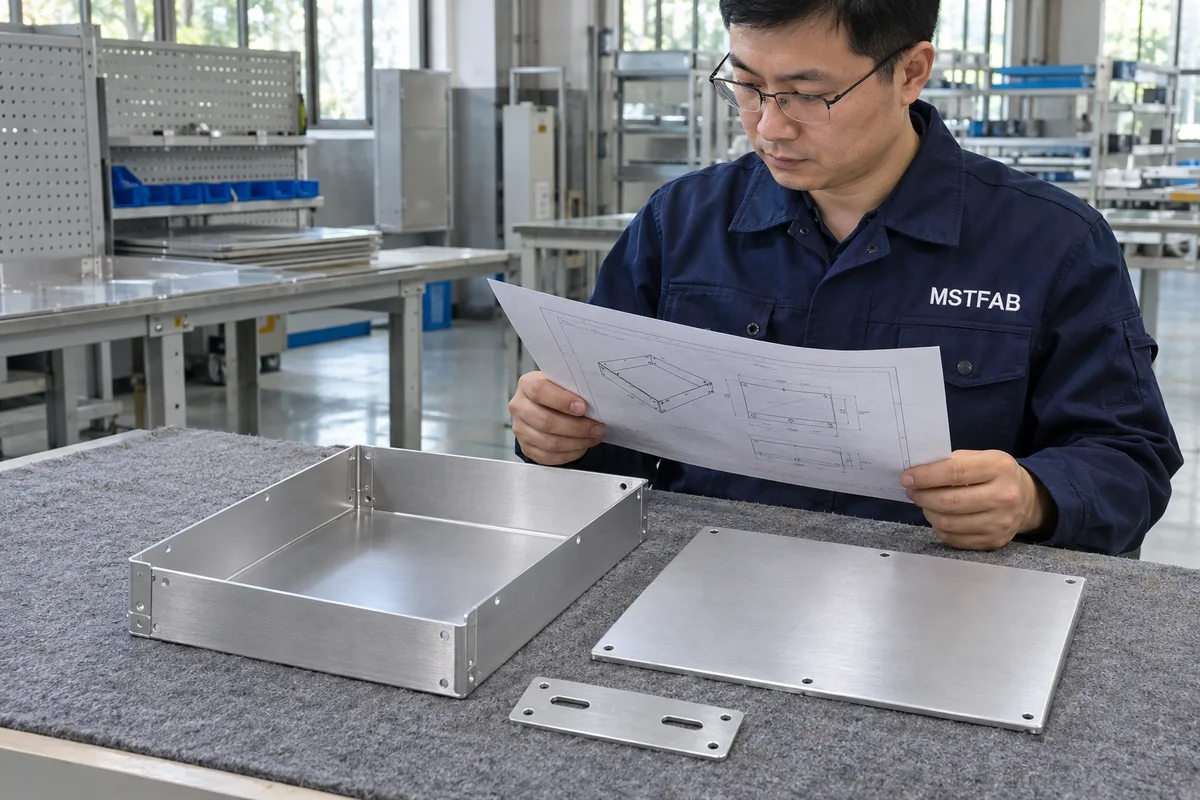
Common Materials for Rackmount Chassis
5052 and 6061 Aluminum
Not all aluminium alloys behave identically on a CNC press brake. In custom sheet metal rackmount fabrication, selecting the wrong aluminium temper causes immediate bend-line cracking:
- EN AW-5052-H32 (AlMg2.5): The premier sheet metal enclosure aluminium alloy. Featuring excellent ductility, tight inside bend radius capability (down to 1.0t–1.5t without outer-surface cracking), superior marine/coastal corrosion resistance, clean TIG/laser weldability, and smooth clear/black anodising response, 5052-H32 in 1.5 mm to 2.5 mm gauges is ideal for bent chassis bodies, U-trays, and removable covers.
- EN AW-6061-T6 (AlMg1SiCu): A heat-treated structural alloy with higher yield strength (~276 MPa vs. ~193 MPa for 5052-H32) and crisp CNC machinability, but poor cold-bending ductility in the fully aged T6 temper (requiring 2.5t–3.5t bend radii to avoid fracturing). Engineers therefore specify 6061-T6 (3.0 mm to 5.0 mm thick) primarily for flat CNC-milled or laser-cut front faceplates, heavy-duty mounting brackets, and integrated heatsink blocks—rather than complex multi-bend sheet trays.
Cold-Rolled and Galvanized Steel
Carbon steel sheets form the backbone of commercial server, industrial control, and networking chassis worldwide:
- Cold-Rolled Steel — SPCC (JIS G3141) / DC01 (DIN EN 10130) / ASTM A1008: Offers an ultra-smooth surface finish, high stiffness, crisp 0.8t–1.0t bend radii, effortless PEM hardware clinching, and strong electrostatic powder-coat adhesion. Because bare SPCC/DC01 rusts if left unprotected, every external and internal surface must receive powder coating, zinc electroplating, or e-coating.
- Hot-Dip & Electro-Galvanized Steel — SGCC / DX51D+Z (DIN EN 10346) / AS 1397 Z275 / SECC: Pre-coated zinc-layer steels provide built-in corrosion protection and electrically conductive bare-metal interior surfaces—a massive advantage for rackmount electronics! Using 1.0 mm–1.5 mm SGCC or SECC for internal chassis trays, divider walls, and rear I/O panels eliminates interior masking labor because the zinc coating conducts RF grounding currents across lid seams without rusting.
Stainless Steel 304 and 316
Austenitic SUS304 (EN 1.4301) and marine/chemical-grade SUS316L (EN 1.4404) in 1.0 mm to 2.0 mm gauges are selected for rackmount equipment deployed in washdown food-processing plants, pharmaceutical cleanrooms, offshore oil/gas platforms, coastal Australian mining substations, and medical sterilisation environments. Stainless steel requires zero paint to prevent corrosion, cleans effortlessly, and accepts attractive No. 4 satin brushed finishes—though it carries higher raw material cost, heavier weight, slower laser/bending speeds, and requires hardened stainless-compatible PEM fasteners (FH4/CLS4 series).
Aluminum vs Steel Performance Comparison
| Engineering Parameter | Aluminium 5052-H32 | Aluminium 6061-T6 | Cold-Rolled Steel (SPCC/DC01) | Galvanized Steel (SGCC/SECC) | Stainless Steel (SUS304/316L) |
|---|---|---|---|---|---|
| Density (Weight) | 2.68 g/cm³ (Very Light) | 2.70 g/cm³ (Very Light) | 7.85 g/cm³ (Heavy) | 7.85 g/cm³ (Heavy) | 7.93–8.00 g/cm³ (Heaviest) |
| Elastic Modulus (Stiffness) | 70 GPa (Needs thicker gauge) | 69 GPa | 200 GPa (2.9× stiffer) | 200 GPa (2.9× stiffer) | 193 GPa (Very stiff) |
| Thermal Conductivity | 138 W/m·K (High) | 167 W/m·K (Highest) | ~50 W/m·K (Moderate) | ~50 W/m·K (Moderate) | 16 W/m·K (Low) |
| Low-Freq Magnetic Shielding | Non-magnetic (Weak <100 kHz) | Non-magnetic | Ferromagnetic (Excellent) | Ferromagnetic (Excellent) | Non-magnetic (Austenitic) |
| Min Inside Bend Radius | 1.0t – 1.5t (Excellent) | 2.5t – 3.5t (Prone to crack) | 0.8t – 1.0t (Excellent) | 1.0t (Excellent) | 1.2t – 1.5t (Higher springback) |
| Corrosion Resistance (Raw) | High (Natural oxide film) | Good | Low (Requires full coating) | High (Sacrificial zinc) | Superior (316L marine grade) |
| Relative Total Cost Index | 1.4× – 1.8× | 1.6× – 2.2× | 1.0× (Baseline economical) | 1.05× – 1.15× (Best EMC ROI) | 2.2× – 3.0× |
Weight and Mechanical Rigidity
While aluminium is nearly three times lighter per cubic centimetre than steel, stiffness (resistance to bending deflection under load) is governed by E × t3 (Elastic Modulus times sheet thickness cubed). To match the bending rigidity of a 1.2 mm cold-rolled steel 2U chassis pan holding a heavy 12 kg power transformer, a 5052 aluminium chassis must step up to 1.8 mm or 2.0 mm wall thickness—still achieving a net weight savings of roughly 45% to 50% compared with steel. For heavy 3U and 4U industrial servers exceeding 20 kg loaded weight, steel remains structurally superior at resisting rack-ear cantilever creep and screw-thread pull-out under transport shock.
Thermal Conductivity and Corrosion Resistance
With thermal conductivity nearly triple that of carbon steel (138–167 W/m·K vs. ~50 W/m·K), an aluminium rackmount chassis acts as a natural passive heat spreader—conduction-cooling wall-mounted MOSFETs, solid-state relays, or DC-DC converters bolted directly onto the chassis floor via thermal interface pads. For outdoor telecom shelters, coastal Australian installations, or humid unconditioned factory cabinets, raw aluminium with clear chromate (SurTec 650 / Alodine) or anodising resists red rust indefinitely, whereas scratched powder-coated SPCC steel requires zinc-rich primer or SGCC/SUS304 base metal to avoid creep corrosion.
Material and Manufacturing Cost
Raw aluminium sheet costs significantly more per kilogram than cold-rolled or galvanized steel, and requires slightly thicker gauges (1.5–2.0 mm vs. 1.0–1.2 mm) plus specialized TIG/laser welding shielding gas and chemical conversion baths. On a typical 2U custom rackmount chassis order of 100 units, an all-aluminium 5052 anodised build generally costs 30% to 55% more per unit than an equivalent powder-coated SPCC or SGCC steel enclosure—an investment easily justified when air-freight savings, portable field-case ergonomics, or premium front-panel brand aesthetics matter. See our custom rackmount chassis manufacturing cost guide for full price breakdowns.
Sheet Metal Manufacturing Considerations
Laser Cutting and CNC Bending
At MSTFAB, modern solid-state fiber lasers cleanly process reflective aluminium alloys (5052/6061) using high-pressure nitrogen assist gas without the back-reflection risks of legacy CO₂ systems, achieving ±0.10 mm contour accuracy across both steel and aluminium. During CNC press brake bending, aluminium is softer and more susceptible to die-shoulder scratch marks; our operators apply protective polyurethane bending films over V-dies on cosmetic aluminium faceplates and adjust ram over-bend angles dynamically to counter stainless steel springback.
Hardware Installation and Welding
Standard carbon-steel zinc-plated PEM self-clinching nuts and standoffs require the host sheet metal to be softer than the fastener (maximum HRB 80 for steel, HRB 70 for aluminium)—meaning 5052-H32, SPCC, and SGCC accept economical standard PEM hardware effortlessly. However, if you specify harder 6061-T6 panels or SUS304 stainless steel sheets, you must specify stainless-grade PEM series (such as CLS / FH4) to ensure the fastener knurls bite cleanly without stripping. For structural corner welding, carbon steel welds rapidly with minimal thermal distortion, whereas aluminium requires precision AC TIG or wobble fiber-laser welding and careful jig clamping to prevent weld-seam shrinkage warp.
Surface Finish Selection
Powder Coating for Steel Chassis
Thermoset electrostatic powder coating (typically 60–80 μm in matte/fine-texture RAL 9005 Jet Black or RAL 7035 Light Grey) over zinc-phosphated SPCC or SGCC steel delivers high scratch resistance, uniform corporate aesthetics, and economical batch pricing. When EMC grounding continuity is required inside a steel chassis, two proven OEM strategies work best: (1) fabricate the body from pre-galvanized SGCC / SECC and powder-coat only the exterior front faceplate while leaving interior cover flanges bare conductive zinc; or (2) mask dedicated grounding studs and cover contact pads with silicone caps prior to full-chassis powder coating.
Anodising and Powder Coating for Aluminum
Aluminium enclosures unlock premium cosmetic and conductive finishes unavailable on mild steel:
- Brushed + Clear or Black Type II Sulphuric Anodising: Creates a hard, wear-resistant, metallic architectural appearance prized by German test-instrument and broadcast audio OEMs—providing high-contrast crispness for white silkscreen or laser-etched legends. (Note: Anodising is electrically non-conductive; always specify masked bare/chromate contact pads around grounding screws and EMC gaskets!)
- RoHS-Compliant Trivalent Chromate Conversion (SurTec 650 / Iridite NCP): Forms a microscopic corrosion-resistant film that remains 100% electrically conductive—the gold standard for aerospace, telecom, and military EMC rackmount chassis interiors, either standalone or as a primer beneath exterior powder coating.
Choosing Materials for Specific Applications
Telecom and Networking Equipment
For high-density 1U and 2U Ethernet switches, optical transceivers, and telecom base-station routers deployed in climate-controlled data halls, the highest-ROI material configuration is a 1.0 mm–1.2 mm SGCC/SECC galvanized steel chassis body (providing rock-solid stiffness, low cost, and built-in conductive EMC grounding across the entire interior) paired with either a fine-texture RAL 9005 powder-coated steel bezel or a 3.0 mm brushed clear/black anodised 5052/6061 aluminium front faceplate for premium brand presence. For portable telecom field analyzers and remote tower units, an all-5052 aluminium enclosure cuts weight by ~50%.
Industrial Computing and Power Electronics
Heavy 2U–4U industrial PCs, rackmount UPS/battery inverters, CNC machine controllers, and automated test systems house heavy transformers, redundant PSUs, and multi-slot GPU cards subject to continuous vibration and cabinet slide loads. Specify 1.5 mm–2.0 mm cold-rolled steel (SPCC/DC01) or galvanized steel (SGCC) for the load-bearing tray, internal stiffeners, and 2.5 mm–3.0 mm rack ears—ensuring superior low-frequency magnetic shielding around switching power supplies and zero structural creep under 25–40 kg payloads. Pair with our custom sheet metal fabrication engineering desk to test hybrid alloy combinations before volume rollout.
1U vs 2U vs 3U vs 4U Size Selection Guide →
Rackmount Ventilation & Airflow Design →
Next: 8 Rackmount Chassis Cost Factors →
Frequently Asked Questions
1. Which is better for a custom rackmount chassis: 5052 aluminium or 6061 aluminium?
Use 5052-H32 aluminium for bent sheet metal chassis pans, U-trays, and covers because it bends cleanly to tight 1.0t–1.5t inside radii without cracking. Reserve 6061-T6 aluminium for flat CNC-milled or laser-cut front faceplates (3.0–5.0 mm thick), solid rack handles, and structural heatsink blocks that do not require sharp 90-degree bends.
2. Why do many OEMs combine a galvanized steel chassis body with an anodised aluminium front panel?
A hybrid chassis delivers the best engineering and commercial balance: the 1.2 mm SGCC galvanized steel body provides 3× higher stiffness, lower raw material cost, strong PEM thread retention, and bare-metal conductive EMC seams inside the rack, while the 3.0 mm brushed anodised aluminium front panel delivers a premium, scratch-resistant exterior interface.
3. Is anodised aluminium electrically conductive for chassis grounding?
No. Type II and Type III anodised aluminium oxide layers are electrical insulators. If your anodised aluminium rackmount chassis requires EMC seam bonding or safety earthing, specify localized masking and RoHS-compliant conductive chromate conversion coating (SurTec 650) on mating flanges and grounding bosses.
4. Can steel rackmount chassis meet strict weight limits for air-freighted equipment?
For shallow 1U or 2U equipment using 1.0 mm–1.2 mm SPCC/SGCC steel, empty chassis weight is often only 2.2 kg to 4.5 kg—very manageable for air freight. However, on deep 3U and 4U enclosures where steel shells reach 8 kg–14 kg empty, switching non-structural covers and internal baffles to 1.5 mm 5052 aluminium can shave 3 kg–5 kg off every shipped unit.
5. Can MSTFAB quote both steel and aluminium versions from the same 3D STEP file?
Yes. Upload your 3D STEP and 2D PDF drawings and request an A/B alloy comparison quote. Our engineers will verify bend radii and gauge adjustments (for example, 1.2 mm SPCC vs. 1.5 mm 5052 aluminium) and return side-by-side prototype and batch pricing within 24 hours.
Get a Side-by-Side Steel vs. Aluminium Rackmount Chassis Quote
Debating between powder-coated SPCC/SGCC steel, brushed anodised 5052/6061 aluminium, or a hybrid design? Send your 3D STEP drawings to MSTFAB for a complimentary material DFM evaluation and itemized 24-hour quotation.
 WeChat Contact
 WhatsApp Me Directly