
“Brass” is Not a Material Specification
Submitting a CAD drawing that simply says “Brass” is a critical procurement error. Brass is not a single metal; it is a complex family of copper-zinc alloys. If you mistakenly specify C360 (Free-Machining Brass) for a tight 90-degree sheet metal bend, the material will fracture instantly under the press brake. If you specify C260 (Cartridge Brass) for high-speed CNC threading, your machining costs will skyrocket due to poor chip formation. Successful sheet metal fabrication demands absolute metallurgical precision.
How to Choose the Right Brass Alloy for Custom Metal Parts
Brass is highly prized in custom metal parts manufacturing for its premium aesthetic, excellent electrical conductivity, and natural corrosion resistance. However, the exact ratio of copper, zinc, and trace elements like lead radically alters how the alloy behaves during manufacturing.
For OEM engineers and procurement teams, selecting the correct brass alloy directly dictates manufacturability, unit cost, and long-term field reliability. You must align the alloy with the exact fabrication process—whether that is CNC bending, laser cutting, stamping, or Swiss lathe machining.
This guide breaks down the hard engineering realities of C260, C360, and C464 brass for your materials specification.
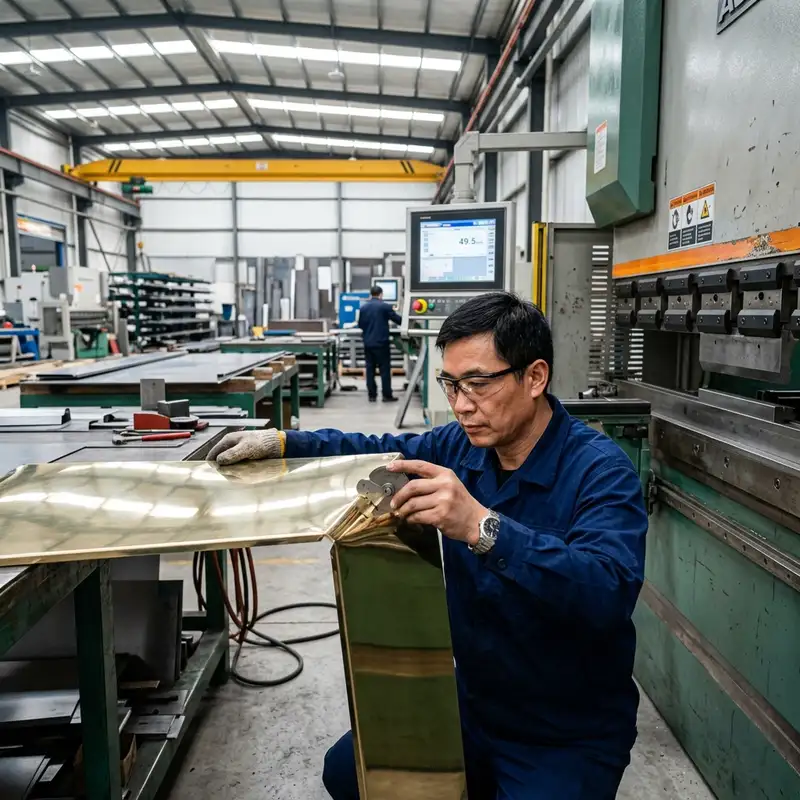
C260 Brass: The Undisputed King of Bending & Forming
C260 Brass (also known as Cartridge Brass or 70/30 Brass) contains 70% Copper and 30% Zinc. It possesses the highest ductility in the yellow brass family, making it the absolute best choice for brass sheet metal forming.
C260 is the mandatory alloy for:
- Complex bent brackets and chassis components
- Deep-drawn enclosures and custom sheet metal enclosures
- Stamped architectural panels and premium bezels
- Laser-cut and formed decorative components
The Engineering Reality: Because of its high ductility, C260 elongates without fracturing on the outer radius of a bend. However, engineers must still respect minimum bend radii relative to sheet thickness to avoid “orange peeling” on highly polished surfaces.
C360 Brass: Built for High-Speed CNC Machining (Do Not Bend)
C360 Brass (Free-Machining Brass) contains approximately 3% Lead. This trace amount of lead acts as a microscopic lubricant, causing the metal to shear into small, brittle chips rather than long, stringy ribbons during machining.
C360 is the undisputed champion for:
- CNC turned threaded inserts and standoffs
- High-precision fluid fittings and valve bodies
- Complex milled blocks and hardware components
The Fatal Mistake: The exact lead content that makes C360 machine so beautifully also destroys its ductility. If you attempt to bend C360 brass in a press brake, it will crack and fail catastrophically. C360 should never be specified for formed sheet metal parts.

C464 Brass (Naval Brass): Maximum Corrosion Resistance
C464 Brass (Naval Brass) contains about 60% Copper, 39% Zinc, and 1% Tin. The addition of tin dramatically increases its resistance to dezincification—a specific type of corrosion that destroys standard brass in saltwater environments.
C464 is required for:
- Marine hardware and coastal equipment components
- Industrial fluid handling in highly corrosive environments
- Outdoor architectural elements exposed to severe coastal humidity
While C464 is incredibly durable, it is harder than C260 and significantly more difficult to form. Bend radii must be substantially increased to prevent cracking.
Brass Alloy Comparison Matrix
| Brass Alloy | Primary Application | Engineering Advantage | Critical Manufacturing Risk |
|---|---|---|---|
| C260 (Cartridge) | Laser cutting, CNC Bending, Stamping | Maximum ductility; easily formed into complex shapes | Poor machinability; creates stringy chips on lathes |
| C360 (Free-Machining) | CNC Turning, Threading, Milling | 100% machinability rating; fast cutting, excellent threads | Zero ductility; will crack instantly if bent |
| C464 (Naval) | Marine, Saltwater, High Humidity | Immune to dezincification in saltwater | Harder material; requires large bend radii |
Key Design Considerations for Brass Projects
1. Avoid Vague Material Callouts
If your drawing notes simply state “Material: Brass”, you are leaving your project up to interpretation. A professional drawing must explicitly state the alloy (e.g., C260), the temper (e.g., Half-Hard), and the required finish.
2. Calculate Bend Radii for C260
Even highly ductile C260 has limits. If you are designing a 3mm thick brass bracket, specifying a sharp 0.5mm inner radius will cause tearing. Always consult your fabricator for the minimum safe bend radius based on the material’s temper and grain direction.
3. Surface Oxidation and Finishing
Raw brass oxidizes and develops a patina rapidly. If you require the bright gold appearance to remain permanently, the drawing must specify a clear lacquer coating, physical vapor deposition (PVD), or specialized anti-oxidation plating.
Manufacture with Metallurgical Precision
Do not let poor material selection ruin your batch production. Upload your 3D STEP and 2D PDF drawings to MSTFAB today. Our engineering team will review your alloy specifications, execute a strict DFM audit, and provide a factory-direct quotation for your custom brass parts.
FAQ: Brass Alloy Selection
Can I bend C360 Free-Machining Brass?
No. C360 contains lead to improve machinability, which severely reduces its ductility. If bent on a press brake, it will almost certainly crack along the bend line.
Which brass alloy is best for laser cutting and bending?
C260 (Cartridge Brass) is the industry standard for sheet metal fabrication. It possesses the high ductility required to withstand laser cutting heat and tight CNC bending without fracturing.
What information do you need to quote a brass part?
We require a native 3D STEP file (to review bend radii and machining feasibility) and a 2D PDF drawing that explicitly calls out the brass alloy (e.g., C260 or C360), material thickness, ISO 2768 tolerances, and required surface finish.
CNC sheet metal bending services
MSTFAB provides CNC press brake bending services for precision sheet metal parts, enclosures, brackets and OEM assemblies.
 WeChat Contact
 WhatsApp Me Directly