
Sheet Metal Enclosure Fabrication: What It Can and Cannot Prove
Sheet metal enclosure fabrication turns a defined design into physical panels, frames, doors and mounting features. Those features affect how the next assembly fits and operates. They do not, by themselves, establish the electrical safety, cooling capacity, environmental protection or structural rating of a completed product.
Quick answer: define the enclosure’s measurable geometry, hardware, joints, material and finish, then verify those requirements in the agreed delivered condition. Keep that mechanical acceptance separate from product-level performance evidence. A well-made shell is an important input to the product, not a substitute for validating the finished configuration.
See what fabrication checks actually establish.
Why the Physical Interfaces Matter More Than the Box Shape
Two enclosures with similar external dimensions can behave differently during integration. A connector cutout has a position and mounting-face requirement. A door has hinge and latch relationships. An equipment support has specified attachment points. Treating all three as a single general box tolerance hides the features that determine fit.
The useful manufacturing brief identifies those relationships and the stage at which they are accepted. A dimension checked on a flat blank is not automatically an accepted dimension on a formed, welded and finished shell. State the required condition rather than using “precision” or “zero tolerance” as an inspection instruction.
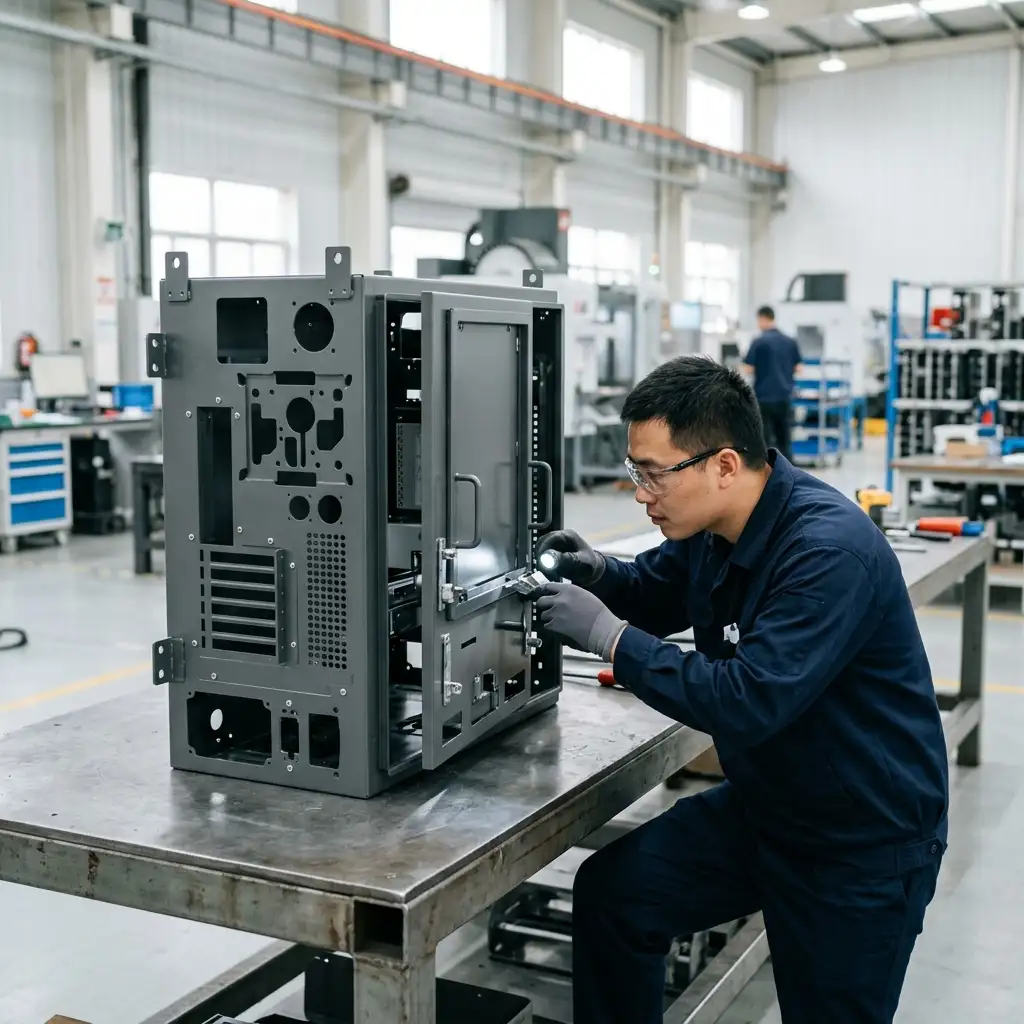
What Can a Fabrication Check Establish?
| Defined feature | Mechanical evidence | What it does not establish alone |
|---|---|---|
| Device cutout and mounting holes | Specified size, position, edge condition and relevant finished interface. | Compatibility with every device revision or electrical clearance requirements. |
| Door, hinges and latch | Defined alignment, movement, engagement and closure geometry. | Water-ingress performance of an untested final configuration. |
| Frame and support brackets | Drawing-defined section, joints, mounting locations and inspection results. | An unspecified static, transport or vibration load rating. |
| Coated surfaces and masked areas | The specified finish and relevant acceptance results, including defined protected interfaces. | A universal corrosion lifetime or completed-system bonding performance. |
Cutouts and Hardware Must Match the Actual Mating Component
An opening that looks correct in a rendering can still be incompatible with the component fitted later. Review the controlled device outline, fixing pattern, flange or gasket contact area, fastener access and relevant protrusions. Identify which component revision the enclosure drawing supports.
Likewise, “hardware installed” should identify the selected hinges, latches, nuts, studs or standoffs and their orientation. Do not assume an item with the same thread size is an acceptable substitute. Where trial fitting is part of acceptance, define the mating component or gauge and what the check must demonstrate.
For design-stage access and fit questions, refer to the separate sheet metal design-for-assembly guide. This article addresses the meaning of fabrication acceptance, not a replacement design procedure.
Door Alignment Is Not an Ingress-Protection Test
A door that opens, closes and engages its latch as specified has passed those mechanical checks. Whether the enclosure meets an ingress requirement is a separate question involving the relevant configuration and evidence. IEC 60529 classifies degrees of protection provided by enclosures; it is not a certificate issued by selecting a metal or quoting a bending tolerance.
Specify the closure and sealing geometry required by the approved design, including the relevant gasket and installed interfaces. Identify responsibility for the applicable verification. Do not translate a photograph of an aligned door into a waterproof, hurricane-resistant or NEMA-rated product claim.
Supports and Ventilation Features Need Defined Performance Inputs
A battery tray or equipment bracket needs an approved design basis, not an arbitrary kilogram claim. Identify the supported equipment, mounting arrangement and applicable loading conditions for the responsible designer to assess. The fabricator can then confirm the proposed manufacturing route and inspect the defined features. A visually substantial weld is not a load-test result.
Similarly, louvers and fan cutouts provide physical interfaces. Their presence does not establish the completed equipment’s cooling performance. Device selection, airflow restrictions, operating environment and the complete thermal design need appropriate assessment. Fabrication should implement the specified geometry without inventing a cooling guarantee.
Finish Quality and Product Certification Have Different Boundaries
Specify the material, surface preparation, finish, cosmetic requirements and protected contact areas needed for the project. Request the relevant acceptance evidence rather than relying on a generic claim of a flawless or corrosion-proof coating. A masked bonding provision is not the same as verification of the completed bonding arrangement.
Certification scope also matters. UL Solutions distinguishes an industrial control panel enclosure from an enclosed industrial control panel: certification of the enclosure alone does not investigate the compatibility of all installed equipment and wiring. Check the actual product identity and scope of any claimed certification; this article makes no UL certification claim for MSTFAB.
For delivery responsibilities and documentation, use the dedicated fabricator-to-integrator cabinet handoff guide, rather than assuming that a finished shell includes electrical integration.
Frequently Asked Questions
Does sheet metal enclosure fabrication automatically include wiring?
No. A fabrication description does not define the electrical integration scope. Confirm the quoted deliverables, supplied components and responsibilities rather than assuming that a metal shell includes wiring or circuit design.
Can a single bending tolerance guarantee enclosure performance?
No. Different interfaces have different requirements, and mechanical dimensions alone do not establish ingress, thermal, electrical or structural performance of the completed product.
Is a door-fit check the same as an IP test?
No. Door movement and closure geometry are mechanical checks. An ingress requirement needs appropriate evidence for the applicable enclosure configuration and acceptance criteria.
Technical References
Background: IEC 60529: degrees of protection provided by enclosures; UL Solutions: enclosure and control-panel certification scope. Apply the relevant project requirements and qualified product assessment; the references are not evidence that a particular MSTFAB shell has passed testing.
Define Your Enclosure Fabrication Requirements
For MSTFAB custom enclosure fabrication, provide the controlled shell and assembly drawings, material, quantity, finish and critical interfaces. Identify any required performance evidence separately and request confirmation of what the quotation includes.
 WeChat Contact
 WhatsApp Me Directly