
PRE-RFQ ENGINEERING AUDIT • HEAVY & INDUSTRIAL OEM SHELLS — EXECUTIVE TECHNICAL BRIEF
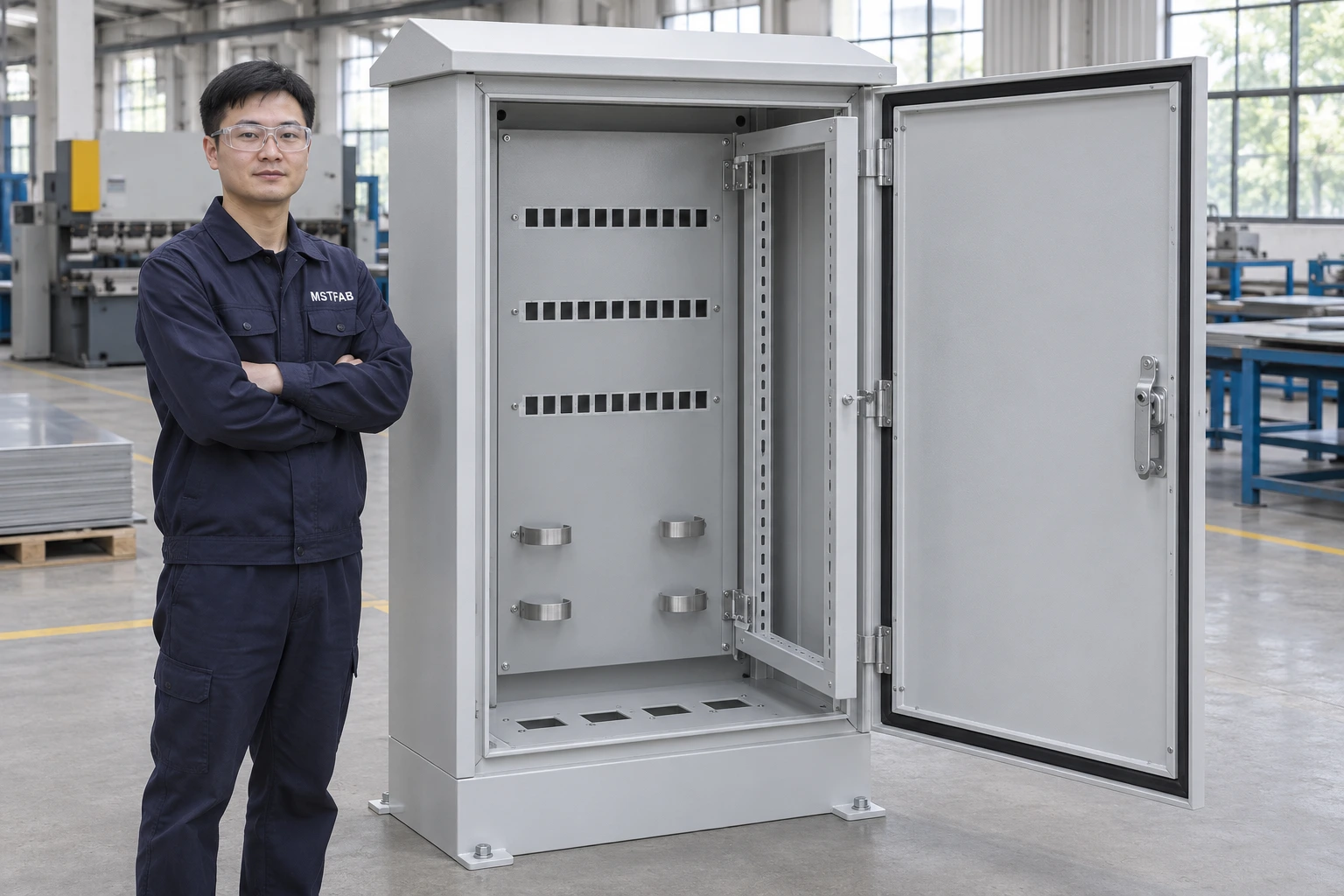
Sending an industrial equipment RFQ to a general light-gauge sheet metal shop is a fast path to bowed 2-meter cabinet doors, cracked weld corners, and failed IP54 dust seals. Heavy OEM machinery frames, automation guards, and floor-standing control cabinets combine 2.5–6.0 mm structural plates with 1.5–2.0 mm cosmetic doors—demanding machine-floor capabilities that standard bracket vendors rarely possess. Before releasing drawings for formal pricing, engineering and sourcing teams must qualify fiber-laser nitrogen cutting capacity, long-bed CNC press-brake crowning, 3D weld-table fixturing, dual-coat primer/topcoat booths, and oversized export crating. At MSTFAB in Guangzhou, pre-RFQ equipment audits align your 3D STEP geometry directly to verified tonnage, bed length, and flatness tolerances so custom enclosures arrive structurally square and ready for panel integration.
- Fiber-Laser Power & Nitrogen Edge Quality: Verify >= 6 kW fiber-laser capacity with high-pressure nitrogen assist for oxide-free cut edges on 3.0–6.0 mm carbon steel and SUS304/316L plates, preventing edge paint flaking under industrial vibration.
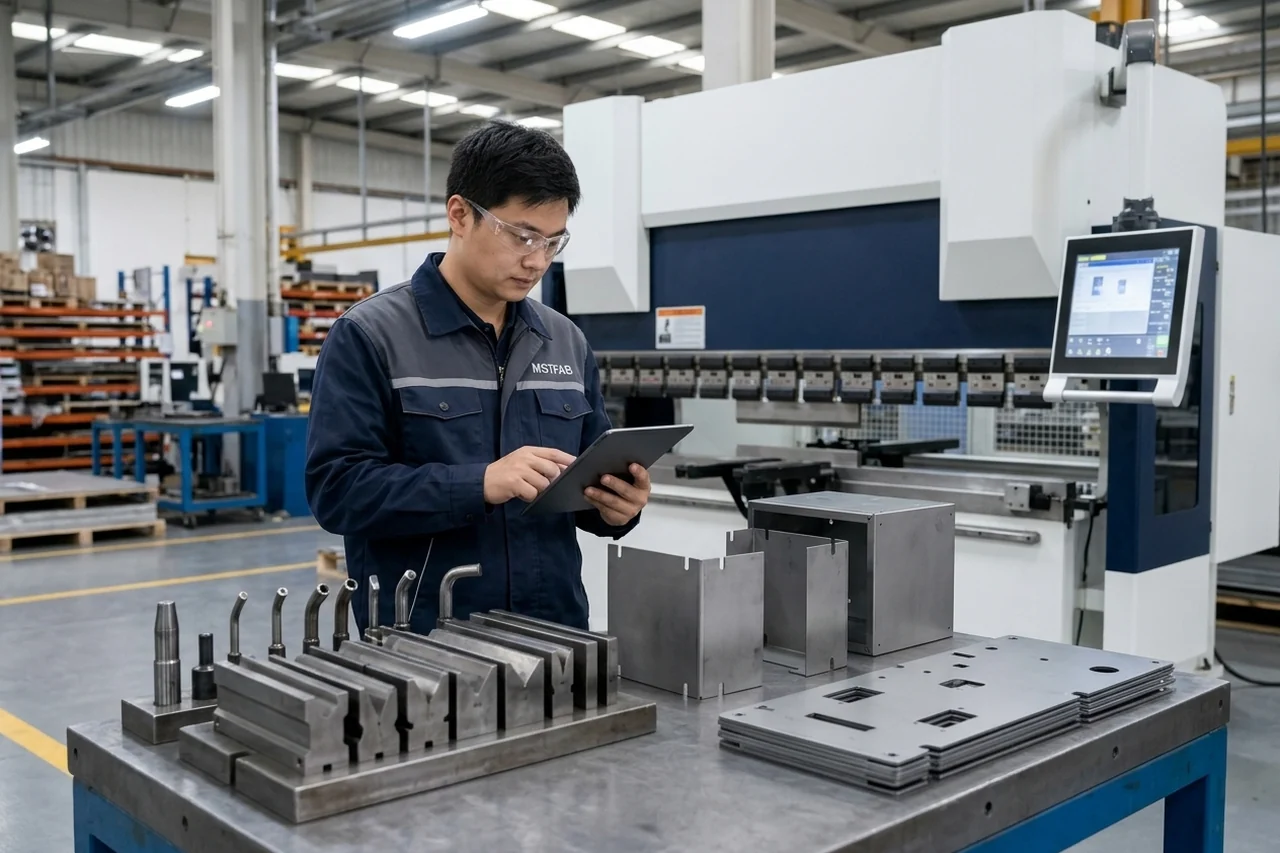
- Press-Brake Bed Length & Hydraulic Crowning: Confirm >= 3.0 m bending beds rated >= 200 tons with active CNC hydraulic crowning so 2.0–2.5 m cabinet doors hold ±0.5° angle uniformity and <= 0.5 mm/m straightness without mid-span bow.
- Heavy-Frame Weld Fixturing & Sealing Flatness: Audit 3D modular weld tables, balanced skip-weld sequencing, and continuous knife-edge door returns engineered to maintain 25%–35% EPDM gasket compression for IP54/IP65 and NEMA 12 enclosure performance.
- Dual-Coat Corrosion & Oversized Crating: Qualify zinc-rich epoxy primer + UV-stable polyester topcoats (90–120 µm total DFT) and bolted ISPM-15 skid crating built under MSTFAB's ISO 9001:2015, IATF 16949:2016, and ISO 14001:2015 operations.
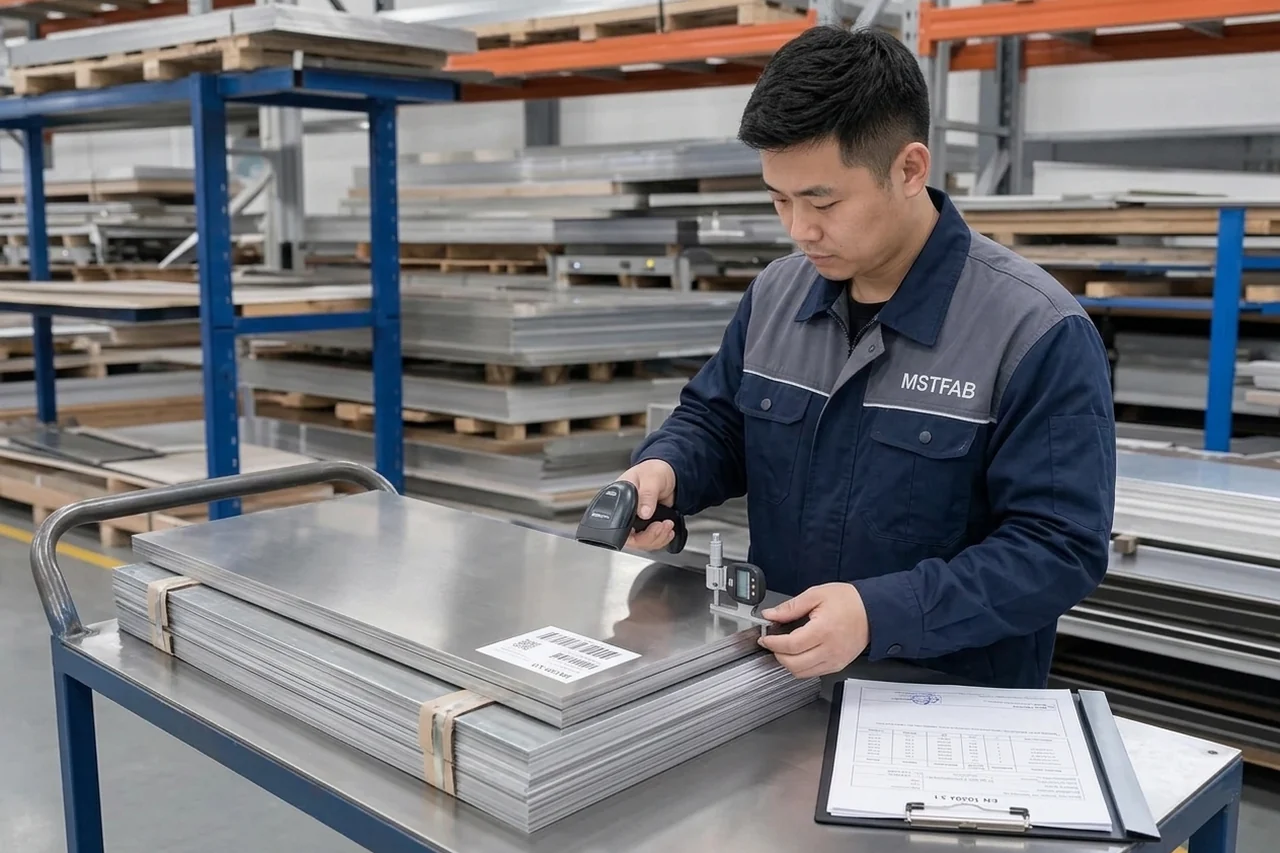
Every project at MSTFAB includes a complimentary 24-hour CAD Design-for-Manufacturing (DFM) audit, heat-number-traceable EN 10204 3.1 mill certificates, and a ballooned First Article Inspection (FAI) report prior to volume release.
01 / Engineering Specifications & Comparison Matrix
Pre-RFQ Equipment Fabrication Capability & Tolerance Matrix
Evaluating a sheet metal supplier for industrial OEM machinery requires matching your cabinet's physical envelope—plate thickness, door span, weld mass, and sealing target—against verifiable shop-floor equipment capacity before RFQ issue. A vendor equipped only for 1.2 mm electronics brackets cannot hold 0.5 mm/m flatness across a 2.1-meter welded machine frame or prevent edge flaking on 4.0 mm base plates. Use this engineering capability matrix during pre-RFQ technical screening to verify machine limits, tolerance guarantees, inspection tools, and downstream integration value.
Each parameter below is verified during incoming raw material quarantine, in-process CNC stage checks, and final First Article Inspection (FAI) before shipment release:
| Engineering Parameter / Zone | Material & Process Specification | Target Tolerance / Performance Standard | Inspection Method & OEM Value |
|---|---|---|---|
| Fiber-Laser Capacity & Nitrogen Edges | >= 6 kW fiber-laser cutting with high-pressure nitrogen assist on structural plates and stainless panels. | ISO 2768-mK profile accuracy (±0.15 mm); zero brittle Fe3O4 oxide scale on <= 4.0 mm nitrogen edges. | Optical edge-scale check and micrometer kerf audit on 3.0–6.0 mm first-off plate coupons: Eliminates manual edge grinding and stops powder-coat chipping along equipment door cutouts. |
| Long-Bed Press-Brake Crowning | >= 200-ton, 3.0–3.2 m CNC press brake with active hydraulic crowning for long cabinet doors. | Angle uniformity ±0.5° end-to-center; long-panel straightness <= 0.5 mm/m along 2.4 m spans. | Angle check at left, center, and right span plus calibrated straightedge flatness verification: Prevents mid-span door bowing so latches and hinges close smoothly without gasket leaks. |
| Heavy-Frame Weld Fixture & Squareness | 3D modular weld-table fixturing with balanced skip-weld sequencing on heavy base and mullion frames. | Frame diagonal delta <= 1.5 mm per meter; door-aperture coplanarity <= 0.8 mm across full span. | 100% calibrated diagonal tape measurement and 1,500 mm straightedge + feeler-gauge check: Delivers plumb equipment frames that accept lift-off doors and DIN sub-plates without field shimming. |
| IP54/IP65 Gasket Knife-Edge Flatness | Double-return drip-lip knife edges paired with continuous EPDM/EMI gaskets and compression latches. | Door-to-frame gap 2.0 ±0.5 mm; zero chalk-line contact breaks along 360° gasket perimeter. | Feeler-gauge paper/chalk-transfer contact test plus 25%–35% compression deflection verification: Gives OEMs mechanical readiness to pass internal IP54/IP65 or NEMA 12 ingress validation tests. |
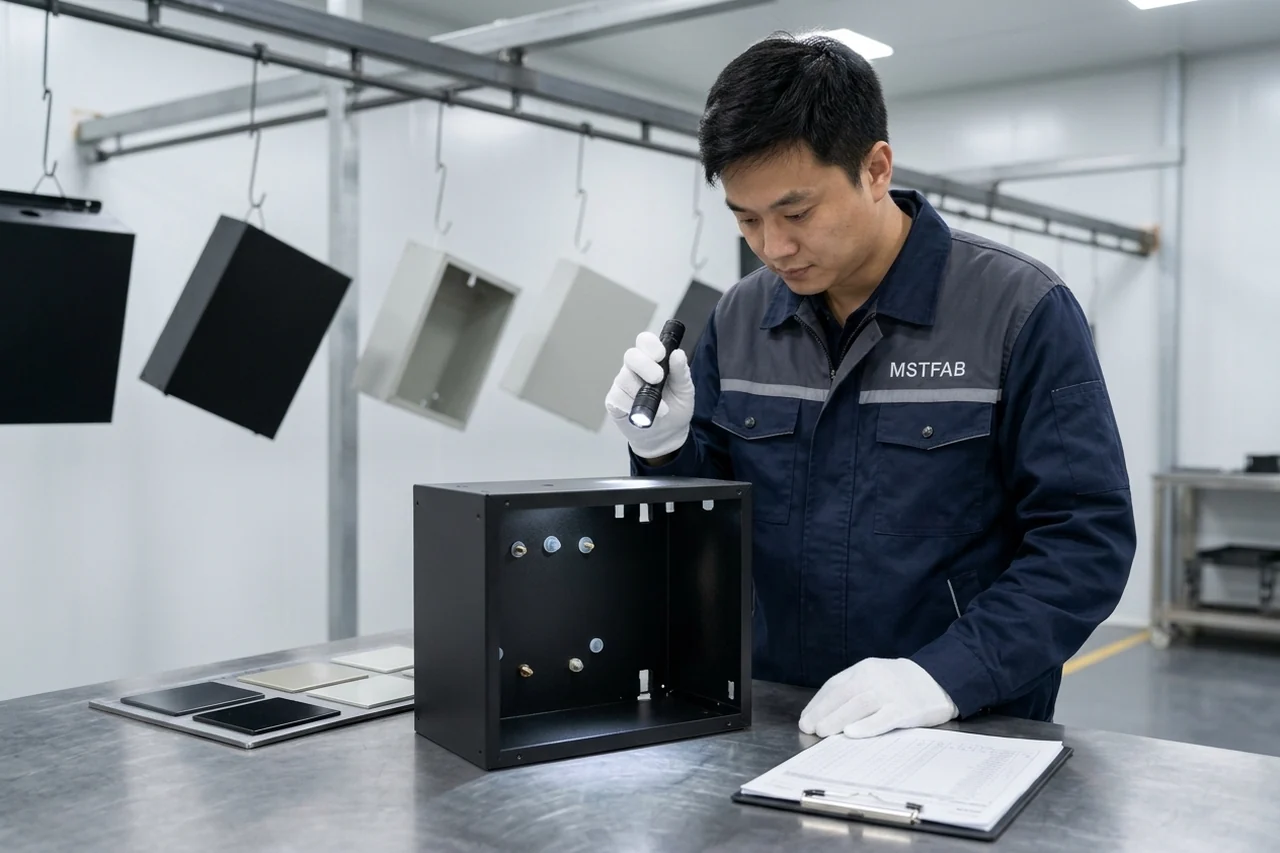
| Dual-Coat Primer & Industrial Topcoat | Blast/chemical pretreatment + zinc-rich epoxy primer + UV-stable industrial polyester topcoat. | Total DFT 90–120 µm (primer 40–50 µm + topcoat 50–70 µm); gloss ±5 GU to master chip. | PosiTector dual-stage DFT log, ASTM D3359 cross-hatch (>= 4B), and pencil hardness >= 2H check: Protects industrial machinery against shop coolants, washdown spray, and coastal export humidity. |
| Oversized ISPM-15 Skid & Export Rigging | Frame bolted to reinforced ISPM-15 skid base with EPE door bracing and sealed VCI vapor shroud. | Zero frame-to-crate movement; >= 35 mm EPE perimeter cushion around latches and viewing windows. | Crate-bolt torque audit, VCI seal inspection, and shock/tilt indicator log prior to container load: Protects 100–350 kg welded cabinets from forklift impact and sea-air corrosion during export transit. |
02 / Sheet Metal DFM & Structural Controls
Pre-RFQ Engineering Pitfalls on Heavy Industrial OEM Cabinets
Requesting quotes from sheet metal shops before verifying their laser gas capability, press-brake bed crowning, and heavy-frame weld fixturing guarantees costly tooling surprises after PO award. Evaluating these three mechanical failure modes upfront protects equipment lead times and sealing integrity.
Press-Brake Ram Deflection Bowing Long 2.4-Meter Industrial Cabinet Doors
Failure Mechanism: Bending 2.0–2.5 meter equipment cabinet doors on an undersized or non-crowned press brake deflects the center of the ram upward, leaving mid-span flanges open by 2°–3° while ends over-bend, causing center gasket gaps and pinched corner hinges.
Engineering Solution: Pre-qualify vendors for CNC hydraulic crowning and >= 3.0-meter bed length on tall doors, and add 1.5 mm inward pre-camber or stiffening return ribs along vertical door stiles during pre-RFQ DFM review.
Verified Outcome: Ensures uniform 25%–35% EPDM gasket compression along the full height of tall equipment doors.
Oxygen-Cut Laser Oxide Scale Causing Edge Coating Delamination on Thick Plates
Failure Mechanism: Small job shops cut 3.0–4.0 mm mild steel plates with oxygen assist to save gas cost, baking a brittle Fe3O4 oxide scale onto aperture edges that flakes away together with powder coat once equipment doors vibrate in plant service.
Engineering Solution: Require high-pressure nitrogen fiber-laser cutting on <= 4.0 mm carbon steel and all stainless plates, or specify mandatory mechanical edge descaling and blast-cleaning prior to zinc-primer pretreatment.
Verified Outcome: Eliminates cut-edge rust creep and premature powder-coat chipping around latches and windows.
Unbalanced Structural Weld Heat Input Warping Door-Seal Knife Edges and Hinges
Failure Mechanism: Welding heavy 3.0 mm base channels directly to 1.5 mm enclosure mullions without rigid clamping or balanced skip sequencing twists door openings out-of-plane by > 3.0 mm, forcing technicians to shim hinges in the field to pass IP54 seals.
Engineering Solution: Qualify suppliers with dedicated modular 3D weld-table fixturing, balanced alternating stitch-weld SOPs, and post-weld straightedge/diagonal checks on every welded industrial equipment frame before coating.
Verified Outcome: Holds enclosure door apertures planar within <= 0.8 mm/m without secondary mechanical straightening.
Manufacturing Scope Boundary: Pre-RFQ Scope Boundary: Empty Mechanical Equipment Shells vs. Turnkey Wiring: Industrial equipment OEMs occasionally ask sheet metal fabricators to wire PLC sub-panels or self-certify UL 508A / CE Machinery Directive enclosures during initial RFQ, blurring mechanical vs. electrical liability and delaying supplier selection. — Engineering Fix: MSTFAB supplies welded, coated, and hardware-fitted empty industrial housings (hinges, compression latches, viewing windows, EPDM gaskets) built to your 3D STEP + 2D PDF drawings under ISO 9001:2015, giving your panel builders square, seal-ready shells for UL/CE integration. MSTFAB manufactures custom sheet metal parts and empty mechanical enclosure shells strictly to your 3D STEP and 2D PDF drawings.
03 / Representative Engineering Scenario & Process Control
Case Study: Industrial Automated Handler Cabinet Pre-RFQ Re-Qualification
Project Profile: 45 equipment cabinets/quarter • 1,500 x 900 x 2,100 mm • 3.0 mm Q235B/SPCC welded frame + 2.0 mm Al 5052-H32 gasketed doors • Zinc-rich epoxy primer + RAL 7035 polyurethane/polyester topcoat (90–120 µm DFT)
OEM Engineering Challenge: An OEM manufacturer of automated semiconductor-adjacent wafer-handling equipment suffered recurring field leaks and assembly delays from an undersized sheet metal vendor. The vendor's 1.5 kW laser cut 3.0 mm Q235B frame plates with oxygen assist, leaving brittle oxide scale that chipped along door apertures, while an uncrowned 2.0-meter press brake bowed 2.4-meter Al 5052-H32 access doors by 2.8 mm at mid-span—breaking IP54 dust-seal continuity.
MSTFAB Manufacturing Solution: Using a pre-RFQ technical qualification checklist, MSTFAB matched the cabinet geometry directly to machine-floor capacity before quoting. Structural 3.0 mm frame gussets and door mullions were assigned to high-pressure nitrogen laser cutting for oxide-free edges, 2.4-meter doors were routed to a 3.2-meter 220-ton CNC press brake with active hydraulic crowning, and a pinned steel weld jig with copper heat sinks maintained door-aperture flatness within 0.5 mm/m ahead of dual-coat zinc-primer powder finishing.
- 0% Edge Paint Chipping: Upgrading to nitrogen-assisted fiber-laser cutting on <= 4.0 mm structural plates eliminated laser edge oxide flaking and passed 1,000-hour dual-coat adhesion exposure without edge creep.
- <= 0.45 mm Door Flatness: Forming 2.4-meter access doors on a 3.2-meter CNC hydraulically crowned press brake reduced mid-span door bow from 2.8 mm to <= 0.45 mm across the full perimeter.
- 1.2 mm Frame Diagonal Hold: Balanced skip-weld fixturing on the 2,100 mm structural frame held diagonal squareness within 1.2 mm and achieved 30% uniform EPDM gasket compression for full IP54 dust sealing.
- 4.5 hrs/Unit Site Time Saved: Heavy-duty ISPM-15 export crates with internal shock-isolated steel skid bolts prevented racking damage across ocean transit, saving 4.5 hours of site shimming per equipment bay.
Every production lot is archived with locked CNC laser nests, press-brake bend programs, weld fixture setups, and signed golden samples to guarantee identical repeatability across multi-year reorders.
04 / Quality Verification, Traceability & Surface Finishing
4-Stage Manufacturing Workflow, Surface Treatment & Metrology Control
To maintain Cpk ≥ 1.33 on critical-to-quality (CTQ) dimensions from prototype through series production, MSTFAB executes a closed-loop four-stage fabrication protocol:
Step 01 — Equipment Envelope & DFM Screening: Match overall cabinet dimensions, plate gauges (1.5–6.0 mm), and door span against verified >= 6 kW nitrogen laser, >= 3.0 m crowned press-brake, and overhead-crane paint-booth limits prior to formal pricing.
Step 02 — Weld Fixture & Crowned-Bend Trial: Validate 3D weld-table fixturing, copper heat-sink placement, and door-aperture flatness controls, cutting first-article structural coupons to verify nitrogen edge cleanliness and crowned bend angles.
Step 03 — Dual-Coat Finishing & Seal Readiness QC: Execute dual-coat zinc-primer + polyester topcoat finishing, mount EPDM gaskets, compression latches, and windows, and perform 360° chalk-transfer gasket seal and straightedge coplanarity checks.
Step 04 — Skid-Bolted Export Crating & Dispatch: Bolt finished mechanical shells onto reinforced ISPM-15 skid bases with internal EPE bracing, VCI vapor shrouds, and EN 10204 3.1 traceability packets for damage-free ocean delivery.
All raw sheets (SPCC, SGCC, SECC, SUS304/316L, Al 5052-H32/6061-T6) are verified via optical emission spectrometry (OES) or XRF upon arrival and linked by barcode to your purchase order.
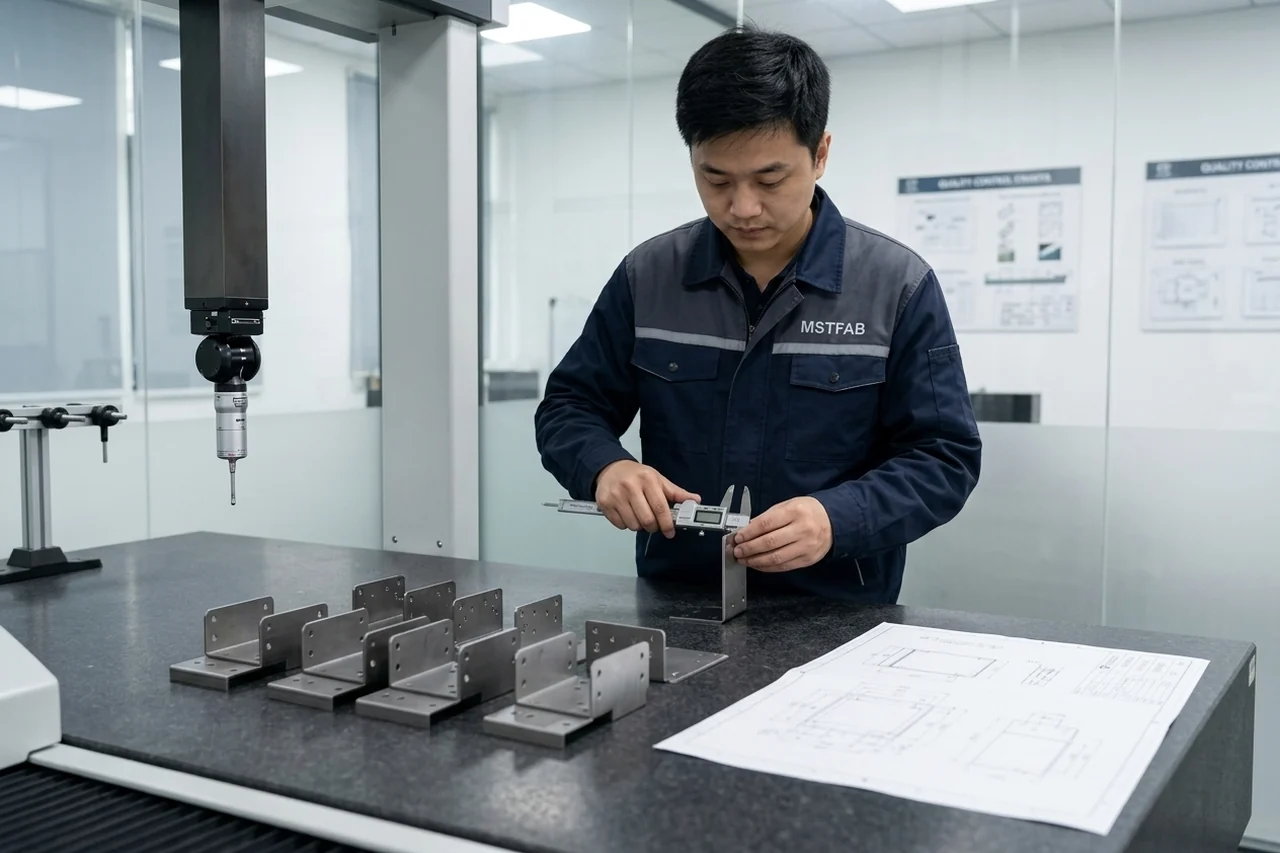
Prior to export crating in ISPM-15 fumigated plywood boxes, our quality lab conducts ballooned dimensional FAI checks, dry-film thickness (DFT) mapping, ASTM D3359 cross-hatch adhesion testing, and ground-continuity verification.

05 / 8-Point OEM RFQ Checklist & Topic Cluster Hub
OEM Engineering RFQ Checklist & Connected Fabrication Hubs
Include these eight drawing and specification controls in your RFQ package so our engineering team can lock down tooling, material traceability, and inspection fixtures on day one:
- RFQ Requirement 01Include maximum overall assembly dimensions (L x W x H) and heaviest single welded sub-frame weight so vendors confirm crane, weld-table, and paint-booth envelope clearance upfront.
- RFQ Requirement 02Specify plate-edge cut quality requirements (e.g., high-pressure nitrogen assist for <= 4.0 mm carbon steel or mandatory oxide descaling) on all coated structural frames.
- RFQ Requirement 03Define maximum allowable door bow and seal-face flatness (e.g., <= 0.8 mm/m across gasketed apertures) alongside press-brake crowning expectations on panels >= 1.5 meters.
- RFQ Requirement 04Call out exact structural weld symbols (continuous seal weld vs. staggered intermittent stitch weld), grinding expectations, and acceptable diagonal squareness (<= 1.5 mm/m).
- RFQ Requirement 05Specify target environmental sealing intent (e.g., IP54/IP65 or NEMA 12 mechanical readiness), compression-latch part numbers, and EPDM/silicone gasket profile dimensions.
- RFQ Requirement 06Indicate dual-coat corrosion protection requirements (zinc-rich epoxy primer + UV polyester topcoat, 90–120 µm total DFT) for outdoor or industrial plant equipment.
- RFQ Requirement 07Provide target quarterly/annual cabinet quantities, staggered delivery schedules, and whether empty frames require bolted forklift skids or caster base mounts.
- RFQ Requirement 08Define export crating rules including ISPM-15 certification, base-bolt shock isolation, VCI moisture protection, and container door-height clearance limits.
Explore Connected Sheet Metal Fabrication Services & Enclosure Hubs
06 / OEM Buyer & Engineer FAQ
Pre-RFQ OEM Equipment Sheet Metal Qualification FAQs
What machine-list specifications must a fabricator prove before receiving an industrial cabinet RFQ?
Before sending a full RFQ package, verify five concrete machine-floor specifications: 1) fiber-laser wattage (>= 6 kW preferred) and nitrogen assist capability on 3–6 mm steel; 2) maximum press-brake bed length (3.0–3.2 m for tall cabinets) and whether CNC hydraulic crowning is active; 3) overhead crane capacity and booth clearance for powder-coating 2.2+ meter welded frames; 4) availability of 3D modular Siegmund/Demmeler-style weld fixturing; and 5) calibrated long-span straightedges or laser-tracker inspection capability.
Why does nitrogen vs. oxygen laser cutting matter so much on 3–4 mm equipment frames?
Oxygen-assisted laser cutting reacts exothermically with carbon steel, leaving a dark, brittle iron-oxide layer along the cut edge. While fast on thick structural plate, powder coating over oxygen-cut edges frequently peels or blisters under thermal cycling or washdown exposure. High-pressure nitrogen cutting produces a bright, oxide-free edge that accepts zinc-rich primer and topcoat cleanly—eliminating slow manual grinding on complex ventilation louvers and aperture cutouts.
Does MSTFAB build UL 508A-listed electrical panels or turnkey automated equipment?
MSTFAB fabricates empty mechanical industrial cabinets, machine guards, and welded frames to customer 3D STEP and 2D PDF drawings—complete with EPDM perimeter gaskets, quarter-turn compression latches, lift-off hinges, and polycarbonate viewing windows. We do not hold UL 508A panel-shop certification or issue CE Machinery Directive declarations for powered equipment; instead, we deliver precision-welded, square, gasket-ready mechanical housings backed by ISO 9001:2015 quality records and EN 10204 3.1 material traceability.
What structural and flatness controls ensure heavy sheet metal cabinets pass IP54/IP65 sealing?
Achieving reliable IP54, IP65, or NEMA 12 ingress performance requires more than gluing a foam strip onto a flat flange. Pre-RFQ design checks should verify a formed drip-lip or double-return knife edge on the cabinet aperture (minimum 12 mm contact return), weld-corner smoothness <= 0.2 mm step at gasket crossings, door flatness <= 0.8 mm/m via crowned bending, and latch spacing <= 350–400 mm to maintain uniform 25%–35% EPDM gasket compression without door flexing.
Can one fabricator process mixed-alloy cabinets combining Q235B steel frames with Al 5052 or SUS304 doors?
Yes. Industrial OEM equipment often mixes 3.0–4.0 mm Q235B or SPCC base frames for forklift rigidity with 1.5–2.0 mm Al 5052-H32 lift-off doors to keep operator access panels under ergonomic weight limits, or SUS304/316L brushed stainless panels for chemical/washdown zones. During pre-RFQ review, MSTFAB separates dissimilar-metal grounding and fastener interfaces (using isolated stainless hardware or coated mating surfaces) to prevent galvanic corrosion in humid plant environments.
How should oversized welded OEM cabinets be engineered for ocean export crating?
Floor-standing OEM equipment cabinets fail most frequently in ocean freight from racking distortion or moisture condensation rather than factory defects. Qualified suppliers must bolt heavy frames directly to reinforced ISPM-15 hardwood/plywood skid bases using vibration-damped steel brackets, brace internal door spans with high-density EPE blocks so latches do not chafe gaskets, wrap assemblies in sealed VCI corrosion-inhibitor shrouds with desiccant packs, and apply tilt/shock indicators outside the crate.
International Standards & Engineering References
- ISO 2768-1 / 2768-2 — General Linear, Angular and Geometrical Tolerances for Sheet Metal Fabrication
- IEC 60529 / NEMA 250 — Degrees of Protection Provided by Enclosures (IP Code & Environmental Sealing)
- ISO 9001:2015 & IATF 16949:2016 — Quality Management Systems & Production Part Approval Process (PPAP)
Ready to Quote Your Custom Sheet Metal Enclosure or Fabrication Project?
Upload your 3D STEP models and 2D PDF drawings. MSTFAB will review your tolerances, material specs, and DFM details to deliver a transparent factory quote within 24 hours.
Request Your 24-Hour DFM & Custom Quote →
Direct engineering desk: caroline@mstfab.com | ISO 9001 & IATF 16949 Certified Factory in Guangzhou, China
 WeChat Contact
 WhatsApp Me Directly