
NEMA 4X ENCLOSURE DFM — EXECUTIVE TECHNICAL BRIEF
Designing a galvanized steel junction box to survive NEMA 250 Type 4X 65 GPM hose-down and 200-hour corrosion exposure fails most often at laser-cut edges, TIG-welded corners, and unvented zinc spangle. Standard hot-dip galvanized SGCC (Z275) vaporizes zinc along weld seams and outgasses pinholes during 195 °C powder curing, triggering premature red rust at mitered joints. By specifying 1.5–2.0 mm galvannealed A60 (DX51D+ZF120) or pre-treated SGCC, welding continuous corners flush to ±0.15 mm without wall thinning, pairing a 90° hemmed knife-edge trough with 30–40% gasket compression, and applying a zinc-rich epoxy primer under UV-stable polyester (110–140 µm total DFT), OEMs achieve durable build-to-print mechanical shells ready for third-party NEMA 4X qualification.
- Alloy & Zinc Selection: Specify 1.5–2.0 mm galvannealed A60 (DX51D+ZF120) over spangled G90/Z275 when heavy TIG welding and Class-A powder coating are required, cutting outgassing pinholes and improving ASTM D3359 cross-hatch adhesion to Grade 5B.
- Corner Seam & Lip Geometry: Form a 12 mm continuous 90° return rain trough around the door opening and TIG-weld mitered corners flush within ±0.15 mm, keeping minimum residual wall thickness above 1.35 mm for structural rigidity.
- Gasket Compression Window: Compress closed-cell EPDM or robotic FIPFG polyurethane gaskets 30–40% (8.0 mm free height down to 5.0–5.5 mm) using SUS316 quarter-turn compression latches spaced at maximum 180 mm intervals along the door flange.
- Dual-Coat Corrosion Stack: Combine zirconium-silane conversion pretreatment, 50–65 µm zinc-rich epoxy primer, and 60–80 µm UV-stabilized TGIC polyester topcoat (110–145 µm total DFT) to exceed 500-hour ASTM B117 salt-spray witness coupon resistance cleanly.
Every project at MSTFAB includes a complimentary 24-hour CAD Design-for-Manufacturing (DFM) audit, heat-number-traceable EN 10204 3.1 mill certificates, and a ballooned First Article Inspection (FAI) report prior to volume release.

01 / Engineering Specifications & Comparison Matrix
NEMA 4X Galvanized Junction Box Critical Specification Matrix
Galvanized steel behaves very differently from 304 or 316L stainless steel during fiber-laser cutting, press-brake forming, corner TIG welding, and powder-coat oven curing. Whereas austenitic stainless steel relies on passive chromium oxide throughout the full wall cross-section, galvanized carbon steel depends on a thin 10–25 µm sacrificial zinc or iron-zinc alloy skin that is locally breached at every laser kerf, pierced knockout, and corner weld heat-affected zone. Without tight shop-floor engineering controls across substrate grade, corner-grind depth, gasket-trough coplanarity, pre-bake degassing, and primer chemistry, a junction box that looks uniform off the line will blister along the bottom door flange within months of coastal or washdown service. The control matrix below defines the exact mechanical tolerances, coating thickness windows, and incoming/lot quality verification tests MSTFAB enforces on NEMA 4X-targeted shells.
Each parameter below is verified during incoming raw material quarantine, in-process CNC stage checks, and final First Article Inspection (FAI) before shipment release:
| Engineering Parameter / Zone | Material & Process Specification | Target Tolerance / Performance Standard | Inspection Method & OEM Value |
|---|---|---|---|
| Base Sheet & Coating Grade | 1.5 mm or 2.0 mm Galvannealed DX51D+ZF120 (A60) or Hot-Dip SGCC Z275 (G90) cold-formed sheet | Thickness ±0.08 mm per EN 10143; flatness ≤ 1.0 mm over 300 mm span | Calibrated micrometer check across 5 coil-lot points plus EN 10204 3.1 mill certificate verification for zinc coating mass and tensile yield: Prevents zinc spangle outgassing during cure while preserving weldability and sacrificial edge protection across harsh outdoor installations. |
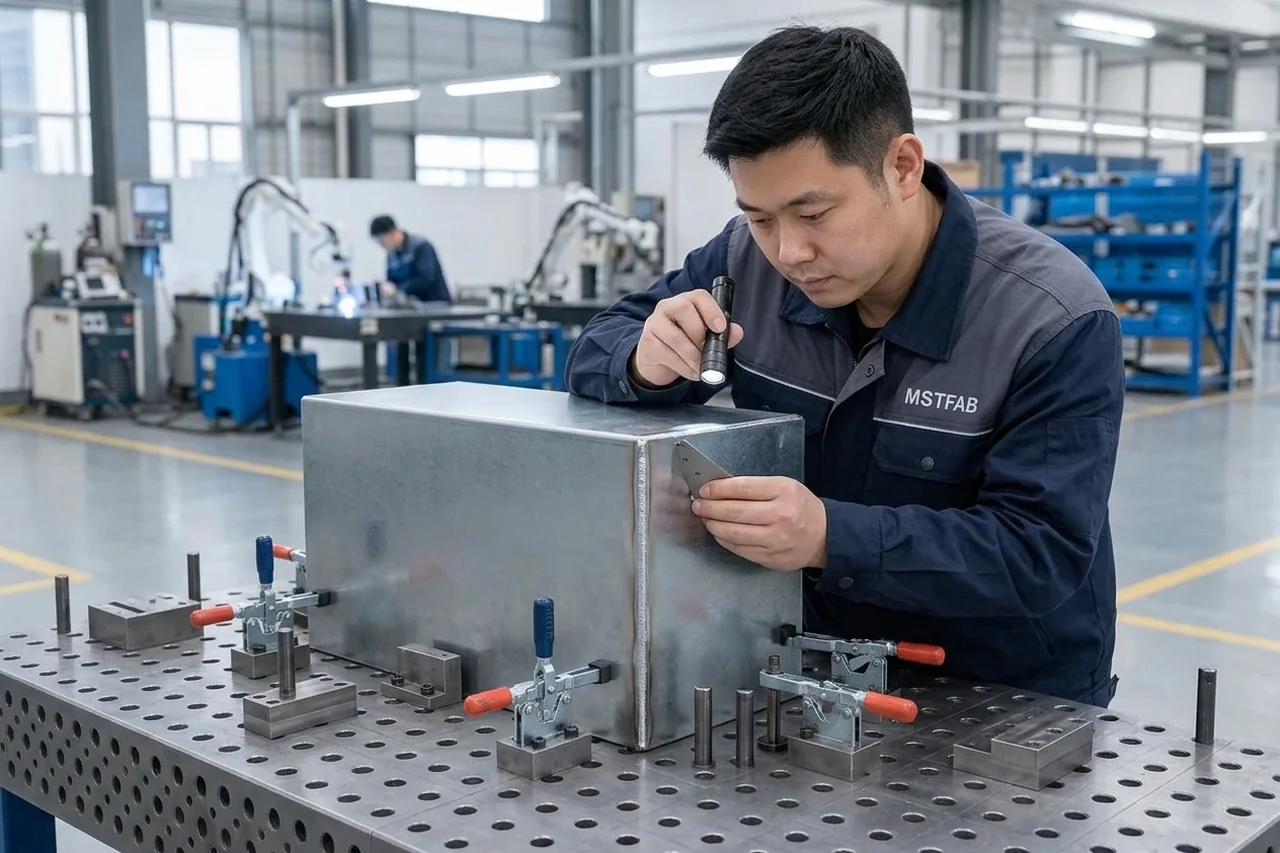
| Mitered Corner TIG Seams | Full-penetration autogenous/ER70S-6 TIG corner welds ground flush on sealing faces and exterior radii | Flushness ±0.15 mm; zero pinholes; residual corner wall ≥ 90% nominal gauge | 100% visual backlight pinhole check, dye-penetrant sampling on first-article shells, and ultrasonic thickness gauging across ground corners: Eliminates capillary water-entry channels and raised weld beads that unseat perimeter gaskets under 65 GPM hose-down impact. |
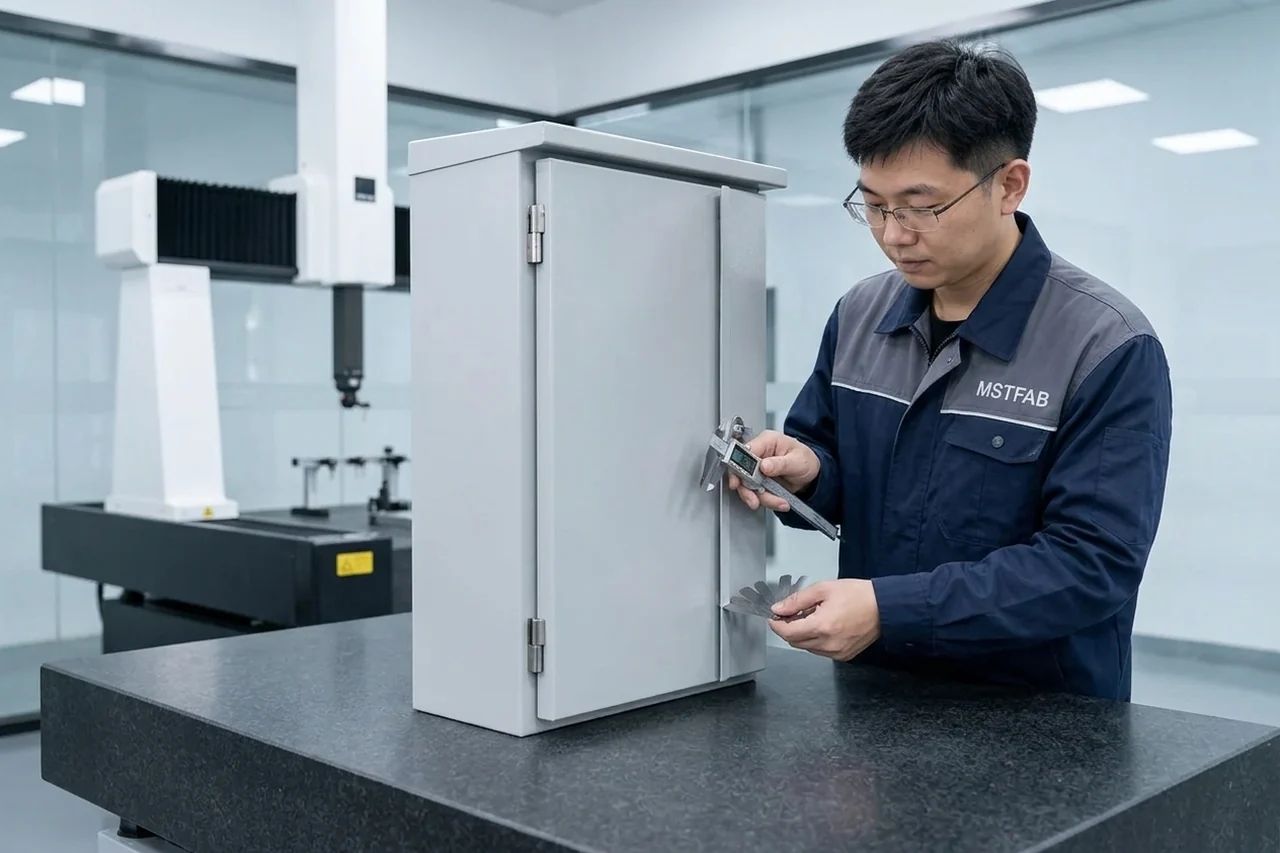
| Door Return Flange & Knife-Edge | Double-folded 90° rain-trough return lip with 2.0 mm hemmed sealing edge interfacing gasket centerline | Trough coplanarity ≤ 0.40 mm across 400 mm span; bend angle 90.0° ± 0.5° | Granite surface-plate feeler-gauge flatness audit and CNC press-brake laser-angle verification on every production setup: Maintains uniform 30–40% gasket compression around the full perimeter and sheds washdown spray away from the seal line. |
| Dual-Coat Corrosion System | Zirconium-silane pretreatment + 50–65 µm zinc-rich epoxy primer + 60–80 µm RAL 7035 UV polyester | Total DFT 110–145 µm; ASTM D3359 cross-hatch adhesion ≥ 4B; 500 h ASTM B117 coupon | Eddy-current DFT mapping at 12 enclosure zones, MEK cure rub test, cross-hatch tape pull, and lot witness salt-spray coupons: Rebuilds cathodic barrier protection over laser-cut edges and weld heat-affected zones where mill zinc was vaporized. |
| Gland Plate & Grounding Studs | Removable 2.0 mm gasketed bottom gland plate plus masked copper-plated M6/M8 weld grounding studs | Cutout pattern ±0.10 mm; ground path resistance ≤ 0.08 Ω at 25 A test load | CMM coordinate verification of M20/M25/NPT gland clusters, pull-test on studs, and four-wire milliohmmeter continuity testing: Enables clean off-line harness termination without field drilling chips and guarantees low-impedance protective earth continuity. |
| External Hardware & Latches | Investment-cast SUS316 quarter-turn compression latches, concealed lift-off hinges, and 3.0 mm mounting feet | Latch pull-down stroke 4.0 ± 0.3 mm; mounting foot hole pitch ±0.25 mm | Functional door-closure compression gauge check using pressure-sensitive film and Go/No-Go mounting pitch fixture inspection: Prevents dissimilar-metal galvanic seizure on outdoor racks and isolates external wall-mount holes from the sealed interior. |
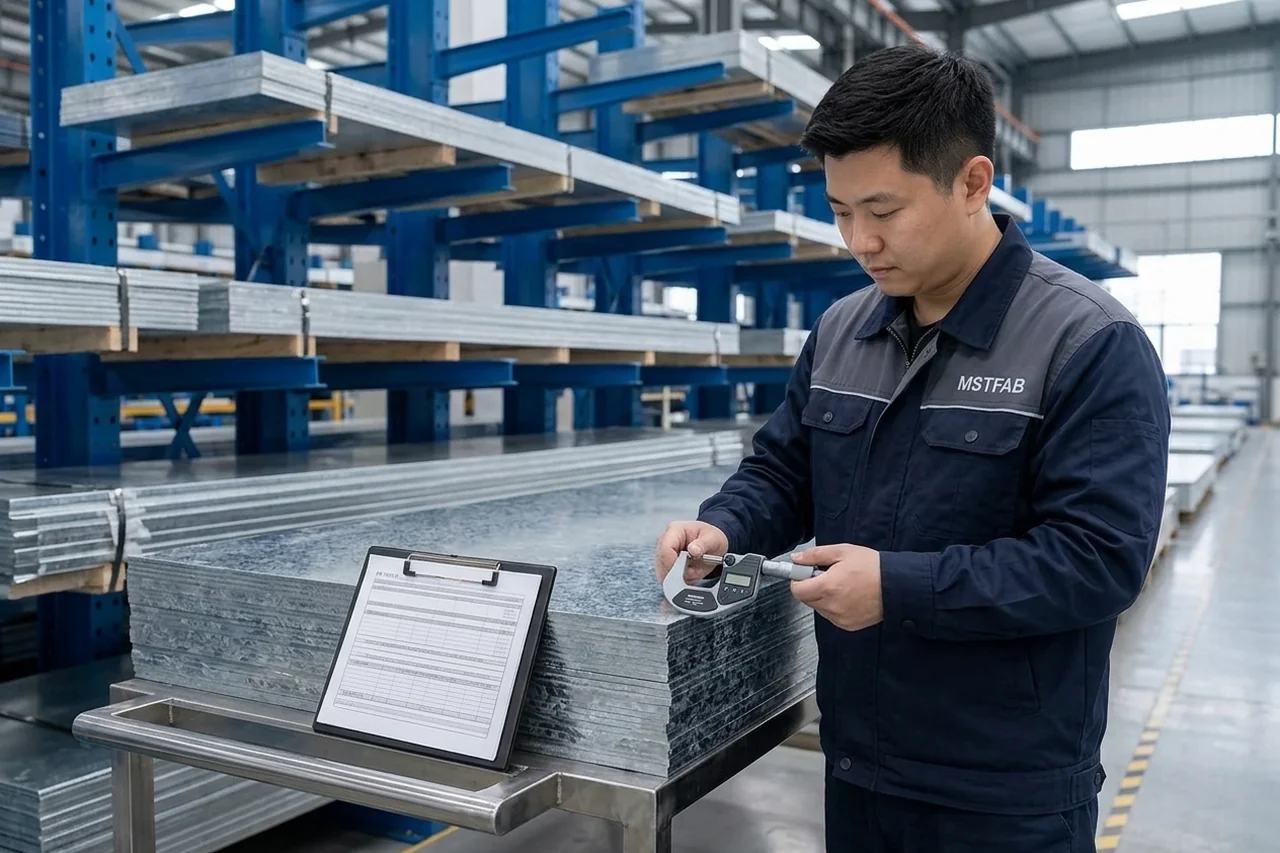
02 / Sheet Metal DFM & Structural Controls
Common Galvanized NEMA 4X Failure Modes & Shop-Floor Controls
Even well-drawn junction boxes fail ingress or salt-spray qualification audits when standard cold-rolled mild-steel fabrication habits are applied uncritically to galvanized sheet. Below are the three dominant mechanical, metallurgical, and sealing failure mechanisms MSTFAB engineers eliminate during pre-production DFM review, press-brake tooling design, weld-fixture setup, and dual-coat finishing line qualification.
Weld-Burned Zinc & Laser-Edge Red Rust Along Mitered Corner Seams
Failure Mechanism: Fiber-laser cutting vaporizes zinc within 0.25 mm of the kerf, while TIG welding burns off 8–15 mm of zinc around corner joints. Single-coat polyester powder applied directly over bare heat-affected zones develops creeping under-film rust within 96 hours of salt-fog exposure.
Engineering Solution: MSTFAB specifies galvannealed A60 where heavy corner welding occurs, mechanically abrades weld oxide down to bright clean metal, applies a controlled zirconium-silane or zinc-phosphate conversion bath, and sprays a 55–65 µm zinc-rich epoxy primer across all edges prior to UV polyester topcoating.
Verified Outcome: Restores cathodic edge protection and achieves zero creeping corrosion over 500-hour ASTM B117 witness coupon testing.
Zinc Outgassing Pinholes & Coating Delamination on Spangled Hot-Dip SGCC Sheet
Failure Mechanism: Heavy hot-dip G90/Z275 spangle retains microscopic surface porosity and trapped hydrogen-zinc hydrates. When baked at 195–200 °C in a standard powder-coat oven, outgassing blisters create micro-pinholes that fail ASTM D3359 adhesion tape tests and admit corrosive moisture along door edges.
Engineering Solution: We run a controlled 210 °C pre-bake degassing cycle prior to electrostatic coating, recommend galvannealed DX51D+ZF120 on cosmetic doors whenever drawing specs allow, and apply an outgassing-forgiving (OGF) zinc-rich epoxy primer formulated specifically for hot-dip galvanized substrates across every batch.
Verified Outcome: Eliminates cure-oven pinholing on first-pass runs and locks coating adhesion consistently at ASTM D3359 Class 5B.
Corner Gasket Unloading Under 65 GPM NEMA 4X Hose-Down Jets
Failure Mechanism: Die-cut four-piece strip gaskets spliced at 90° corners leave micro-gaps or stiff compression spikes. Coupled with ±0.8 mm door flange bow from weld distortion, local gasket deflection drops below 20%, letting pressurized water jets breach the cabinet interior during hose-down tests.
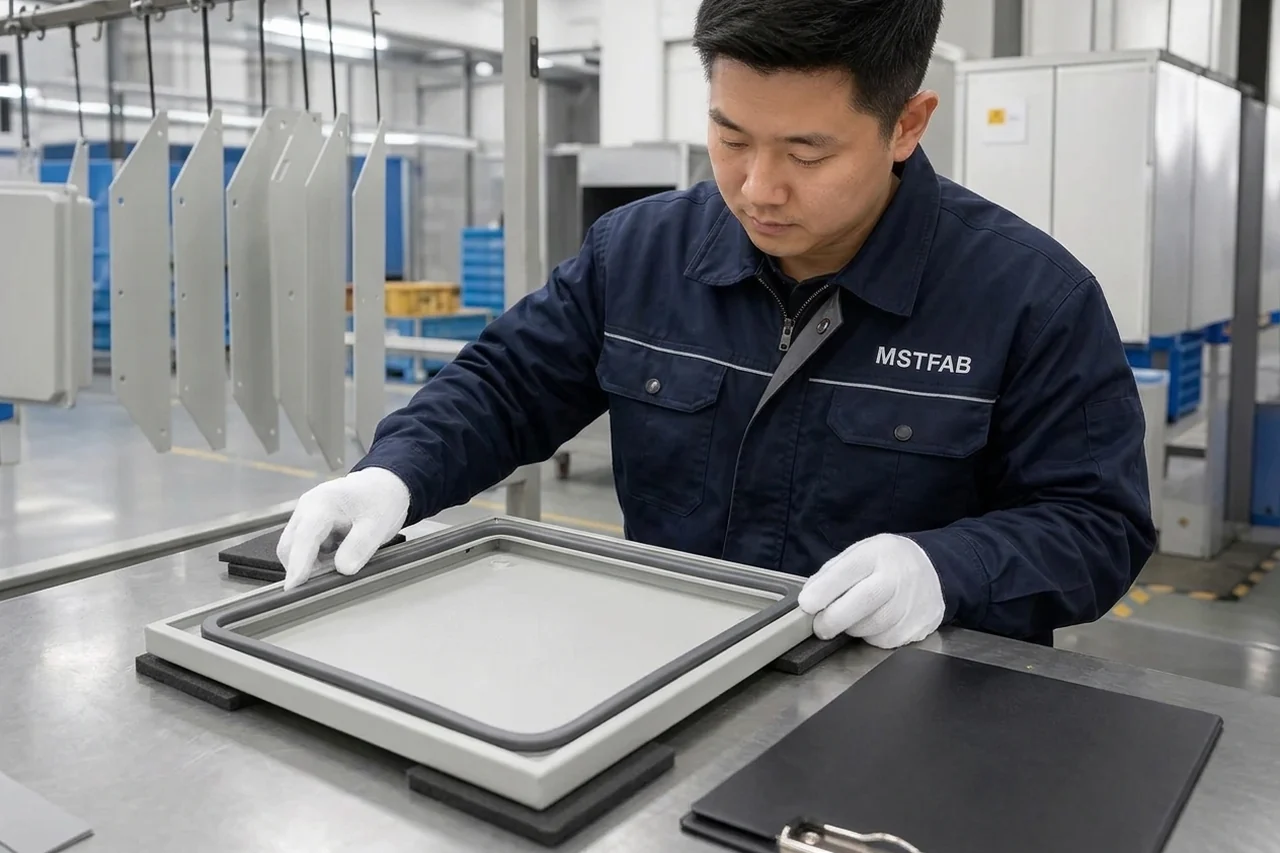
Engineering Solution: MSTFAB forms a continuous 90° hemmed knife-edge rain trough held to ≤ 0.40 mm coplanarity across the opening, pairs it with seamless robotic FIPFG polyurethane or molded-corner EPDM gaskets targeting 35% compression, and integrates heavy-duty SUS316 compression-latch pull-down mechanics around the door perimeter.
Verified Outcome: Maintains uniform seal contact pressure around all four corners during internal 100 L/min IP66/hose-down witness checks.
Manufacturing Scope Boundary: Commercial & Certification Boundary: Build-to-Print Shell vs. UL 50E Listing: Many buyers assume a Chinese contract fabricator can ship a custom junction box carrying an official UL 50, UL 508A, or UL 50E Listed label under the factory's own file number, or mistakenly equate ISO 9001 factory quality certification with component safety listing. — Engineering Fix: MSTFAB holds ISO 9001:2015, IATF 16949:2016, and ISO 14001:2015 and builds empty mechanical enclosures strictly to customer 3D STEP and 2D PDF drawings. We supply EN 10204 3.1 mill certificates, RoHS/REACH declarations, DFT/B117 witness coupons, and dimensional FAI reports supporting your own UL/NEMA qualification. MSTFAB manufactures custom sheet metal parts and empty mechanical enclosure shells strictly to your 3D STEP and 2D PDF drawings.
03 / Representative Engineering Scenario & Process Control
Representative OEM Case: Coastal Wastewater Telemetry Junction Box
Project Profile: 600 units/batch | 1.5 mm Galvannealed DX51D+ZF120 (A60) | 300 × 250 × 150 mm | Zinc-Epoxy Primer + RAL 7035 UV Polyester
OEM Engineering Challenge: A European municipal wastewater telemetry OEM previously sourced single-coat SGCC junction boxes that passed initial factory visual inspection but developed red rust along bottom door welds and suffered latch-corner water ingress during coastal storms. Re-designing the housing in 316L stainless steel pushed unit enclosure cost up by 68%, threatening municipal project bid margins. They urgently needed a galvanized steel mechanical shell retaining stainless-level corrosion resilience and repeatable airtight seal geometry.
MSTFAB Manufacturing Solution: MSTFAB DFM engineers transitioned the shell from spangled SGCC to 1.5 mm galvannealed DX51D+ZF120, incorporated a 12 mm hemmed knife-edge rain trough, and moved wall-mounting brackets completely outside the gasketed perimeter using rear-welded 3.0 mm lugs. Mitered corners were TIG-welded in copper chill-bar fixtures and ground flush within ±0.12 mm without thinning the base gauge. Each shell received zirconium-silane pretreatment, a 210 °C degas pre-bake, 60 µm zinc-rich epoxy primer, 70 µm RAL 7035 TGIC polyester, molded-corner EPDM gaskets, and SUS316 quarter-turn compression latches.
- 41% Unit Cost Savings: Delivered 41% lower enclosure BOM cost compared with equivalent 1.5 mm SUS316L welded housings while meeting all customer coastal corrosion and mechanical stiffness durability targets.
- 600+ Hr Salt-Spray Pass: Production batch witness coupons completed 600 continuous hours of ASTM B117 neutral salt-spray exposure with zero under-film scribe creep exceeding 1.5 mm at ground welds.
- 100% Hose-Down Lot Yield: First-article and AQL water-spray qualification shells achieved zero internal moisture trace across gasketed corners and latch stems under 100 L/min multi-angle industrial nozzle witness testing.
- ±0.12 mm Corner Flatness: Copper-chilled TIG fixturing reduced door-opening thermal warp by 72%, maintaining 34–38% uniform gasket compression across all four mitered perimeter corners on every serialized production unit.
Every production lot is archived with locked CNC laser nests, press-brake bend programs, weld fixture setups, and signed golden samples to guarantee identical repeatability across multi-year reorders.
04 / Quality Verification, Traceability & Surface Finishing
4-Stage Manufacturing Workflow, Surface Treatment & Metrology Control
To maintain Cpk ≥ 1.33 on critical-to-quality (CTQ) dimensions from prototype through series production, MSTFAB executes a closed-loop four-stage fabrication protocol:
Step 01 — DFM & Substrate Qualification: MSTFAB engineers audit your 3D STEP and 2D PDF tolerances, validate galvannealed A60 versus hot-dip SGCC Z275 weldability, optimize bend reliefs and 90° knife-edge rain troughs, verify gland-plate locknut wrench clearances, and flag any internal mounting holes that would compromise the NEMA 4X seal boundary.
Step 02 — Laser Nesting, Brake Forming & Chill-Bar TIG: Coil-verified galvanized sheets are nitrogen fiber-laser cut with ±0.10 mm cutout accuracy, formed on CNC press brakes with real-time laser angle sensing, and TIG-welded in copper-backed fixtures to suppress thermal distortion, prevent weld burn-through, and preserve door-opening coplanarity within 0.40 mm across the seal perimeter.
Step 03 — Degas Pre-Bake & Dual-Coat Finishing: Welded shells undergo mechanical weld-oxide dressing, zirconium-silane conversion, a 210 °C outgassing pre-bake, high-temperature silicone masking on grounding studs and threaded inserts, and electrostatic application of 50–65 µm zinc-rich epoxy primer plus 60–80 µm UV polyester cured under continuous digital oven-profile logging and batch witness coupon testing.
Step 04 — Gasket Dispensing, FAI & Export Crating: SUS316 quarter-turn compression latches and concealed hinges are torqued to specification, continuous molded EPDM or robotic FIPFG polyurethane gaskets are seated and compression-checked with pressure-sensitive film, CMM, DFT, and 4-wire ground-continuity FAI reports are compiled, and finished boxes ship in VCI/EPE foam inside ISPM-15 crates.
All raw sheets (SPCC, SGCC, SECC, SUS304/316L, Al 5052-H32/6061-T6) are verified via optical emission spectrometry (OES) or XRF upon arrival and linked by barcode to your purchase order.
Prior to export crating in ISPM-15 fumigated plywood boxes, our quality lab conducts ballooned dimensional FAI checks, dry-film thickness (DFT) mapping, ASTM D3359 cross-hatch adhesion testing, and ground-continuity verification.

05 / 8-Point OEM RFQ Checklist & Topic Cluster Hub
OEM Engineering RFQ Checklist & Connected Fabrication Hubs
Include these eight drawing and specification controls in your RFQ package so our engineering team can lock down tooling, material traceability, and inspection fixtures on day one:
- RFQ Requirement 01Supply 3D STEP assembly and part files plus 2D PDF drawings calling out critical gasket-flange coplanarity, ground-stud coordinates, hardware BOMs, and ISO 2768-mK or tighter tolerances.
- RFQ Requirement 02Specify exact galvanized substrate preference: galvannealed A60 (DX51D+ZF120) for welded Class-A powder finish or hot-dip SGCC Z275 (G90) for heavier bare zinc sacrificial corrosion protection.
- RFQ Requirement 03Define the target dual-coat stack, including pretreatment chemistry, zinc-rich epoxy primer DFT (50–65 µm), RAL color code, UV polyester topcoat DFT (60–80 µm), and gloss tolerance.
- RFQ Requirement 04Detail gasket material (robotic FIPFG polyurethane or molded-corner closed-cell EPDM), uncompressed profile height, Shore A hardness, and target 30–40% compression stop dimensions across door corners.
- RFQ Requirement 05Specify external and internal hardware grades—explicitly mandating SUS316 hinges, quarter-turn compression latches with O-ring stem seals, and external mounting lugs to avoid dissimilar-metal galvanic rust.
- RFQ Requirement 06Identify all conductive grounding-stud zones, door-bond braid tabs, DIN-rail bosses, and panel-mount standoffs requiring high-temperature silicone masking prior to zinc-epoxy primer and topcoat spray application.
- RFQ Requirement 07Include removable bottom or side gland plate drawings with exact M16/M20/M25/NPT knockout spacing ensuring locknut wrench swing clearance against enclosure return flanges and wall stiffeners.
- RFQ Requirement 08Clarify required incoming and lot inspection deliverables: EN 10204 3.1 mill certificates, RoHS/REACH declarations, ASTM B117 salt-spray witness coupons, and ballooned First Article Inspection reports.
Explore Connected Sheet Metal Fabrication Services & Enclosure Hubs
06 / OEM Buyer & Engineer FAQ
Engineering FAQs: NEMA 4X Galvanized Steel Junction Boxes
Can galvanized steel junction boxes truly meet NEMA 4X requirements instead of 304/316L stainless steel?
Yes, provided the coating system protects cut edges and weld heat-affected zones. NEMA 250 Type 4X specifies hose-down ingress integrity plus a 200-hour corrosion resistance benchmark (equivalent to ASTM B117 or comparative exposure against Type 304 stainless steel) rather than mandating solid stainless alloy. A bare galvanized box will fail at burned weld seams, but a galvannealed A60 or SGCC shell finished with silane pretreatment, 55–65 µm zinc-rich epoxy primer, and 60–80 µm UV-stable polyester topcoat combined with SUS316 external hardware routinely exceeds 500-hour salt-spray testing at substantially lower cost than 316L stainless.
Why does MSTFAB recommend galvannealed A60 (ZF120) over spangled G90/Z275 for welded boxes?
Standard hot-dip G90/Z275 carries a relatively thick, pure-zinc spangled surface that vaporizes violently during TIG welding, produces porous weld soot, and outgasses micro-blisters when cured at 195–200 °C under polyester powder. Galvannealed A60 (DX51D+ZF120) undergoes an inline annealing pass that alloys roughly 8–12% iron into the zinc layer, creating a matte, spangle-free intermetallic surface. This surface welds with minimal spatter, anchors zinc-rich epoxy primer to ASTM D3359 Grade 5B adhesion, and eliminates cure-oven pinholing while still delivering sacrificial cathodic protection under the dual-coat barrier.
Does MSTFAB provide UL 50 or UL 50E certification labels on custom junction boxes?
No—and transparency on this boundary protects your compliance timeline. MSTFAB is certified to ISO 9001:2015, IATF 16949:2016, and ISO 14001:2015 as a build-to-print OEM sheet metal manufacturer. We do not hold UL 50, UL 50E, or UL 508A listing under our own company file. Instead, we manufacture the empty mechanical shell strictly to your controlled drawings—holding gasket-trough coplanarity, continuous corner weld integrity, grounding continuity, and dual-coat DFT—while supplying EN 10204 3.1 mill certs, coating witness coupons, and FAI reports for your third-party UL or CSA submittal.
How do you prevent water from entering around wall-mounting holes and hinges?
Every through-hole inside the gasketed compartment is a potential NEMA 4X leak path. MSTFAB recommends keeping all wall-mounting holes completely outside the seal perimeter by welding 3.0 mm external mounting feet or top/bottom flange ears to the rear body, or adding sealed blind weld-nuts with bonded EPDM washers if rear-panel bolting is unavoidable. Similarly, we mount concealed lift-off hinges inside the exterior return flange and use SUS316 quarter-turn compression latches with integrated O-ring shaft seals so hardware actuation never compromises internal ingress protection.
What minimum order quantities and lead times apply to custom NEMA 4X-targeted junction boxes?
For prototype and engineering validation builds (EVT/DVT), MSTFAB supports 5–20 units with soft-tooled laser and press-brake setups in 12–18 calendar days, including dual-coat powder finishing and full dimensional FAI. Production batches typically start at 100–500 units per release with 22–30 calendar day lead times depending on custom gasket tooling or FIPFG programming. Grouping common enclosure footprints with interchangeable laser-cut gland plates allows OEMs to standardize one welded body across multiple field-wiring configurations without repeating enclosure qualification tooling.
International Standards & Engineering References
- ISO 2768-1 / 2768-2 — General Linear, Angular and Geometrical Tolerances for Sheet Metal Fabrication
- IEC 60529 / NEMA 250 — Degrees of Protection Provided by Enclosures (IP Code & Environmental Sealing)
- ISO 9001:2015 & IATF 16949:2016 — Quality Management Systems & Production Part Approval Process (PPAP)
Ready to Quote Your Custom Sheet Metal Enclosure or Fabrication Project?
Upload your 3D STEP models and 2D PDF drawings. MSTFAB will review your tolerances, material specs, and DFM details to deliver a transparent factory quote within 24 hours.
Request Your 24-Hour DFM & Custom Quote →
Direct engineering desk: caroline@mstfab.com | ISO 9001 & IATF 16949 Certified Factory in Guangzhou, China
 WeChat Contact
 WhatsApp Me Directly