
SEMICONDUCTOR SUBFAB ENCLOSURE DFM — EXECUTIVE TECHNICAL BRIEF
Subfab wafer-handling controllers, vacuum pump drivers, and gas-box power cabinets need NEMA 12 dust-tight shells that block fine particulates and oil mist without releasing volatile siloxanes. Early OEM enclosure failures rarely stem from raw steel strength; instead, they occur when perimeter TIG welds warp the door flange, foam gaskets tear at mitered corners, or paint overspray coats grounding bosses and spikes EMI impedance. By specifying CNC laser blanking, rigid double-return door lips, robotically dispensed silicone-free 2K polyurethane FIPFG seals, and masked earth lands under ISO 9001:2015 and ISO 2768-mK rules, fab equipment teams cut sheet-metal rework, avoid cleanroom AMC issues, lower warranty cost, and achieve repeatable sealing across volume runs.
- Door-Flange Flatness & Seal Compression: Hold perimeter return-lip flatness within ±0.30 mm per linear meter and bend angles within ±0.5° so compression latches compress the 6 mm × 10 mm silicone-free PU FIPFG gasket uniformly to 30%–35% without localized corner lift or oil-canning.
- Silicone-Free Cleanroom Powder Finish: Apply low-outgassing, silicone-free epoxy-polyester RAL 7035 fine-texture powder coat at 65–85 µm DFT (ASTM D7091), achieving 5B cross-hatch adhesion (ASTM D3359) and ≥2H pencil hardness to eliminate wafer-area molecular contamination and flaking risks.
- Equipotential EMC & Grounding Paths: Mask removable gland-plate perimeters, lock-cam seats, and M6/M8 welded copper-plated ground studs prior to coating, maintaining <0.05 Ω contact resistance across door-to-chassis braided straps for sensitive VFD, RF-generator, and multi-axis motion shielding.
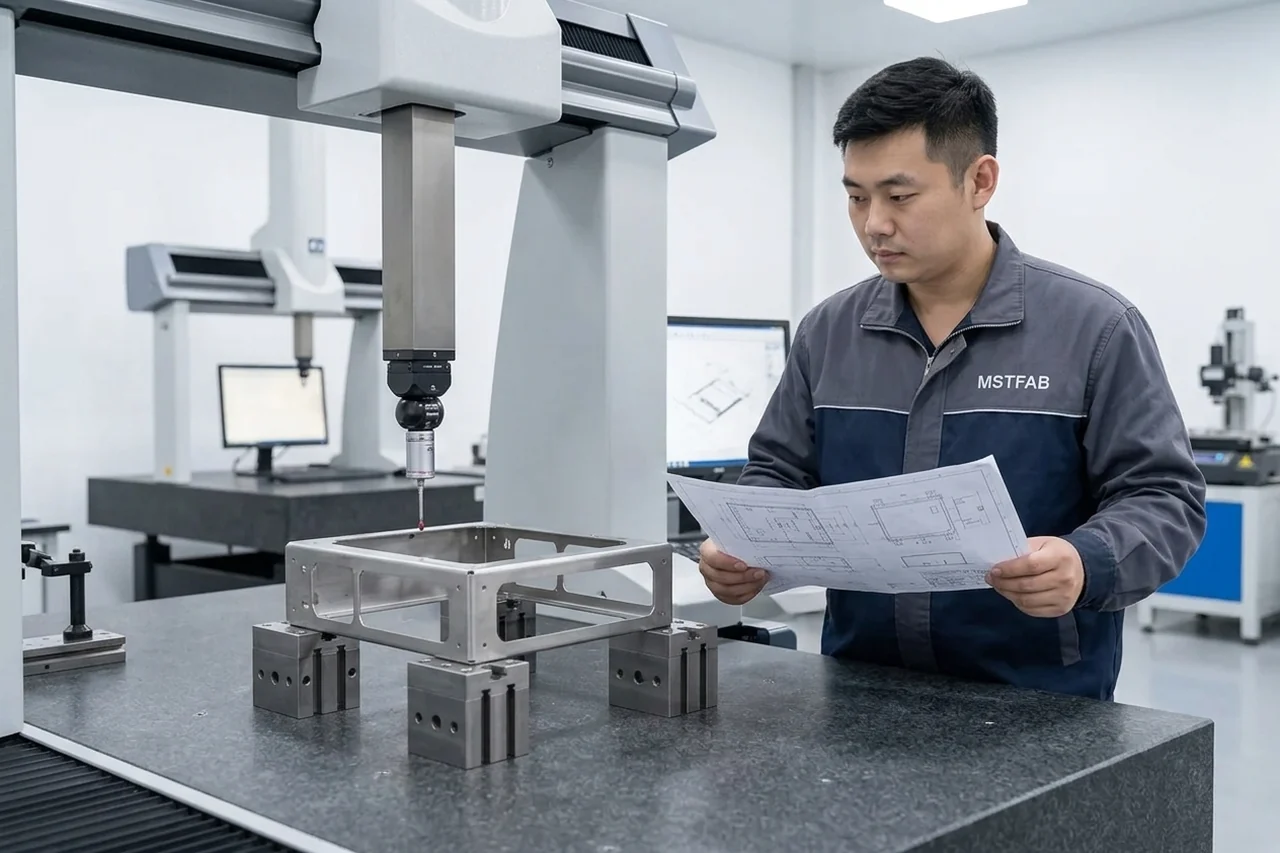
- Process Capability & Incoming Traceability: Verify critical DIN-rail, subplate, and latch-cutout pitch tolerances (±0.10 mm, Cpk ≥ 1.33) via optical CMM first-article inspection, backed by EN 10204 3.1 mill certificates and RoHS/REACH declarations for OEM tool qualification.
Every project at MSTFAB includes a complimentary 24-hour CAD Design-for-Manufacturing (DFM) audit, heat-number-traceable EN 10204 3.1 mill certificates, and a ballooned First Article Inspection (FAI) report prior to volume release.
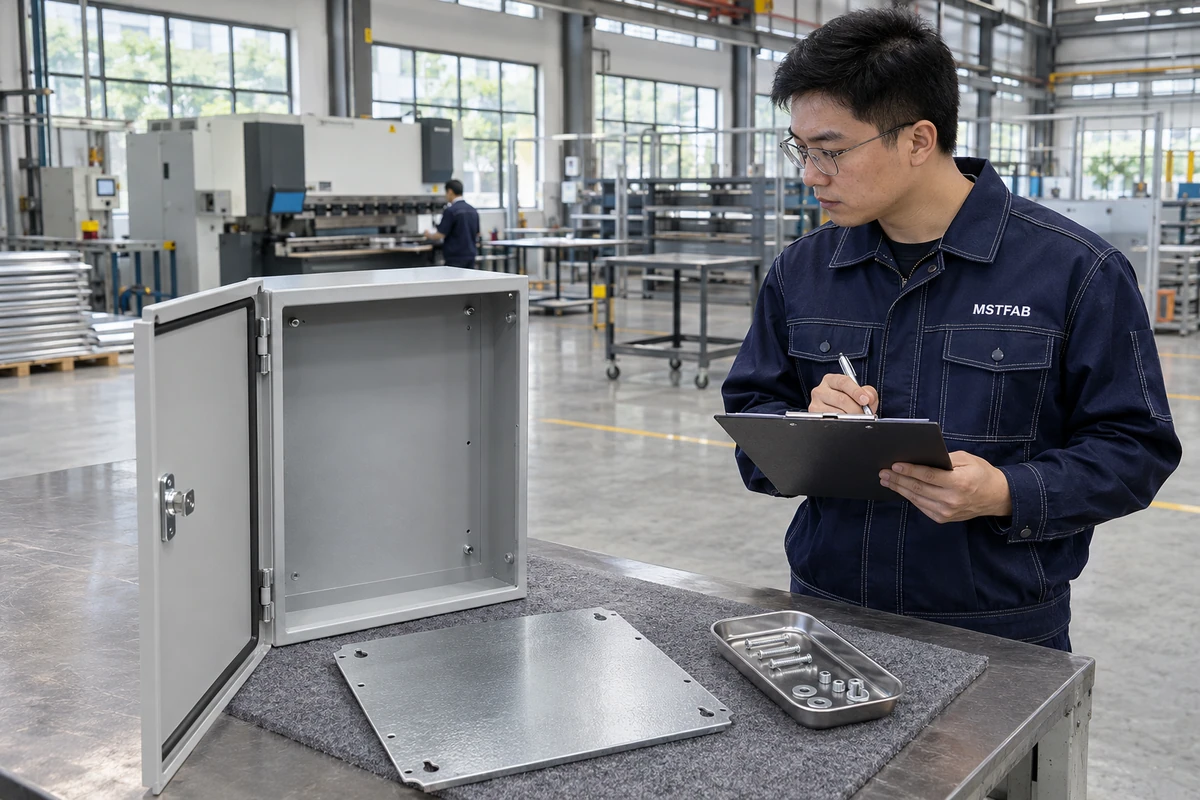
01 / Engineering Specifications & Comparison Matrix
NEMA 12 Subfab Mechanical Shell Specification & Inspection Matrix
Unlike outdoor washdown cabinets, indoor semiconductor subfab NEMA 12 enclosures fail mainly through micro air-bypass paths, thread galling, and chemical outgassing issues rather than water jets. Negative-pressure cleanroom aisles, tool-chase maintenance bays, and turbulent exhaust plenums pull constant pressure drops across door seams and cable-entry plates, drawing metallic wear dust, pump oil mist, or process fumes through any unsealed gap above 0.15 mm. Tool integrators also bolt heavy servo drives, high-current power supplies, and multi-pin Harting bulkheads onto internal subplates, so welded frames must stay square during forklift rigging, rolling on cleanroom floors, and seismic anchoring. Meanwhile, subfab teams expect drop-in interchangeability across multi-bay tool lines without manual filing or field gasket patching. Each zone in the matrix below pairs exact sheet metal tolerances with metrology checks and assembly gains.
Each parameter below is verified during incoming raw material quarantine, in-process CNC stage checks, and final First Article Inspection (FAI) before shipment release:
| Engineering Parameter / Zone | Material & Process Specification | Target Tolerance / Performance Standard | Inspection Method & OEM Value |
|---|---|---|---|
| Main Shell Body & Corner Seams | 1.5 mm or 2.0 mm SPCC (JIS G 3141) or SGCC hot-dip galvanized structural shell featuring continuous seam-welded outer corner miters ground flush for dust-tight cleanroom and subfab installation. | ±0.25 mm overall box envelope; ±0.15 mm cutout pitch; ≤1.6 µm Ra corner seam finish without thinning parent wall below 1.35 mm. | Optical CMM and digital height-gauge first-article dimensional inspection paired with 100% dark-room light-box seam pinhole verification performed prior to multi-stage chemical pretreatment: Eliminates corner dust-ingress crevices and preserves rigid cabinet squareness (≤1.0 mm diagonal delta) during subfab crane rigging, cleanroom caster rolling, and multi-bay cabinet bolting. |
| Door Return Lip & Dust Gutter | Precision CNC press-brake formed 18 mm to 22 mm double-return perimeter knife-edge flange creating an elevated dust-shedding trough around the complete cabinet door aperture. | ±0.30 mm/m straightness across full door height; ±0.5° flange bend angle; 4.0 mm to 5.0 mm uniform door-to-body reveal gap. | Calibrated feeler-gauge gap sweep around all four door sides and 1,000 mm granite straightedge flatness verification performed immediately after stress-relief welding and cooling: Maintains uniform 30% to 35% compression along the entire perimeter gasket path, stopping airborne subfab particulate draw-in under negative tool-exhaust pressure differentials. |
| Silicone-Free PU FIPFG Seal Path | Robotically dispensed two-component closed-cell polyurethane foam-in-place gasket featuring a seamless overlapped start-and-stop junction applied directly inside the cleaned inner door return channel. | 6.0 mm × 10.0 mm nominal bead profile (±0.5 mm width, ±0.4 mm height); cured Shore 00 hardness controlled between 25 and 35. | Optical laser profile cross-section verification per production batch combined with full-perimeter chalk-transfer contact line checking across 100% of door latch compression points: Delivers zero-siloxane, dust-tight NEMA 12 and IP55 sealing integrity without brittle manual adhesive joints, corner gap splices, or field-applied RTV caulk contamination. |
| Removable Cable-Entry Gland Plate | 2.0 mm SGCC or unpainted SUS304 removable bottom and top cable-entry gland plate featuring captive M5 PEM studs spaced ≤100 mm apart and closed-cell EPDM seal. | ±0.10 mm bulkhead connector cutout alignment; ≤0.15 mm local plate flatness across adjacent fastener spans under full assembly torque. | Calibrated Go/No-Go pin gauging on multi-pin Harting connector cutouts combined with torque-verified gasket compression checks at 3.5 N·m on all M5 nuts: Allows OEM wire-harness assembly teams to bench-terminate heavy armored cables outside the shell while maintaining even gasket compression across wide cable-entry openings. |
| Cleanroom Powder Coat & EMC Masking | Silicone-free zinc-phosphate pretreatment plus RAL 7035 fine-texture epoxy-polyester powder coat with high-temp silicone-plug masked M6/M8 ground studs and conductive contact lands. | 65–85 µm cured DFT; 5B cross-hatch adhesion per ASTM D3359; <0.05 Ω DC ground continuity measured across masked earth bosses. | Eddy-current or magnetic DFT gauge check (five readings per enclosure face), ASTM D3359 tape adhesion coupon audit, and 4-wire Kelvin milliohmmeter continuity testing: Prevents coating flaking near cleanroom tool doors while guaranteeing low-impedance electromagnetic shielding continuity for sensitive wafer-stage servo drives, power controllers, and RF electronics. |

02 / Sheet Metal DFM & Structural Controls
Top 3 NEMA 12 Semiconductor Shell Failure Modes & Engineering Fixes
Even cleanly modeled NEMA 12 enclosure drawings frequently trigger late rework during prototype qualification when sheet metal springback, weld thermal input, and powder coating buildup are underestimated. Addressing these three recurring mechanical failure modes during upfront DFM review prevents costly tooling delays, subplate assembly interference, and field dust-ingress rejects in service.
Door Panel Oil-Canning and Mid-Span Gasket Gap on Wide Single Doors
Failure Mechanism: Single-leaf doors wider than 650 mm built from unreinforced 1.5 mm SPCC bow outward between quarter-turn compression latches when pressing against a 35 Shore 00 polyurethane gasket. This drops mid-span seal compression below 15% and lets fine subfab dust bypass into drive electronics.
Engineering Solution: Add 1.5 mm hat-section vertical stiffener channels resistance-spot-welded inside the door panel, upgrade center-only latches to a 3-point internal rod-lock mechanism on door heights ≥800 mm, and form a rigid 20 mm double-return perimeter flange around all four door edges.
Verified Outcome: Restores uniform ≥30% gasket compression from corner to center, passing 100% chalk-transfer contact verification without frame distortion.
Powder-Coat Over-Thickness and Thread Seizure on Captive M6/M8 Grounding Studs
Failure Mechanism: Unmasked M6/M8 capacitor-discharge ground studs and PEM clinched standoffs accumulate 80 to 120 µm of cured epoxy-polyester powder inside fine metric threads. Operators experience nut cross-threading during subplate assembly, while insulating paint layers push EMI ground impedance far above 1.0 Ω.
Engineering Solution: Specify high-temperature tapered silicone thread caps on every captive stud plus 16 mm circular Kapton masking discs around equipotential earth bosses, lock-cam contact seats, and removable gland-plate sealing lands prior to automated electrostatic powder spraying and thermal oven cure cycles.
Verified Outcome: Maintains <0.05 Ω ground bonding impedance and eliminates post-coat thread chasing that leaves steel swarf inside shells.
Thermal Flange Distortion Along Continuous Door-Frame Corner Miter Seam Welds
Failure Mechanism: Excessive TIG amperage along four outer frame miters warps the 20 mm knife-edge gasket lip by 1.2 to 1.8 mm, forcing technicians to over-torque concealed hinges and causing aggressive cosmetic weld grinding that thins corner walls below 1.2 mm structural gauge.
Engineering Solution: Incorporate laser-cut internal tab-and-slot alignment keys inside mitered corners, clamp the full door frame securely against heavy copper heat-sink chill blocks during low-heat pulsed TIG welding, and enforce controlled flap-disc blending stops that strictly preserve original parent sheet metal thickness.
Verified Outcome: Limits frame-face twist to ≤0.30 mm/m and preserves parent wall gauge for smooth, repeatable door closure.
Manufacturing Scope Boundary: Scope & Compliance Boundary: Build-to-Print Mechanical Shells vs. UL Listing: Many semiconductor OEM buyers assume a NEMA 12 sheet metal fabricator automatically supplies UL 50 or UL 508A listed labels on custom-designed cabinets. That assumption causes costly compliance gaps during fab safety inspections when custom mechanical builds arrive without an electrical panel-shop UL file. — Engineering Fix: MSTFAB is certified to ISO 9001:2015, IATF 16949:2016, and ISO 14001:2015 and supplies build-to-print empty mechanical enclosure shells per customer 3D STEP and 2D PDF drawings—not UL-listed electrical panels. We provide EN 10204 3.1 mill certificates, RoHS/REACH declarations, and FAI metrology packets to support your UL or SEMI S2 certification files. MSTFAB manufactures custom sheet metal parts and empty mechanical enclosure shells strictly to your 3D STEP and 2D PDF drawings.
03 / Representative Engineering Scenario & Process Control
Representative OEM Project: 1,200 mm Subfab Wafer-Sorter Controller Shell
Project Profile: Batch: 150 units/quarter | Alloy: 1.5 mm SPCC body + 2.0 mm SGCC internal subplate | Finish: Silicone-free RAL 7035 epoxy-polyester powder coat (75 µm DFT)
OEM Engineering Challenge: A semiconductor automation OEM transferring subfab tool assembly to Asia faced an 18% incoming rejection rate on previous-supplier NEMA 12 control shells across three pilot builds. Primary root causes included 1.4 mm door-frame twist from unfixtured miter welds, silicone-based RTV corner caulking flagged during cleanroom airborne molecular contamination (AMC) outgassing screening, and 0.6 mm cumulative cutout misalignment on bottom removable gland plates that repeatedly delayed final Harting wire-harness docking on the line.
MSTFAB Manufacturing Solution: MSTFAB's DFM team redesigned the door perimeter with a 20 mm double-return flange and internal 1.5 mm hat-section stiffeners, transitioned frame corners to copper-chilled pulsed TIG welding with laser-cut tab-and-slot alignment keys, and replaced manual foam tape and RTV caulk with robotically dispensed silicone-free 2K polyurethane FIPFG gasketing. All removable gland-plate perimeters, lock cams, and M8 ground studs received precision Kapton and silicone masking before RAL 7035 powder application, while critical Harting cutouts were laser-nested from a single absolute datum.
- 0.22 mm/m Flatness: Reduced door-frame perimeter twist from 1.4 mm down to ≤0.22 mm/m across all 150 production shells, achieving a verified 100% chalk-transfer gasket contact pass rate on audit.
- 1.52 Cpk Pitch: Held ±0.08 mm position tolerance across 24 Harting and M25 gland-plate cutouts per cabinet, eliminating manual field reaming and reducing OEM harness assembly cycle time on subfab lines.
- 0.028 Ω Grounding: Verified <0.05 Ω equipotential bonding impedance across masked M8 studs and unpainted SGCC subplate mounts during 100% end-of-line 4-wire Kelvin electrical continuity testing across all units.
- Zero AMC Rejects: Validated silicone-free polyurethane FIPFG and zero-silicone epoxy-polyester powder chemistry backed by complete EN 10204 3.1 mill certificates and RoHS/REACH compliance packets per lot for cleanroom wafer fab acceptance.
Every production lot is archived with locked CNC laser nests, press-brake bend programs, weld fixture setups, and signed golden samples to guarantee identical repeatability across multi-year reorders.
04 / Quality Verification, Traceability & Surface Finishing
4-Stage Manufacturing Workflow, Surface Treatment & Metrology Control
To maintain Cpk ≥ 1.33 on critical-to-quality (CTQ) dimensions from prototype through series production, MSTFAB executes a closed-loop four-stage fabrication protocol:
Step 01 — 3D STEP DFM & Bend-Allowance Audit: Review customer 3D STEP assemblies and 2D GD&T prints within 24 hours, auditing sheet K-factors, minimum flange-to-hole clearances (≥2.5× sheet thickness plus bend radius), 3-point rod-latch travel envelopes, and internal subplate interference before releasing laser nesting programs. Any thin-wall weld risks are flagged with actionable geometry markups for approval.
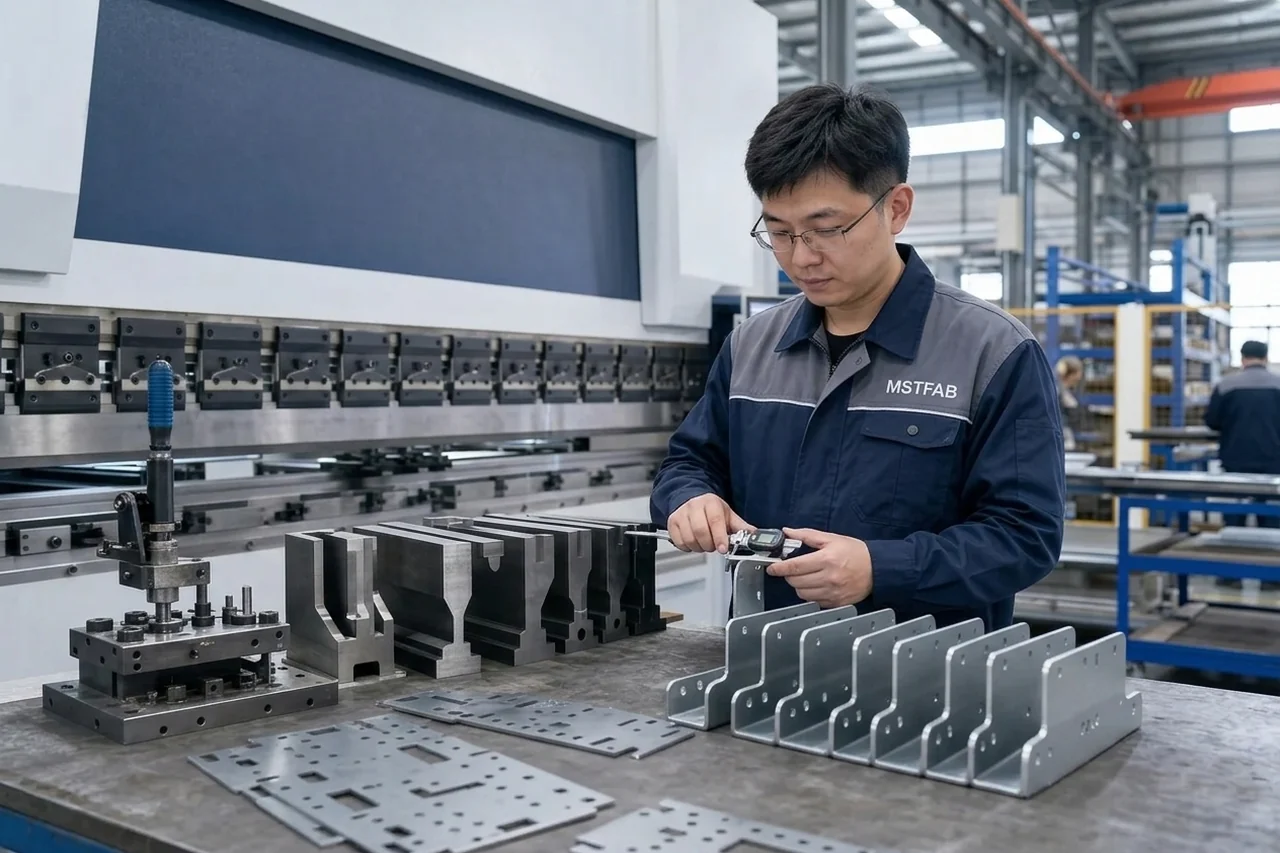
Step 02 — Fiber-Laser Blanking & Copper-Chilled Forming: Cut SPCC and SGCC blanks on nitrogen-assist CNC fiber lasers (±0.10 mm repeatability), clinch PEM studs and standoffs under calibrated hydraulic tonnage, and form double-return door lips on CNC press brakes using segmented gooseneck tooling. Corner miters are clamped inside copper-backed TIG fixtures to limit thermal flange warp.
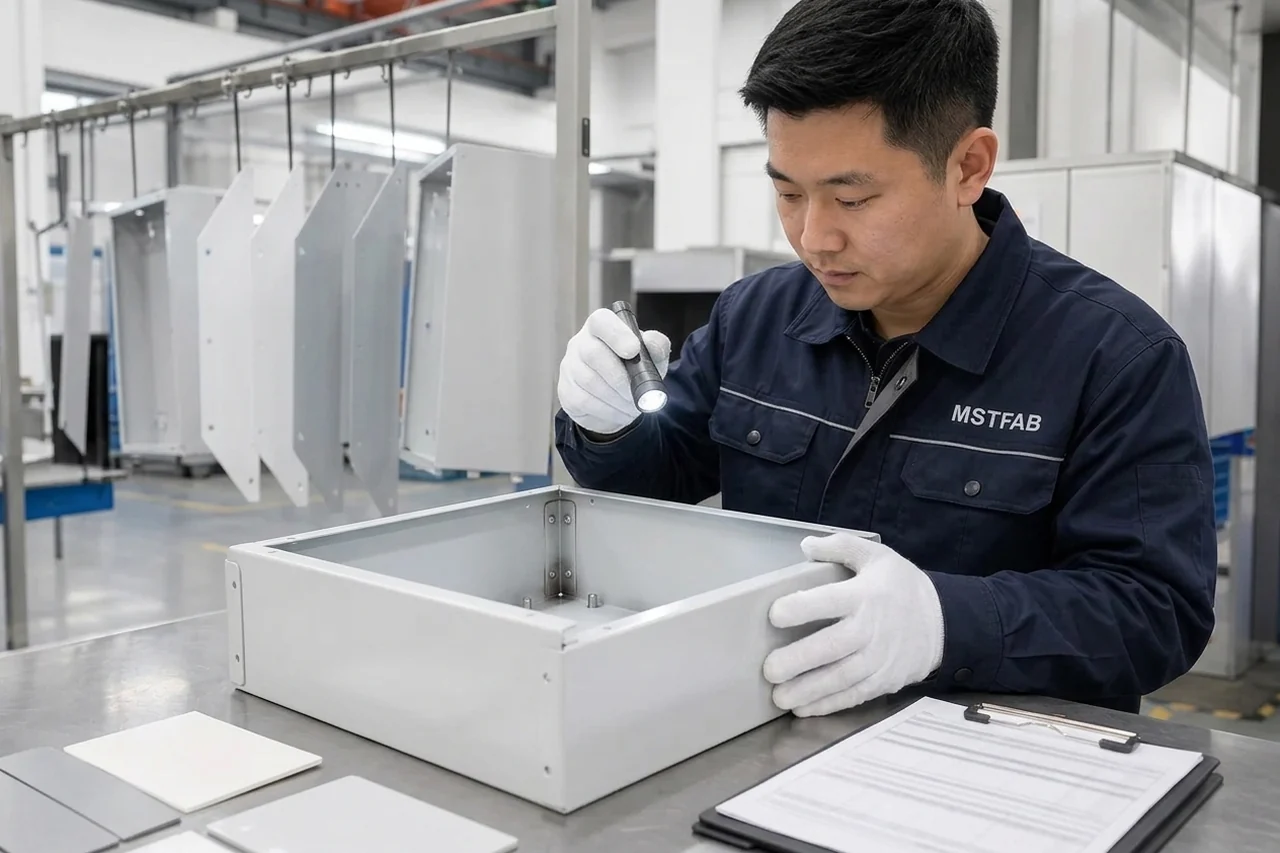
Step 03 — Silicone-Free Pretreatment, Masking & FIPFG Dispensing: Run multi-stage alkaline degrease and zinc-phosphate conversion, install high-temperature silicone caps and Kapton masking discs on ground bosses and gland-plate lands, cure silicone-free RAL 7035 powder at 65–85 µm DFT, and robotically dispense continuous 2K polyurethane FIPFG perimeter gaskets onto precision-cleaned inner door channels prior to final cure.
Step 04 — FAI Metrology, Seal Audit & Export Crating: Execute ISO 2768-mK optical CMM first-article dimensional inspection, 5-point magnetic DFT coating checks, <0.05 Ω 4-wire ground continuity testing, and full-perimeter chalk-transfer gasket verification before sealing completed shells inside anti-corrosion VCI bags, molded EPE corner guards, and heat-treated ISPM-15 export plywood crates for global shipment.
All raw sheets (SPCC, SGCC, SECC, SUS304/316L, Al 5052-H32/6061-T6) are verified via optical emission spectrometry (OES) or XRF upon arrival and linked by barcode to your purchase order.
Prior to export crating in ISPM-15 fumigated plywood boxes, our quality lab conducts ballooned dimensional FAI checks, dry-film thickness (DFT) mapping, ASTM D3359 cross-hatch adhesion testing, and ground-continuity verification.

05 / 8-Point OEM RFQ Checklist & Topic Cluster Hub
OEM Engineering RFQ Checklist & Connected Fabrication Hubs
Include these eight drawing and specification controls in your RFQ package so our engineering team can lock down tooling, material traceability, and inspection fixtures on day one:
- RFQ Requirement 01Native 3D STEP (.stp) assembly model plus 2D PDF drawings specifying general tolerances per ISO 2768-mK, critical datum references, and flat-pattern bend allowance notes for every enclosure sub-assembly.
- RFQ Requirement 02Exact steel grade and nominal sheet thickness specified per sheet-metal component, such as 1.5 mm SPCC JIS G 3141 outer shell body and 2.0 mm SGCC Z120 unpainted internal subplate.
- RFQ Requirement 03Explicit NEMA 12 and IP55 sealing specification noting silicone-free polyurethane FIPFG gasket path, target Shore 00 hardness range (25–35), and 30%–35% perimeter compression stop height.
- RFQ Requirement 04Powder-coat finish specification including exact RAL color code, gloss target (25–35 GU fine texture), cured DFT range (65–85 µm), and mandatory cleanroom silicone-free chemistry for fab compatibility.
- RFQ Requirement 05Detailed masking map identifying unpainted EMC grounding lands, removable gland-plate sealing flanges, lock-cam contact seats, and captive stud threads requiring high-temperature silicone caps before coating.
- RFQ Requirement 06Complete hardware BOM listing exact PEM, Southco, or Dirak part numbers (or approved functional equivalents) for 3-point compression rod latches, concealed lift-off hinges, and braided ground straps.
- RFQ Requirement 07Expected prototype lead time, quarterly production batch volume, first-article CMM dimensional report scope, and required EN 10204 3.1, RoHS, and REACH material certificate package per shipment lot.
- RFQ Requirement 08Export packaging specification detailing individual VCI anti-corrosion film bags, high-density EPE shock-absorbing corner protection, desiccant packs, and ISPM-15 heat-treated wooden pallet or plywood crating standards.
Explore Connected Sheet Metal Fabrication Services & Enclosure Hubs
06 / OEM Buyer & Engineer FAQ
Engineering FAQ: NEMA 12 Semiconductor Enclosure Fabrication
Why specify silicone-free powder coat and polyurethane FIPFG instead of silicone gaskets for semiconductor NEMA 12 shells?
Volatile cyclic siloxanes (D4 through D10) outgassing from conventional RTV silicone gaskets or silicone-modified coatings cause airborne molecular contamination (AMC) that hazes deep-UV lithography optics and degrades wafer gate-oxide yield inside cleanrooms and subfab corridors. Specifying a two-component closed-cell polyurethane (PU) FIPFG gasket paired with a certified silicone-free epoxy-polyester powder coat preserves full NEMA 12 dust and oil-drip protection while maintaining cleanroom outgassing compatibility. MSTFAB segregates silicone-free masking plugs and curing runs whenever specified on OEM drawings, keeping build-to-print lots free of siloxane cross-contamination.
Should internal subplates inside a NEMA 12 semiconductor cabinet be powder-coated or unpainted SGCC galvanized steel?
For high-noise servo amplifiers, RF generators, or VFD control enclosures, unpainted SGCC (hot-dip galvanized steel with clear RoHS trivalent passivation) is strongly preferred over powder-coated SPCC subplates. Unpainted zinc surfaces provide continuous, low-impedance ground planes (<0.05 Ω) directly beneath DIN rails, EMI filters, and copper ground bars without requiring assembly technicians to scrape paint under mounting screws. Where visual contrast demands a coated subplate, call out masked conductive lands at all earth bosses, PEM standoffs, and filter footprints on your 2D PDF drawing.
What minimum wall gauge and door reinforcement prevents gasket bypass on 1,000 mm+ tall NEMA 12 enclosures?
While 1.5 mm SPCC performs reliably for compact junction shells below 500 mm height, enclosures ≥800 mm tall should specify 1.5 mm to 2.0 mm SPCC outer bodies combined with 20 mm double-return door flanges and spot-welded vertical hat-section door stiffeners. Without internal stiffeners and a 3-point internal rod-latch mechanism, latch compression force concentrates solely at the center cam, allowing top and bottom door corners to deflect outward by 0.5 to 1.0 mm under gasket rebound load and fail NEMA 12 dust-tightness checks.
How does MSTFAB handle removable gland plates without creating a NEMA 12 leak path?
Removable bottom or top gland plates are laser-cut from 2.0 mm SGCC or SUS304 with captive M5 PEM studs spaced at 80 to 100 mm maximum centers around the full perimeter. Tighter stud pitch prevents sheet metal bowing between adjacent fasteners under gasket reaction force. We bond a continuous closed-cell EPDM seal or dispense a PU FIPFG perimeter bead onto the gland plate mating face, while masking a clean 5 mm conductive perimeter land whenever EMC cable-gland shield bonding is required for shielded motor or encoder cables.
Can MSTFAB apply a UL 50 or UL 508A sticker to custom NEMA 12 enclosure shells?
No—MSTFAB operates strictly as a build-to-print OEM sheet metal fabrication factory certified to ISO 9001:2015, IATF 16949:2016, and ISO 14001:2015, and we do not hold UL 50 or UL 508A panel-shop listings. We manufacture custom empty mechanical enclosure shells precisely to your 3D STEP and 2D PDF drawings and deliver complete material traceability (EN 10204 3.1 mill certificates), coating DFT and adhesion logs, and FAI CMM dimensional reports so your internal engineering team can complete UL or SEMI S2 qualification smoothly.
International Standards & Engineering References
- ISO 2768-1 / 2768-2 — General Linear, Angular and Geometrical Tolerances for Sheet Metal Fabrication
- IEC 60529 / NEMA 250 — Degrees of Protection Provided by Enclosures (IP Code & Environmental Sealing)
- ISO 9001:2015 & IATF 16949:2016 — Quality Management Systems & Production Part Approval Process (PPAP)
Ready to Quote Your Custom Sheet Metal Enclosure or Fabrication Project?
Upload your 3D STEP models and 2D PDF drawings. MSTFAB will review your tolerances, material specs, and DFM details to deliver a transparent factory quote within 24 hours.
Request Your 24-Hour DFM & Custom Quote →
Direct engineering desk: caroline@mstfab.com | ISO 9001 & IATF 16949 Certified Factory in Guangzhou, China
 WeChat Contact
 WhatsApp Me Directly