
ISO 9001:2015 Reorder Engineering Guide — EXECUTIVE TECHNICAL BRIEF
Agricultural OEMs sourcing galvanized steel control cabinets face a distinct manufacturing hazard: the First Article Inspection (FAI) sample fits perfectly, yet Lot 3 or Lot 4 arrives with shifted mounting centers, twisted door flanges, or premature edge rust around laser cutouts. Because off-highway telematics boxes, irrigation pump panels, and grain-silo sensor housings operate under constant vibration, UV radiation, and corrosive fertilizer mist, minor process drift between reorders causes immediate field assembly stalls. Under MSTFAB's ISO 9001:2015 and IATF 16949:2016 quality management systems, repeatable reorder performance relies on locking incoming SGCC/DX51D+Z275 coil metallurgy, freezing CNC press-brake bend deductions per heat lot, protecting nitrogen-cut edges, and enforcing strict engineering change control across every build-to-print mechanical shell batch.
- Coil & Mill Traceability: Require EN 10204 3.1 mill certificates tying every SGCC or DX51D+Z275 batch to heat number, zinc coating mass (180–275 g/m2), and tensile yield band within ±25 MPa so press-brake springback stays predictable across annual blanket releases.
- Revision-Locked Flat Patterns: Freeze K-factor bend deductions, laser kerf compensation, and NC turret/brake program IDs against the buyer's signed 2D PDF revision under ISO 9001:2015 Clause 8.3/8.5 to prevent silent tooling drift between Lot 1 FAI and Lot 10 reorders.
- Cut-Edge & Weld Zinc Restoration: Mandate nitrogen-assist fiber laser cutting plus zinc-rich epoxy primer or 75–95 µm outdoor TGIC polyester powder over zirconium pretreatment, restoring galvanic edge defense against urea, ammonia, and humid washdown spray.
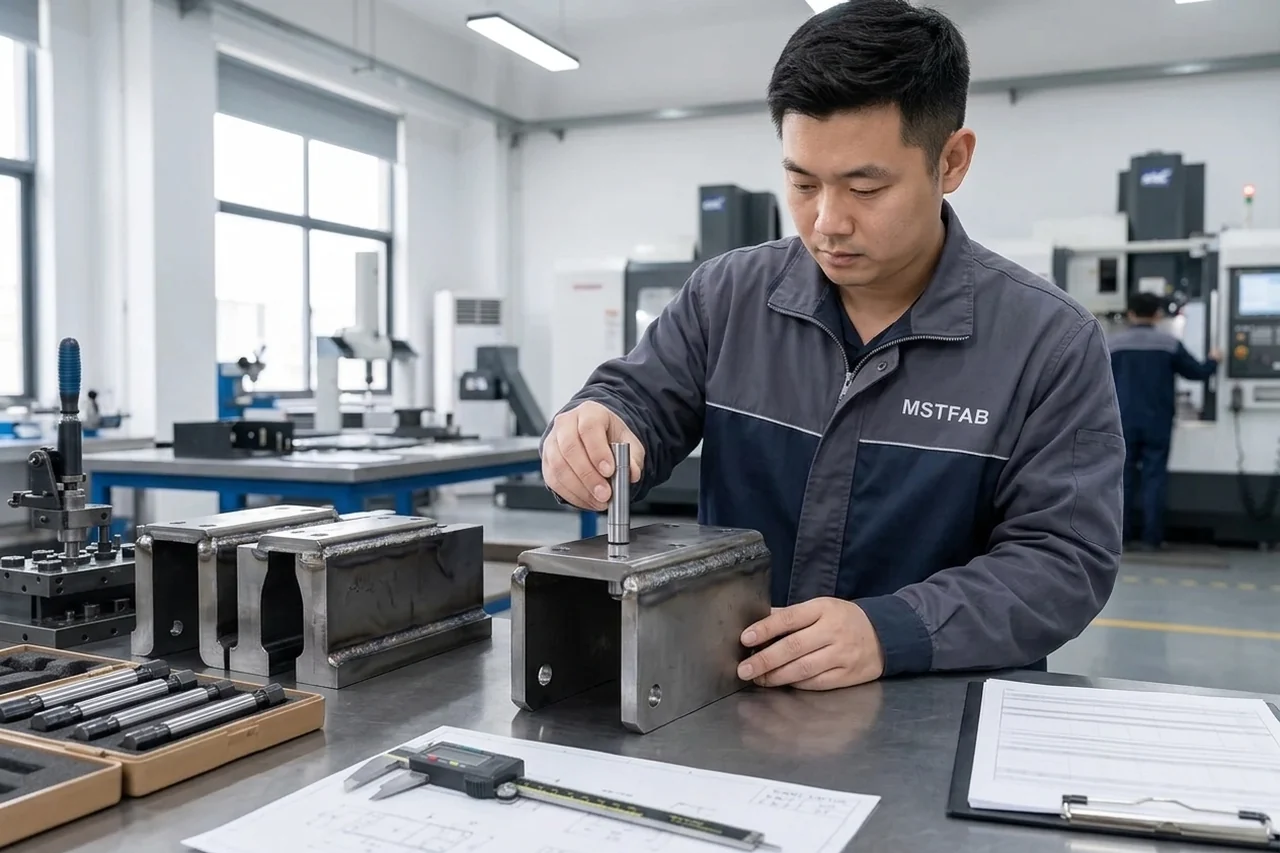
- Reorder SPC & Pin-Gauge Checks: Hold ISO 2768-mK dimensional stability with Cpk >= 1.33 on critical mounting hole pitch (±0.15 mm) and door-seal flange compression (±0.25 mm) using dedicated go/no-go check fixtures on every 25th shell.
Every project at MSTFAB includes a complimentary 24-hour CAD Design-for-Manufacturing (DFM) audit, heat-number-traceable EN 10204 3.1 mill certificates, and a ballooned First Article Inspection (FAI) report prior to volume release.
01 / Engineering Specifications & Comparison Matrix
ISO 9001 Reorder Control & Galvanized Enclosure Spec Matrix
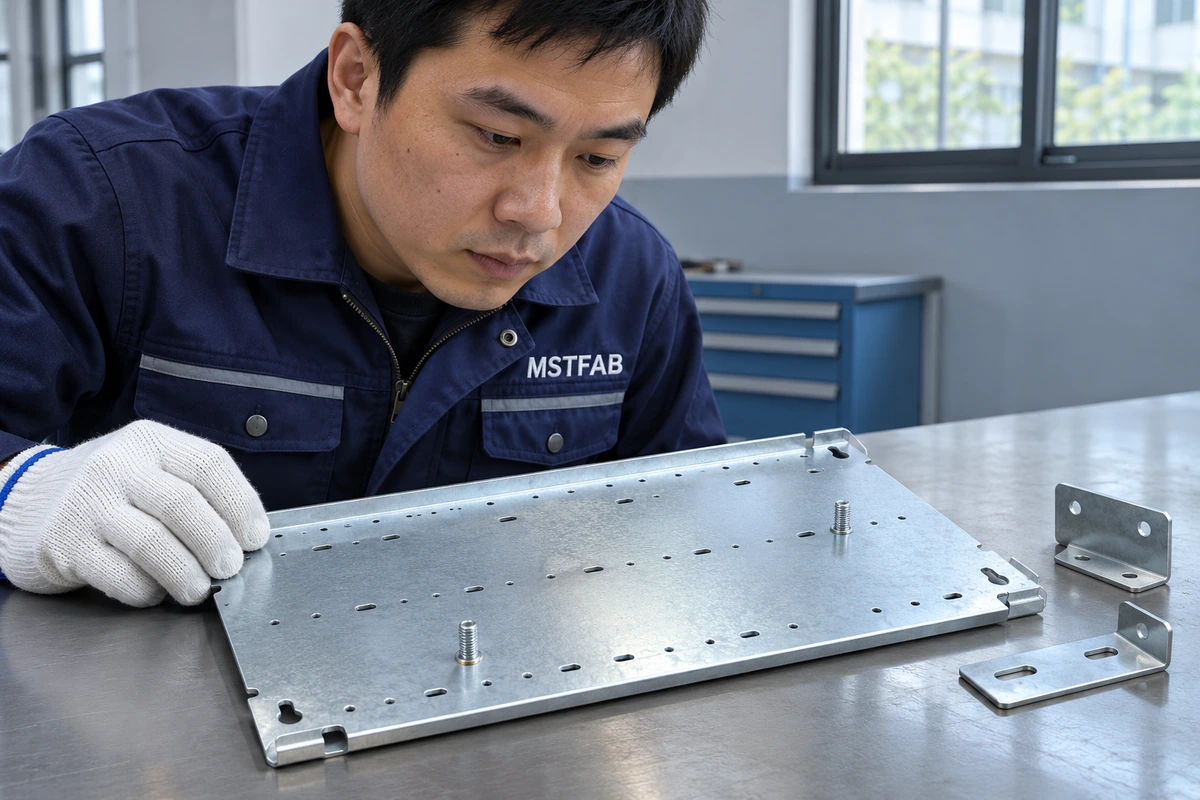
Consistent agricultural enclosure reorders depend on converting subjective craftsmanship into auditable numeric gates from coil receiving through crating. On galvanized sheet metal (SGCC per JIS G3302 or DX51D+Z275 per EN 10346), mill-to-mill variations in base-steel carbon content, temper rolling, and hot-dip zinc spangle thickness directly alter press-brake bend radii and powder-coat outgassing behavior. Without locked specification bands, a shop trying to hold standard ISO 2768-mK tolerances will see mounting brackets wander out of fixture alignment within two or three production quarters. The matrix below defines the exact material, forming, welding, coating, and traceability benchmarks MSTFAB enforces so OEM agricultural buyers receive identical mechanical shells across every release.
Each parameter below is verified during incoming raw material quarantine, in-process CNC stage checks, and final First Article Inspection (FAI) before shipment release:
| Engineering Parameter / Zone | Material & Process Specification | Target Tolerance / Performance Standard | Inspection Method & OEM Value |
|---|---|---|---|
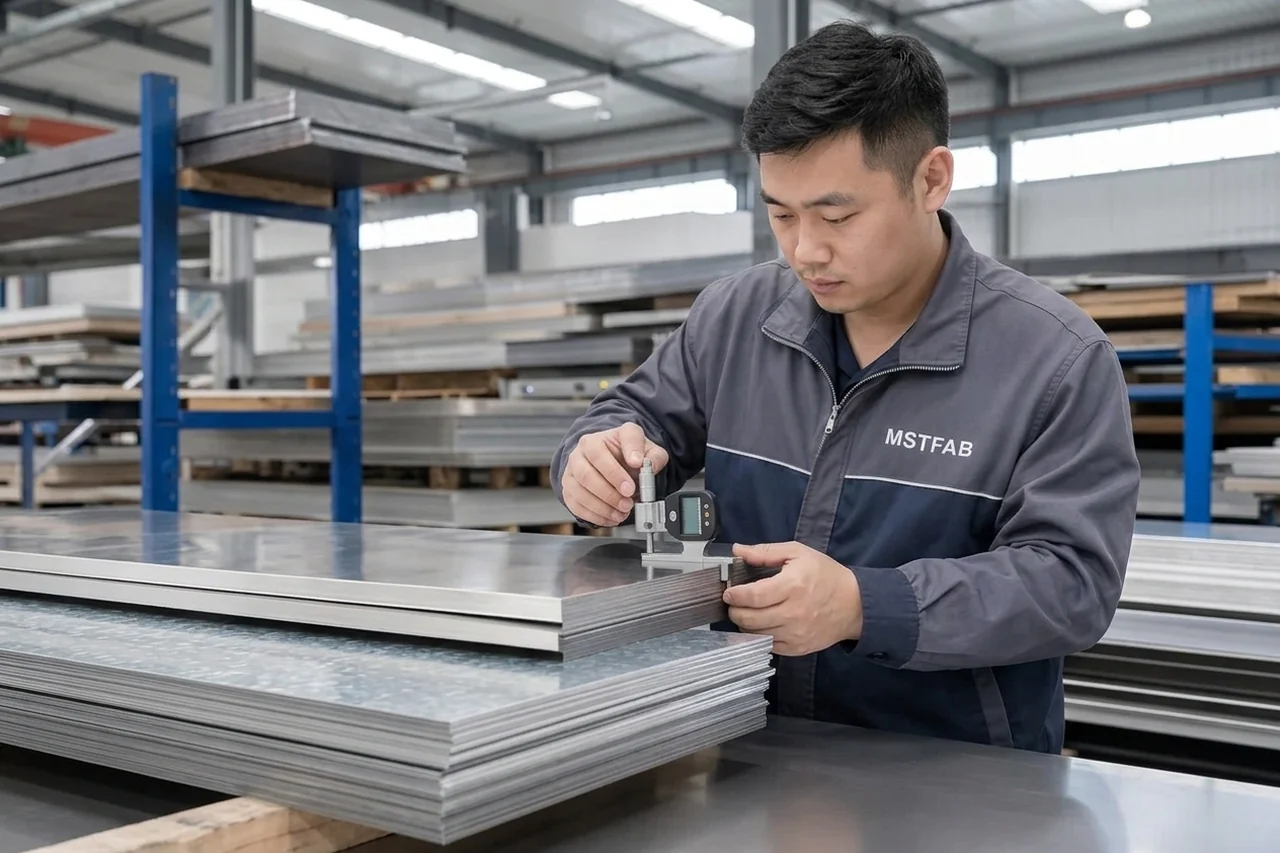
| Raw Coil Metallurgy & Zinc Mass | SGCC (JIS G3302) or DX51D+Z275 (EN 10346), 1.5–2.5 mm thick, 275 g/m2 total zinc coating mass. | Thickness ±0.06 mm; Yield Strength gated 240–280 MPa; Zinc mass >= 275 g/m2 triple-spot. | Review EN 10204 3.1 mill certificate; verify sheet thickness (±0.06 mm) via calibrated micrometer on 3 coil zones: Eliminates unannounced coil hardness jumps that cause press-brake springback drift and inconsistent latch engagement on reorders. |
| Laser Kerf & Formed Mounting Pitch | Nitrogen-assist fiber laser cut blanks formed on CNC press brakes with revision-locked K-factor bend deductions. | ISO 2768-mK general; ±0.15 mm on CTF mounting hole centers; ±0.5 degrees on 90-degree return flanges. | Digital height gauge and optical CMM scan on 5-piece FAI and every 25th shell per production batch: Guarantees tractor, combine, and irrigation pump sub-assemblies drop straight onto cabinet studs without field reaming. |
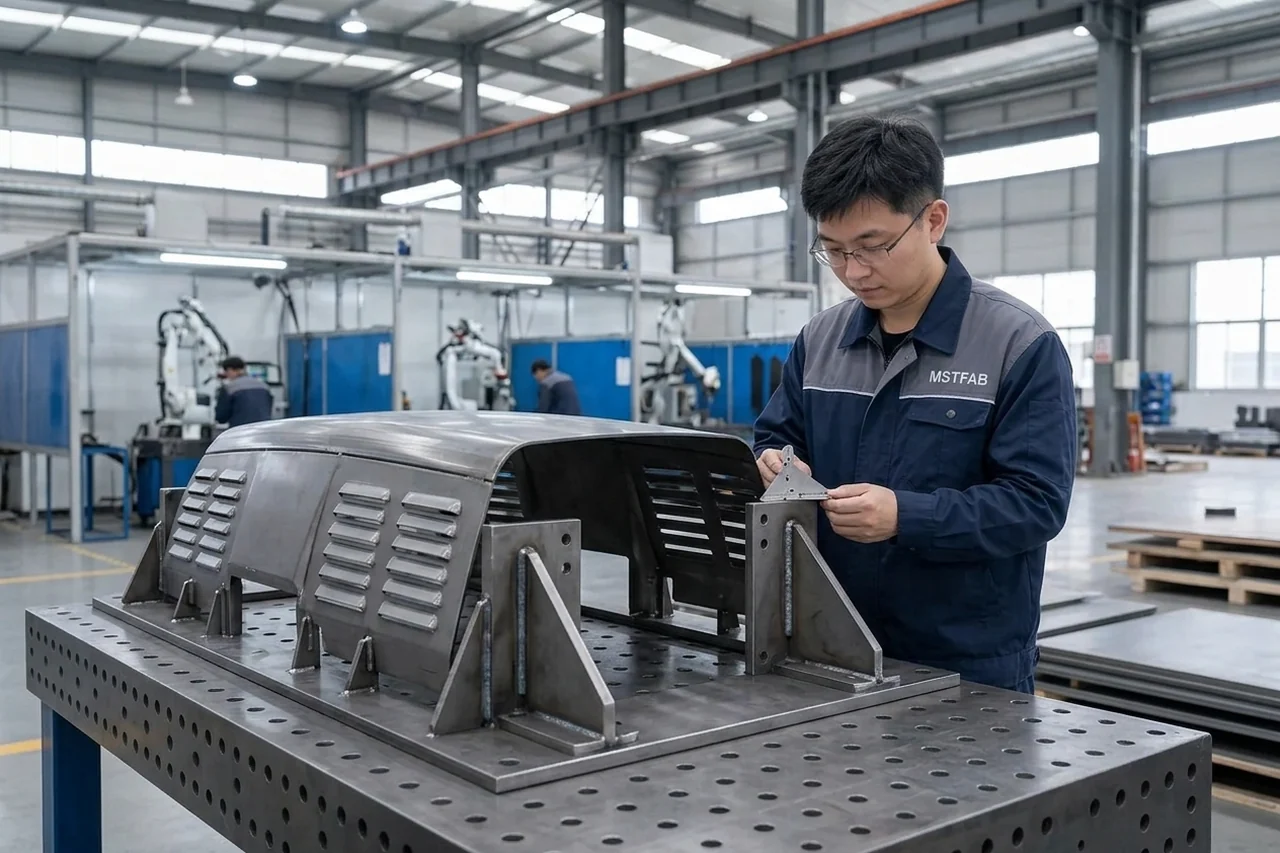
| Corner Seam Welds & HAZ Restoration | Continuous exterior corner TIG seam welds ground flush, mechanically cleaned, and sealed with zinc-rich epoxy primer. | Zero pinholes; ground flush within +0.10/-0.05 mm of parent sheet; minimum 25 µm zinc-primer barrier. | 100% backlit visual weld check plus destructive coupon pull test at shift start; zinc-primer DFT check: Restores sacrificial cathodic protection where welding heat vaporizes zinc, stopping corner red rust in humid barns. |
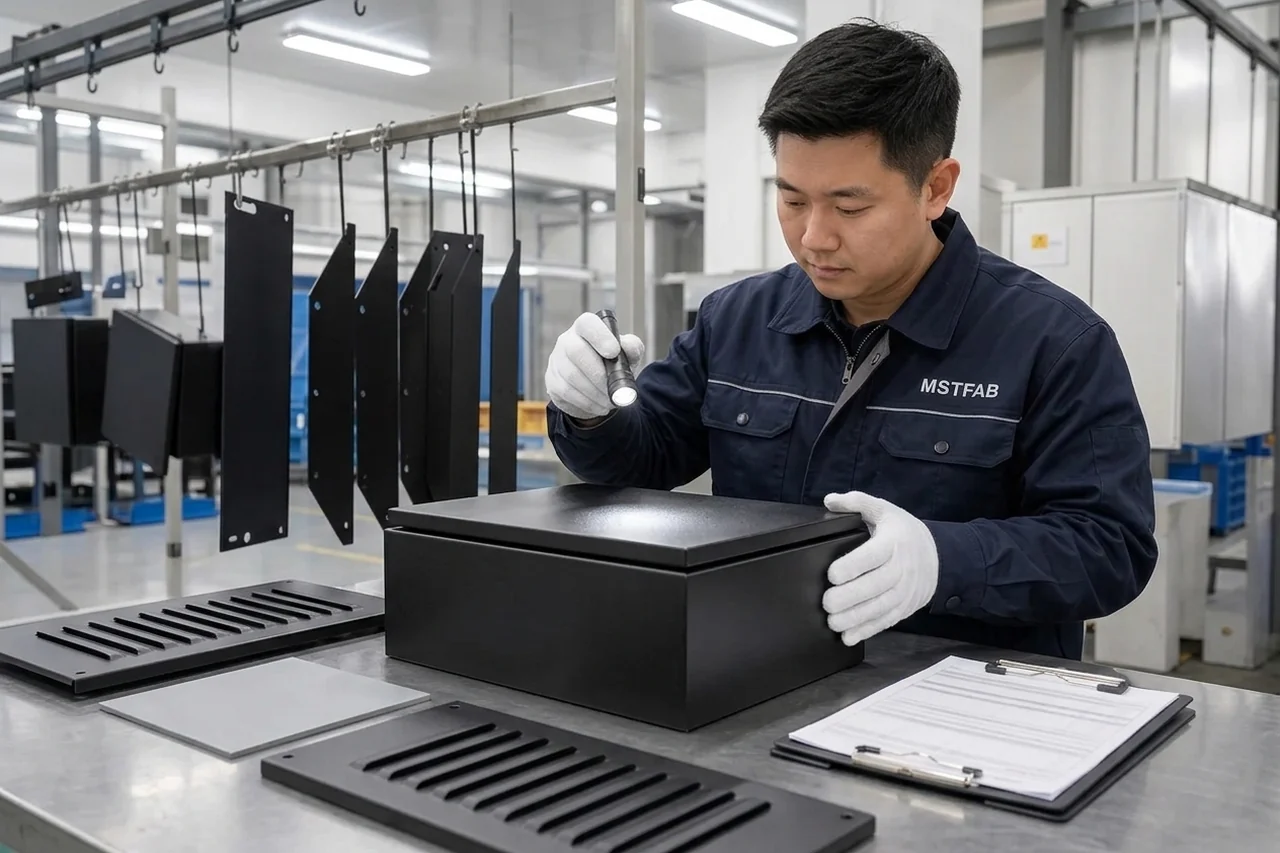
| Surface Pretreatment & Outdoor Coating | Zirconium conversion pretreatment followed by UV-stabilized outdoor TGIC polyester powder coat (RAL 7035 / OEM color). | 75–95 µm cured DFT on exterior faces; ISO 2409 Class 0 adhesion; 500–720 hr ASTM B117 coupon validation. | PosiTector magnetic DFT gauge across 5 zones per shell; ISO 2409 cross-hatch tape adhesion and MEK cure rub: Prevents UV chalking, fertilizer chemical blistering, and edge peeling across multi-year outdoor deployment cycles. |
| Captive Hardware & Grounding Continuity | 304 stainless steel PEM blind standoffs/studs and masked M6 copper-plated chassis earth studs. | Thread gauge GO/NO-GO 6H/6g pass; push-out >= 1.8 kN; earth stud resistance < 0.05 ohm post-coat. | Calibrated torque wrench and push-out gauge on setup coupons; 100% visual check of silicone masking plugs: Maintains vibration-proof fastener retention on off-highway implements while preserving reliable electrical ground continuity. |
02 / Sheet Metal DFM & Structural Controls
Top 3 DFM Failure Modes in Recurring Agricultural Enclosure Orders
Agricultural enclosures fail on repeat production lots far more often from material-lot drift, cut-edge oxidation, and unlogged drawing tweaks than from initial prototype errors. Engineering out these three shop-floor failure modes before Lot 1 freezes ensures every quarterly reorder bolts straight onto field machinery without shimming or rework.
Coil Yield-Strength Drift Breaking Flange Pitch on Multi-Lot Reorders
Failure Mechanism: Switching hot-dip galvanized coils between mill heats shifts yield strength by 40–70 MPa and zinc coating thickness by ±12 µm. Running the same CNC press-brake punch depth causes 1.5–2.5 degrees of springback drift, throwing M5/M6 PEM stud pitch out of alignment with tractor or pump harnesses.
Engineering Solution: Lock EN 10204 3.1 yield-strength acceptance bands at incoming QC and calibrate K-factor bend allowance on a 3-piece coupon check at every new coil heat number, saving the verified CNC press-brake angle offset under a revision-locked part program.
Verified Outcome: Maintains Cpk >= 1.33 on flanged hole-to-hole mounting patterns across multi-year OEM reorder lots.
Oxygen-Cut Oxide Kerfs Causing Premature Edge Rust in Fertilizer Environments
Failure Mechanism: Cutting 1.5–2.5 mm SGCC Z275 with oxygen assist gas creates brittle iron-oxide scale along laser kerfs and vaporizes sacrificial zinc 0.4 mm back from the edge. Direct powder coating over uncleaned oxide edges blisters within one season of liquid fertilizer and ammonia vapor exposure.
Engineering Solution: Specify nitrogen-assisted fiber laser cutting to leave oxide-free bright kerfs, pair with zirconium or zinc-phosphate conversion pretreatment, and apply a zinc-rich epoxy primer or edge-wrapping 75–95 µm outdoor TGIC polyester powder coat.
Verified Outcome: Achieves zero edge blistering after 720-hour ASTM B117 salt-spray exposure on production coupons.
Uncontrolled Silent Drawing Tweaks Mixing Legacy Brackets Into Current Lots
Failure Mechanism: When agricultural OEMs email minor hole-size or bracket tweaks without formal revision increments, legacy nesting files and press-brake backgauge stops linger on the shop floor. Mixed Revision A and Revision B enclosure bodies then ship in the same pallet, halting field wiring harnesses.
Engineering Solution: Enforce ISO 9001:2015 Clause 8.5.6 change control by tying ERP work orders, DXF flat patterns, and laser NC files to the exact 2D PDF revision letter, physically quarantining obsolete brake templates and requiring signed ECR approval before cutting.
Verified Outcome: Eliminates mixed-revision shipments and reduces incoming QA disposition delays on recurring quarterly blanket orders.
Manufacturing Scope Boundary: Build-to-Print Commercial & Testing Scope Boundary: MSTFAB manufactures custom empty galvanized sheet metal enclosure shells strictly to OEM build-to-print specifications; we do not stock off-the-shelf catalog boxes or perform electrical harness assembly, PCB potting, or agency field testing on powered farm controllers. — Engineering Fix: Provide frozen 3D STEP plus 2D PDF drawings calling out critical mounting datums, annual volume bands, and target IP/salt-spray thresholds so MSTFAB can lock hard gauge fixtures and coil-lot SPC checks into your recurring build plan. MSTFAB manufactures custom sheet metal parts and empty mechanical enclosure shells strictly to your 3D STEP and 2D PDF drawings.
03 / Representative Engineering Scenario & Process Control
Case Study: Eliminating Lot-to-Lot Springback Drift in SGCC Z275 Irrigation Controller Enclosures
Project Profile: 350 pcs/quarter | 2.0 mm SGCC + Z275 Hot-Dip Galvanized | Nitrogen Laser + CNC Bend + TIG Corner Seal | 85 µm TGIC RAL 7035 Polyester Powder Coat
OEM Engineering Challenge: A European precision-irrigation OEM sourcing 350-unit quarterly batches of 2.0 mm SGCC Z275 pump-controller cabinets suffered 14% assembly-line rework on Lot 3 after an unannounced coil-supplier switch raised sheet yield strength from 245 MPa to 315 MPa. Increased press-brake springback shifted flange angles to 92.5 degrees, opening a 1.6 mm top-corner gap in the door seal and pushing PEM M6 mounting hole centers 0.55 mm off nominal against die-cast aluminum pump-head castings.
MSTFAB Manufacturing Solution: MSTFAB audited the OEM 3D STEP and 2D PDF drawings, froze Revision C across ERP work orders, and mandated EN 10204 3.1 mill certificates gating yield strength within 240–280 MPa before coil release. Our engineers ran a 5-piece first-article calibration per coil heat lot, updating CNC press-brake V-die crowning and K-factor bend deductions in the locked NC program while deploying go/no-go pin-gauge fixtures for every 25th welded cabinet shell.
- Cpk >= 1.52 on Critical Mounting Centers: Enforced coil heat-lot tensile gating and dynamic press-brake bend correction, cutting mounting-pitch rejects from 14% to 0.3% across four consecutive quarterly reorders.
- Zero IP65 Seal Failures Across 1,400 Cabinets: Locked closed-loop angle measurement and zinc-rich cut-edge sealing, eliminating field gasket weep and red-rust edge creep in 720-hour salt-spray checks.
- 65% Faster Incoming QC Clearance: Standardized revision-controlled NC bend programs and pre-shipment FAI packets, trimming incoming receiving inspection time at the OEM plant.
Every production lot is archived with locked CNC laser nests, press-brake bend programs, weld fixture setups, and signed golden samples to guarantee identical repeatability across multi-year reorders.
04 / Quality Verification, Traceability & Surface Finishing
4-Stage Manufacturing Workflow, Surface Treatment & Metrology Control
To maintain Cpk ≥ 1.33 on critical-to-quality (CTQ) dimensions from prototype through series production, MSTFAB executes a closed-loop four-stage fabrication protocol:
Step 01 — Drawing Freeze & DFM Alignment: Engineers cross-check your 3D STEP and 2D PDF drawings for K-factor realism, bend-relief clearances near mounting cutouts, nitrogen laser kerf compensation, and zinc-coating compatibility, issuing a written DFM report before locking Revision A/B/C in our ERP.
Step 02 — Heat-Lot Gating & CNC Tooling Lock: Incoming SGCC or DX51D+Z275 coils are quarantined until EN 10204 3.1 mill certs confirm yield strength and Z275 coating mass. Each laser nest and press-brake bend program is locked to the heat number via a 5-piece calibrated coupon test.
Step 03 — Weld Remediation, Masking & Curing: After corner TIG welding and flush grinding, operators restore weld heat-affected zones with zinc-rich primer, mask earth studs with silicone caps, execute zirconium pretreatment, and cure 75–95 µm outdoor TGIC polyester powder while logging magnetic DFT readings across every rack.
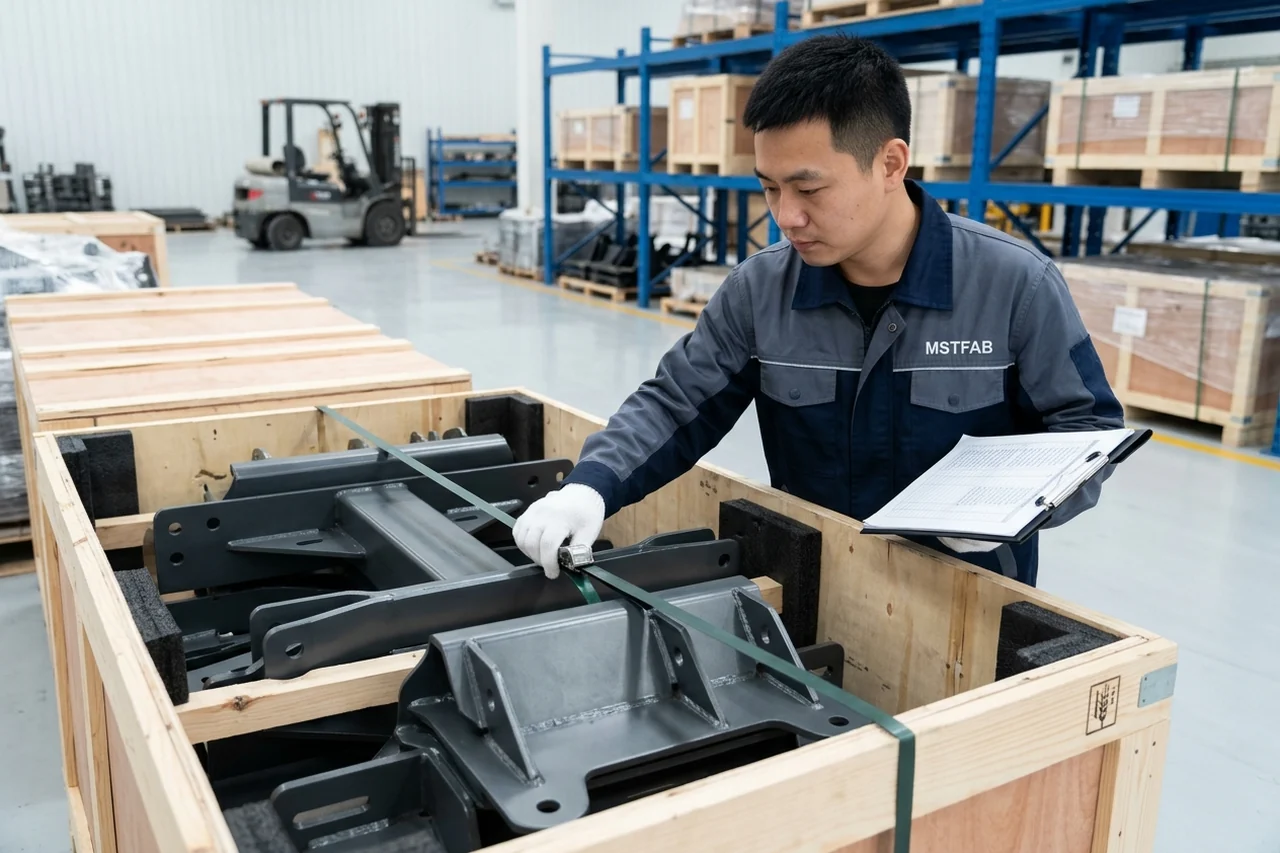
Step 04 — SPC Audit, FAI Packet & VCI Crating: Quality technicians validate CTF mounting pitches on CMM/pin gauges (Cpk >= 1.33), seal FAI dimensional packets alongside RoHS/REACH and mill certs, and pack shells in VCI film plus EPE corner guards inside ISPM-15 export crates.
All raw sheets (SPCC, SGCC, SECC, SUS304/316L, Al 5052-H32/6061-T6) are verified via optical emission spectrometry (OES) or XRF upon arrival and linked by barcode to your purchase order.
Prior to export crating in ISPM-15 fumigated plywood boxes, our quality lab conducts ballooned dimensional FAI checks, dry-film thickness (DFT) mapping, ASTM D3359 cross-hatch adhesion testing, and ground-continuity verification.
05 / 8-Point OEM RFQ Checklist & Topic Cluster Hub
OEM Engineering RFQ Checklist & Connected Fabrication Hubs
Include these eight drawing and specification controls in your RFQ package so our engineering team can lock down tooling, material traceability, and inspection fixtures on day one:
- RFQ Requirement 01Specify exact galvanized grade and coating mass (e.g., SGCC Z275 or DX51D+Z275 per EN 10346) plus EN 10204 3.1 mill cert requirement.
- RFQ Requirement 02Supply matched native 3D STEP and fully dimensioned 2D PDF drawings with explicit revision letter and critical-to-function (CTF) datum callouts.
- RFQ Requirement 03Define general tolerances per ISO 2768-mK and flag tight hole-to-hole mounting centers (±0.15 mm) requiring go/no-go gauge verification.
- RFQ Requirement 04State laser assist gas preference (nitrogen for clean paintable edges) and mandatory zinc-rich primer restoration over any ground exterior TIG welds.
- RFQ Requirement 05Specify powder chemistry (outdoor TGIC polyester, UV-stabilized), exact RAL code, gloss level, and 75–95 µm cured dry-film thickness (DFT) range.
- RFQ Requirement 06Identify all keep-out masking zones including M6 earthing studs, DIN rail mounting bosses, and door-latch grounding contact pads.
- RFQ Requirement 07Indicate captive PEM hardware series (stainless CLS/FH or blind CSOS), installation side, and minimum push-out/torque-out verification frequency.
- RFQ Requirement 08Define recurring lot packaging requirements including VCI moisture barrier bags, EPE edge protectors, lot-label barcodes, and ISPM-15 crating.
Explore Connected Sheet Metal Fabrication Services & Enclosure Hubs
06 / OEM Buyer & Engineer FAQ
Agricultural Enclosure Reorder Engineering FAQs
What quality certifications and lot documentation does MSTFAB supply for recurring agricultural enclosure orders?
MSTFAB holds ISO 9001:2015, IATF 16949:2016, and ISO 14001:2015 certifications for custom sheet metal manufacturing and empty mechanical enclosure fabrication. We tie every reorder to the buyer's frozen 3D STEP and 2D PDF revision under formal engineering change control. For each batch, we provide EN 10204 3.1 mill certificates, RoHS/REACH material declarations, FAI/SPC dimensional reports, and coating DFT/adhesion logs to support the OEM's own product compliance files.
Should we specify SGCC or DX51D+Z275 galvanized steel on our 2D drawings for outdoor farm equipment?
SGCC (JIS G3302) and DX51D+Z275 (EN 10346) perform comparably when zinc coating mass is matched, with Z275 (275 g/m2 total both sides) strongly preferred over Z120 for outdoor agricultural washdown and fertilizer exposure. Because Chinese, Japanese, and European mills use slightly different base-steel chemistries, yield strength can span 210–320 MPa. Specifying a bounded yield window plus Z275 minimum coating weight in the 2D drawing prevents springback surprises when switching regional mills.
How do you protect welded corners and laser-cut edges on galvanized steel against red rust?
After CNC press-brake bending, every exterior corner seam is TIG-welded and ground flush, which locally burns off the sacrificial zinc layer along a 3–5 mm heat-affected zone. To prevent rust initiation along welded corners, we brush-blast or mechanically clean weld discoloration, apply a cold-galvanizing zinc-rich epoxy primer over the weld track, run multi-stage zirconium conversion pretreatment, and cure 75–95 µm of UV-stable TGIC polyester powder coat across the entire shell.
Can captive PEM fasteners hold reliably in 1.5 mm to 2.0 mm galvanized steel under tractor vibration?
Yes, provided you specify sealed blind-hole PEM standoffs (such as CSOS) or captive stainless weld studs inside the seal boundary rather than open-barrel nuts that penetrate outdoor walls. For high-vibration tractor and harvester mounts, we verify installation press-force curves and run destructive torque-out and push-out coupon checks at lot startup, maintaining ISO 2768-mK ±0.15 mm hole-to-hole accuracy without weakening thin 1.5–2.0 mm galvanized walls.
How do you prevent bend-angle drift between production runs spaced six months apart?
Before cutting Lot 2 or Lot 5, our incoming QC verifies coil thickness with calibrated micrometers and logs the mill heat number's yield strength. Our press-brake technicians bend a 3-piece trial coupon using the revision-locked NC program, verify flange angle with a digital protractor and height gauge, and apply micro-crowning compensation only if coil springback shifts by more than 0.3 degrees—never altering the underlying flat-pattern DXF without an approved ECR.
International Standards & Engineering References
- ISO 2768-1 / 2768-2 — General Linear, Angular and Geometrical Tolerances for Sheet Metal Fabrication
- IEC 60529 / NEMA 250 — Degrees of Protection Provided by Enclosures (IP Code & Environmental Sealing)
- ISO 9001:2015 & IATF 16949:2016 — Quality Management Systems & Production Part Approval Process (PPAP)
Ready to Quote Your Custom Sheet Metal Enclosure or Fabrication Project?
Upload your 3D STEP models and 2D PDF drawings. MSTFAB will review your tolerances, material specs, and DFM details to deliver a transparent factory quote within 24 hours.
Request Your 24-Hour DFM & Custom Quote →
Direct engineering desk: caroline@mstfab.com | ISO 9001 & IATF 16949 Certified Factory in Guangzhou, China
 WeChat Contact
 WhatsApp Me Directly