
EVSE & IATF 16949 DFM GUIDE — EXECUTIVE TECHNICAL BRIEF
Commercial EV chargers—from 22 kW AC pedestals to 360 kW DC fast-charging cabinets—operate outdoors for 10+ years under public vandalism, coastal salt fog, thermal cycling, and strict automotive-OEM quality mandates. Common field and production failures stem from water bypass through poorly baffled cooling louvers, powder-coat insulation over equipotential grounding studs, and door-panel oil-canning under 20 J IK10 impact loads. Certified directly to IATF 16949:2016, ISO 9001:2015, and ISO 14001:2015, MSTFAB manufactures build-to-print galvanized steel EVSE shells from customer 3D STEP and 2D PDF drawings using PPAP Level 3 process controls, SPC-verified laser-angle bending (Cpk >= 1.33), dual-coat 1,500-hour corrosion barriers, and precision masking—giving EVSE OEMs repeatable mechanical reliability at scale.
- IATF 16949 PPAP & SPC Control: Manufactured under MSTFAB's certified IATF 16949:2016 QMS with full PPAP Level 3 submissions, PFMEA, Control Plans, and laser-monitored press-brake forming holding Cpk >= 1.33 across door-gap and lock-cutout CTQ dimensions.
- Coastal Anti-Corrosion System: 2.0 mm DX51D+Z275 galvanized steel finished with zinc-rich epoxy primer (40–50 µm) plus UV-stabilized polyester powder coat (75–90 µm, total DFT 115–140 µm) passes 1,500 h ISO 9227 salt spray and 1,000 h QUV-A (ΔE <= 1.5).
- IK10 & IP55 Labyrinth Architecture: Hat-stiffened 2.0 mm doors with concealed stainless hinges resist 20 J IK10 impacts (IEC 62262), while 35° progressive louvers backed by Z-baffle plenums achieve IEC 60529 IP55 rain protection without choking fan static pressure.
- Masked Bonding & EMI Integrity: Silicone-masked M6 copper-plated CD weld studs and chromate-masked EMI gasket tracks guarantee < 0.05 Ω protective earth continuity per IEC 61851-1 and zero manual paint scraping on the OEM final assembly line.
Every project at MSTFAB includes a complimentary 24-hour CAD Design-for-Manufacturing (DFM) audit, heat-number-traceable EN 10204 3.1 mill certificates, and a ballooned First Article Inspection (FAI) report prior to volume release.
01 / Engineering Specifications & Comparison Matrix
IATF 16949 EV Charger Enclosure Engineering & PPAP Control Matrix
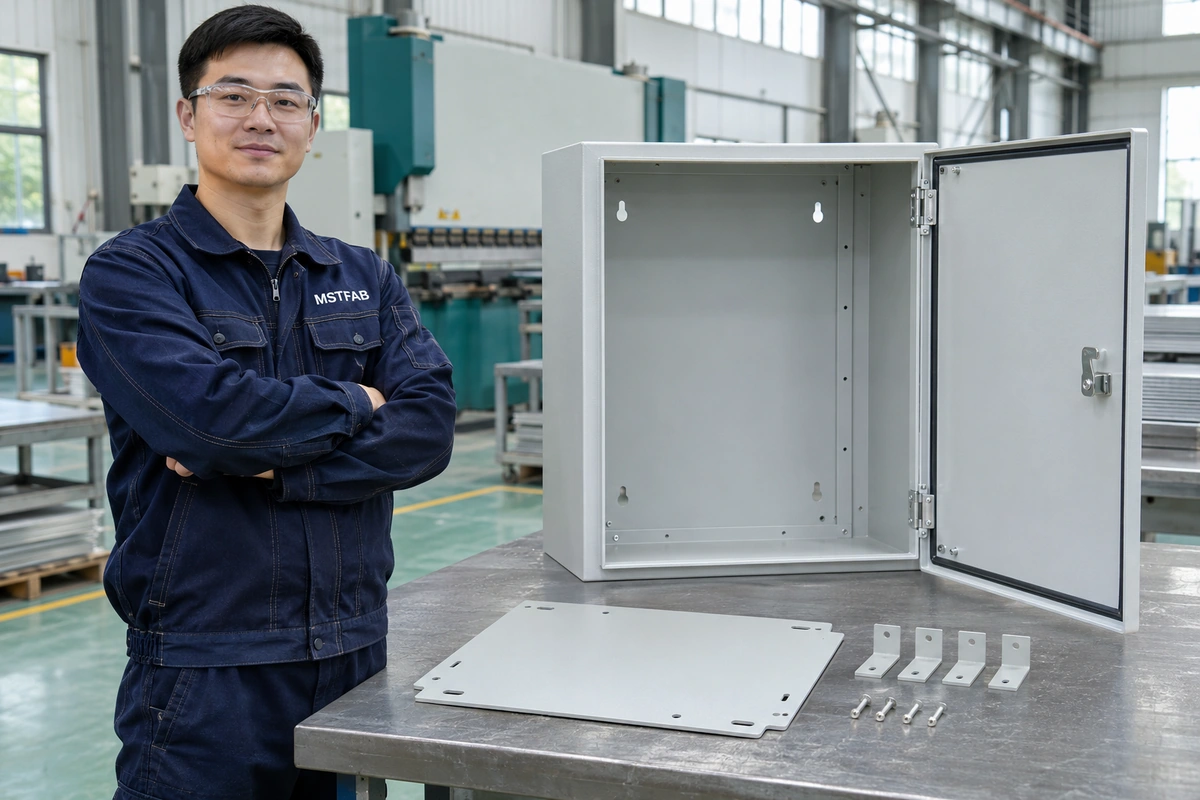
Electric vehicle supply equipment (EVSE) enclosures must survive simultaneously as architectural street furniture, high-voltage EMI/grounding shields, thermal management ducts, and IK10 vandal-resistant armor. Under IATF 16949:2016 production standards, achieving consistent field performance at 1,000+ unit annual volumes requires locking down process capability (Cpk) on bend angles, weld-stud placement, dual-coat dry-film thickness, and IP55 louver baffle clearances rather than relying on post-production rework. The specification matrix below links each critical EVSE enclosure subsystem—from Z275 structural gauge selection and laser-monitored forming to masked equipotential bonding and 1,500-hour coastal salt-spray resistance—directly to shop-floor metrology and PPAP control limits so EVSE OEMs can qualify MSTFAB tooling with zero assembly-line surprises.
Each parameter below is verified during incoming raw material quarantine, in-process CNC stage checks, and final First Article Inspection (FAI) before shipment release:
| Engineering Parameter / Zone | Material & Process Specification | Target Tolerance / Performance Standard | Inspection Method & OEM Value |
|---|---|---|---|
| Galvanized Gauge & Structural Plinth | DX51D+Z275 hot-dip galvanized sheet: 2.0 mm outer skins/doors, 1.5 mm internal air baffles, 3.0 mm anchor base plinth. | Thickness ±0.08 mm; zinc mass >= 275 g/m²; plinth flatness <= 0.50 mm across 800 mm base footprint. | XRF zinc-mass scan and incoming coil thickness audit cross-checked against EN 10204 3.1 mill test certificates per batch: Provides structural stiffness for IK10 resistance and a heavy base anchor without resorting to high-cost stainless frames. |
| SPC-Controlled Forming & Reveals | CNC fiber laser blanking and servo press-brake forming with inline laser angle correction on door returns and lock cutouts. | Bend angle ±0.35°; door-to-frame reveal 2.5 mm ±0.40 mm; CTQ dimensions held at Cpk >= 1.33. | Real-time optical laser angle feedback during pressing plus 30-piece SPC capability study across door and hinge datums: Eliminates field door rub, ensures consistent latch cam engagement, and maintains uniform aesthetic reveals across multi-cabinet sites. |
| UV & Coastal Dual-Coat Finish | Zirconium-silane conversion + 40–50 µm zinc-rich epoxy primer + 75–90 µm super-durable UV polyester powder coat (RAL 7016/9003). | Total DFT 115–140 µm; 1,500 h salt spray <= 2.0 mm creepage; QUV-A 1,000 h ΔE <= 1.5; gloss ±5 GU. | PosiTector DFT grid inspection, 5B cross-hatch adhesion test, color spectrophotometer (ΔE), and 1,500 h ISO 9227 test plaques: Protects public roadside chargers against coastal salt fog, de-icing road spray, and 10-year solar UV chalking. |
| Equipotential Bonding & Masking | Robotic CD-welded M6 copper-plated grounding studs and chromate-masked EMI fingerstock landings protected by molded silicone caps. | Door-to-chassis bonding resistance <= 0.05 Ω (well below 0.1 Ω IEC 61851-1 limit); zero paint bleed within 2.0 mm of stud collar. | 4-wire micro-ohmmeter continuity check on 100% of finished doors and visual masking edge audit under calibrated LED light: Eliminates manual paint-scraping rework on the OEM assembly line and ensures repeatable protective earth and CISPR EMI performance. |
| IP55 Louver & FIPG Airflow Path | Progressive-tool 35° downward intake louvers paired with Z-baffle water-separation plenum, bottom drains, and polyurethane FIPG door seal. | Baffle overlap >= 15 mm; FIPG bead height 4.5 mm ±0.4 mm; zero water droplets inside HV compartment post-IP55 test. | IEC 60529 IP55 water-jet nozzle audit (12.5 mm nozzle, 100 L/min) on prototype units and caliper check of baffle overlap: Delivers >= 65% free airflow for 150–360 kW power-module cooling while blocking wind-driven rain and road splash. |
| IK10 Impact Reinforcement & Locks | 2.0 mm SGCC door reinforced by spot-welded 22 mm hat-section stiffeners, concealed stainless hinges, and 3-point swing-handle locks. | Spot-weld pitch 80 mm ±5 mm; permanent door deflection <= 1.5 mm after 20 J IK10 impact; zero latch release. | IEC 62262 20 J pendulum hammer test on prototype doors and ultrasonic spot-weld nugget diameter audit per IATF Control Plan: Prevents unauthorized cabinet entry, protects brittle HMI glass displays, and satisfies municipal public-deployment durability specs. |

02 / Sheet Metal DFM & Structural Controls
Sheet Metal DFM Failure Modes in Outdoor EV Charger Cabinets
Outdoor AC wallboxes and DC fast-charger cabinets face simultaneous structural, thermal, electrical-bonding, and weatherproofing demands under IATF 16949 automotive-grade scrutiny. Resolving these three recurring sheet metal failure modes early in DFM eliminates IP55 test failures, EMI grounding rework, and IK10 structural rejections.
Wind-Driven Rain Bypass Through Straight-Through EVSE Cooling Louvers
Failure Mechanism: Simple stamped louvers in outdoor EVSE doors permit wind-driven rain and IP55 water jets to rebound off internal louver hoods directly onto high-voltage rectifier modules and DC busbars, causing insulation-resistance faults and catastrophic ground trips.
Engineering Solution: Form downward-angled 35° progressive louvers backed by an internal Z-baffle water-separation plenum with a 15 mm vertical offset, bottom drain slots, a 45° return drip lip, and an easily serviceable hydrophobic filter cartridge frame.
Verified Outcome: Maintains high cooling airflow (> 65% free area) while guaranteeing zero water ingress during IEC 60529 IP55 jet testing.
Powder Coat Bridging on Equipotential Grounding Studs & EMI Shielding Lands
Failure Mechanism: Unmasked electrostatic powder coating insulates M6 door and chassis grounding studs, pushing equipotential bonding resistance above the 0.1 Ω IEC 61851-1 limit. Manual post-paint scraping damages the zinc layer and triggers rust at the chassis bond point.
Engineering Solution: Apply tight-tolerance silicone masking caps over copper-plated CD weld studs prior to spraying, specify bare-chromate masked contact pads around EMI fingerstock tracks, and use serrated stainless conical washers for reliable metallic bite.
Verified Outcome: Achieves consistent < 0.05 Ω ground continuity out of the box and eliminates manual rework on OEM assembly lines.
Door Deflection & Cam-Lock Pop-Out Under 20 J IK10 Public Vandalism Impact
Failure Mechanism: Unreinforced 1.5 mm galvanized EV charger doors deflect more than 8 mm under a 20 J IK10 pendulum hammer strike, popping cam locks, distorting perimeter gaskets, and cracking internal HMI display bezels during public vandalism or curbside impact.
Engineering Solution: Step outer skins and doors to 2.0 mm DX51D+Z275, spot-weld internal 22 mm hat-section stiffener channels at 80 mm pitch around HMI cutouts, recess concealed stainless lift-off hinges, and use 3-point rod-actuated swing-handle locks.
Verified Outcome: Passes 20 J IK10 impact testing per IEC 62262 with < 1.5 mm permanent deflection and intact IP55 sealing.
Manufacturing Scope Boundary: Commercial Scope & Certification Boundary: IATF 16949 Mechanical Shells vs. Complete EVSE Safety Listings: EVSE OEMs occasionally request UL 2202, UL 2594, or CE/IEC 61851 system certification directly from the sheet metal fabricator. Those safety listings apply to complete energized charging systems including PCBs, contactors, and cabling, which MSTFAB does not assemble or certify. — Engineering Fix: MSTFAB executes custom build-to-print fabrication of unpopulated EVSE enclosures, internal power-module trays, and plinths under IATF 16949:2016, ISO 9001:2015, and ISO 14001:2015—delivering PPAP Level 3 records, EN 10204 3.1 steel certs, and coating test reports that feed directly into the OEM's safety certification file. MSTFAB manufactures custom sheet metal parts and empty mechanical enclosure shells strictly to your 3D STEP and 2D PDF drawings.

03 / Representative Engineering Scenario & Process Control
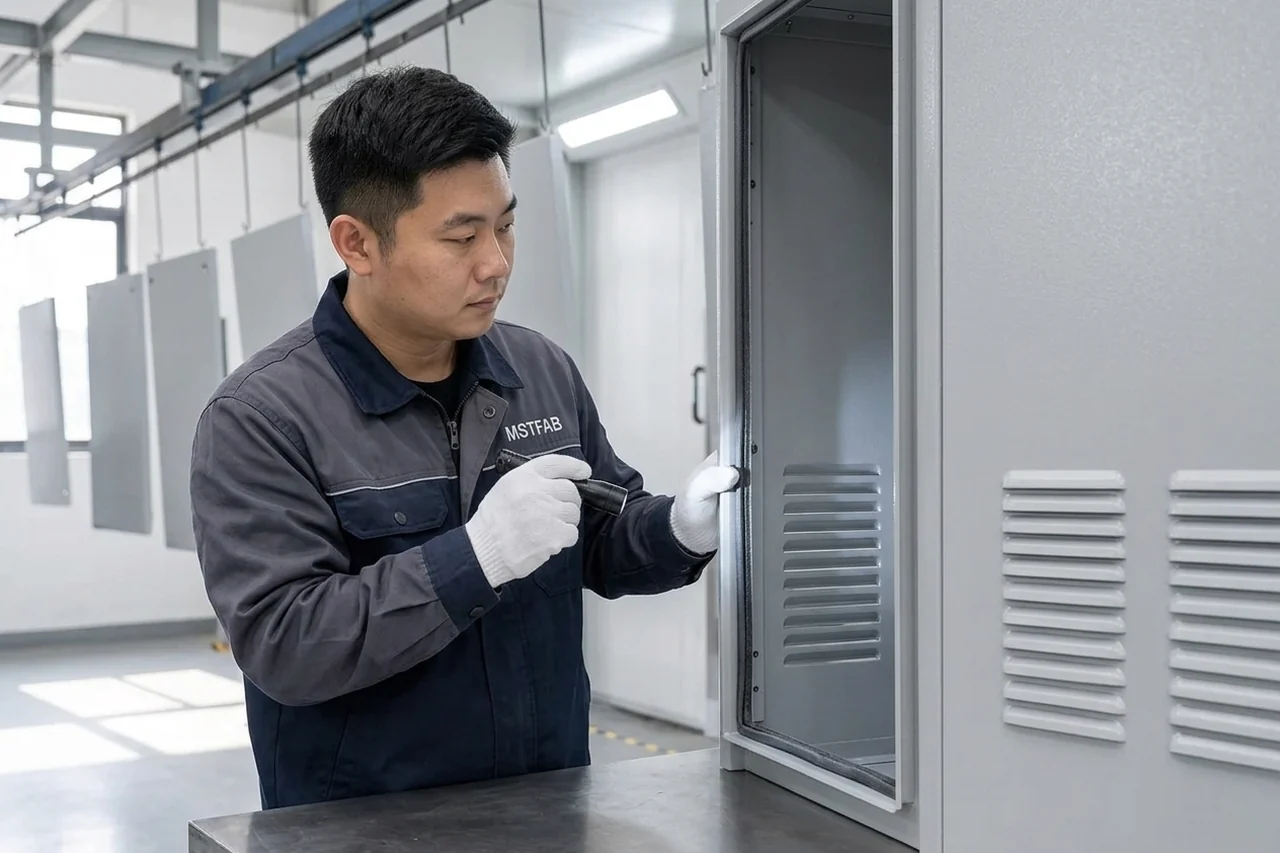
OEM Engineering Case Study: IATF 16949 PPAP Level 3 Release for a 150 kW Outdoor EV Charger Cabinet
Project Profile: Batch: 1,200 cabinets/year | Alloy: DX51D+Z275 (2.0 mm outer skins/doors, 1.5 mm internal baffles, 3.0 mm plinth) | Finish: 45 µm zinc-rich epoxy primer + 80 µm UV-resistant RAL 7016 polyester powder coat
OEM Engineering Challenge: A Tier-1 European EV charging OEM scaling 150 kW DC fast charger cabinets experienced a 14% incoming rejection rate and field failures in coastal installations. Their previous sheet metal vendor struggled with ±1.2° bend-angle drift on 2.0 mm SGCC panels—causing misaligned door gaps—while straight-through louver slots let wind-driven rain reach HV DC busbars during IP55 testing. Over-sprayed powder coat on M6 grounding studs also forced expensive manual wire-brushing on the OEM's final assembly line.
MSTFAB Manufacturing Solution: MSTFAB deployed an IATF 16949:2016 PPAP Level 3 launch team to re-engineer the cabinet shell. Doors were upgraded with spot-welded 22 mm hat-section stiffeners to pass 20 J IK10 impact testing, while intake panels gained internal Z-baffle water-trap plenums and 45° drip hems. Automated robotic CD stud welding paired with high-temp silicone masking caps protected all M6 grounding bonds during dual-coat spraying, and inline laser angle measurement locked critical door-gap tolerances to Cpk >= 1.45.
- Cpk 1.52 Bend Stability: Laser-integrated press-brake angle control stabilized 90° bend variation to ±0.35° with Cpk = 1.52 across 50 consecutive critical door-gap and hinge-datum dimensions.
- 100% IP55 Rain-Test Pass: Introducing Z-baffle rear plenums behind 35° progressive louvers achieved zero water droplet penetration during 12.5 mm IEC 60529 IP55 nozzle spray testing.
- < 0.04 Ω Ground Continuity: Custom molded silicone stud caps and laser-cleaned grounding pads kept door-to-chassis resistance below 0.04 Ω across 100% of units, eliminating post-coat rework.
- < 0.25% Incoming Defect Rate: Full PPAP Level 3 approval, PFMEA closure, and automated robotic stud welding cut the OEM's incoming inspection defect rate from 14% to under 0.25%.
Every production lot is archived with locked CNC laser nests, press-brake bend programs, weld fixture setups, and signed golden samples to guarantee identical repeatability across multi-year reorders.
04 / Quality Verification, Traceability & Surface Finishing
4-Stage Manufacturing Workflow, Surface Treatment & Metrology Control
To maintain Cpk ≥ 1.33 on critical-to-quality (CTQ) dimensions from prototype through series production, MSTFAB executes a closed-loop four-stage fabrication protocol:
Step 01 — IATF 16949 DFM, PFMEA & Masking Freeze: Evaluate 3D STEP assemblies and 2D prints to confirm IK10 door stiffener pitch, IP55 louver Z-baffle clearances, robotic CD stud-weld access, and explicit masking zones, locking a formal PFMEA and Control Plan under IATF 16949 before cutting steel.
Step 02 — Laser Blanking, Louver Stamping & SPC Forming: Cut EN 10204 3.1 DX51D+Z275 blanks via nitrogen fiber laser, stamp 35° progressive louvers, form returns on laser-angle-controlled press brakes (±0.35°), spot-weld hat stiffeners, and validate Cpk >= 1.33 on critical door-gap and HMI datums.
Step 03 — Stud Welding, Dual-Coat Spray & Ground Verification: Robotically CD-weld M6 copper grounding studs, pre-treat in zirconium-silane baths, install molded silicone stud caps and EMI tape masks, apply 45 µm zinc-rich primer plus 80 µm UV polyester topcoat, and verify 100% < 0.05 Ω ground continuity.
Step 04 — FIPG Sealing, PPAP Level 3 Sign-Off & Export Crating: Apply continuous polyurethane FIPG seals or EPDM profiles, assemble 3-point latches and concealed hinges, compile the full PPAP Level 3 PSW dossier, and pack cabinets in VCI film, EPE blocks, and ISPM-15 crates for export.
All raw sheets (SPCC, SGCC, SECC, SUS304/316L, Al 5052-H32/6061-T6) are verified via optical emission spectrometry (OES) or XRF upon arrival and linked by barcode to your purchase order.
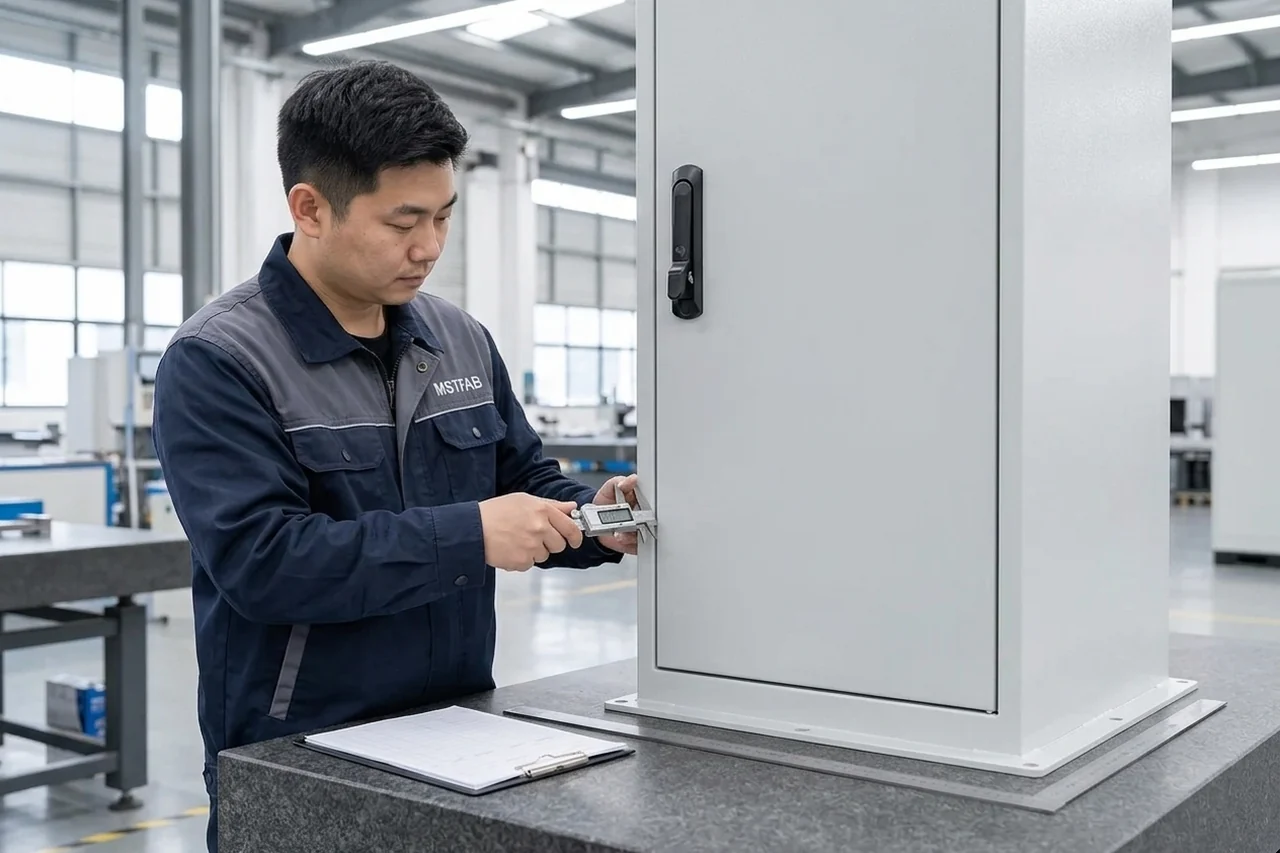
Prior to export crating in ISPM-15 fumigated plywood boxes, our quality lab conducts ballooned dimensional FAI checks, dry-film thickness (DFT) mapping, ASTM D3359 cross-hatch adhesion testing, and ground-continuity verification.

05 / 8-Point OEM RFQ Checklist & Topic Cluster Hub
OEM Engineering RFQ Checklist & Connected Fabrication Hubs
Include these eight drawing and specification controls in your RFQ package so our engineering team can lock down tooling, material traceability, and inspection fixtures on day one:
- RFQ Requirement 01Define IATF 16949 PPAP submission level (typically Level 3) and explicitly flag all Critical-to-Quality (CTQ) door-gap, lock, and HMI bezel tolerances requiring Cpk >= 1.33 studies.
- RFQ Requirement 02Specify DX51D+Z275 (or SGCC Z275) structural gauges by sub-part: e.g., 2.0 mm outer doors/skins, 1.5 mm internal baffles, and 3.0 mm anchor base plinth.
- RFQ Requirement 03Detail outdoor dual-coat specification: silane pretreatment, 40–50 µm zinc-rich epoxy primer, 75–90 µm UV-stabilized polyester powder coat, and 1,500 h ISO 9227 salt-spray target.
- RFQ Requirement 04Provide explicit 2D masking drawings showing silicone-cap locations for M6/M8 grounding studs, bare EMI fingerstock tracks, and blind PEM/weld-nut threads.
- RFQ Requirement 05Specify IP55/IP65 target per IEC 60529 including louver Z-baffle clearances, drain slot geometry, filter media retention clips, and polyurethane FIPG or EPDM gasket profile.
- RFQ Requirement 06Confirm IEC 62262 IK10 (20 J) mechanical impact zones and approve internal 22 mm hat-section stiffeners or reinforced hinge pockets around glass/polycarbonate HMI windows.
- RFQ Requirement 07Include IEC 61851-1 equipotential bonding target (< 0.1 Ω door-to-chassis resistance) and specify captive serrated star-washer hardware or braided copper strap mounting bosses.
- RFQ Requirement 08Clarify packaging and freight protection requirements: VCI anti-corrosion bags, EPE edge protectors, ISPM-15 export crates, and container-load pallet footprint limits.
Explore Connected Sheet Metal Fabrication Services & Enclosure Hubs
06 / OEM Buyer & Engineer FAQ
Technical FAQs for IATF 16949 EV Charger Enclosure Manufacturing
Does MSTFAB support full IATF 16949 PPAP Level 3 submissions for EV charger enclosures?
Yes. MSTFAB holds active IATF 16949:2016 certification alongside ISO 9001:2015 and ISO 14001:2015. For EVSE OEMs requiring automotive-tier quality discipline, we execute full PPAP Level 3 packages including Process Flow Diagrams, PFMEA, Control Plans, Measurement System Analysis (MSA / Gage R&R), Dimensional Results with Cpk >= 1.33 capability studies on designated CTQ features, and Part Submission Warrants (PSW) prior to serial ramp-up.
What galvanized grade and coating stack do you recommend for 10-year coastal EV charging pedestals?
Standard Z120/Z140 indoor galvanized sheet is insufficient for coastal EVSE deployments. We specify DX51D+Z275 (275 g/m² zinc) or electro-galvanized + E-coat substrates paired with a 40–50 µm zinc-rich epoxy primer and 75–90 µm super-durable UV-resistant polyester topcoat (total DFT 115–140 µm). Properly pretreated with zirconium-silane conversion and nitrogen-cut laser edges, this dual-coat system reliably passes 1,500 hours ASTM B117 / ISO 9227 salt-spray testing and 1,000 hours QUV-A weathering with ΔE <= 1.5.
How do you design sheet metal cooling louvers to pass IEC 60529 IP55 rain and jet tests?
High-power DC chargers require significant airflow without compromising IP54/IP55 rain protection. We replace flat stamped louvers with deep 35° progressive-tool louver slats backed by an internal Z-baffle plenum. Incoming water droplets impinge on the primary baffle, drop via gravity through bottom-edge drain slots, and bypass the upward air path leading to the hydrophobic filter media—maintaining low pressure drop while passing IEC 60529 12.5 mm IP55 water-jet testing.
How does MSTFAB prevent powder coat from insulating door grounding studs and EMI contact points?
We integrate laser-etched datum fiducials and precision-molded high-temperature silicone caps over all M6 copper-plated CD weld studs and threaded ground bosses before electrostatic powder spraying. Flat EMI gasket landings or hinge-bonding pads receive die-cut polyester masking tape to preserve conductive chromate-free conversion coating. After curing, caps are stripped cleanly to expose bare metallic threads, achieving < 0.05 Ω ground continuity with zero wire-brushing rework.
What sheet thickness and internal stiffening strategy is required to pass IK10 (20 J) vandalism testing?
To meet IEC 62262 IK10 (20 J impact from a 5 kg striker dropped 400 mm), single-skin 1.5 mm steel usually dents deeply or pops single-point latches. We recommend 2.0 mm DX51D+Z275 outer skins reinforced with spot-welded 22 mm hat-section internal stiffener ribs, concealed stainless steel hinges inside a protected door return, and 3-point rod-actuated swing-handle locks—keeping permanent deflection below 1.5 mm and preserving gasket contact.
Does MSTFAB supply UL 2202 / IEC 61851 certified complete chargers or empty mechanical shells?
MSTFAB fabricates custom build-to-print empty mechanical EVSE enclosures—outer skins, structural frames, plinths, DIN/power-module mounting trays, and baffled doors—strictly to your 3D STEP + 2D PDF drawings. We do not assemble live HV electronics, power modules, or obtain UL 2202/IEC 61851 system certifications on your behalf; instead, we supply material traceability, coating certifications, and PPAP dimensional records supporting your safety-agency listing.
International Standards & Engineering References
- ISO 2768-1 / 2768-2 — General Linear, Angular and Geometrical Tolerances for Sheet Metal Fabrication
- IEC 60529 / NEMA 250 — Degrees of Protection Provided by Enclosures (IP Code & Environmental Sealing)
- ISO 9001:2015 & IATF 16949:2016 — Quality Management Systems & Production Part Approval Process (PPAP)
Ready to Quote Your Custom Sheet Metal Enclosure or Fabrication Project?
Upload your 3D STEP models and 2D PDF drawings. MSTFAB will review your tolerances, material specs, and DFM details to deliver a transparent factory quote within 24 hours.
Request Your 24-Hour DFM & Custom Quote →
Direct engineering desk: caroline@mstfab.com | ISO 9001 & IATF 16949 Certified Factory in Guangzhou, China
 WeChat Contact
 WhatsApp Me Directly