
AG-EQUIPMENT HOUSING FAI & ECN — EXECUTIVE TECHNICAL BRIEF
Agricultural equipment housings—protecting tractor ECUs, fertilizer spreader controllers, and harvester hydraulic valves—fail prematurely when sheet metal designs ignore heavy structural chassis weldment tolerances and mid-season harness updates. Off-road frames routinely carry ±2.0 mm weldment bolt-hole scatter; bolting a rigid galvanized housing with tight round holes twists the door frame, collapses the IP65/IP66 gasket seal, and initiates fatigue cracks at mounting ears under 5–15 G vibration and 2,000 psi washdown. Simultaneously, unlogged mid-season connector Engineering Change Notices (ECNs) cause mixed-revision housings to stall OEM assembly lines. Under IATF 16949:2016, ISO 9001:2015, and ISO 14001:2015, MSTFAB prevents these failures via slotted datum mounting geometry, 2.0–3.0 mm DX51D+Z275/Zn-Al-Mg dual-coated shells, 100% ballooned First Article Inspection (FAI), and revision-locked ECN cut-in controls.
- Weldment Fit-Up Compensation: Replace tight round mounting holes with one Ø8.5 mm primary datum hole and Ø8.5 × 15.0 mm radial clearance slots paired with Shore 60A EPDM isolators to absorb ±2.5 mm chassis weldment float.
- Agrochemical Dual-Coat Stack: Pair 2.0–3.0 mm DX51D+Z275 or Zn-Al-Mg sheet with Zr-silane conversion, 60 µm zinc-rich epoxy primer, and 60 µm UV-stable polyurethane/polyester (120 µm total DFT) for fertilizer and 2,000 psi washdown defense.
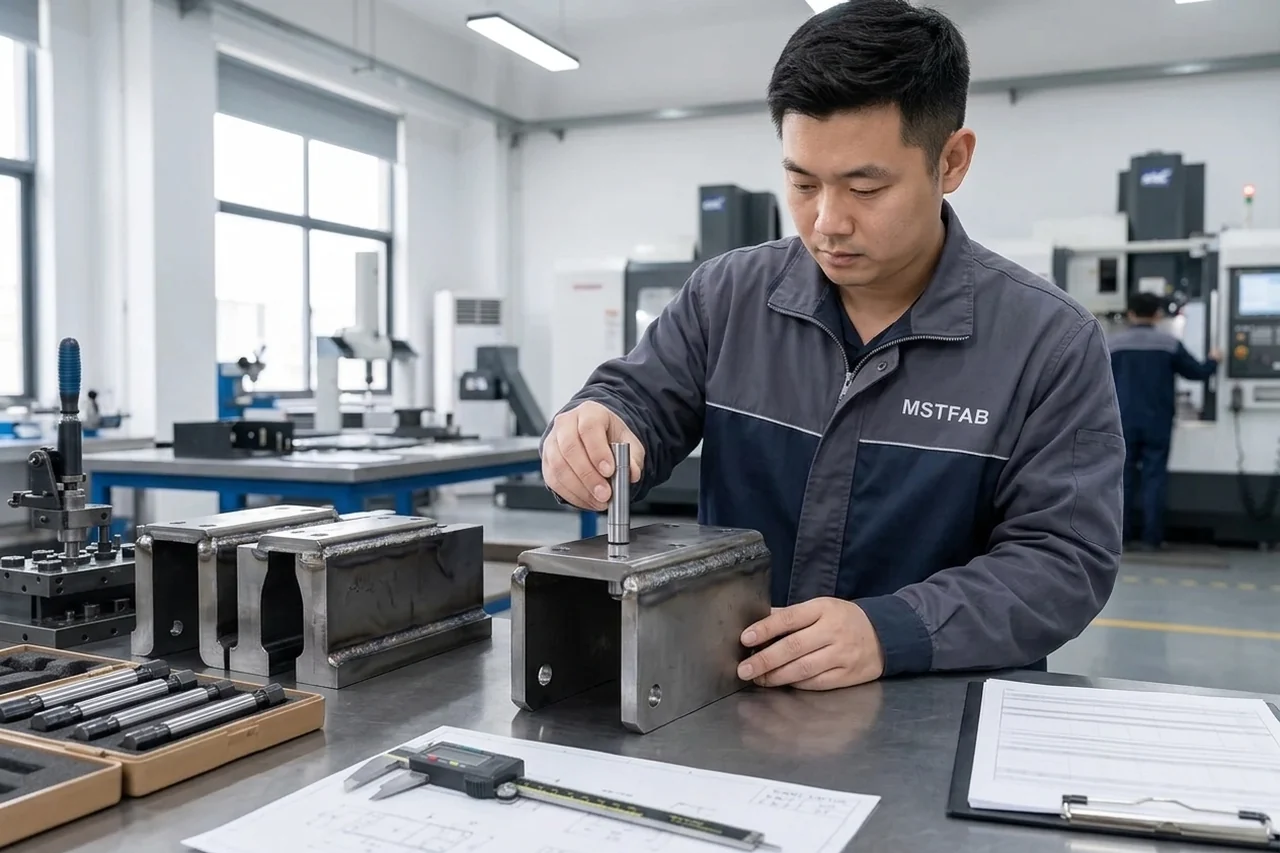
- Ballooned FAI Protocol: Execute 100% ballooned 2D First Article Inspection (FAI) across every slotted hole pattern, Deutsch/Amphenol connector cutout (±0.10 mm), door seal-flange flatness, weld fillet leg, and fastener torque-out before releasing series production.
- Revision-Locked ECN Cut-In: Enforce IATF 16949 ECN sign-off by assigning PO breakpoints, purging superseded laser and press-brake NC files, re-validating weld fixtures, and applying barcode Rev-B/Rev-C serial tags to stop mixed-revision line stoppages.
Every project at MSTFAB includes a complimentary 24-hour CAD Design-for-Manufacturing (DFM) audit, heat-number-traceable EN 10204 3.1 mill certificates, and a ballooned First Article Inspection (FAI) report prior to volume release.
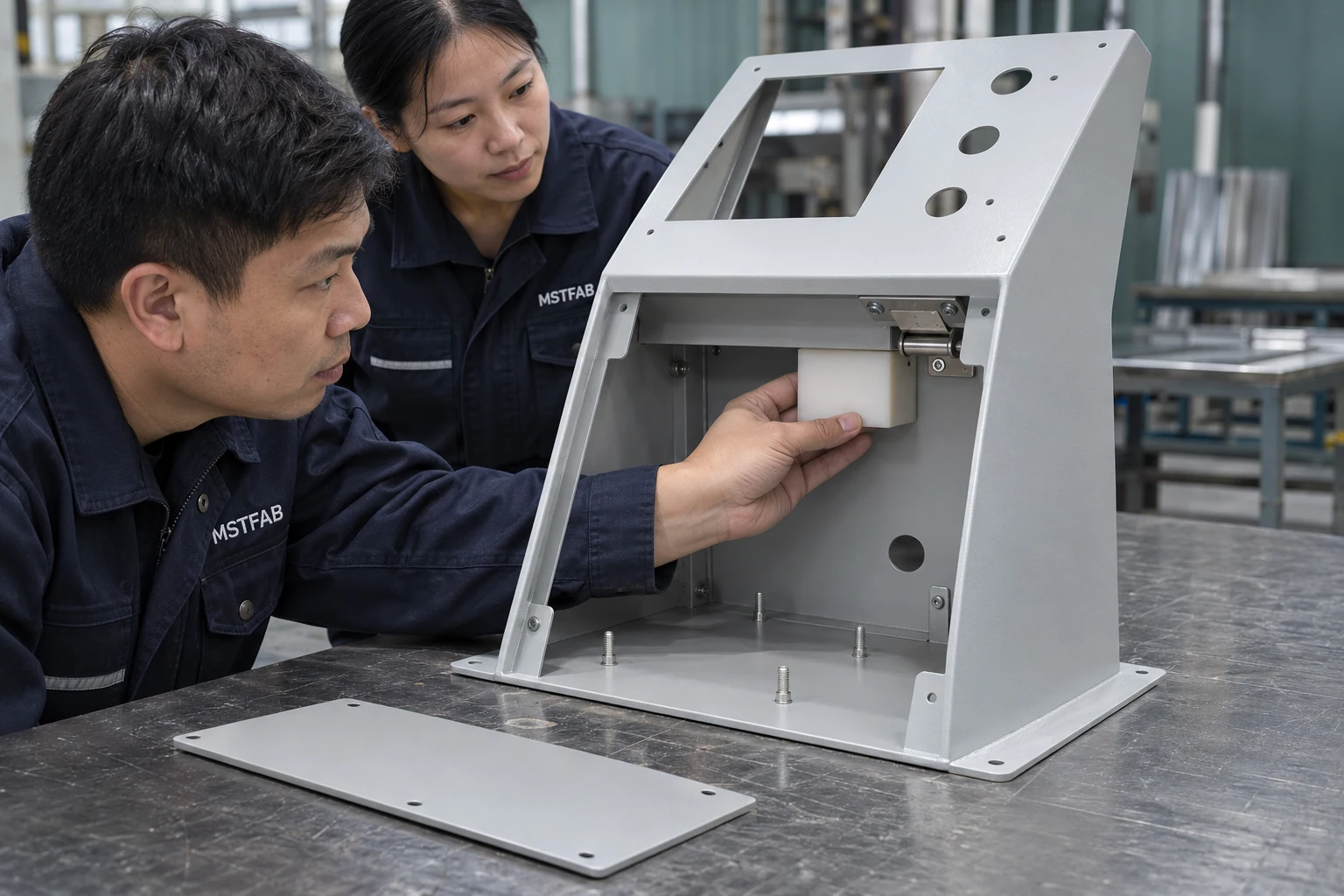
01 / Engineering Specifications & Comparison Matrix
Agricultural Housing Fit-Up, Corrosion & Change-Control Specification Matrix
Unlike stationary indoor electrical boxes, mobile agricultural housings work inside a tough mix of continuous off-road shock, wet mud packing, ammonia and liquid urea splash, stone grit impact, high-pressure steam washdown, and intense sun UV rays. Worse, OEM tractor, sprayer, and implement builders often change wire-harness paths, Deutsch DT/DTP bulkhead ports, and hydraulic valve cutouts mid-season without stopping busy plant assembly lines. Without clear chassis frame fit-up tolerance stack math, heavy-gauge gusset weld rules, dual-coat chemical barrier layers, and strict ECN NC-file purging protocols across production shifts, a box that fit early trial rigs either binds tightly against a welded frame ear or ships with old port holes. The specification matrix below sets out MSTFAB's build-to-print mechanical, coating, and change-control rules for rugged farm steel housings, doors, and mounting brackets.
Each parameter below is verified during incoming raw material quarantine, in-process CNC stage checks, and final First Article Inspection (FAI) before shipment release:
| Engineering Parameter / Zone | Material & Process Specification | Target Tolerance / Performance Standard | Inspection Method & OEM Value |
|---|---|---|---|
| Chassis-Mount Interface | One primary Ø8.5 mm datum hole plus Ø8.5 × 15.0 mm clearance slots with 3.0 mm gusseted ears | Slot pitch ±0.25 mm; radial float ±3.25 mm; ear flatness ≤ 0.35 mm | Coordinate measuring machine datum-to-slot audit and physical mounting verification on an OEM-matched weldment check jig: Absorbs ±2.0 mm agricultural chassis weldment distortion without twisting the housing body or unloading the perimeter door gasket. |
| Heavy-Gauge Substrate | 2.0–3.0 mm Hot-Dip Galvanized DX51D+Z275 (G90) or Zn-Al-Mg (ZM310) structural sheet | Gauge ±0.10 mm; yield ≥ 240 MPa; 100% EN 10204 3.1 coil lot traceability | Digital micrometer thickness mapping, mill certificate tensile/coating review, and weld-coupon penetration sectioning: Resists stone-strike denting, 5–15 G implement vibration, and edge creep in wet urea and ammonium-nitrate environments. |
| Connector Cutouts & Seals | Laser-pierced Deutsch DT/DTP, Amphenol, and M12 bulkhead clusters with hemmed door seal trough | Cutout profile ±0.10 mm; trough coplanarity ≤ 0.40 mm; 35% EPDM gasket compression | Optical 2D profile comparator check on complex connector keyways, feeler-gauge flange audit, and pressure-wash spray witness check: Locks waterproof bulkhead connectors cleanly without keyway binding and prevents 2,000 psi pressure-washer ingress. |
| Fatigue Rib & Gusset Welds | Stitch-welded 3.0 mm corner gussets and embossed stiffening ribs around cantilevered mounts | Fillet leg ≥ 2.5 mm; zero undercut or crater cracks; weld-oxide dressed clean | Visual weld-gauge verification, magnetic-particle or dye-penetrant FAI sampling, and zinc-rich weld-zone restoration: Eliminates cyclic bending stress concentration at mounting tabs, preventing fatigue cracks over 10,000-hour field duty. |
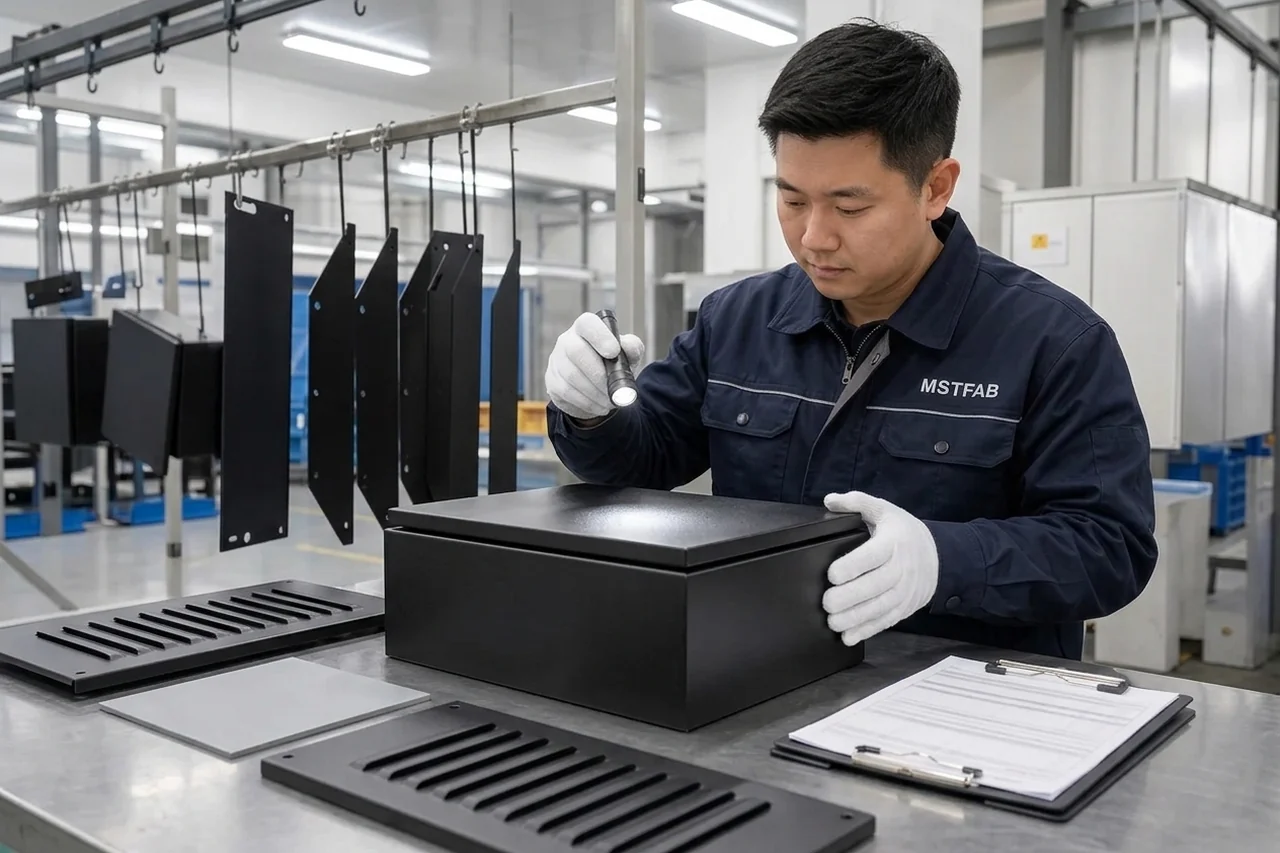
| Agrochemical UV Finish | Zr-silane pretreatment + 55–70 µm zinc-rich epoxy primer + 55–70 µm UV aliphatic/polyester topcoat | Total DFT 110–140 µm; ASTM D3359 Grade 5B; 720 h ASTM B117 / ASTM G154 UV | Multi-zone eddy-current DFT scan, cross-hatch adhesion pull, MEK cure test, and seasonal lot salt-spray/UV witness coupons: Prevents chalking, chemical blistering, and edge rust under continuous outdoor sunlight and acidic fertilizer residue. |
| FAI & ECN Revision Control | 100% ballooned 2D FAI report + MES revision-locked NC programs and physical barcode rev labels | 100% ballooned dimensions verified; zero unlogged ECN cut-ins; serialized lot tag | Dual-engineer FAI sign-off prior to shipment, locked ERP revision routing, and documented deletion of superseded laser/brake programs: Guarantees zero mixed-revision deliveries during mid-season agricultural equipment model updates and accelerates incoming QC. |
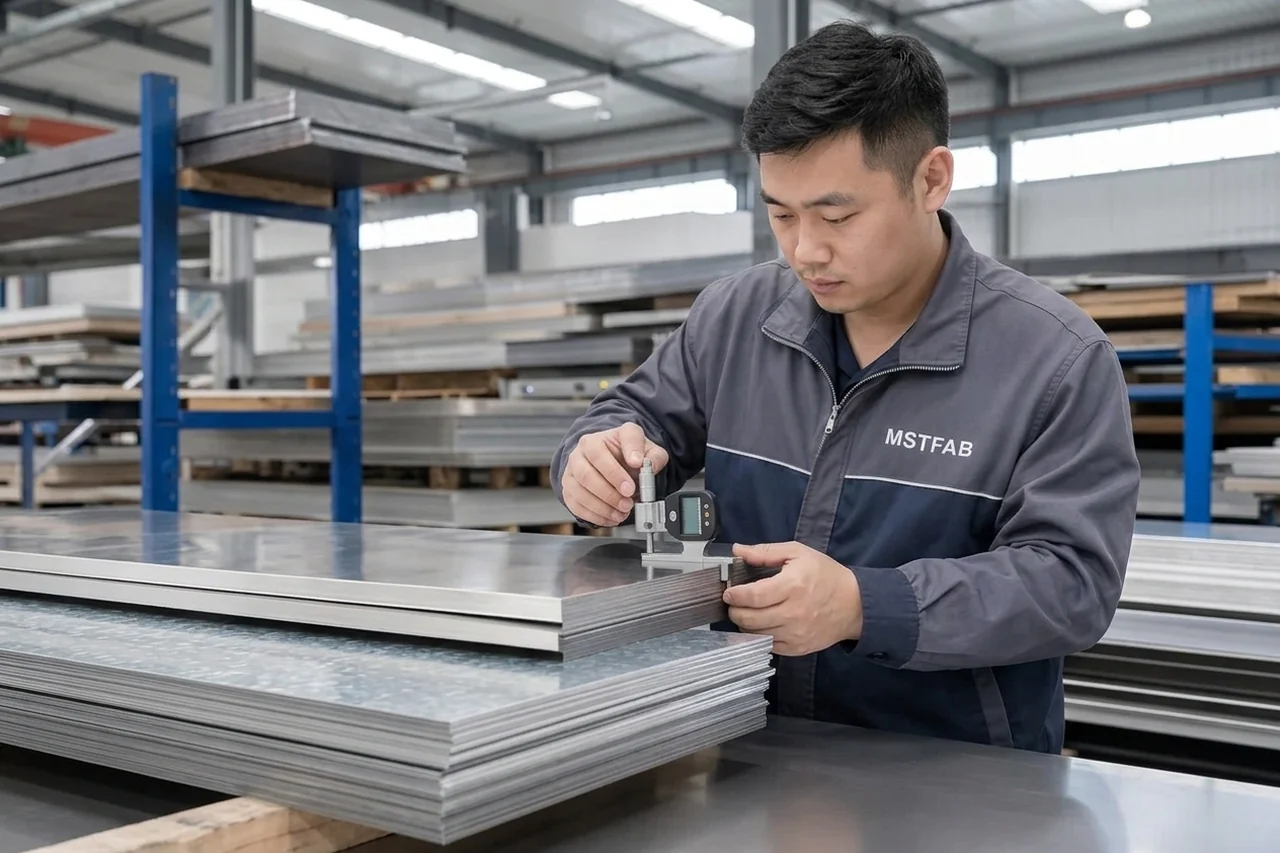
02 / Sheet Metal DFM & Structural Controls
Three Agricultural Housing Failures Solved by Fit-Up DFM & ECN Control
Field warranty returns on agricultural electronics housings rarely stem from circuit boards alone; most trace back to mechanical mount binding, cyclic fatigue cracks, or uncoordinated drawing revisions. MSTFAB eliminates these three structural, metallurgical, and change-control root causes during pre-production DFM engineering, weld-fixture design, coating setup, and ERP revision-lock quality controls.
Tight Round Mounting Holes Twisting Housings on Structural Chassis Weldments
Failure Mechanism: When a sheet metal housing uses four tight Ø8.5 mm round holes to bolt onto a tractor frame weldment carrying ±2.0 mm bracket scatter, assemblers force-draw the bolts with impact guns. This pre-loads and twists the enclosure body, breaking the IP65/IP66 door gasket seal.
Engineering Solution: MSTFAB converts secondary mounts into Ø8.5 × 15.0 mm radial clearance slots anchored from one primary datum hole, pairs them with Shore 60A EPDM vibration-damping compression grommets, and verifies slot pitch on a master steel weldment check plate prior to release.
Verified Outcome: Eliminates assembly preload distortion and preserves uniform 35% door-gasket compression across uneven structural chassis weldments.
Fatigue Cracking at Cantilevered Mounting Ears Under 5–15 G Terrain Shock
Failure Mechanism: Unsupported 90° bent mounting tabs on thin 1.5 mm galvanized boxes experience severe cyclic bending moments from off-road implement vibration and heavy wet mud-pack mass. Stress concentrates along the bend tangent line, initiating through-wall fatigue cracks within a single harvest season.
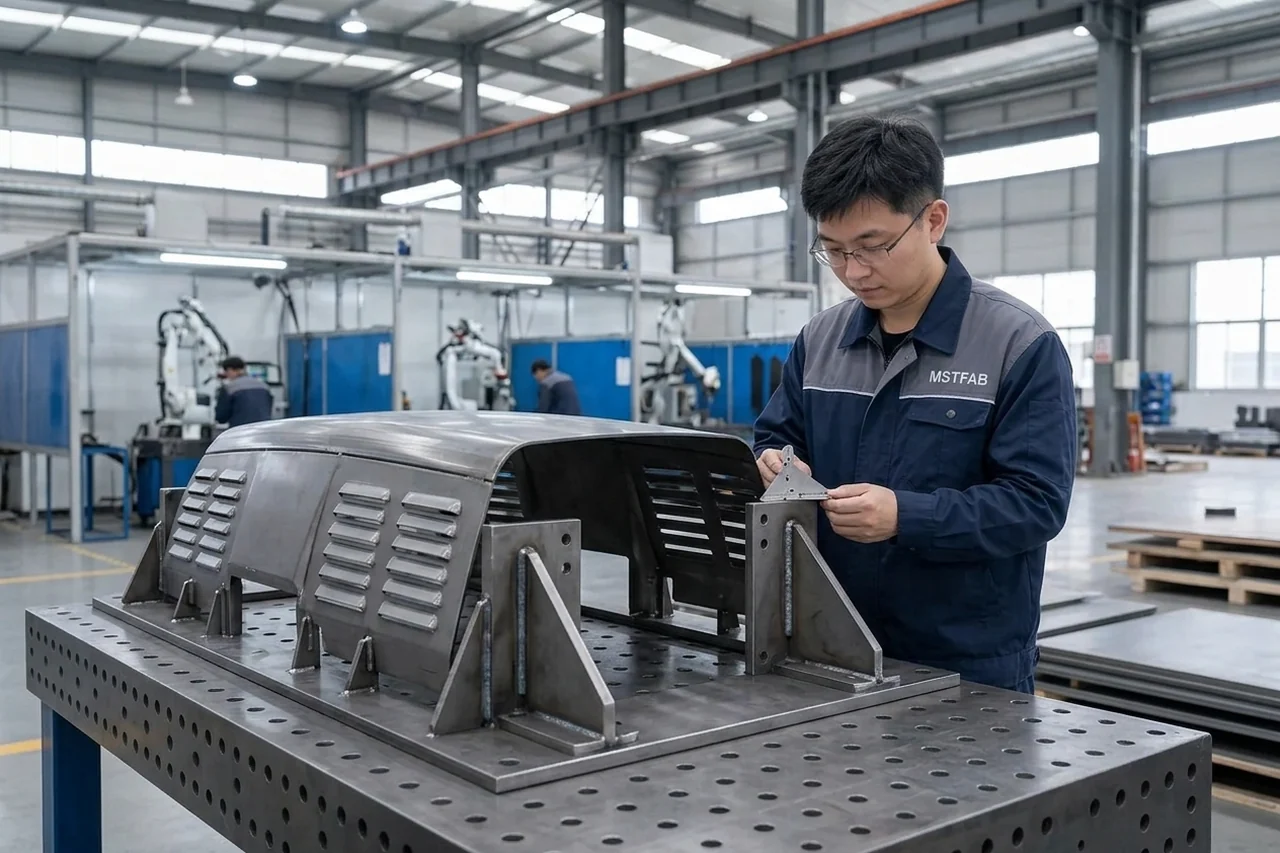
Engineering Solution: We upgrade structural housing walls to 2.0–3.0 mm DX51D+Z275 or Zn-Al-Mg sheet, stitch-weld 3.0 mm triangular corner gussets directly across the bend radius inside dedicated weld fixtures, and specify serrated flange lock-bolts or Nord-Lock washer interfaces to prevent bolt loosening under shock.
Verified Outcome: Multiplies mounting-ear cyclic fatigue life and prevents field housing detachment under severe off-road implement shock loads.
Uncontrolled Mid-Season Harness ECNs Causing Mixed Rev B and Rev C Shipments
Failure Mechanism: Agricultural OEMs frequently update Deutsch connector layouts mid-production. When a job shop modifies laser nests verbally without locking press-brake NC programs, updating fixtures, and quarantining WIP stock, mixed-revision housings arrive at the tractor assembly line and trigger immediate line stoppages.
Engineering Solution: Under IATF 16949, MSTFAB requires formal ECN cut-in serial numbering, purges and archives superseded NC programs from laser and brake controllers, updates weld-fixture locators, executes a delta FAI on modified cutouts, and marks every unit with a Rev-level barcode label.
Verified Outcome: Ensures 100% revision purity per shipping pallet and cuts ECN-to-production turnaround to 5–7 business days.
Manufacturing Scope Boundary: Mechanical Housing & ECN Control vs. Whole-Machine OEM Approval: Agricultural OEMs sometimes expect a contract sheet metal vendor to hold whole-machine ISO or SAE agricultural homologation, assembled electronic EMC/EMI shielding certification, or full vehicle-level IP69K system approvals on an unpopulated enclosure shell, blurring build-to-print engineering and legal compliance responsibility. — Engineering Fix: MSTFAB operates under ISO 9001:2015, IATF 16949:2016, and ISO 14001:2015 to fabricate build-to-print mechanical housings, brackets, and sub-assemblies to your 3D STEP + 2D PDF drawings. We provide EN 10204 3.1 mill certs, ballooned FAI packages, ECN revision records, and coating/spray witness data for your system certification. MSTFAB manufactures custom sheet metal parts and empty mechanical enclosure shells strictly to your 3D STEP and 2D PDF drawings.
03 / Representative Engineering Scenario & Process Control
Representative OEM Case: Precision Fertilizer Spreader ECU & Valve Housing
Project Profile: 450 units/batch (3 seasonal variants) | 2.0 mm DX51D+Z275 Galvanized Steel | 420 × 310 × 180 mm | Zinc-Epoxy + Matte UV RAL 9005
OEM Engineering Challenge: A precision agriculture implement manufacturer faced 6.5% assembly installation rework and recurring field seal leaks on 420 mm galvanized steel ECU and hydraulic valve housings mounted near rear fertilizer spinners. Their previous supplier used tight round mounting holes that bound against ±2.2 mm frame weldments, single-coat polyester that blistered under wet granular urea, and shipped 14 obsolete Rev-A housings mixed inside a Rev-B batch following a mid-winter harness connector update.
MSTFAB Manufacturing Solution: MSTFAB redesigned the mounting flanges during pre-production DFM with one Ø8.5 mm datum hole, three Ø8.5 × 15.0 mm clearance slots, and 3.0 mm corner gussets, backed by Shore 60A EPDM isolation bushings. We upgraded the finish to Zr-silane pretreatment, 60 µm zinc-rich epoxy primer, and 65 µm UV-stabilized matte RAL 9005 polyester (125 µm average DFT). Under IATF 16949 ECN rules, all three seasonal variants shared a common welded shell with barcode-tracked removable connector plates, validated via 100% ballooned FAI before each variant release.
- Zero Mixed-Revision Defects: IATF 16949 MES revision locking and barcode rev-tags eliminated mixed Rev-A and Rev-B deliveries across 1,800 seasonal units and three sequential harness connector layout ECNs.
- 6.5% Rework Eliminated: Slotted datum mounting geometry absorbed ±2.5 mm implement frame weldment float, reducing OEM housing installation time by 40% with zero door-frame twist or bolt-hole binding.
- 720+ Hr Salt/Urea Pass: Dual-coat zinc-epoxy plus UV polyester witness coupons passed 720 continuous hours of ASTM B117 neutral salt-spray exposure without blistering or creep along laser-cut Deutsch connector cutouts.
- 100% Ballooned FAI Approval: All 64 ballooned 2D dimensions, connector keyway profiles (±0.08 mm actual), weld gusset fillets, and fastener torque-out tests passed OEM SQE sign-off on first article.
Every production lot is archived with locked CNC laser nests, press-brake bend programs, weld fixture setups, and signed golden samples to guarantee identical repeatability across multi-year reorders.
04 / Quality Verification, Traceability & Surface Finishing
4-Stage Manufacturing Workflow, Surface Treatment & Metrology Control
To maintain Cpk ≥ 1.33 on critical-to-quality (CTQ) dimensions from prototype through series production, MSTFAB executes a closed-loop four-stage fabrication protocol:
Step 01 — Chassis Fit-Up DFM & ECN Baseline: MSTFAB engineers review your housing 3D STEP and 2D PDF files alongside chassis weldment stack-up tolerances, convert over-constrained mounting holes into datum-and-slot patterns, verify corner gusset stiffness against 5–15 G vibration loads, and lock baseline drawing revision levels inside our ERP and MES routing system.
Step 02 — Laser Connector Piercing & Heavy-Gauge Forming: 2.0–3.0 mm DX51D+Z275 or Zn-Al-Mg structural sheets are nitrogen fiber-laser cut to ±0.10 mm on Deutsch and Amphenol connector keyways, formed on heavy-tonnage CNC press brakes with coil bend-allowance compensation, and reinforced with stitch-welded 3.0 mm triangular corner gussets inside dedicated steel locating weld jigs.
Step 03 — Agrochemical Dual-Coat Finishing & Sealing: Housings undergo mechanical weld-oxide dressing, zirconium-silane conversion, 60 µm zinc-rich epoxy priming, and 60 µm UV-stabilized polyester or aliphatic polyurethane topcoating (110–140 µm total DFT), followed by Shore 60A EPDM vibration-bushing installation, SUS316 compression-latch mounting, and robotic FIPFG or molded EPDM perimeter seal gasket seating.
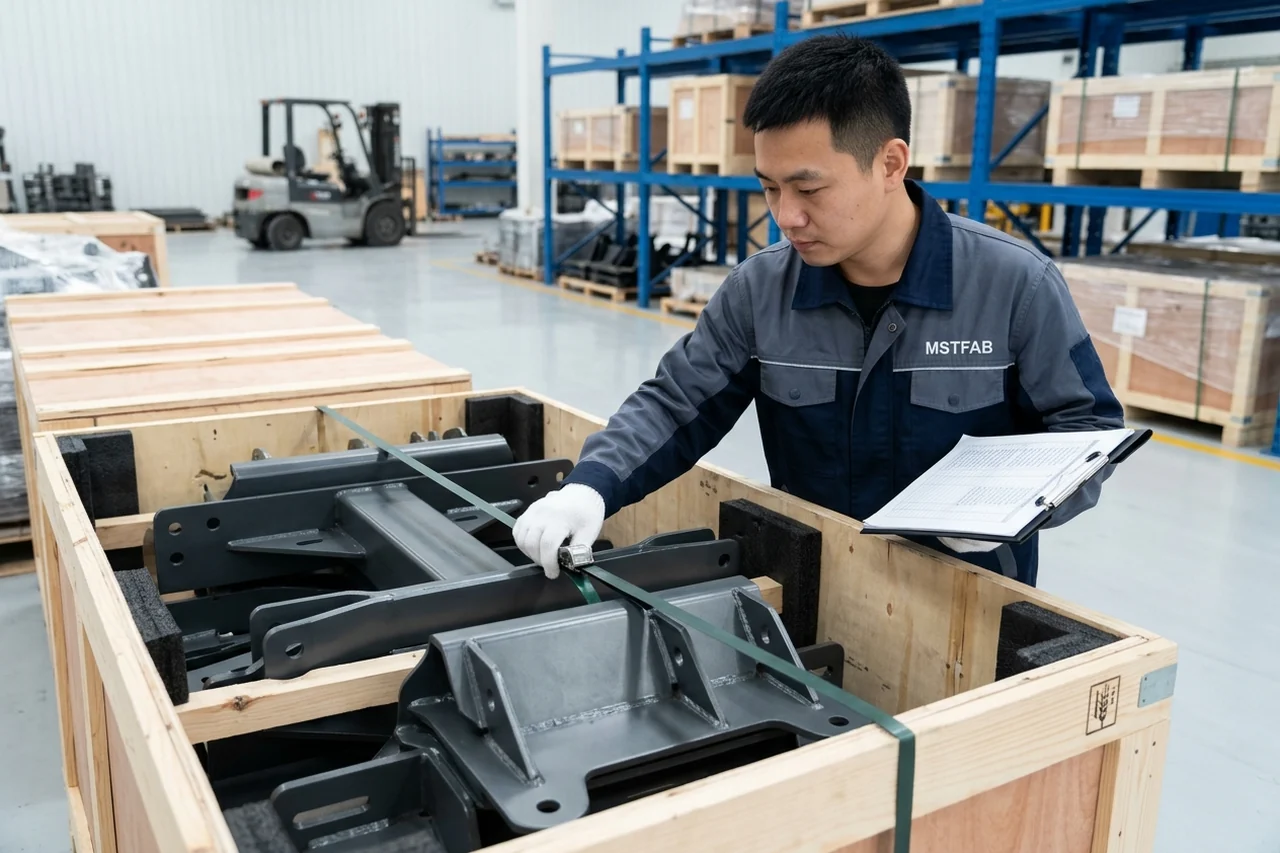
Step 04 — Ballooned FAI, Delta-ECN Audit & Export Packing: Every new part number or mid-season ECN triggers a 100% ballooned dimensional FAI, optical keyway check, eddy-current DFT mapping, and fastener torque-out verification. Approved lots receive serialized revision barcode labels and ship sealed inside VCI moisture-barrier bags with EPE foam inside ISPM-15 export crates.
All raw sheets (SPCC, SGCC, SECC, SUS304/316L, Al 5052-H32/6061-T6) are verified via optical emission spectrometry (OES) or XRF upon arrival and linked by barcode to your purchase order.
Prior to export crating in ISPM-15 fumigated plywood boxes, our quality lab conducts ballooned dimensional FAI checks, dry-film thickness (DFT) mapping, ASTM D3359 cross-hatch adhesion testing, and ground-continuity verification.
05 / 8-Point OEM RFQ Checklist & Topic Cluster Hub
OEM Engineering RFQ Checklist & Connected Fabrication Hubs
Include these eight drawing and specification controls in your RFQ package so our engineering team can lock down tooling, material traceability, and inspection fixtures on day one:
- RFQ Requirement 01Include chassis weldment mounting tolerances (±1.5 to ±3.0 mm) so MSTFAB can size primary datum holes and radial clearance slots without warping the finished housing.
- RFQ Requirement 02Specify heavy-gauge galvanized sheet grade (2.0–3.0 mm DX51D+Z275 or Zn-Al-Mg ZM310) alongside expected off-road shock and vibration G-loads and field pressure-wash nozzle ratings (psi or bar).
- RFQ Requirement 03Provide 2D PDF drawings with balloon-ready critical dimensions, Deutsch/Amphenol/M12 connector keyway tolerances (±0.10 mm), weld fillet leg symbols, and internal wire-harness clearance envelopes for assembly.
- RFQ Requirement 04Define agrochemical and UV coating stack: pretreatment chemistry, zinc-rich epoxy primer thickness, UV topcoat resin (polyester versus aliphatic polyurethane), RAL color, and total DFT targets.
- RFQ Requirement 05Specify vibration-resistant fastening hardware: Nord-Lock or serrated flange lock-bolt interfaces, Shore 60A EPDM isolation bushings, captive quarter-turn latches, and high-strength PEM stud retention pull-out grades.
- RFQ Requirement 06Detail First Article Inspection (FAI) sample quantity (1–5 units), required CMM and optical keyway reports, and destructive weld-gusset or self-clinching fastener torque-out test coupon deliverables.
- RFQ Requirement 07Establish formal ECN/ECR communication rules: exact cut-in serial or PO breakpoint, WIP stock disposition instructions, and mandatory barcode revision labeling on both housings and cartons.
- RFQ Requirement 08Confirm export packaging expectations—individually VCI-bagged housings, custom die-cut EPE shock-absorbing dividers, desiccant packs, and heat-treated ISPM-15 wooden export crates for ocean or air freight transit.
Explore Connected Sheet Metal Fabrication Services & Enclosure Hubs
06 / OEM Buyer & Engineer FAQ
Engineering FAQs: Agricultural Galvanized Housings, FAI & ECN Control
Why should agricultural housings use datum-plus-slot mounting holes instead of four tight round holes?
Tractor and implement frames are heavy structural steel weldments whose mounting brackets naturally drift ±1.5 to ±3.0 mm after MIG welding and thermal distortion. When an ECU or valve housing uses four tight Ø8.5 mm round holes, assembly technicians force-align bolts with impact wrenches, pulling the sheet metal shell out of square. That distortion bows the door return lip, drops perimeter gasket compression below 20%, and lets high-pressure washdown water inside. Designing one primary round datum hole plus three Ø8.5 × 15.0 mm radial clearance slots absorbs weldment float completely without stressing the enclosure.
How does MSTFAB handle mid-season Engineering Change Notices (ECNs) without mixing revisions?
Under our IATF 16949:2016 quality system, every drawing revision is locked to an ERP part-revision master. When an OEM issues an ECN—such as shifting a Deutsch DTP cutout or adding a ground boss—MSTFAB executes a formal ECN impact review, assigns an exact PO or serial cut-in breakpoint, purges and archives superseded laser nesting and press-brake NC programs from machine controllers, updates weld-fixture locators, performs a delta First Article Inspection on the changed features, and applies human-readable plus barcode revision tags (e.g., Rev C) to every finished housing and crate.
What is included in a typical MSTFAB First Article Inspection (FAI) package for OEM agricultural buyers?
Our FAI package starts with a 100% ballooned 2D engineering drawing paired with an Excel/PDF dimensional report recording actual measured values versus drawing tolerances (CMM, optical comparator, and pin/thread gauge readings) across 1–5 first-article samples. We also attach incoming EN 10204 3.1 steel coil mill certificates, RoHS/REACH compliance declarations, multi-point eddy-current coating DFT maps, ASTM D3359 cross-hatch adhesion results, PEM stud torque-out coupon logs, and high-resolution inspection photos so your Supplier Quality team can approve series release remotely with zero guesswork.
Is standard galvanized steel enough for fertilizer spreaders, or do we need Zn-Al-Mg or dual-coat finishing?
Bare galvanized steel or thin single-coat powder fails quickly around urea, ammonium nitrate, and liquid potash fertilizers because fertilizer salts hold moisture directly against laser-cut edges and weld seams. For heavy agrochemical exposure, MSTFAB recommends 2.0–3.0 mm DX51D+Z275 or Magnesium-added Zn-Al-Mg (ZM310) base steel finished with Zr-silane conversion, a 55–70 µm zinc-rich epoxy primer, and a 55–70 µm UV-stabilized aliphatic polyurethane or super-durable polyester topcoat. That combination seals cut kerfs, resists 720+ hours of salt spray, and withstands intense sunlight without chalking.
Can MSTFAB manage variant housing families when connector layouts change across implement models?
Yes—modularizing connector entry is one of the fastest ways to cut tooling cost and simplify ECNs on agricultural platforms. Instead of piercing Deutsch, Amphenol, and M12 cutouts directly into the main welded housing wall, MSTFAB recommends standardizing one rugged welded galvanized body and routing all harness variations through a 2.0 mm laser-cut, gasketed removable bulkhead plate fastened with captive PEM nuts. When a new sprayer or tractor model requires different connectors, only the small bulkhead plate changes revision while the main enclosure body and FAI baseline remain untouched.
International Standards & Engineering References
- ISO 2768-1 / 2768-2 — General Linear, Angular and Geometrical Tolerances for Sheet Metal Fabrication
- IEC 60529 / NEMA 250 — Degrees of Protection Provided by Enclosures (IP Code & Environmental Sealing)
- ISO 9001:2015 & IATF 16949:2016 — Quality Management Systems & Production Part Approval Process (PPAP)
Ready to Quote Your Custom Sheet Metal Enclosure or Fabrication Project?
Upload your 3D STEP models and 2D PDF drawings. MSTFAB will review your tolerances, material specs, and DFM details to deliver a transparent factory quote within 24 hours.
Request Your 24-Hour DFM & Custom Quote →
Direct engineering desk: caroline@mstfab.com | ISO 9001 & IATF 16949 Certified Factory in Guangzhou, China
 WeChat Contact
 WhatsApp Me Directly