
HYGIENIC DISTRIBUTION ENCLOSURE DFM — EXECUTIVE TECHNICAL BRIEF
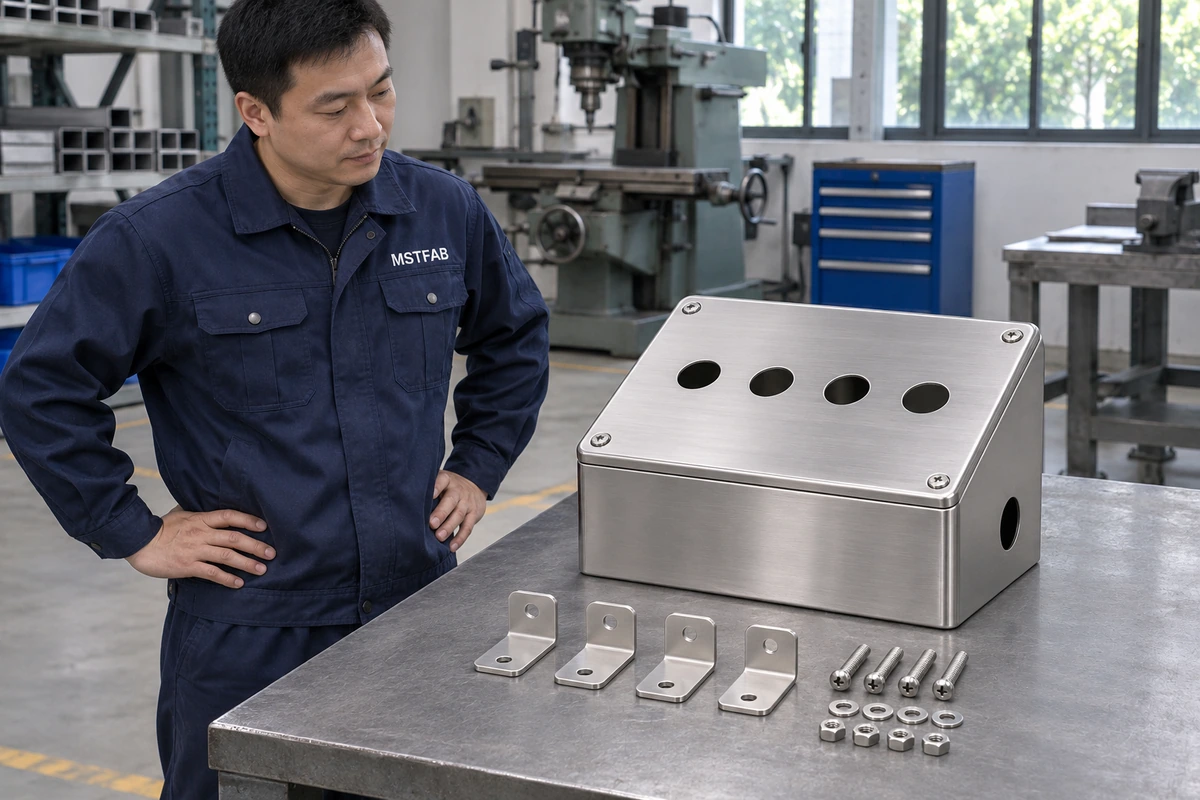
Food, beverage, and pharmaceutical processing plants increasingly specify galvanized steel distribution box shells in dry packaging halls, utility corridors, and washdown-adjacent zones where 316L stainless steel blows past capex budgets. However, standard electrical box fabrication introduces severe hygienic failure modes: micro-pinholes from zinc outgassing during 190 °C powder curing, unsealed spot-weld crevices that trap organic residue, and sheared laser edges that corrode under alkaline sanitizer wipe-downs. At MSTFAB in Guangzhou, build-to-print hygienic shell manufacturing solves these risks through skin-passed SECC or minimized-spangle SGCC Z275 selection, mandatory 205 °C thermal degassing pre-bakes, continuous CuSi3/TIG seam welding ground to Ra ≤ 1.6 µm, and 70–90 µm FDA 21 CFR 175.300-compliant polyester films. Every shell ships with EN 10204 3.1 mill heat traceability to support OEM facility compliance dossiers.
- Zero-Pinholing Zinc Pre-Bake: Thermal outgassing of moisture and zinc hydroxide on SGCC Z275 (ASTM A653 G90) is eliminated via zirconium-silane conversion and a 20-minute 205 °C pre-bake, achieving void-free 70–90 µm RAL 9003/7035 hygienic polyester curing tested to ASTM D3359 5B adhesion.
- Crevice-Free Seam Geometry: All 1.5 mm and 2.0 mm exterior corners use continuous CuSi3 silicon-bronze MIG or pulse-TIG seam welds dressed to Ra ≤ 1.6 µm with zero open lap joints, paired with 15°–20° sloped tops that prevent liquid pooling and particulate accumulation.
- IP65/IP66 Knife-Edge Seal Path: Double-return 2.5 mm formed door gutters compress platinum-cured, food-contact silicone or closed-cell EPDM gaskets by 28–32%, maintaining IP65/IP66 dust-and-splash integrity across ±0.4 mm door flatness tolerances per ISO 2768-mK without external dirt-trapping hinge knuckles.
- Traceable OEM Compliance Support: While MSTFAB fabricates empty shells to buyer STEP/PDF files without holding FDA or UL certification itself, our ISO 9001:2015 and IATF 16949:2016 lots include EN 10204 3.1 mill certificates, RoHS/REACH declarations, and powder-resin FDA 21 CFR 175.300 datasheets.
Every project at MSTFAB includes a complimentary 24-hour CAD Design-for-Manufacturing (DFM) audit, heat-number-traceable EN 10204 3.1 mill certificates, and a ballooned First Article Inspection (FAI) report prior to volume release.
01 / Engineering Specifications & Comparison Matrix
Engineering Specification Matrix for Hygienic Galvanized Distribution Shells
Converting standard galvanized electrical enclosures into cleanable distribution boxes for hygienic-grade facilities demands simultaneous control of metallurgy, joint topology, and thermoset film continuity. Unlike bare SPCC cold-rolled steel, hot-dip galvanized SGCC Z275 carries an inhomogeneous zinc-iron intermetallic layer that traps microscopic surface porosity and vaporizes near nitrogen-cut edges during welding. Without disciplined DFM rules, these metallurgical traits produce microscopic coating craters, localized edge rust under quaternary ammonium cleaners, and recessed screw heads where biofilms establish. Conversely, switching blindly to heavy-gauge SUS316L can inflate raw material and laser-cutting cycle costs by 2.4× to 3.1× for non-immersion control zones. The engineering specification matrix below establishes measurable thresholds across six critical shell zones—linking substrate alloy grade, bend and weld geometry, film thickness, metrology verification, and OEM lifecycle value so plant engineers and procurement teams can audit supplier capability before releasing production tooling.
Each parameter below is verified during incoming raw material quarantine, in-process CNC stage checks, and final First Article Inspection (FAI) before shipment release:
| Engineering Parameter / Zone | Material & Process Specification | Target Tolerance / Performance Standard | Inspection Method & OEM Value |
|---|---|---|---|
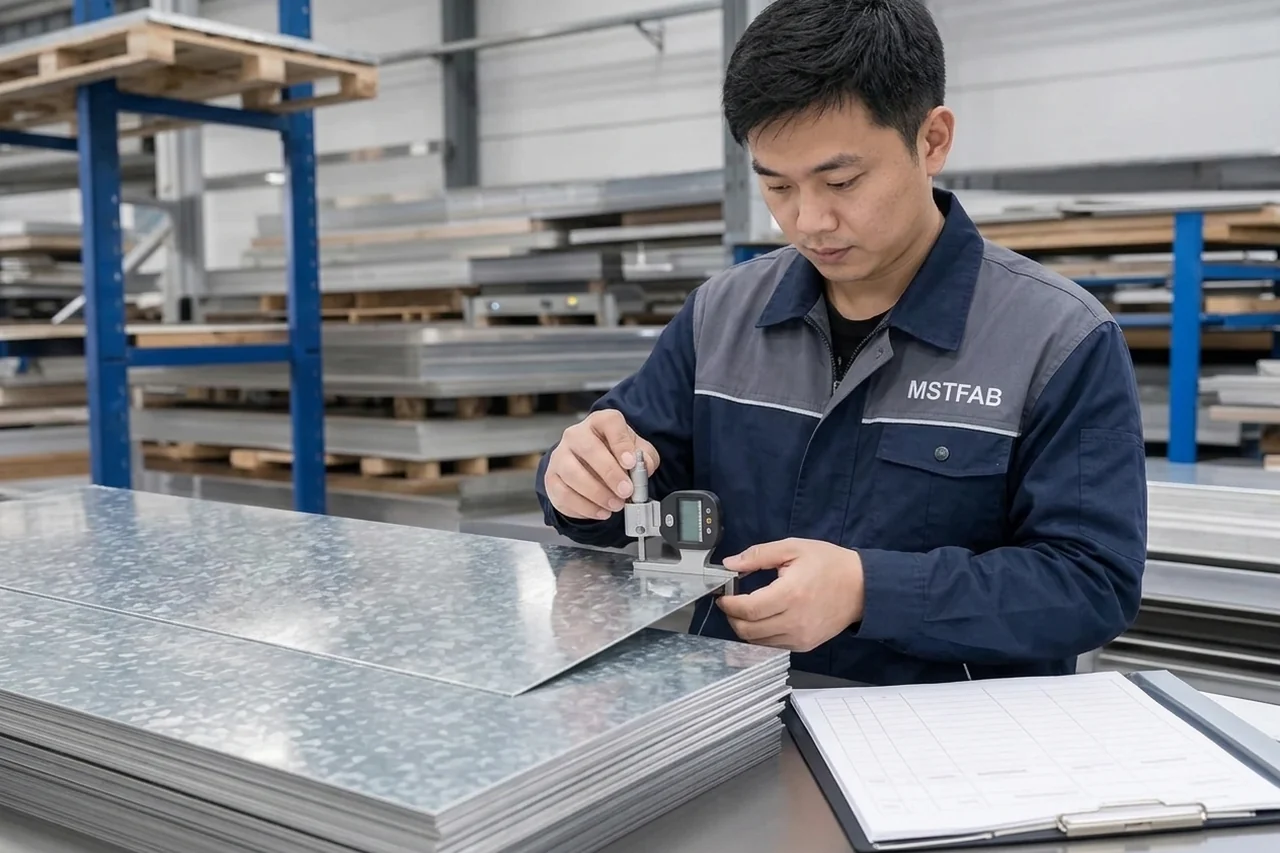
| 01 — Substrate Alloy & Zinc Coating Weight | 1.5 mm or 2.0 mm skin-passed SECC electro-galvanized (JIS G3313) or minimized-spangle SGCC Z275 hot-dip galvanized steel (EN 10346 DX51D+Z) selected for flat surface profile and secondary washdown corrosion resistance. | Sheet gauge tolerance ±0.08 mm per EN 10143; zinc mass ≥ 275 g/m² total both sides (SGCC) or ≥ 20/20 g/m² (SECC); surface waviness Wsa ≤ 0.8 µm prior to conversion. | Calibrated micrometer three-point edge-and-center coil check, handheld XRF zinc-coating thickness gauge verification per incoming sheet lot, and EN 10204 3.1 mill certificate heat-number matching: Eliminates coarse spangle telegraphing through glossy hygienic powder coats while delivering 50–65% raw material cost reduction compared with full-body SUS304 or SUS316L cabinets in dry/splash zones. |
| 02 — Sloped Roof & Corner Seam Weldment | Integral 15°–20° top-overhang roof flange with 25 mm drip lip; self-fixturing laser-tabbed 90° box corners continuously welded via CuSi3 silicon-bronze MIG or pulse-TIG without external lap seams. | Angle accuracy ±0.5°; roof overhang projection 25.0 ± 0.5 mm; weld heat-affected zone ≤ 4.0 mm; dressed corner surface roughness Ra ≤ 1.6 µm with zero undercut or pinholes. | 100% visual and light-box leak inspection on raw weldments, digital bevel protractor angle check, and portable stylus profilometer Ra validation on one sample per 25-unit batch: Prevents standing washdown condensate, eliminates horizontal dust shelves, and removes sharp micro-crevices that trap organic debris during routine facility dry-wipe and sanitizer cleaning. |
| 03 — Door Return Gutter & Hygienic Gasket | Double-formed 90° knife-edge perimeter gutter (8 mm throat) compressing removable or FIPFG platinum-cured translucent silicone (FDA 21 CFR 177.2600 grade) or smooth closed-cell EPDM perimeter seal. | Gutter lip straightness ≤ 0.4 mm over 600 mm span; target gasket compression 28–32% (1.8–2.4 mm deflection); door-to-body reveal uniformity 1.5 ± 0.4 mm per ISO 2768-mK. | Granite surface plate feeler-gauge flatness audit, Fujifilm Prescale gasket compression band mapping during FAI, and in-house IP65/IP66 water-nozzle splash witness verification per batch: Blocks airborne flour, active pharmaceutical powder, and sanitizer mist ingress while allowing rapid seal inspection or replacement without tearing porous adhesive-backed foam strips. |
| 04 — Low-Bake Degassed Hygienic Powder Finish | Chromium-free zirconium/silane conversion, mandatory 205 °C 20-minute thermal degas pre-bake, zinc-rich epoxy edge primer where cut, and degassing-grade smooth polyester topcoat (RAL 9003/7035). | Total dry film thickness (DFT) 70–90 µm across exterior faces and ≥ 55 µm on internal flanges; gloss 75–85 GU at 60°; pencil hardness ≥ 2H; zero craters or pinholes. | Elcometer 456 magnetic-induction DFT mapping across 12 zones, ASTM D3359 Method B cross-hatch tape adhesion (5B), and 20× illuminated loupe inspection for zinc-outgassing pinholes: Delivers a non-porous, solvent-resistant smooth barrier aligned with powder-resin FDA 21 CFR 175.300 technical datasheets and resists yellowing under UV and dilute quaternary sanitizers. |
| 05 — Concealed Hinges, Latches & Mounting Standoffs | Internal SUS304 lift-off hinge blocks (zero external knuckle pockets), smooth-dome quarter-turn hygienic compression latches, and 20 mm welded rear SUS304 standoff bosses replacing flush wall mounting. | Hinge pin coaxial alignment ≤ 0.25 mm; standoff coplanarity ≤ 0.5 mm across four corners; latch tongue engagement compression ±0.3 mm after 500-cycle functional check. | CMM coordinate audit on rear mounting boss and hinge-hole centers, calibrated torque-driver latch verification, and 500-cycle door articulation check during First Article Inspection: Creates clear sweep-behind wall clearance for mop and vacuum access while eliminating exposed hinge barrels and knurled fasteners that cannot be sanitized effectively. |
| 06 — Cut-Edge Protection & Bonding Continuity | Nitrogen-assist fiber laser cutting (dross-free kerf) with manual chamfered deburr; M6/M8 copper-plated or SUS304 weld studs masked with high-temp silicone sleeves before coating. | Edge burr height ≤ 0.05 mm; minimum grounding contact pad diameter 12.0 mm cleanly masked; earth bonding resistance ≤ 0.05 Ω across door-to-chassis strap terminals. | Micro-ohmmeter four-wire continuity test on 100% of coated enclosures, thread go/no-go plug gauging on all masked PEM/weld studs, and 72-hour ASTM B117 salt-spray witness coupons: Prevents red-rust bleeding from laser-cut gland knockouts and guarantees reliable protective earth bonding without requiring OEM assembly technicians to scrape powder coat on the line. |
02 / Sheet Metal DFM & Structural Controls
Top 3 Hygienic Galvanized Box DFM Failure Modes & Shop-Floor Countermeasures
Standard electrical box drawings frequently fail hygienic facility audits because sheet metal tolerances, welding sequences, and zinc-coating physics interact differently than in plain SPCC cabinets. Below are the three highest-risk DFM failure modes MSTFAB engineers resolve during pre-production review of galvanized distribution box shells, along with verified shop-floor countermeasures.
Zinc-Outgassing Pinholing and Cratering on Hot-Dip SGCC Powder-Coated Doors
Failure Mechanism: When 1.5 mm hot-dip SGCC Z275 is sprayed directly with standard polyester powder and cured at 190 °C, absorbed moisture and zinc-hydroxide decomposition release micro-bubbles through the molten film. The resulting 0.2–0.5 mm pinholes expose raw zinc, trap process dust, and fail cleanroom wipe-down visual inspection.
Engineering Solution: MSTFAB switches flat exterior doors to skin-passed SECC or low-spangle SGCC, enforces Cr-free zirconium conversion, runs a mandatory 20-minute thermal degas pre-bake at 205 °C prior to electrostatic spraying, and specifies an outgassing-forgiving (OGF) smooth polyester resin formulated for hot-dip galvanized substrates.
Verified Outcome: Reduces coating pinhole rework from 14% to under 0.3% and achieves consistent 70–90 µm ASTM D3359 5B films.
Spot-Welded Roof Overlaps and Flat Tops Creating Uncleanable Biofilm Crevices
Failure Mechanism: Conventional NEMA 1/12 distribution boxes fold flat roofs over spot-welded body flanges, leaving 0.3–0.8 mm capillary gaps along the exterior rim. During washdown-adjacent misting or sanitizer wipe-downs, moisture wicks into the un-coated overlap, breeding microbial harborage and accelerating hidden white-to-red rust corrosion.
Engineering Solution: We redesign the upper crown as an integral 18° sloped roof with a 25 mm front drip visor, eliminating top lap joints via self-indexing laser corner tabs that are continuously TIG/CuSi3 seam-welded on the outside and dressed smooth to Ra ≤ 1.6 µm before conversion.
Verified Outcome: Delivers zero exposed lap seams, instant fluid runoff, and rapid wipe-down verification in secondary food and pharma zones.
Laser-Cut Gland Knockouts and Exposed Hinge Knuckles Causing Sanitizer Corrosion
Failure Mechanism: Fiber-laser cutting vaporizes protective zinc along perimeter gland holes and knockout tabs, leaving bare carbon-steel sidewalls. Combined with standard external piano hinges and sharp 90° burr edges, routine alkaline or quaternary sanitizer wiping triggers rapid red-rust streaking and tears cleaning wipes on the box perimeter.
Engineering Solution: MSTFAB cuts all cable entries cleanly with nitrogen-assist laser (eliminating brittle punch knockouts in hygienic zones), smoothly radii edges to R0.3 mm, sprays a zinc-rich epoxy edge-primer wrap, and installs concealed internal SUS304 lift-off hinges behind a continuous silicone-gasketed door gutter.
Verified Outcome: Eliminates perimeter rust staining across 72-hour ASTM B117 witness checks and removes external lint-snagging hardware.
Manufacturing Scope Boundary: Commercial & Regulatory Scope: Build-to-Print Mechanical Shells vs. OEM Facility Certification: Many industrial buyers mistakenly ask sheet metal fabricators for 'FDA-certified' or 'UL-listed' distribution boxes. In reality, the U.S. FDA does not certify empty metal enclosures, and UL 508A/50E listings belong to the completed panel builder or registered enclosure catalog owner—not a custom contract OEM factory. — Engineering Fix: MSTFAB is certified to ISO 9001:2015, IATF 16949:2016, and ISO 14001:2015 and manufactures custom empty mechanical shells strictly to your 3D STEP and 2D PDF drawings. We supply EN 10204 3.1 mill heat certs, RoHS/REACH declarations, and powder-resin FDA 21 CFR 175.300 datasheets for your compliance dossier. MSTFAB manufactures custom sheet metal parts and empty mechanical enclosure shells strictly to your 3D STEP and 2D PDF drawings.


03 / Representative Engineering Scenario & Process Control
Case Study: 1.5 mm SECC/SGCC Hygienic Distribution Shells for Automated Beverage Packaging Lines
Project Profile: Batch: 450 units/quarter | Body: 1.5 mm SGCC Z275; Door: 1.5 mm SECC | Finish: 80 µm OGF Smooth Polyester (RAL 9003)
OEM Engineering Challenge: A European beverage-conveyor integrator was paying $168 per shell for fully welded SUS304 distribution boxes deployed in dry secondary carton-packing halls, yet experienced 6-week lead times and weld-tint distortion. When they trialed a local low-cost painted SPCC box, condensation and weekly sanitizer wipe-downs caused severe edge rust around bottom cable entries within four months, while outgassing pinholes on the hot-dip roof forced 18% incoming QC rejection at their assembly plant.
MSTFAB Manufacturing Solution: MSTFAB engineering converted the assembly into a hybrid hygienic shell: 1.5 mm SGCC Z275 body with an 18° sloped top and CuSi3 continuous corner welds dressed to Ra 1.2 µm, paired with a 1.5 mm skin-passed SECC door featuring a 2.5 mm knife-edge gutter and FDA-grade platinum-cured silicone seal. All shells underwent zirconium conversion, a 20-minute 205 °C degas pre-bake, zinc-rich edge priming, and 80 µm RAL 9003 OGF polyester coating with silicone-masked M6 internal grounding studs.
- 46% Unit Cost Reduction: Replaced heavy SUS304 secondary-zone cabinets with degassed SECC/SGCC hygienic shells, cutting landed shell cost from $168 to $91 per unit across 450-unit quarterly releases.
- 0.2% Coating Defect Rate: Mandatory 205 °C thermal pre-bake and OGF polyester chemistry cut zinc-outgassing pinholes from 18% to 0.2% across three consecutive 450-unit production lots.
- IP65 Splash Validation: Double-return 2.5 mm gutter geometry compressed silicone gaskets uniformly to 30% deflection, passing 100% in-house IP65 nozzle splash and light-box seam checks.
- 14-Day Lead Time: Standardized laser-tabbed self-fixturing body corners eliminated manual weld jigs, shrinking order-to-ship lead time from 6 weeks to 14 calendar days from Guangzhou.
Every production lot is archived with locked CNC laser nests, press-brake bend programs, weld fixture setups, and signed golden samples to guarantee identical repeatability across multi-year reorders.
04 / Quality Verification, Traceability & Surface Finishing
4-Stage Manufacturing Workflow, Surface Treatment & Metrology Control
To maintain Cpk ≥ 1.33 on critical-to-quality (CTQ) dimensions from prototype through series production, MSTFAB executes a closed-loop four-stage fabrication protocol:
Step 01 — DFM Review & Hygienic Topology Audit: MSTFAB engineers inspect your 3D STEP and 2D PDF files for open lap seams, flat horizontal surfaces, sharp internal corners, and cutout edge clearances. We recommend sloped-top angles, self-fixturing laser weld tabs, concealed SUS304 hinge pockets, and silicone-masked earthing pads before releasing blanking nests.
Step 02 — Coil Verification & Precision Fiber Laser Blanking: Incoming SECC and SGCC Z275 sheets undergo micrometer thickness verification, XRF zinc-mass confirmation, and EN 10204 3.1 heat-lot logging. High-pressure nitrogen fiber lasers cut burr-free blanks and gland openings, followed by CNC press-brake forming calibrated to zinc-adjusted K-factors and rolled-edge deburring.
Step 03 — Continuous Seam Welding & Ra Surface Dressing: Dedicated fixtures lock 90° box miters for low-heat CuSi3 silicon-bronze or pulse-TIG seam welding, keeping the heat-affected zone under 4.0 mm. Certified finishers dress all exterior seams cleanly to Ra ≤ 1.6 µm and verify zero pinholes via internal dark-room light-box inspection.
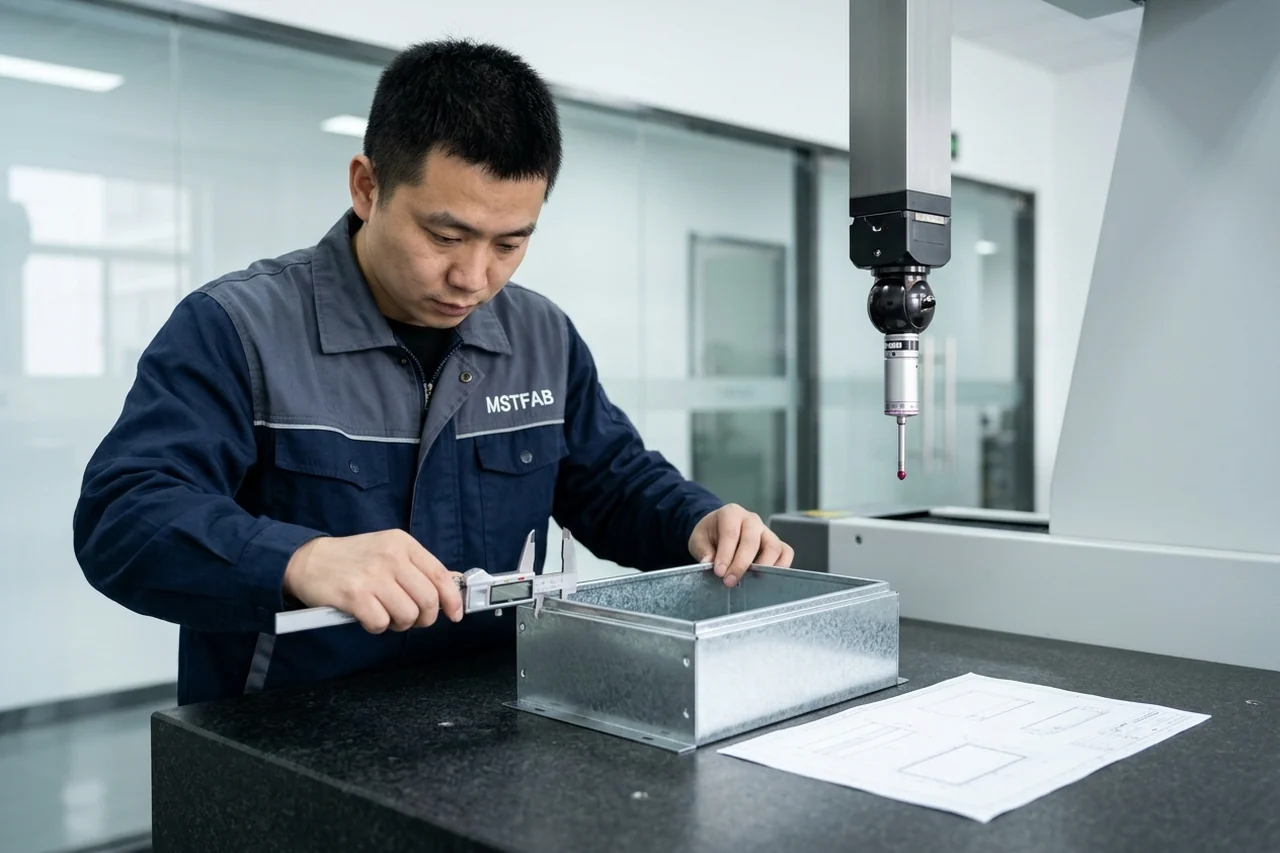
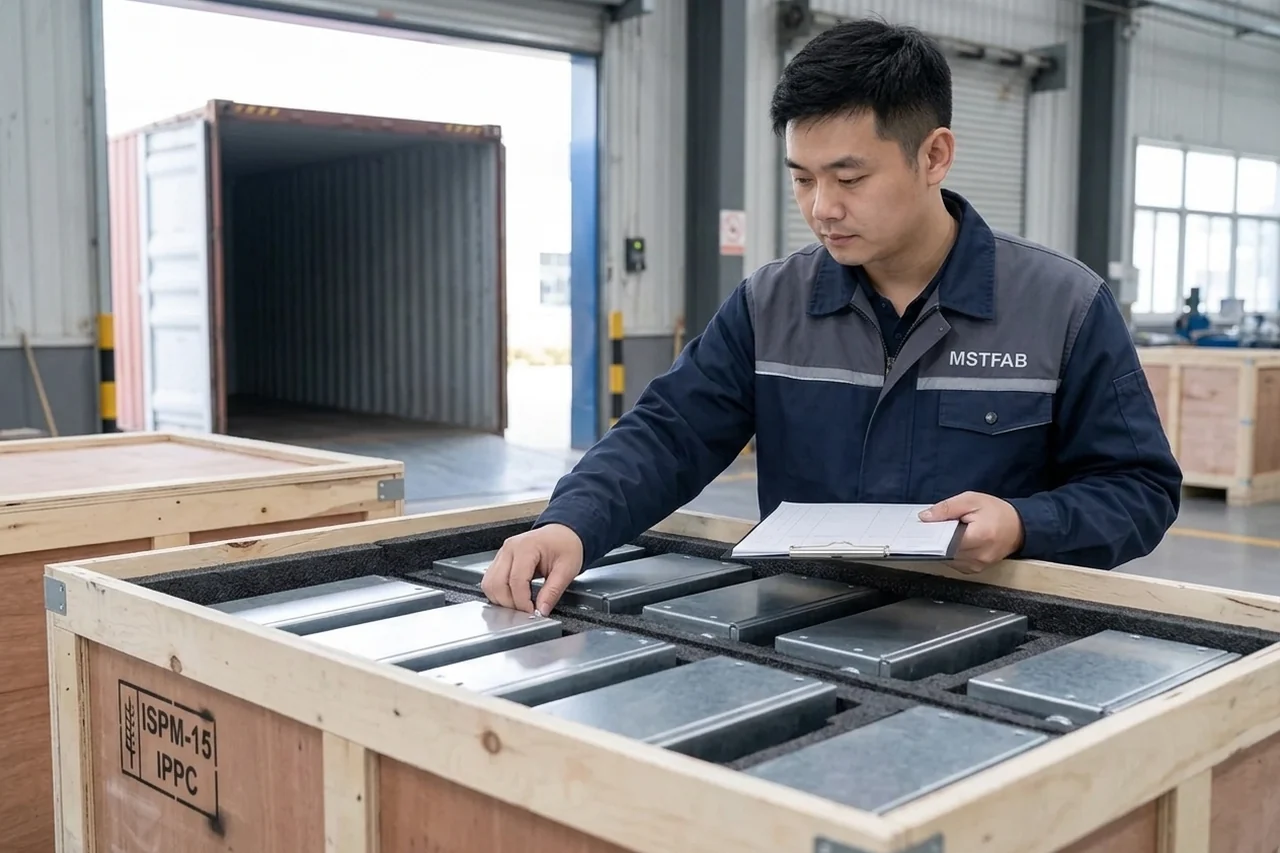
Step 04 — Pre-Bake Degassing, Hygienic Coating & FAI Release: Shells pass through Cr-free zirconium conversion, a 20-minute 205 °C thermal degas cycle, and electrostatic 70–90 µm OGF polyester powder curing. Final QC verifies Elcometer DFT, ASTM D3359 5B adhesion, < 0.05 Ω ground continuity, gasket compression, and CMM dimensions prior to VCI/EPE export crating.
All raw sheets (SPCC, SGCC, SECC, SUS304/316L, Al 5052-H32/6061-T6) are verified via optical emission spectrometry (OES) or XRF upon arrival and linked by barcode to your purchase order.
Prior to export crating in ISPM-15 fumigated plywood boxes, our quality lab conducts ballooned dimensional FAI checks, dry-film thickness (DFT) mapping, ASTM D3359 cross-hatch adhesion testing, and ground-continuity verification.
05 / 8-Point OEM RFQ Checklist & Topic Cluster Hub
OEM Engineering RFQ Checklist & Connected Fabrication Hubs
Include these eight drawing and specification controls in your RFQ package so our engineering team can lock down tooling, material traceability, and inspection fixtures on day one:
- RFQ Requirement 01Specify exact alloy and coating mass (e.g., SECC JIS G3313 or SGCC EN 10346 DX51D+Z275 minimized-spangle) plus whether EN 10204 3.1 mill heat certificates are required per shipment.
- RFQ Requirement 02Define sloped-roof angle (15°–20° recommended), overhang drip-lip dimension, and exact exterior weld dressing roughness target (e.g., Ra ≤ 1.6 µm continuous seam weld, no intermittent stitch welds).
- RFQ Requirement 03Call out powder resin chemistry and compliance documentation needed (e.g., smooth RAL 9003/7035 OGF polyester, 70–90 µm DFT, powder supplier FDA 21 CFR 175.300 technical datasheet, RoHS/REACH declarations).
- RFQ Requirement 04Indicate gasket profile and food-contact elastomer requirement (e.g., platinum-cured silicone per FDA 21 CFR 177.2600 or closed-cell EPDM), target compression ratio (25–35%), and target IP65/IP66 test envelope.
- RFQ Requirement 05Specify internal concealed hinge grade (SUS304 or SUS316), hygienic smooth-dome quarter-turn latch model, and rear wall-standoff boss height (15–25 mm) required for facility clean-behind sweep clearance.
- RFQ Requirement 06Mark all copper-plated or stainless grounding studs, PEM threaded inserts, and gasket contact lands that require high-temp silicone masking caps prior to pretreatment and powder coating.
- RFQ Requirement 07Clarify whether bottom/side cable entries should be CNC laser-cut to fixed metric/PG/NPT diameters or supplied as removable gasketed gland plates (never use standard fractured punch knockouts in hygienic zones).
- RFQ Requirement 08State First Article Inspection (FAI) sample quantity, CMM/DFT reporting template, salt-spray witness coupon requirement (e.g., 72-hr ASTM B117), and export crating pallet standard (ISPM-15 fumigated plywood).
Explore Connected Sheet Metal Fabrication Services & Enclosure Hubs
06 / OEM Buyer & Engineer FAQ
Hygienic Galvanized Distribution Box Engineering FAQs
Can MSTFAB supply an FDA-certified galvanized distribution box?
No—and buyers should distrust any sheet metal vendor claiming 'FDA certification' on an empty metal box. The U.S. FDA does not issue certifications for electrical enclosure shells, and galvanized steel itself is not approved for direct wet food contact. Instead, MSTFAB manufactures build-to-print mechanical shells under ISO 9001:2015 and IATF 16949:2016 for dry, secondary packaging, and washdown-adjacent facility zones. We supply EN 10204 3.1 mill heat certificates, RoHS/REACH statements, and powder-manufacturer FDA 21 CFR 175.300 / silicone 21 CFR 177.2600 technical datasheets to support your own facility or machine compliance file.
Why choose SECC or SGCC with hygienic powder coat over SUS304 stainless steel?
In aggressive high-pressure caustic washdown zones, passivated SUS304 or SUS316L remains mandatory. However, across dry ingredient handling, carton-packing corridors, HVAC plenums, and cleanroom mechanical chases, full SUS316L construction inflates enclosure cost by 2.4× to 3.1× and extends laser-and-TIG weld polishing lead times. Pairing a 1.5 mm SECC door with an SGCC Z275 body, continuous dressed seam welds, and a 70–90 µm low-bake OGF polyester film delivers a cleanable, non-porous exterior with sacrificial zinc cut-edge defense at roughly half the landed cost of stainless.
How do you prevent blisters and pinholes when powder coating hot-dip galvanized SGCC?
Hot-dip galvanized coatings trap microscopic gases and surface zinc hydroxides that expand abruptly when heated to 190 °C, blowing micro-pinholes through curing powder. MSTFAB eliminates this defect with a four-step protocol: specifying minimized-spangle or skin-passed sheets, applying chromium-free zirconium-silane conversion instead of heavy iron-phosphate, executing a mandatory 20-minute thermal degassing pre-bake at 205 °C (above final cure temperature) to purge entrapped volatiles before spraying, and coating with outgassing-forgiving (OGF) polyester formulations verified at 20× magnification for zero cratering.
Are knockouts acceptable on galvanized distribution boxes in hygienic-grade facilities?
Standard mechanical concentric punch knockouts are a major hygienic failure point. Their stamped score lines create recessed 0.4 mm dirt-collecting grooves on both faces, and breaking them out in the field fractures the cured powder film while leaving jagged, unsealed carbon-steel edges that rust rapidly during washdown misting. For hygienic distribution shells, MSTFAB recommends either precision nitrogen-laser-cut fixed cable gland apertures sealed with hygienic IP68 stainless/polyamide glands or a bolted, silicone-gasketed removable bottom gland plate that arrives pre-punched and fully edge-sealed from the factory.
What inspection reports ship with production lots of hygienic galvanized shells?
Every FAI and production lot from MSTFAB ships with a full traceable quality package aligned with ISO 9001:2015: incoming raw sheet EN 10204 3.1 mill test certificates tied to production lot numbers, dimensional CMM/height-gauge inspection reports to ISO 2768-mK, 12-point Elcometer DFT thickness logs, ASTM D3359 Method B 5B cross-hatch adhesion records, 100% < 0.05 Ω ground-continuity verification, and dark-room light-box seam-weld integrity logs. When specified in your RFQ, we also include 72-hour ASTM B117 salt-spray witness coupon photos and material RoHS/REACH declarations.
International Standards & Engineering References
- ISO 2768-1 / 2768-2 — General Linear, Angular and Geometrical Tolerances for Sheet Metal Fabrication
- IEC 60529 / NEMA 250 — Degrees of Protection Provided by Enclosures (IP Code & Environmental Sealing)
- ISO 9001:2015 & IATF 16949:2016 — Quality Management Systems & Production Part Approval Process (PPAP)
Ready to Quote Your Custom Sheet Metal Enclosure or Fabrication Project?
Upload your 3D STEP models and 2D PDF drawings. MSTFAB will review your tolerances, material specs, and DFM details to deliver a transparent factory quote within 24 hours.
Request Your 24-Hour DFM & Custom Quote →
Direct engineering desk: caroline@mstfab.com | ISO 9001 & IATF 16949 Certified Factory in Guangzhou, China
 WeChat Contact
 WhatsApp Me Directly