
The Short Answer
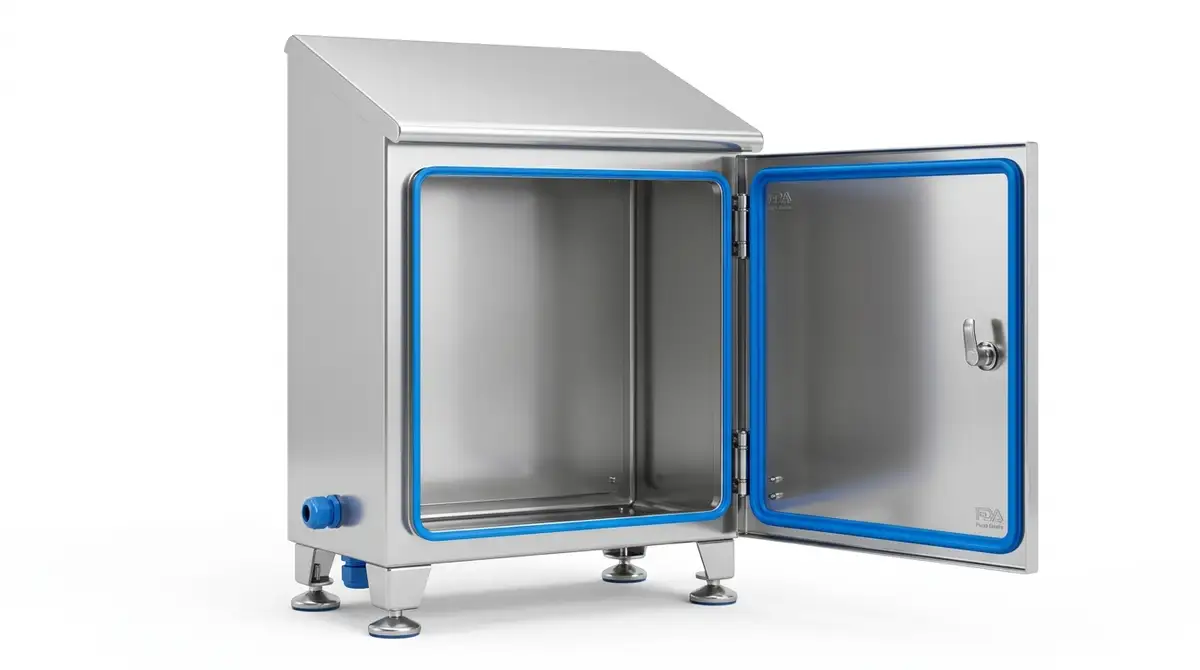
Specifying distribution box shells for food and pharmaceutical facilities starts with matching the empty enclosure material, roof geometry, and seam construction to the room washdown zone. Dry utility corridors and packaging halls often use galvanized or cold-rolled steel shells with sealed cut edges and chemical-resistant polyester or epoxy powder coating, whereas direct splash and caustic washdown rooms require 304L or 316L stainless steel with continuous TIG welds, sloped tops, and knife-edge gasket return flanges.
Explore this guide
01 / Facility Zoning & Shell Architecture
Align the empty distribution box shell with the room cleaning regime.
Food, beverage, and pharmaceutical plants divide floor space into distinct environmental zones—ranging from dry mechanical mezzanines and secondary carton-packing lines to high-pressure chemical washdown processing rooms. Over-specifying electropolished 316L in a dry warehouse wastes budget, while placing a stitch-welded carbon steel box in a chlorinated washdown zone invites rapid corrosion and water ingress.
Before releasing enclosure drawings for fabrication, define the ambient humidity, cleaning chemical exposure, cable entry direction, and wall-mounting standoffs required for the specific installation zone.
Dry utility & secondary packaging
Galvanized (SGCC/SECC) or cold-rolled steel shells with sealed joints, deburred edges, and smooth polyester or epoxy powder coat.
Moderate wipe-down & clean corridors
304L stainless steel shells with fine directional brushed grain, flush-ground exterior corner welds, and concealed quarter-turn latches.
Caustic & high-pressure washdown
316L stainless steel with sloped roof overhang, continuous crevice-free welds, knife-edge door trough, and hygienic wall standoffs.
Design tip: Avoid top-surface cable gland knockouts in rooms exposed to overhead condensation or washdown sprays; route conduit plates or gland entries through the bottom wall instead.
02 / Seam Integrity & Edge Protection
Eliminate open lap joints and raw laser-cut edges that harbor corrosion.
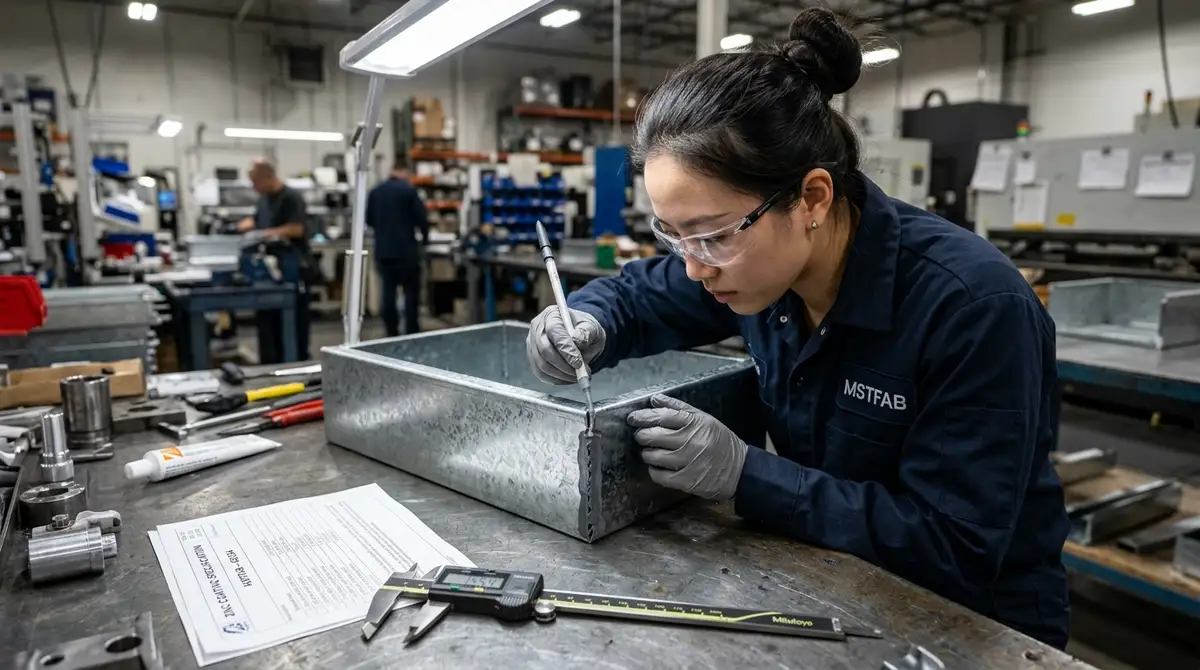
On galvanized and coated steel distribution boxes used in humid utility spaces, corrosion almost always initiates at sheared or laser-cut sheet edges where the sacrificial zinc layer is interrupted or where sharp corners pull powder coating thin during curing.
- Corner weld continuity: Specify full-penetration TIG corner welds rather than spot-welded overlapping flaps so moisture and sanitizing mist cannot wick into capillary crevices.
- Laser-edge radiusing and sealing: Mechanical edge rounding removes laser oxide burr and creates a micro-radius on aperture cutouts, allowing primer, edge sealer, and topcoat to wrap evenly around the metal edge.
- Internal subplate isolation: Mount the removable galvanized or brushed aluminum backplate on welded blind standoffs so fastener penetrations never breach the rear enclosure wall.
Precision sheet metal laser cutting combined with fixture-clamped TIG seam welding ensures tight corner fit-up before edge conditioning and coating.
03 / Forming, Drainage & Gasket Geometry
Form sloped roofs and gutter troughs to shed liquids away from the gasket.
Flat enclosure tops allow washdown water, chemical sanitizers, and dust to pool directly above the upper door seam. When maintenance technicians open the door, standing liquid drips straight onto terminal blocks and breakers.
- Incorporate a 15-degree to 30-degree press-brake-formed sloped top roof with a front drip overhang that directs runoff past the door face.
- Form a perimeter watershed gutter (knife-edge or hemmed return flange) around the body opening so liquid cannot reach the gasket seating plane.
- Maintain uniform flange flatness and return height on the CNC press brake so poured-in-place (FIPFG) or closed-cell silicone gaskets compress evenly by 25% to 35% around the full perimeter.
Repeatable CNC press brake forming keeps the door return flange coplanar with the cabinet body trough, preventing corner gaps and latch binding.
04 / Substrate, Coating & Grounding Control
Specify chemical-resistant finishes and masked grounding points on the drawing.
Whether your distribution box shell is built from galvanized steel for a dry packaging hall or 316L stainless steel for a sterile processing room, surface preparation and hardware masking must be defined explicitly on the 2D drawing.
- Galvanized + powder coat systems: Use sweep-blasting or zinc-phosphate conversion pretreatment followed by degassing-grade primer and smooth high-gloss polyester or epoxy powder coat that wipes clean without trapping lint.
- Stainless steel passivation & Ra control: For unpainted 304L or 316L shells, specify a uniform directional grain (such as Ra <= 0.8 um), weld heat-tint removal, and nitric or citric passivation per ASTM A967.
- Masked grounding studs and bonding straps: Call out copper-plated or stainless M6/M8 grounding studs on the body and door with explicit silicone-cap masking notes so continuity contact faces remain completely free of insulating paint.
Compare industrial coating and passivation workflows on our sheet metal surface treatment page.
05 / Buyer Specification Matrix
Verify five enclosure shell controls before releasing batch fabrication.
Align your electrical engineering, facility hygiene, and sheet metal sourcing teams using this verification table.
06 / First-Article Inspection & Fit Check
Validate door swing, subplate fit, and diagonal squareness at FAI.
An empty distribution box shell must assemble rapidly on the panel builder floor. If weld distortion twists the cabinet aperture by even 2 mm across the diagonal, the door will rub the gutter lip and DIN-rail subassemblies mounted on the internal backplate will misalign with door-mounted HMI cutouts.
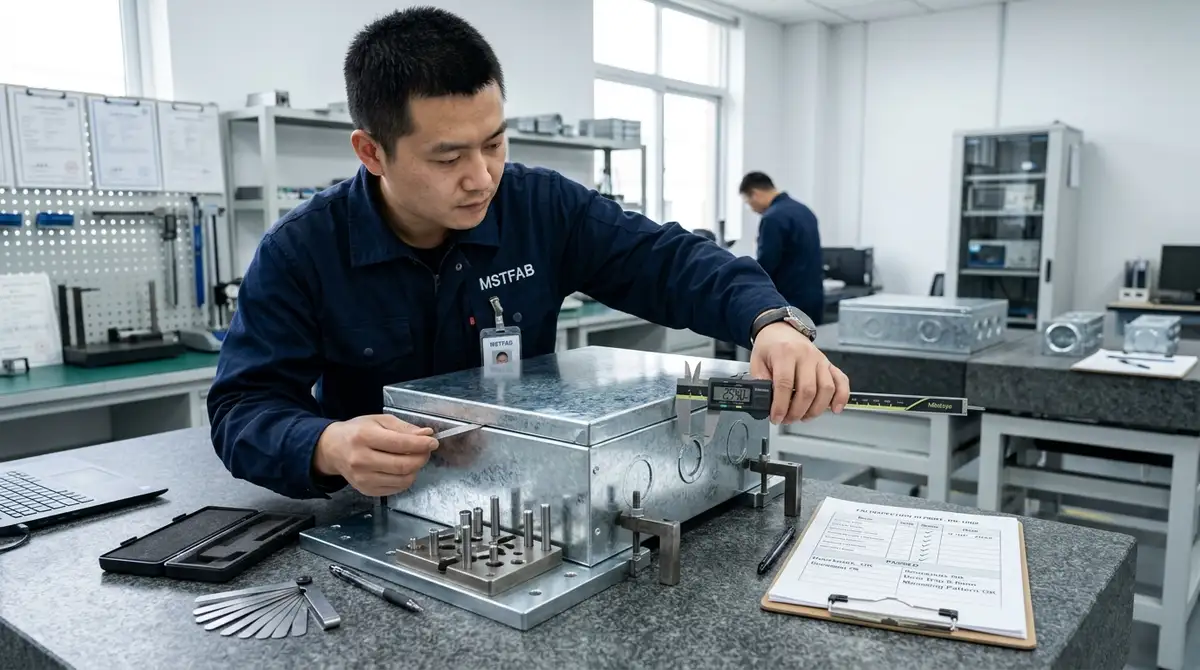
During first-article inspection, quality engineers measure cabinet diagonal squareness, door-to-body gap uniformity, hinge barrel concentricity, and mounting stud pitch against the ballooned 2D drawing.
For coated shells, inspectors also verify dry film thickness on both flat faces and laser-cut aperture edges, confirm cross-hatch adhesion, and test thread go/no-go gauges on every tapped boss and masked ground stud.
See how MSTFAB conducts first-article enclosure inspections →
07 / Clean Packing & Scope Clarity
Ship empty enclosure shells clean, assembled, and ready for panel wiring.
Before packing, finished distribution box shells should be vacuumed and wiped free of metal shavings, grinding dust, and polishing compound residue. Internal subplates and gland plates are bolted securely in place so they cannot shift and scratch interior coatings during freight.
Whether you source standalone distribution boxes or bundle them with custom sheet metal fabrication conduit brackets and hygienic wall standoffs, protective foam corner blocks and moisture-barrier pallet wrapping keep every shell ready for immediate panel shop integration.
Manufacturing scope: MSTFAB manufactures custom empty sheet metal distribution box shells, internal mounting plates, and structural brackets strictly to customer drawings under an ISO 9001 quality management system. Electrical component population, wiring, ingress testing, and final facility or regulatory compliance remain with the OEM or system integrator.
08 / Ready-to-Quote Enclosure Package
Include eight engineering details in your distribution box shell RFQ.
- 3D STEP assembly fileInclude the cabinet body, door, removable subplate, gland plates, and wall brackets.
- 2D PDF drawings with tolerancesSpecify overall dimensions, door cutout locations, and diagonal squareness limits.
- Base material specificationCall out SGCC galvanized steel, CRS, 304L, or 316L stainless steel and exact sheet gauges.
- Roof and gutter geometryIndicate flat vs. sloped top angle, drip overhang, and perimeter trough profile.
- Weld and edge-prep requirementsNote continuous seam welds, flush blending, edge rounding, and cut-edge sealing.
- Finish and masking instructionsState powder coat RAL/gloss or stainless Ra/passivation, plus grounding stud masking.
- Hinge, latch and gasket calloutsSpecify concealed or external hinges, quarter-turn latches, and gasket material/profile.
- Inspection and batch scheduleRequest ballooned FAI reports, material certs, prototype count, and production batch size.
Defining facility washdown exposure and edge-protection requirements upfront allows our DFM team to recommend the most durable seam and coating route before production begins.
Distribution box shell questions from food and pharma engineering teams
When can we use galvanized powder-coated steel instead of stainless steel for facility distribution boxes?
Galvanized steel with proper edge conditioning, zinc-rich or epoxy primer, and smooth polyester/epoxy powder coating performs well in dry utility corridors, mechanical rooms, and secondary carton packaging areas where high-pressure caustic washdowns are not used.
How do you prevent rust along laser-cut edges on galvanized steel enclosures?
We mechanically deburr and radius all laser-cut edges to remove oxide scale and eliminate sharp 90-degree corners, apply edge sealant or zinc-rich primer to exposed cut edges, and verify full powder coat wrap-around during first-article inspection.
What roof angle is recommended for washdown distribution box shells?
A 15-degree to 30-degree sloped roof with a formed front drip lip prevents washdown water and sanitizing solutions from pooling on top of the cabinet or dripping onto the upper door gasket.
How are grounding studs protected during powder coating?
Welded or clinched grounding studs on the cabinet body, door, and gland plates are covered with high-temperature silicone masking caps and base washers before pretreatment and curing, leaving a clean metal-to-metal bonding ring.
Can MSTFAB install the internal mounting plate, hinges, and gaskets before shipping?
Yes. We supply mechanically complete empty enclosure shells with the internal subplate mounted, hinges and quarter-turn latches fitted, and gasket strips or FIPFG seals applied per your BOM and drawing.
Does MSTFAB certify the final electrical distribution assembly?
No. MSTFAB is an ISO 9001 custom sheet metal manufacturer producing empty enclosure shells and mechanical subplates to your drawings. Final electrical wiring, breaker assembly, and system-level facility approvals are completed by the OEM or panel integrator.
Technical references
Consult these industry references when specifying enclosure corrosion protection, hygienic geometry, and sheet metal tolerances on your drawings.
- EHEDG — Hygienic Design Principles for Food and Pharmaceutical Plant Equipment
- ASTM A967 / A967M — Chemical Passivation Treatments for Stainless Steel Parts
- ASTM D3359 — Standard Test Methods for Measuring Coating Adhesion
- ISO 2768 — General Dimensional and Geometrical Tolerances for Sheet Metal Fabrication
Send your distribution box shell drawings for a hygienic DFM review.
Share your 3D STEP model, 2D PDF drawing, facility environment notes, and batch quantity. MSTFAB will review seam geometry, edge protection, and finishing specs and provide a fast quote.
Request Distribution Box Quote →
Have a question first? caroline@mstfab.com
 WeChat Contact
 WhatsApp Me Directly