
Use this page for supplier interview questions, not a generic choosing guide
This article is built for the moment when a buyer has two or three possible factories and needs better questions than 'best price?' That question is how trouble enters politely.
This page has been separated from the general manufacturer selection guide so Google and buyers can see the job of this article clearly. The useful question here is not “can someone make metal parts?” It is: what should a buyer check before sending drawings, approving a quote or moving into production?
- Ask who reviews DFM before quote approval.
- Ask what process evidence can be shared before production.
- Ask how drawing revision and material grade are controlled.
- Ask which inspection report is included and which costs extra.
- Ask how export packaging is chosen for the part size and finish.
| 1 | Ask who reviews DFM before quote approval. |
| 2 | Ask what process evidence can be shared before production. |
| 3 | Ask how drawing revision and material grade are controlled. |
| 4 | Ask which inspection report is included and which costs extra. |
| 5 | Ask how export packaging is chosen for the part size and finish. |
Let’s be honest: choosing a sheet metal fabrication manufacturer for OEM equipment is easy if you only care about getting a quote quickly. You send some files, pick the cheapest number on the spreadsheet, and wait.
Then, the wooden crates arrive at your loading dock. You open them, and reality sets in. The enclosure doors are warped. The mounting holes are offset by 2 millimeters (meaning your electronics boards won’t fit without a hammer). The welds look like a bird had an emergency on the metal. And inside the box, a fresh layer of rust is already starting to form on the raw steel edges. When you call the supplier, they shrug and say, “But we followed your drawing!”
If you’ve been in procurement or engineering for more than five minutes, you know that the cheapest unit price is rarely the lowest total cost. Buying custom metal fabrications—whether it’s enclosures, cabinets, brackets, guards, panels, covers, frames, or welded assemblies—is about risk management, not just cutting and bending steel.
Here is the practical, no-nonsense buyer’s guide to choosing a manufacturer who actually knows what they are doing, so your assembly team can spend their time installing components instead of performing surgery on crooked metal.
1. DFM Review: Why “Crayon Drawings” and Vague STEP Files Aren’t Enough
If you send a drawing to a factory and they quote it in thirty minutes without asking a single question, do not celebrate. Run.
A factory that quotes blindly is a factory that will manufacture blindly. A reliable custom sheet metal fabrication manufacturer does a thorough DFM (Design for Manufacturability) review before they touch a single laser cutter. Why? Because sheet metal is a physical material with limits. It has springback, bend allowances, and physical clearances that CAD software doesn’t always show.
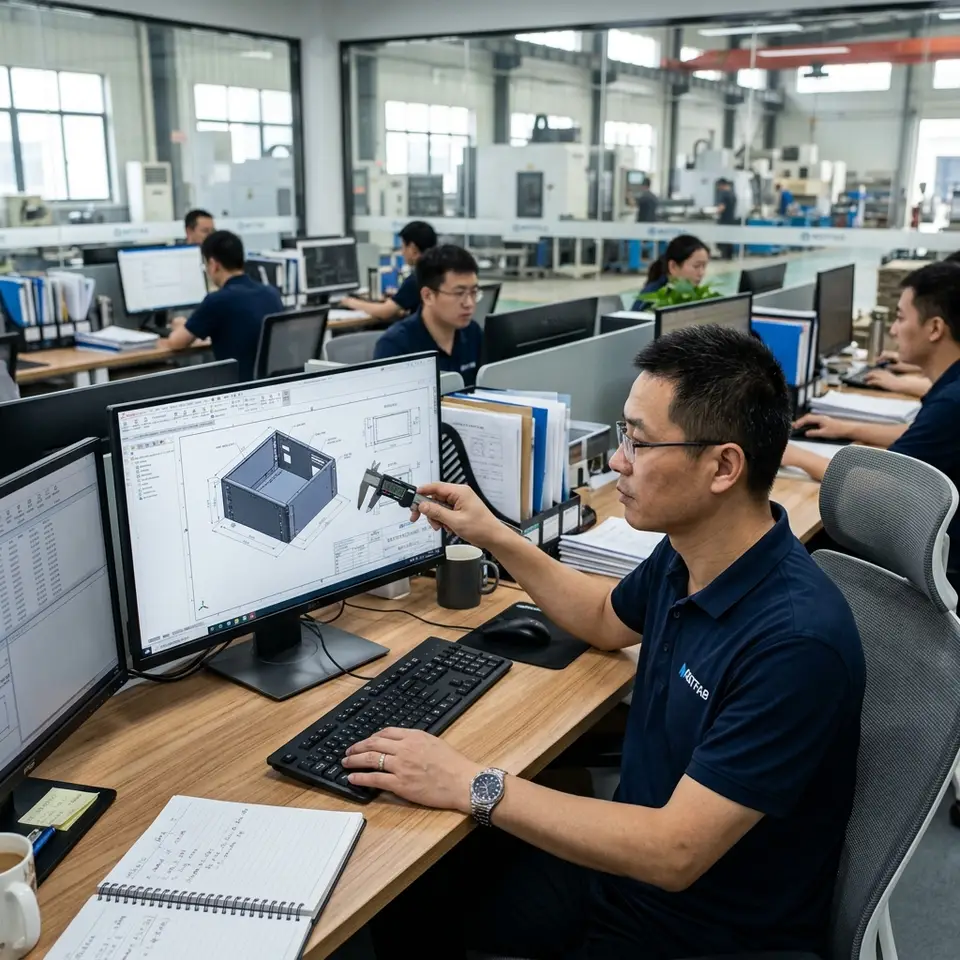
When you evaluate a supplier’s engineering team, ask yourself:
- Do they flag impossible bend radiuses that will crack the metal?
- Do they warn you if a hole is too close to a bend line (which stretches the hole into an oval)?
- Do they calculate welding heat distortion on thin panels before they start?
If your drawings look like crayon sketches with missing tolerances, a good partner will call you out. A bad partner will just build it anyway and blame you when it fails.
2. Precision Laser Cutting: The Difference Between a Perfect Fit and a Hammer
The foundation of any good fabrication is the cut. Today, CNC fiber lasers are standard, but how the manufacturer uses them matters. High-speed lasers can cut parts in seconds, but if the operator doesn’t maintain the optics or program the kerf compensation correctly, your parts will have rough, sharp burrs on the edges.

When auditing a supplier, look at their laser cut edges. Are they clean and smooth? Or do they look like they were chewed off by a very angry beaver? Sharp edges don’t just cut your assembly workers’ hands; they also cause powder coating to fail early, leading to corrosion.
3. CNC Bending: Tolerances Are Not Suggestions
Bending metal is where the real skill shows. A piece of 1.5mm steel sheet isn’t always exactly 1.5mm; it varies by batch. A cheap bending operator will just press the pedal and hope for the best. A skilled operator adjusts the press brake tooling to account for material thickness variation and springback.
If your enclosure needs doors to fit tightly with IP65 water resistance, you cannot afford a bend angle that is off by even 1 degree. If the bend is off, the flange is crooked, the gasket won’t compress evenly, and water will find its way inside. Make sure your manufacturer uses modern CNC press brakes with angle-tracking sensors and high-quality tooling.
4. Welding: Welds That Stand Up (and Don’t Look Like Bird Poop)
Welding sheet metal is an art form. If the welder uses too much heat on a thin cabinet panel, the panel will warp and buckle like a cheap potato chip. If they use too little heat, the weld will fail during shipping or field use.
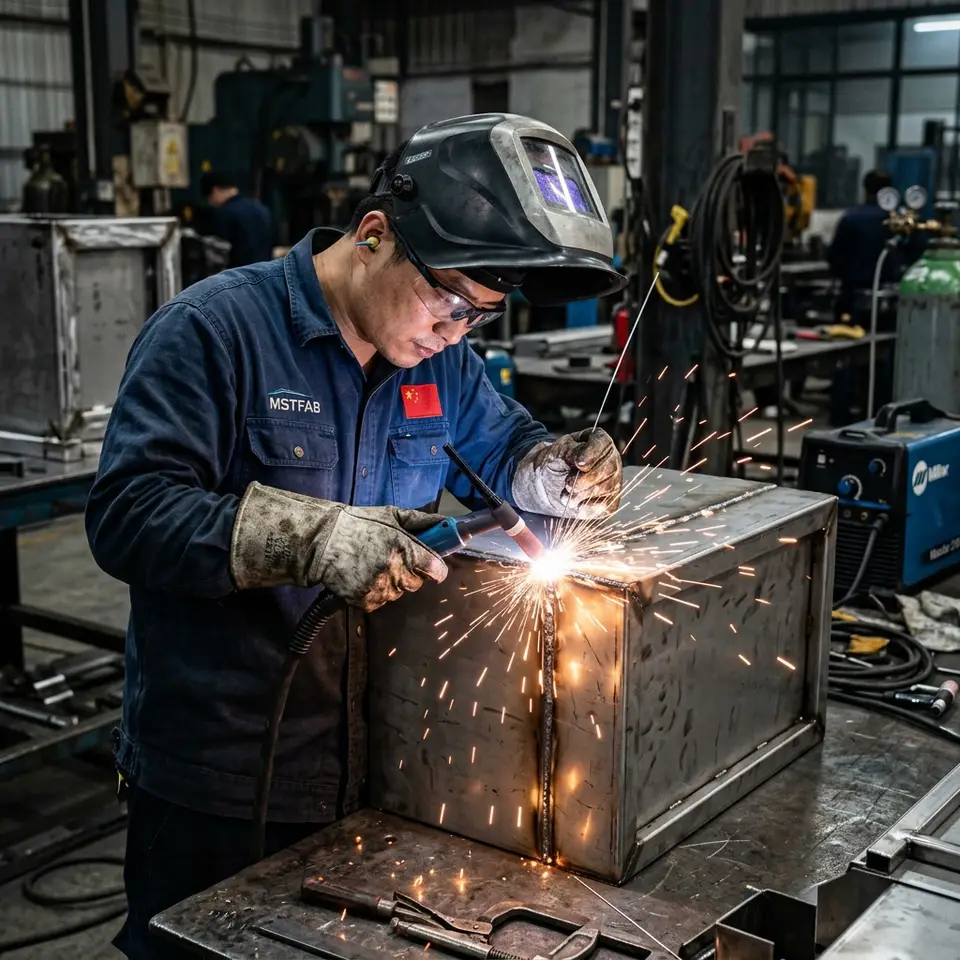
Ask the manufacturer about their welding capabilities. Do they use TIG welding for neat, clean corners that require minimal grinding? Do they have welding fixtures to keep parts square during assembly? If the welded joints look lumpy, porous, or require a bucket of Bondo filler to look smooth, you are dealing with a shop, not a professional manufacturer.
5. Finishing and Coating: Preventing the “Rusting in the Box” Syndrome
A beautiful metal enclosure is useless if the paint flakes off after six months. Many factories cut corners on surface pretreatment to save time and chemical costs. If they don’t wash, degrease, and phosphate the metal properly before powder coating, the paint won’t adhere.
For outdoor or harsh environments, make sure the supplier uses high-quality outdoor polyester powders and can offer chemical pretreatment or primer coatings. Ask them what salt-spray testing they perform to verify their finish quality. If the coating is too thin, it will scratch during shipping; if it is too thick, it will interfere with thread engagement and door tolerances.
6. Inspection: Using More Than a Squint
Some factories have a quality control department that consists of a guy standing at the end of the line, squinting at a finished enclosure, and saying, “Looks okay to me.” This is not quality control.
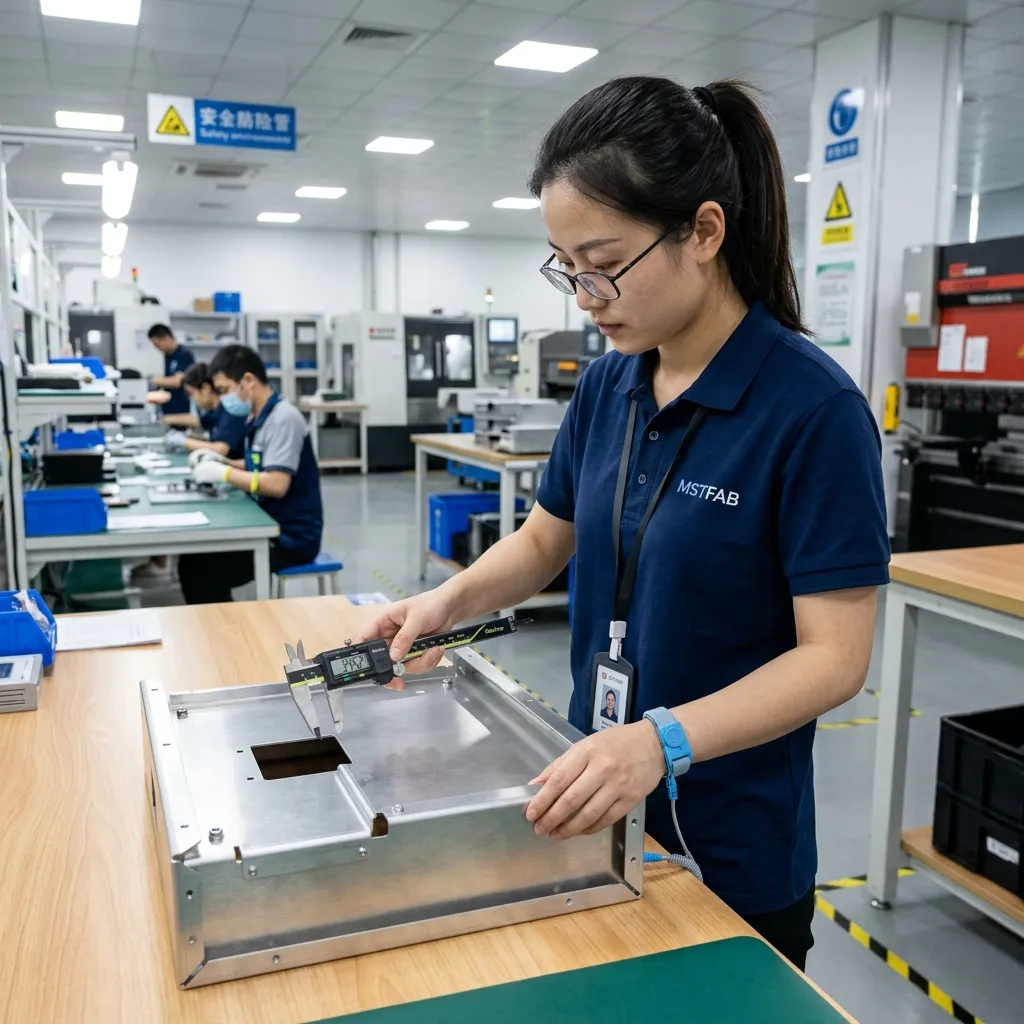
A professional manufacturer will provide a First Article Inspection (FAI) report and maintain statistical process control during batch production. They should inspect:
- Critical dimensions using digital calipers and height gauges.
- Powder coating thickness using magnetic thickness meters.
- Thread clearance on PEM nuts and studs.
- Door alignment and gasket compression.
7. Packaging: The Crate of Broken Dreams
You can manufacture the most precise, beautiful sheet metal cabinet in the world, but if you toss it loosely into a cheap cardboard box and ship it halfway across the globe, it will arrive looking like it went three rounds with a bulldozer.
Export packaging is just as important as the manufacturing process. A professional manufacturer uses custom-cut corner foam, protective film on cosmetic surfaces, sturdy pallets, and fully enclosed wooden crates for sea freight. If your supplier complains that wooden crates cost extra, remind them that shipping damaged parts back costs much more.
—
Trust Evaluation Matrix: Red Flag Factory vs. Reliable Partner
Before you sign a contract or send an RFQ, use this trust matrix to evaluate your potential sheet metal manufacturer:
| Sourcing Factor | Red Flag Factory | Reliable Partner (Like MSTFAB) |
|---|---|---|
| RFQ & Quoting | Quotes immediately without looking at 2D drawings or asking about tolerances. | Performs DFM review, requests 2D PDFs for critical tolerances, and queries application environment. |
| Drawing Review | Tells you “no problem” for everything, then blames your CAD file when doors don’t close. | Suggests minor design changes (e.g., bend radius, hole offset) to prevent cracking or distortion. |
| Bending & Welding | Uses old manual press brakes and structural welders who warp the panels. | Uses high-precision CNC press brakes and TIG welders with fixtures to keep structures perfectly square. |
| Surface Pretreatment | Sprays powder directly onto metal without degreasing. (Paint peels off easily). | Multi-stage chemical washing and phosphate treatment to ensure maximum powder coating adhesion. |
| Quality Control | “Squint inspection” right before packing. No reports or documentation provided. | First Article Inspection (FAI) reports, caliper checks, coating thickness measurement, and fit-testing. |
| Export Packaging | Wrap in thin plastic wrap, throw in a single-wall carton, and hope for the best. | Double-wall boxes, heavy corner foam inserts, wooden crates, and moisture barrier protection. |
—
FAQs: Sourcing Custom Sheet Metal Fabrication
What files do sheet metal manufacturers prefer for a quote?
You should always send a 3D STEP file (which shows the exact 3D geometry) and a 2D PDF drawing. The PDF is critical because it specifies tolerances, thread types, material grade, surface finish, and cosmetic requirements that the 3D file doesn’t contain.
How do I know if a factory can achieve my tolerance requirements?
Ask them about their standard tolerance class (e.g., ISO 2768-m or ISO 2768-f). A professional sheet metal shop should have no problem holding ±0.2mm on CNC laser cuts and ±0.5mm on standard bent parts without charging a premium.
Why is TIG welding preferred over MIG welding for cosmetic enclosures?
TIG welding offers much tighter control over the heat input, resulting in cleaner, smaller weld beads that don’t warp the metal. It requires less grinding and finishing, which makes the corners of your enclosures look seamless after powder coating.
What is the most common mistake buyers make when sending an RFQ?
Failing to specify the exact environment (indoor vs. outdoor). An outdoor enclosure requires galvanized steel or aluminum, stainless steel hardware, and UV-resistant powder coating, whereas an indoor enclosure can use cheaper cold-rolled steel.
sheet metal welding services
MSTFAB provides TIG and MIG sheet metal welding services for structural assemblies, cabinets, frames and OEM metal components.
 WeChat Contact
 WhatsApp Me Directly