
OEM supplier selection guide
How to Choose a Sheet Metal Fabrication Manufacturer
A cheap quote is useful only if the parts arrive on time, fit the drawing, look professional and do not require your assembly team to become emergency metal surgeons.
For OEM buyers, choosing a sheet metal fabrication manufacturer is not only about price. It is about drawing review, material knowledge, bending control, welding discipline, surface finishing, inspection, packaging and communication that does not require a treasure map.
The Short Version for Busy Buyers
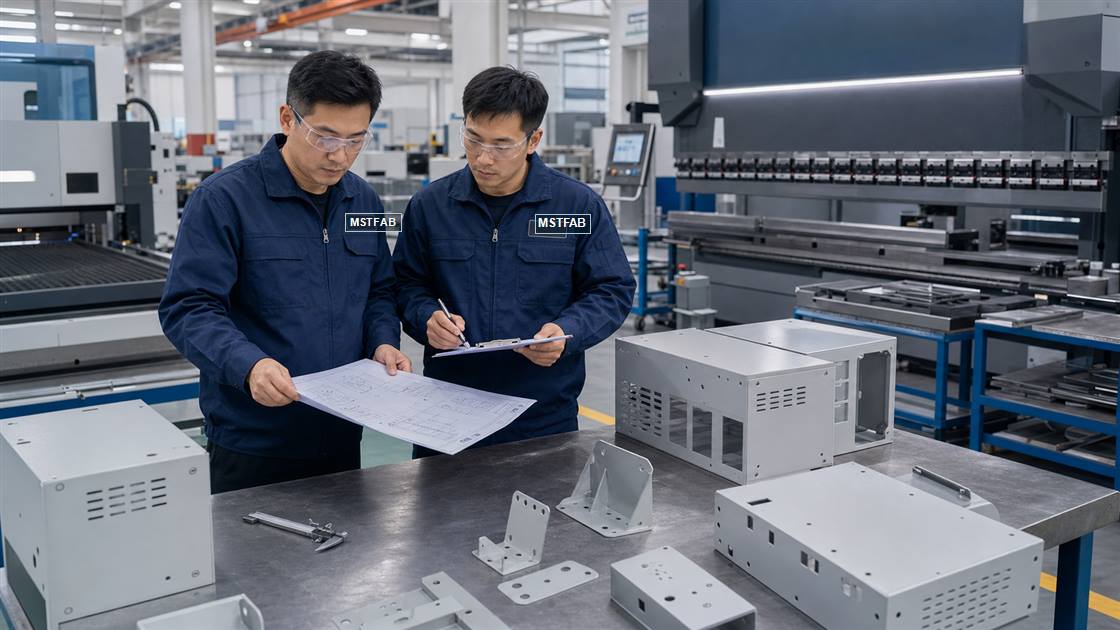
Choose a manufacturer that can explain how your part will be made, not only how much it costs. A reliable supplier should review drawings, confirm material and thickness, plan DFM, control laser cutting and CNC bending, manage welding distortion, protect surface finish and pack parts for export shipment.
Good quote
Shows material, finish, process scope, tolerance assumptions, packaging and lead time clearly.
Risky quote
Only gives a unit price and hopes all awkward details can be discovered later, preferably by someone else.
Best partner
Challenges weak drawings early, explains trade-offs and helps reduce rework before production.
Start With Evidence, Not Sales Poetry
Every supplier can say ?high quality.? That phrase is free. Evidence is better: drawings marked up for manufacturability, first-article inspection, material traceability, finish samples, packaging photos and a clear production route.
When comparing suppliers for custom OEM sheet metal parts, ask for proof that matches your actual product type, not a random factory glamour shot from 2017.
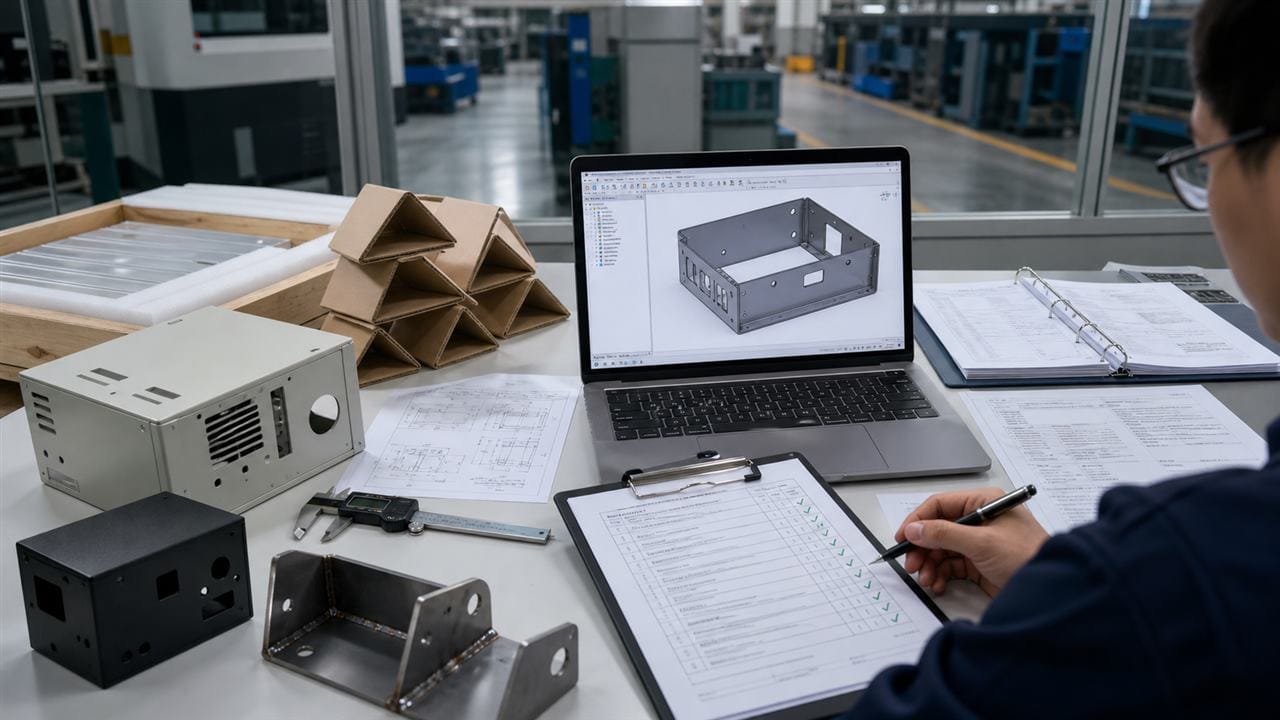
Trust Table: What a Serious Manufacturer Should Prove
| Trust Signal | What to Ask | Why It Matters |
|---|---|---|
| Product fit | Have you made similar enclosures, cabinets, brackets, guards or welded assemblies? | Different products create different tolerance, finish and packaging risks. |
| DFM review | Can you review bends, hole spacing, weld access, coating clearance and assembly risk before quoting? | Drawing mistakes are cheap to fix before production and painful after shipment. |
| Process scope | Which steps are in-house: laser cutting, bending, welding, powder coating, hardware installation, assembly? | More process control usually means fewer communication gaps and fewer surprise delays. |
| Quality control | Do you provide first-article checks, dimensional inspection and surface review? | One beautiful sample is not enough. Batch repeatability is the real test. |
| Export packaging | How are corners, painted surfaces, doors, panels and heavy assemblies protected? | Good parts can become bad parts if packaging is treated as an afterthought. |
| Communication | Can your team discuss drawings, revisions, materials and delivery clearly in English? | Confusion has a lead time too, and it is never listed on the quote. |
1. Check Whether They Understand Your Product Type
Not all sheet metal factories are built for the same work. Some are strong at simple flat brackets. Some are better at custom sheet metal enclosures, cabinets, welded frames or high-finish panels. The right manufacturer should understand the problems your part will create after cutting and bending.
Enclosures and cabinets
Ask about door fit, hinge position, lock clearance, cable entry, ventilation, grounding, mounting plates and powder coating clearance.
Brackets and plates
Check hole position, bend angle, material thickness, load direction, hardware insertion and assembly clearance.
Welded assemblies
Review weld access, fixture control, distortion risk, finishing after welding and inspection points.
2. Ask for DFM Before the Price Looks Too Pretty
A professional supplier should identify manufacturing risks before confirming price and lead time. This includes bend interference, tight hole-to-bend distance, sharp internal corners, welding distortion, finish thickness and difficult assembly sequences. You can compare this with our sheet metal fabrication design guide and tolerance guide.
If a supplier says ?no problem? to every drawing in eight seconds, be careful. Metal is not magic. It has bend radii, springback and opinions.
3. Compare Total Cost, Not Only Unit Price
The lowest unit price can still be the highest total cost if it creates rework, delayed assembly, rejected finish, damaged packaging or late delivery. Use sheet metal cost reduction and cost factor thinking to compare suppliers more fairly.
| Hidden Cost | Typical Cause | Better Supplier Behavior |
|---|---|---|
| Assembly delay | Cutouts, holes or bend angles drift from drawing | Dimensional checks and first-article inspection |
| Finish rejection | Wrong material, poor pretreatment or weak packaging | Finish route review and protected packing plan |
| Engineering rework | No DFM before production | Early drawing feedback and manufacturability notes |
| Shipment damage | Thin cartons, poor stacking or exposed corners | Export packaging based on weight, surface and geometry |
4. Review Materials, Finishing and Process Route
Your supplier should help match material and finish with the application. Common sheet metal materials such as mild steel, SPCC, galvanized steel, stainless steel and aluminum behave differently during cutting, bending, welding and coating.
For powder coated parts, ask about surface preparation. For stainless steel, ask about surface protection. For outdoor cabinets, ask about corrosion resistance, gasket fit and packaging. For precision parts, ask how the fabrication process is controlled from drawing review to shipment.
5. What to Send for a Fair Supplier Comparison
If every supplier receives different information, every quote will be a different species. Send the same RFQ package so you can compare price, scope and risk without guesswork.
- 2D drawing and STEP/STP file
- Material grade and thickness
- Quantity and expected repeat volume
- Critical dimensions and tolerance notes
- Surface finish or RAL color
- Welding, hardware and assembly requirements
- Indoor or outdoor application environment
- Packaging and export delivery expectations
- Photos or sample references when available
- Target lead time and revision history
For a practical file checklist, use our sheet metal RFQ drawing requirements guide.
Where MSTFAB Fits
MSTFAB supports OEM buyers who need custom sheet metal parts, electrical enclosures, telecom cabinets, industrial automation parts, machinery covers and guards, welded assemblies and powder coated components made to drawing.
We focus on practical manufacturing feedback: what can be cut, bent, welded, finished, assembled, inspected and shipped with fewer surprises. The goal is not to win the quote with the prettiest promise. The goal is to help your parts arrive usable.
FAQ: Choosing a Sheet Metal Fabrication Manufacturer
What should I check before choosing a sheet metal fabrication manufacturer?
Check whether the manufacturer understands your product type, reviews drawings before quoting, controls cutting and bending accuracy, supports welding and finishing, documents inspection, communicates clearly and protects parts during export packaging.
Is the lowest sheet metal quote usually the best choice?
Not always. A very low quote can hide missing finishing, weak packaging, poor tolerance control or no DFM review. The lowest unit price can become expensive if parts arrive scratched, distorted or impossible to assemble.
Why does DFM matter when selecting a fabrication supplier?
DFM helps identify bend risks, hole spacing issues, welding distortion, coating clearance and assembly problems before production. It is cheaper to fix a drawing than to fix a container of bad parts.
What RFQ files should I send to compare suppliers fairly?
Send 2D drawings, STEP or STP files, material and thickness, surface finish, quantity, tolerance notes, assembly requirements, application environment and packaging expectations.
Can MSTFAB support OEM sheet metal parts and enclosures?
Yes. MSTFAB supports custom OEM sheet metal parts, enclosures, cabinets, brackets, panels, guards, welded assemblies and powder coated components based on drawings, samples or project specifications.
Ready to compare your project with a real manufacturing review?
Send your drawings, material, thickness, finish and quantity. MSTFAB will review the fabrication route and help you understand the practical risks before production starts.
To compare shortlisted factories consistently, use the sheet metal supplier selection scorecard and record evidence for drawing control, fabrication, inspection, packing and change control.
MSTFAB provides TIG and MIG sheet metal welding services for structural assemblies, cabinets, frames and OEM metal components.
 WeChat Contact
 WhatsApp Me Directly