
Combine harvesters and high-horsepower agricultural tractors work in dense clouds of chaff, dry wheat straw, corn husks, and pulverized soil dust. Under these punishing field conditions, the radiator screen frame and perforated intake panel are all that stand between continuous harvest operation and catastrophic engine overheating. Yet sourcing these critical airflow components requires far more than punching random holes in sheet metal.
Quick Answer: Custom radiator screen frames and perforated metal intake panels are fabricated components used around the cooling-air intake areas of tractors, combine harvesters, and other agricultural machinery. These components can be manufactured from aluminum, carbon steel, galvanized steel, or stainless steel according to the equipment manufacturer’s approved drawings. Typical fabrication processes include laser cutting, CNC bending, welding, deburring, and surface finishing. For agricultural equipment OEMs, the key purchasing requirements include perforation geometry, mounting interfaces, screen retention, vibration resistance, corrosion protection, and access for removing accumulated crop debris. A custom sheet metal fabrication supplier can manufacture the specified frames, perforated panels, mounting brackets, and related mechanical components. The equipment OEM remains responsible for cooling airflow requirements, debris separation performance, and complete system validation.

A qualified custom sheet metal fabrication supplier can manufacture these structural components strictly to approved CAD models and engineering drawings. This technical sourcing guide explains how agricultural machinery manufacturers should specify radiator screen frames, evaluate perforation methods, verify field vibration resilience, and prepare an accurate fabrication RFQ.
What Are Agricultural Radiator Screen Frames and Intake Panels?
Agricultural radiator screen frames are rigid metal structures that house, support, and locate screening elements directly in front of the engine radiator, hydraulic oil cooler, and air-conditioning condenser. Perforated intake panels are formed metal panels containing an engineered array of openings that allow cooling airflow to pass through while physically blocking crop residue, field stones, and airborne stalks.
Depending on the machine architecture, the intake system may be designed as a single formed perforated sheet, a heavy welded support frame with removable wire-mesh cartridges, or a multi-piece hinged access assembly. Explore our dedicated agricultural sheet metal parts manufacturing services for broader context on agricultural equipment components.
Common Fabricated Components
| Component | Primary Engineering Function | Typical Sheet Metal Manufacturing Process |
|---|---|---|
| Perforated intake panel | Provides specified open area for airflow while barring large debris | Fiber laser cutting or CNC turret punching |
| Metal screen frame | Supports and maintains squareness of internal mesh or filter elements | Laser cutting, CNC press brake bending, and TIG welding |
| Mounting flange | Fastens the panel securely to the tractor hood or combine chassis | CNC sheet metal bending with laser-cut mounting slots |
| Reinforcement bracket | Prevents panel drumming and fatigue under diesel engine vibration | Laser-cut gussets, welded stiffener channels, or formed ribs |
| Removable access cover | Allows field technicians to quickly clean accumulated chaff | Formed sheet metal with quick-release quarter-turn latches |
| Screen retaining strip | Clamps replaceable fine wire mesh tightly against the outer frame | Shearing, deburring, piercing, and fastener installation |
| Intake transition panel | Seals aerodynamic ducting between grille outer skin and heat exchanger | Multi-bend CNC forming and stitch welding |
Not every cooling package requires every component listed above. The exact manufacturing scope is dictated by the equipment OEM’s mechanical drawings and bill of materials (BOM).
Why Do Agricultural Machines Need Custom Intake Panels?
While stationary industrial generators can draw cooling air through generic catalog grilles, mobile agricultural machines operate in severe, dust-choked micro-climates. Specialized European manufacturers like Graepel produce custom perforated sheet metal components specifically for harvesters and agricultural tractors. Sourcing custom-fabricated panels provides equipment OEMs with decisive advantages over generic catalog products:
1. How Should OEM Buyers Specify Perforated Metal Panels?
Perforation design directly dictates both structural rigidity and aerodynamic performance. OEM buyers should provide complete geometric perforation specifications on the 2D engineering drawing rather than asking the fabricator to choose an arbitrary pattern.
| Design Parameter | What OEM Buyers Should Explicitly Define | Impact on Fabrication & Quality |
|---|---|---|
| Hole Shape | Round, elongated slot, square, or hexagonal | Affects laser cutting piercing cycle time and tooling requirements |
| Hole Size | Diameter (e.g., Ø3.0 mm) or slot dimensions (e.g., 3.2 × 25 mm) | Controls minimum particle size blocked from entering radiator core |
| Hole Pitch & Pattern | Staggered (60° triangular pitch) vs straight inline pattern | 60° staggered pitch maximizes open area while maintaining structural strength |
| Open Area Percentage | Target percentage (commonly 38% to 58% for cooling intakes) | Determines airflow restriction and total sheet weight reduction |
| Material Thickness | Exact gauge (e.g., 2.0 mm Aluminum 5052 or 1.5 mm Galvanized) | Determines minimum hole-to-thickness ratio for clean cutting/punching |
| Edge Margin | Unperforated border width around the perimeter (min. 15–25 mm) | Essential for press brake clamp grip and perimeter stiffness |
| Unperforated Zones | Solid metal areas reserved for mounting holes or welded brackets | Prevents fastener pull-through and ensures solid weld puddles |
| Surface Burr Limits | Maximum permissible burr height (e.g., burr < 0.1 mm) | Dictates downstream brush deburring or vibratory finishing passes |

Open Area vs. Structural Strength Trade-Off
A common engineering dilemma in radiator intake design is the trade-off between geometric open area and sheet stiffness. Increasing the open area beyond 60% significantly improves engine cooling airflow, but it strips away the metal’s internal cross-sectional structure. Under field conditions, an overly perforated thin panel will sag, flutter like a drumhead in the engine fan’s slipstream, and eventually suffer fatigue fractures along hole ligaments.
To balance airflow and strength, experienced agricultural OEMs use panels with 42% to 52% open area combined with CNC-formed perimeter stiffening flanges, hemmed edges, or diagonal cross-breaks. See our bend radius and flange checklist for guidelines on stiffening formed edges.
2. Laser-Cut Openings vs. Fine Mesh: Which Is Better?
Agricultural equipment intake designs generally utilize one of three primary metal configurations depending on annual production volume, hole diameter, and debris size:
| Manufacturing Route | Key Production Advantages | OEM Purchasing & DFM Considerations |
|---|---|---|
| Laser-Cut Perforated Panels | Zero tooling expense; highly flexible hole patterns; integrated mounting holes and outer contours in a single cutting setup | Economical for prototypes and batch sizes up to thousands of units; piercing thousands of micro-holes (<2 mm) increases cutting cycle time |
| Pre-Perforated Coils / Sheets | Low raw material cost for standard commercial hole patterns; high production speed on press brakes | Perforations extend into bend zones and mounting margins unless custom-ordered; cut edges require deburring; lower dimensional flexibility |
| CNC Turret Punched Panels | Extremely fast cycle times on repetitive hole clusters using multi-hole cluster punch tools; clean edge shearing | Requires upfront tooling investment for specialized cluster dies; sheet flatness requires roller leveling after punching |
| Woven Stainless Wire Mesh in Frame | Provides fine screening (<1.0 mm openings) to capture fine thistle down, dandelion seeds, and tiny chaff | Mesh lacks structural rigidity; must be secured inside a fabricated sheet metal frame using bolted retaining strips or folded pinch seams |
| Expanded Metal Grilles | High open area percentage; rigid one-piece expanded construction with zero material scrap | Diamonds have directional airflow resistance; sharp sheared strand edges can snag crop fibers; requires careful perimeter framing |
For most agricultural machinery OEMs sourcing 50 to 500 units per batch, CNC fiber laser cutting of customized panels with unperforated border margins provides the ideal balance of fast turnaround, structural integrity, and zero tooling cost.
3. What Materials Are Suitable for Agricultural Radiator Screen Frames?
Material selection must account for physical stone impacts, continuous outdoor weathering, fertilizer chemical exposure, high-pressure pressure-washer cleanings, and overall front-axle weight distribution.
| Material Grade | Potential Agricultural Application | Key Manufacturing & Service Considerations |
|---|---|---|
| SPCC / Carbon Steel | Heavy-duty welded tractor grille frames, front bumper brush guards | Economical and strong; requires comprehensive multi-stage zinc primer and exterior powder coating |
| SGCC Galvanized Steel | Combine side intake doors, internal engine bay deflector panels | Pre-applied zinc coating resists corrosion; laser-cut edges and weld seams lose zinc and require cold-galvanizing touch-up |
| Stainless Steel 304 | Fertilizer spreader radiator screens, sugarcane harvester intake panels | Exceptional corrosion resistance against acidic plant sap and moisture; cleanable with aggressive caustic washdowns |
| Stainless Steel 316 | Coastal agriculture, chemical crop sprayer cooling panels | Superior resistance to chloride salts and liquid agricultural chemicals; higher material cost |
| Aluminum 5052-H32 | Removable radiator screen cartridges, top hood intake grilles | Low weight reduces operator fatigue during daily cleanout; excellent marine atmospheric corrosion resistance; non-magnetic |
| Aluminum 6061-T6 | Machined hinge blocks, heavy mounting brackets, structural extrusions | High yield strength; limited formability on tight press brake bends; susceptible to cracking if bent across grain without proper radii |
Aluminum 5052 Intake Panels
Because agricultural operators frequently pull radiator screens out of the machine to blow them clean with compressed air, weight is a major ergonomic concern. Aluminum 5052-H32 (typically 2.0 mm to 3.0 mm thick) is widely specified for removable screen inserts. It provides high fatigue strength, natural atmospheric oxide protection, and easy handling at one-third the weight of steel.
Galvanized and Coated Carbon Steel Frames
For the outer perimeter structure that mounts directly to the tractor frame, carbon steel provides maximum rigidity against tree branch impacts and field collisions. However, unfinished carbon steel quickly corrodes when caked in moist organic mud. Specifying an automotive-grade e-coat (electrophoretic deposition) or zinc-rich primer underneath UV-stable architectural powder coating is essential. For further guidance on alloy trade-offs, consult our sheet metal material selection guide.
OEM Purchasing Recommendation: Never request generic “aluminum” or “steel.” Always specify the exact alloy designation, temper, and sheet thickness on your CAD notes (e.g., “Material: AL 5052-H32, 2.0 mm thk, deburred all edges”).
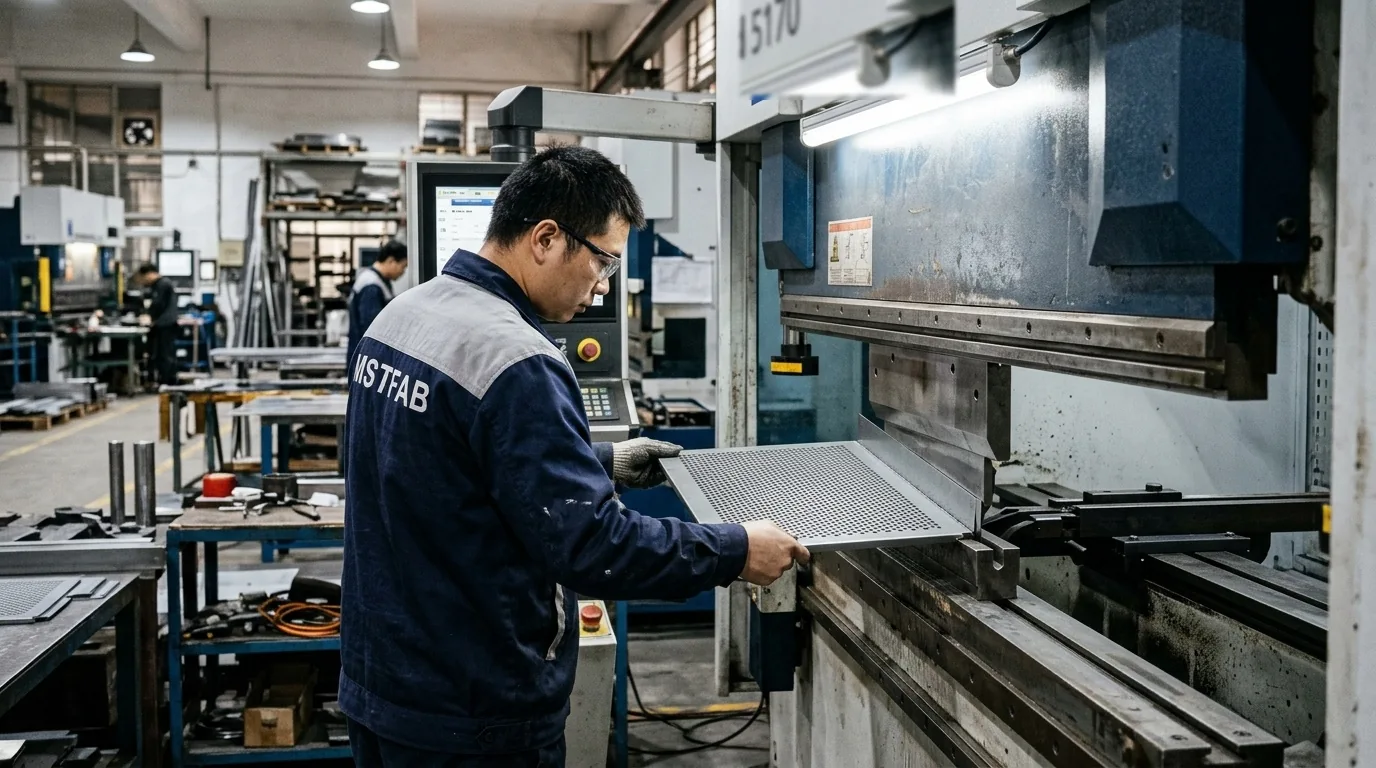
4. How Does CNC Bending Affect Radiator Screen Frames?
Forming flanges on a perforated metal panel behaves very differently from bending solid sheet metal. When perforations are located too close to a press brake bend line, the metal between the holes stretches unpredictably, resulting in severe hole ovalization, waviness along the flange edge, and localized cracking.
Crucial Bending & Forming DFM Rules
5. How Should Radiator Screen Frames Be Mounted?
Mounting interfaces must withstand continuous tractor frame flexing and engine vibration while facilitating rapid, tool-free field servicing.
Vibration-Resistant Fastening
Agricultural diesel engines subject front-end grilles to severe cyclical vibration. Standard machine screws with split lock washers frequently back out in the field. Experienced equipment designers specify:
- Captive clinch studs or PEM self-clinching blind standoff nuts pressed into the frame flanges before powder coating.
- All-metal prevailing torque locknuts (Stover nuts) or serrated flange locknuts.
- EPDM rubber vibration isolation grommets sandwiched between the mounting bracket and the tractor chassis to absorb harmonic engine frequencies.
Debris Extraction Clearance
A screen frame may match its 3D CAD dimensions perfectly, but if the machine hood, hydraulic oil cooler hoses, or front loader mounting masts obstruct its withdrawal path, an operator cannot clean the screen in the field. Design the intake frame with slide-out guide tracks, captured hinge pins, or quarter-turn quick-release fasteners (such as Southco or Dzus style latches). Review our guide on sheet metal fastener access and tool clearance to prevent field servicing nightmares.
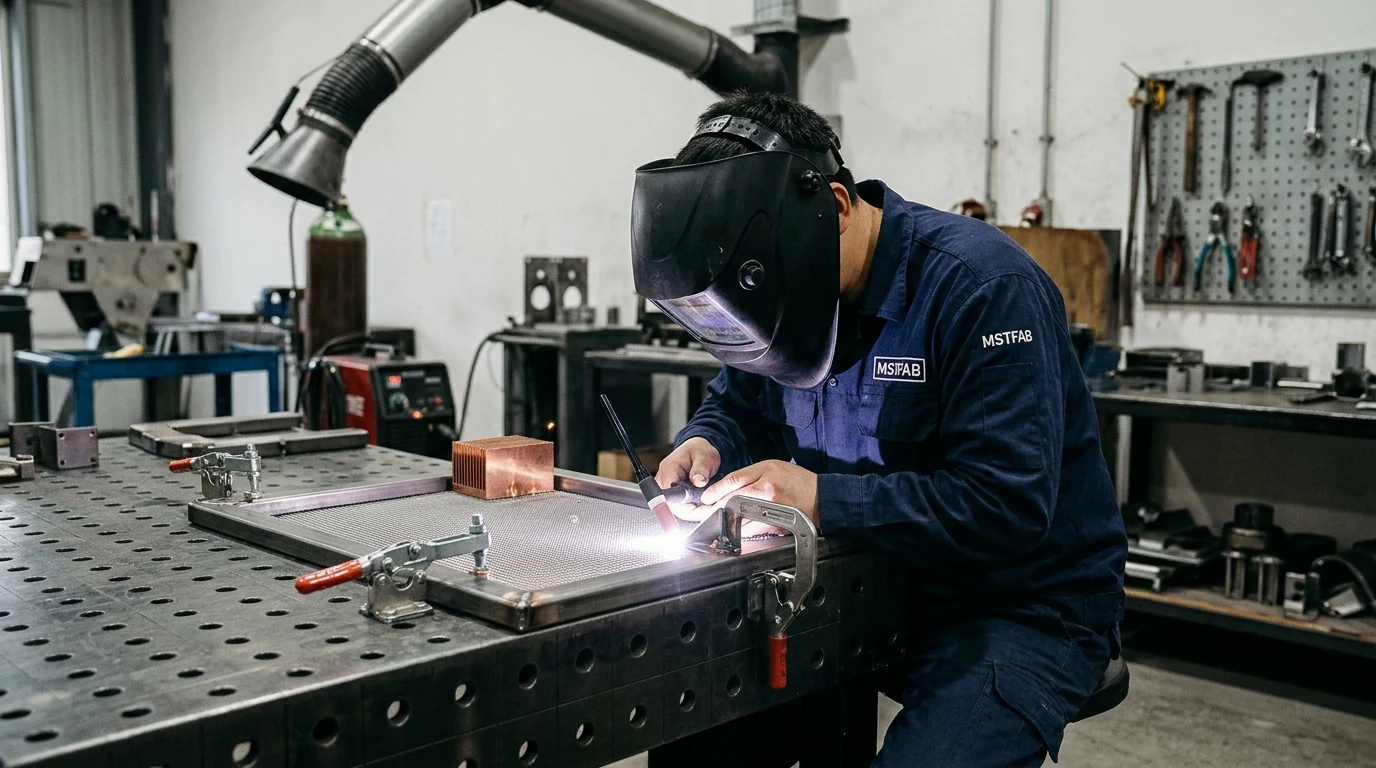
6. Can Perforated Metal Panels Be Welded to Frames?
Yes, perforated intake panels can be joined to perimeter structural frames. However, because a perforated sheet has less thermal mass than a solid plate, it heats up much faster and is exceptionally vulnerable to thermal distortion, buckling, and oil-canning.
| Welding Feature | Fabrication Challenge | MSTFAB Engineering Solution |
|---|---|---|
| Perforated sheet to frame seam | Continuous weld beads melt hole edges and buckle the thin sheet | Specify intermittent stitch welds (e.g., 20 mm weld every 100 mm) or resistance spot welding |
| Frame corner miter joints | Thermal pull pulls the rectangular frame out of squareness | Rigid toggle clamping on cast iron 3D fixture tables with corner squaring blocks |
| Welded mounting brackets & tabs | Weld shrinkage distorts bolt hole center-to-center distances | Symmetrical tacking sequence and post-weld dimensional verification |
| Thin sheet heat dissipation | Excess heat burns through aluminum or stainless sheet ligaments | Heavy copper chill bars clamped directly behind weld seams to sink heat rapidly |
For assemblies requiring high cosmetic appeal and minimal weld cleanup, review our technical guide on welded sheet metal assembly quality checks.
7. How Do Surface Finishes Affect Agricultural Intake Panels?
Surface finishing on perforated agricultural panels requires specialized handling because the panel contains hundreds or thousands of laser-cut or punched edges where coating thickness can vary.
Learn more about chemical pretreatment and finishing standards in our surface treatment guide.
8. What Should Buyers Inspect Before Approving Production?
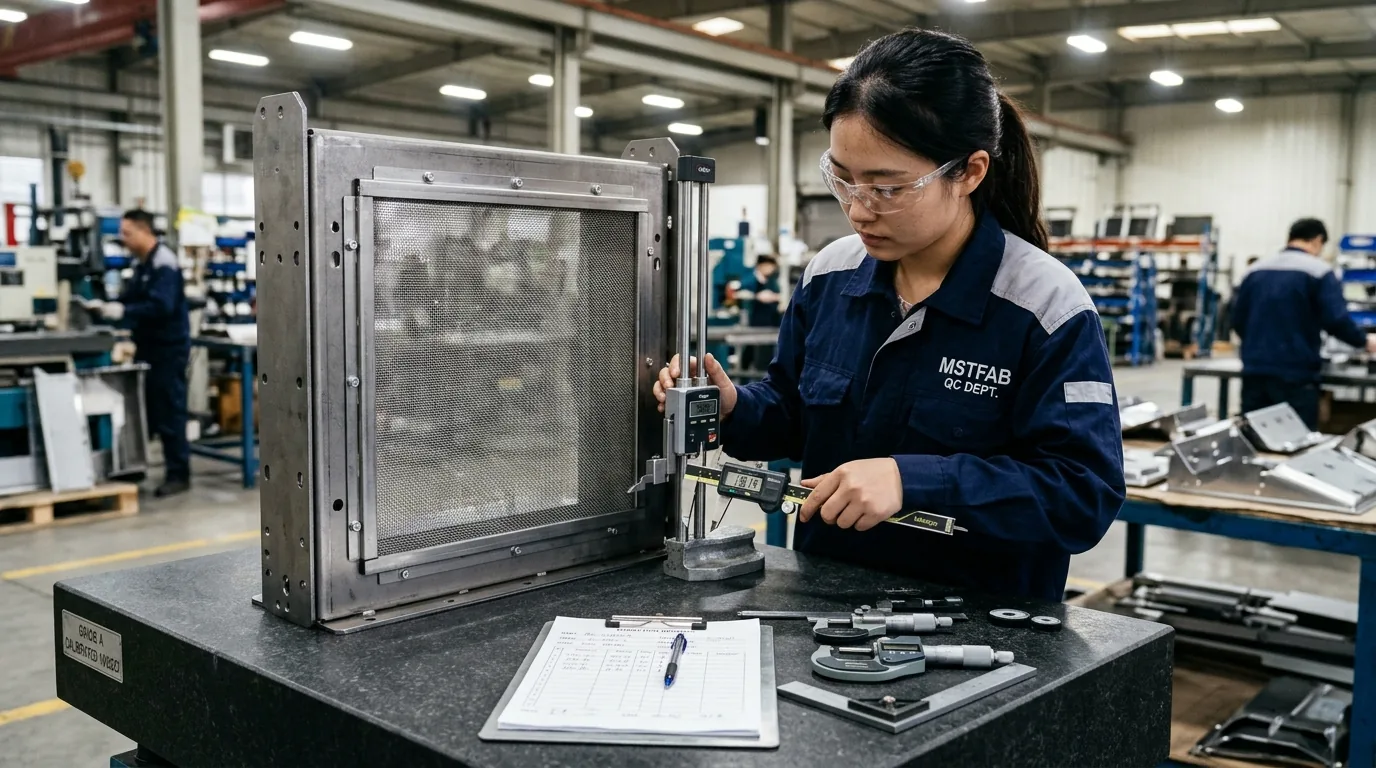
To prevent assembly delays on the tractor production line, OEM buyers should establish a rigorous First Article Inspection (FAI) plan covering both physical geometry and cosmetic durability:
| Inspection Parameter | Measurement Method / Tool | Standard Acceptance Criteria |
|---|---|---|
| Material Grade & Gauge | Digital micrometer & Mill Test Certificate (MTC) | Thickness tolerance per ISO 2768-m or ASTM A240 / B209 |
| Overall Frame Dimensions | Vernier caliper / Laser tracker | ±0.5 mm on overall length and width |
| Mounting Hole Centerlines | CMM or precision coordinate calipers | ±0.3 mm true position relative to primary drawing datum |
| Frame Squareness & Diagonal | Granite table & diagonal cross measurement | Difference between diagonals ≤1.0 mm across 1,000 mm span |
| Perforation Pitch & Pattern | Optical measurement projector / gauge pins | Hole diameter and pitch within ±0.15 mm; zero missing holes |
| Sheet Flatness & Bowing | Feeler gauge on precision surface plate | Flatness within 1.5 mm per meter; no noticeable oil-canning |
| Edge Deburring & Burrs | Tactile glove inspection / optical microscope | 100% burr-free; no sharp edges capable of cutting technician hands |
| Coating Adhesion & Thickness | Electromagnetic film gauge & Cross-hatch tape test | Coating thickness 70–110 µm; cross-hatch rating Class 4B/5B (ASTM D3359) |
| Mechanical Assembly Fit-Up | Physical trial fit to OEM master check fixture | Screen cartridge slides smoothly in and out without binding |
Review our checklist on removable sheet metal covers and inspection for further assembly validation practices.
9. Example RFQ: Agricultural Radiator Intake Panel
Here is an illustrative, production-ready RFQ specification package representing a typical high-horsepower tractor cooling screen:
Representative Agricultural OEM Project Specification
- Component Name: Agricultural Tractor Radiator Intake Screen Panel
- Material: Aluminum 5052-H32, 2.0 mm thickness, mill finish with laser film
- Overall Outside Dimensions: 650 mm (He) × 520 mm (Width) × 25 mm (Flange Depth)
- Perforation Specifications: Ø3.5 mm round holes, 60° staggered pitch, 5.0 mm center-to-center spacing (~44% open area)
- Perimeter Margins: 25 mm solid unperforated border around all 4 sides; 40 mm unperforated zone at latch locations
- Forming Details: 4-sided CNC press brake return flanges (90° bends, R2.0 mm inside bend radius)
- Mounting Hardware: 6× PEM flush-head stainless steel clinch nuts (M6 thread) installed along perimeter flanges
- Surface Finishing: Multi-stage chemical degreasing, conversion coating, satin black exterior polyester powder coat (RAL 9005, 80 µm thickness)
- Inspection Requirements: Full FAI dimensional report, hole pitch verification, 500-hour salt spray test coupon certification
- Order Volumes: 15 pcs prototype trial run, followed by 100, 300, and 600 pcs scheduled annual production releases
- Submitted Files: 3D CAD model (STEP format) and 2D fully dimensioned PDF with GD&T callouts
10. How Does Perforation Design Affect Manufacturing Cost?
The manufacturing cost of an agricultural intake panel is heavily driven by laser cutting pierce cycles, machine processing time, and sheet utilization:
| Manufacturing Cost Driver | Low-Cost Design Approach | High-Cost Design Trap |
|---|---|---|
| Hole Count & Piercing Time | Optimized hole diameter (Ø3.5–5.0 mm) reducing total hole count | Thousands of tiny Ø1.5 mm holes requiring massive laser cutting pierce cycles |
| Hole-to-Edge Margins | Wide solid borders (≥20 mm) allowing standard press brake tooling | Perforations running across bend lines requiring expensive custom forming dies |
| Fastener Integration | Standard pressed-in PEM clinch nuts installed before coating | Hand-welded threaded nuts requiring individual thread chasing and spatter removal |
| Material Nesting Yield | Standard sheet dimensions (1,220 × 2,440 mm) with nesting efficiency >85% | Awkward panel aspect ratios resulting in 40%+ sheet metal scrap rate |
| Welded Subassemblies | One-piece CNC-bent construction with slotted corner tabs | Multi-part welded frames requiring manual TIG labor, grinding, and weld fixturing |
Supplier Trust Evaluation: What to Ask Your Fabricator
When auditing prospective overseas sheet metal suppliers for agricultural equipment parts, use these targeted technical questions:
| Question to Ask the Supplier | A Reliable Answer Sounds Like | Red Flag Warning Sign |
|---|---|---|
| “Can you laser cut 10,000 tiny 1.0 mm holes in 2.0 mm steel?” | “Laser piercing 10,000 1.0 mm holes will overheat the sheet and cause extreme warpage. We recommend turret punch cluster tooling or a woven mesh insert.” | “Yes, our high-power laser can cut anything without issues.” |
| “How do you stop the perforated panel from bowing after bending?” | “We program bend relief margins, use precision segmented tooling, and add formed stiffener ribs or cross-breaks if needed.” | “Bowing is normal for perforated metal; operators can bend it by hand during assembly.” |
| “How do you prevent rust on the sharp laser-cut hole edges?” | “We run parts through an automated edge-rounding brush deburring machine before multi-stage zinc phosphate pretreatment and powder coating.” | “Our powder coating covers everything automatically.” |
| “Can you supply the complete rotating self-cleaning screen fan assembly?” | “We manufacture the build-to-print metal screen frames, brackets, and panels. Motors, vacuum ducts, and fans are outside our scope.” | Agrees to supply complex rotating mechatronic assemblies without asking for electrical schematics. |
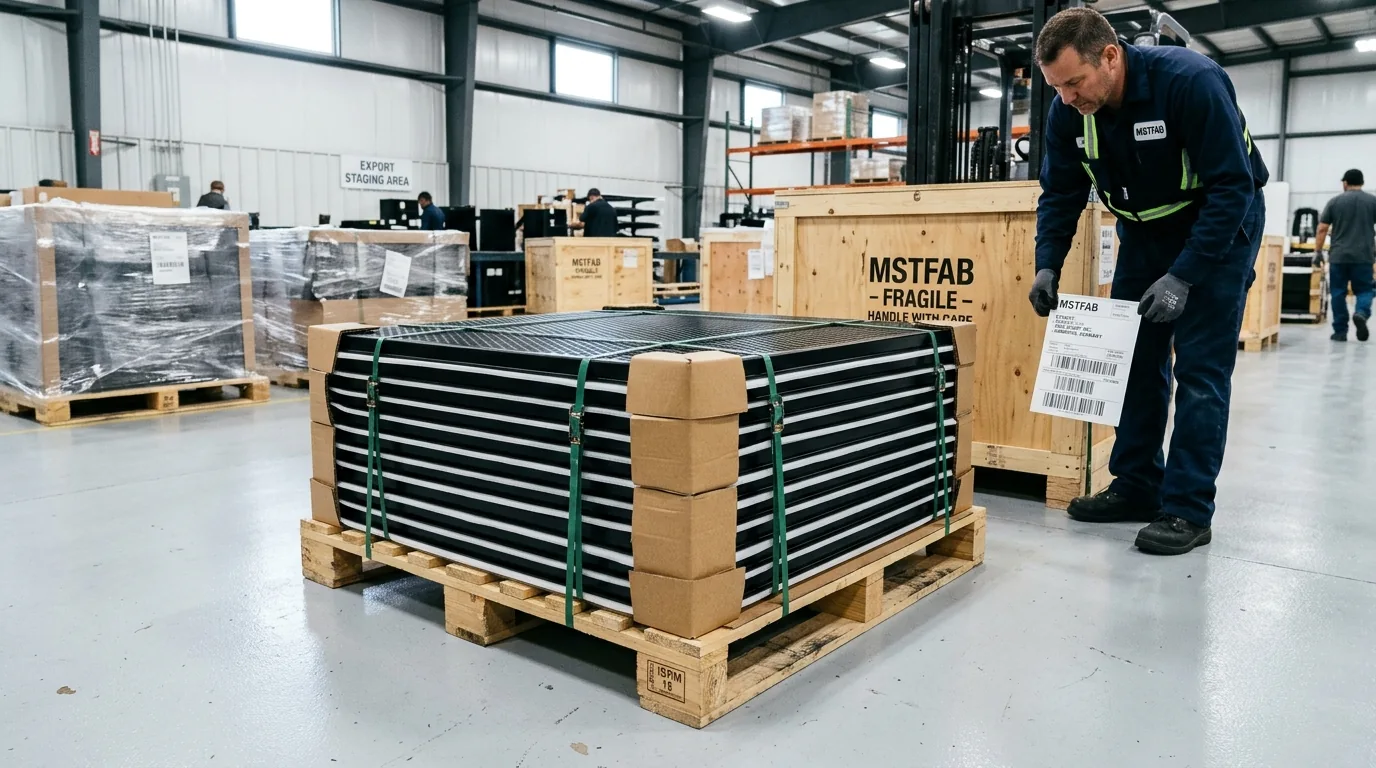
| “What packaging do you use for export shipping?” | “Each panel is interleaved with 2 mm polyethylene foam, stacked with reinforced corner protectors, banded to fumigated pallets, and crated in plywood.” | “We pack them tightly in bulk cardboard cartons.” |
11. What Should Agricultural OEM Buyers Send for an Accurate Quote?
To receive an accurate, line-item quotation within 24 to 48 hours, ensure your RFQ package includes:
- 3D Solid Model (STEP / STP): Defines the finished 3D formed shape, flange sequence, and spatial envelope.
- 2D Dimensioned Drawing (PDF): Contains critical linear tolerances, hole centerlines, hole pitch notes, and GD&T datum frames.
- Perforation Specifications: Hole shape, diameter, center-to-center pitch, and pattern arrangement (or DXF flat blank pattern).
- Material Grade & Temper: (e.g., Aluminum 5052-H32, Stainless Steel 304 2B, or Galvanized SGCC).
- Surface Finish & Color: Powder coating specification, RAL color code, gloss level, and salt spray test requirements.
- Hardware & Fastener Details: Part numbers and locations for any clinch nuts, studs, or latches.
- Batch & Annual Production Quantities: Prototype evaluation batch (e.g., 10–25 pcs) and scheduled production volume tiers.
For more file preparation guidelines, see our comprehensive guide on quoting with STEP, PDF, and DXF files.
12. Can MSTFAB Manufacture Agricultural Radiator Screen Frames and Intake Panels?
Guangzhou Maisituo Sheet Metal Manufacturing Co., Ltd. (MSTFAB) is an export-focused precision custom sheet metal fabrication manufacturer located in Guangzhou, China. We serve agricultural machinery OEMs, combine harvester manufacturers, and heavy equipment builders across North America, Europe, and Australasia.
Our core in-house manufacturing capabilities include:
- High-speed fiber laser cutting (up to 20 mm steel and aluminum) with automated sheet shuttle tables.
- Multi-axis CNC press brake bending up to 4,000 mm length with specialized deep-box gooseneck tooling.
- Certified TIG, MIG, and robotic seam welding for steel, stainless steel, and aluminum structural frames.
- Automatic PEM hardware insertion presses for clinch studs, nuts, and standoffs.
- Automated edge-rounding brush deburring and vibratory surface finishing.
- Coordinated automotive-grade e-coating, architectural powder coating, and hot-dip galvanizing.
- CMM and optical coordinate dimensional verification with full FAI inspection reports.
- ISPM-15 compliant export wood crating and custom foam-dunnage packaging.
For related agricultural equipment components, explore our capabilities in farm machinery mounting brackets and heavy-duty agricultural metal components.
Clear Manufacturing Scope: MSTFAB specializes strictly in build-to-print custom sheet metal parts, welded screen frames, intake panels, and mechanical mounting brackets. We do not manufacture complete tractor cooling packages, radiators, heat exchanger cores, electric cooling fans, rotating air-aspirated screen cleaners, or agricultural diesel engines. Thermal heat-transfer modeling, aerodynamic airflow restriction testing, and field debris validation remain the engineering responsibility of the equipment OEM.
Key Takeaways for Sourcing Agricultural Radiator Screens
- An agricultural radiator screen is an active defense system protecting critical engine heat exchangers from field chaff and dust.
- Always specify solid unperforated margins (≥15–25 mm) along perimeter bend lines to prevent hole elongation and flange cracking during CNC forming.
- Balance cooling airflow against panel stiffness; target 42% to 52% open area reinforced with perimeter return flanges and formed stiffener ribs.
- Aluminum 5052-H32 is optimal for lightweight, removable screen cartridges; coated carbon steel provides maximum rigidity for outer brush-guard frames.
- Use intermittent stitch welding or spot welding combined with copper chill bars to eliminate thermal distortion on thin perforated panels.
- Specify captive clinch hardware and quick-release latches so field operators can quickly slide out and clean screens without tools.
Frequently Asked Questions
Can a sheet metal factory manufacture custom radiator intake panels?
Yes. Custom metal intake panels can be produced through precision fiber laser cutting, CNC turret punching, press brake bending, welding, and surface treatment according to customer-approved 3D CAD drawings.
Can MSTFAB manufacture agricultural radiator screen frames?
Yes. MSTFAB manufactures custom welded screen frames, perforated intake panels, mesh retaining channels, and chassis mounting brackets for agricultural machinery OEMs worldwide.
What is the best material for an agricultural radiator screen frame?
Aluminum 5052-H32 is best for removable, lightweight screen inserts that operators clean by hand. Carbon steel with an exterior-grade powder coating is best for outer structural frames subject to branch impacts. Stainless steel 304 is ideal for high-corrosion fertilizer or chemical spreader equipment.
Can laser cutting produce fine radiator screen mesh?
Laser cutting is economical and precise for hole diameters down to 2.0–3.0 mm. For ultra-fine screening (<1.0 mm openings to block fine thistle seed), sourcing a woven stainless wire mesh insert held inside a laser-cut sheet metal frame is far more practical and cost-effective.
Does a larger perforated open area always improve engine cooling?
Not necessarily. While higher open area reduces airflow restriction, exceeding 55–60% open area severely weakens the panel, causing flutter and fatigue cracking. Engine cooling depends on the total system: radiator core area, fan static pressure, duct sealing, and air velocity.
Can perforated agricultural intake panels be powder coated?
Yes. Panels must undergo thorough edge-rounding deburring so the powder wraps smoothly around hole edges without pulling back. An exterior architectural polyester powder with zinc primer provides excellent UV and stone-chip protection.
Can the frame include a removable screen element?
Yes. MSTFAB frequently fabricates dual-component intake assemblies consisting of a heavy-duty outer mounting frame and an inner slide-out screen cartridge secured with quick-release spring latches or thumb screws.
Does MSTFAB provide complete radiator screen-cleaning systems?
No. MSTFAB manufactures the fabricated metal panels, frames, and mounting brackets. Motorized rotating screen sweepers, vacuum aspiration blowers, radiator cores, and sensors are outside our build-to-print metal fabrication scope.
Can small prototype quantities be manufactured?
Yes. We support OEM customers with initial prototype batches (e.g., 5 to 20 pieces) for physical vehicle fit-up trials, field vibration testing, and assembly validation prior to scheduled volume production releases.
Final Thoughts: Source the Metal Components Around the Approved Cooling Design
A custom radiator screen frame may look straightforward, but its reliable performance in the field depends on precise hole geometry, unperforated bend reliefs, vibration-resistant mounting features, and durable edge-protected coatings. By partnering with an experienced sheet metal fabricator like MSTFAB, agricultural OEMs receive precision intake components that fit the tractor chassis right out of the crate and withstand the harshest field harvest seasons.
Request a Custom Agricultural Sheet Metal Fabrication Quote
Need custom radiator screen frames, perforated intake panels, combine engine covers, or heavy-duty mounting brackets for your agricultural machinery program? Send your STEP models and dimensioned drawings to MSTFAB’s engineering team today. We will review your manufacturability, evaluate perforation cutting options, and provide a competitive quotation within 24 to 48 hours.
Request a Custom Fabrication Quote
Explore Custom Sheet Metal Fabrication
View Agricultural Sheet Metal Parts
View CNC Bending Services
 WeChat Contact
 WhatsApp Me Directly