
The Short Answer
Removable sheet metal equipment covers only stay serviceable in the field when mounting clearances, coating thickness, stiffness, and captive hardware are designed together. Leave 1.5 mm to 2.5 mm perimeter clearance between mating guards, size slotted mounting holes or keyhole hangers to absorb welded-frame tolerances, reinforce perforated ventilation panels with return flanges or safety hems, and specify captive quarter-turn fasteners or lift-off hinges so maintenance technicians can remove covers without losing loose bolts.
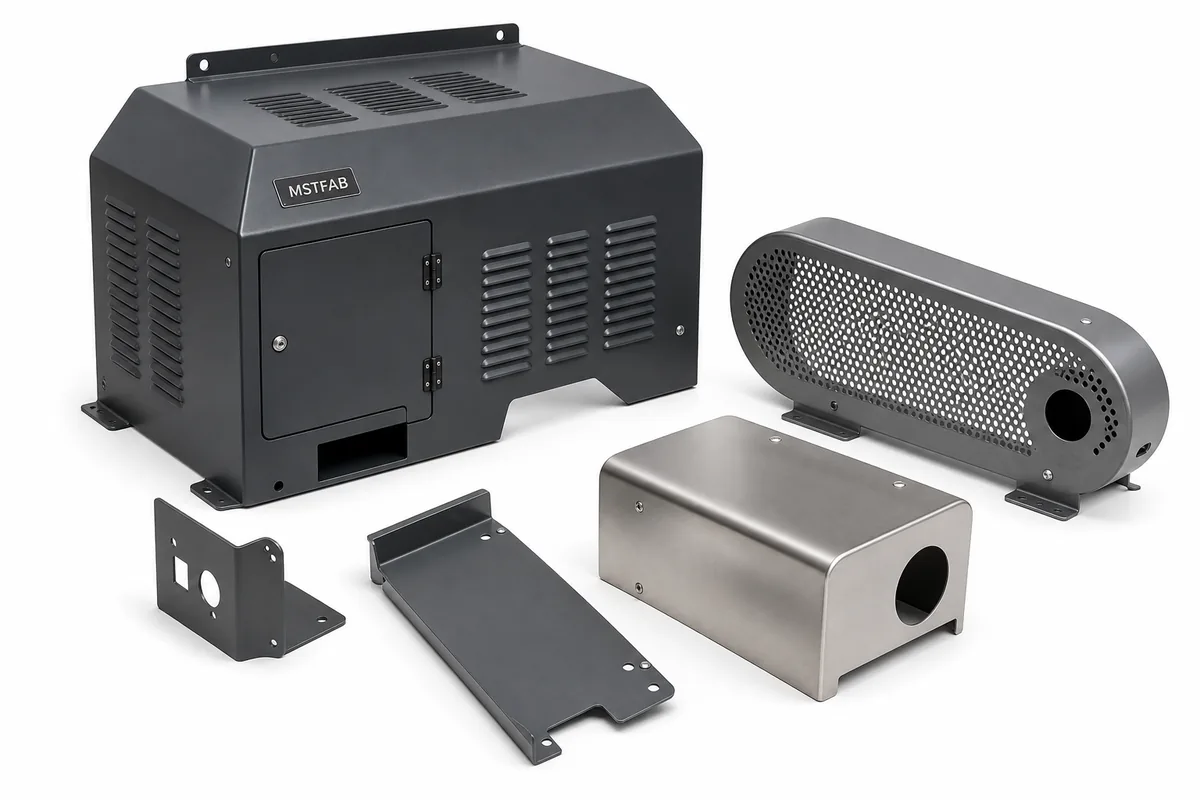
Explore this guide
01 / Fit Clearances and Tolerance Stack-Up
Design seam gaps and mounting slots for real-world frame tolerances and powder-coat buildup.
In 3D CAD, a removable sheet metal cover with a 0.0 mm or 0.5 mm gap to the adjacent frame looks seamless. On the shop floor, once the welded frame varies by +/-1.0 mm and textured powder coating adds 80 um to 120 um per face (0.32 mm to 0.48 mm across two mating edges), a zero-clearance cover binds, scrapes paint during maintenance removal, and leaves crooked sightlines.
Build installation float and coating allowance directly into your cover interface geometry.
Perimeter Seam Gaps
Design a nominal 1.5 mm to 2.5 mm reveal gap between adjacent removable panels so minor angular drift remains visually uniform.
Keyhole & Slotted Hangers
Place teardrop keyhole slots on the top flange so one technician can hang the cover on shoulder bolts before tightening bottom fasteners.
Coating Thickness Allowance
Offset telescoping lip overlaps by at least 0.5 mm per side and add EPDM foam or bulb edge trim where metal-to-metal contact occurs.
Serviceability rule: If a single removable cover weighs more than 15 kg (33 lb) or exceeds 1,200 mm in span, split it into two smaller interlocking panels or add lift-off hinges and recessed pull handles so one maintenance technician can safely remove it.
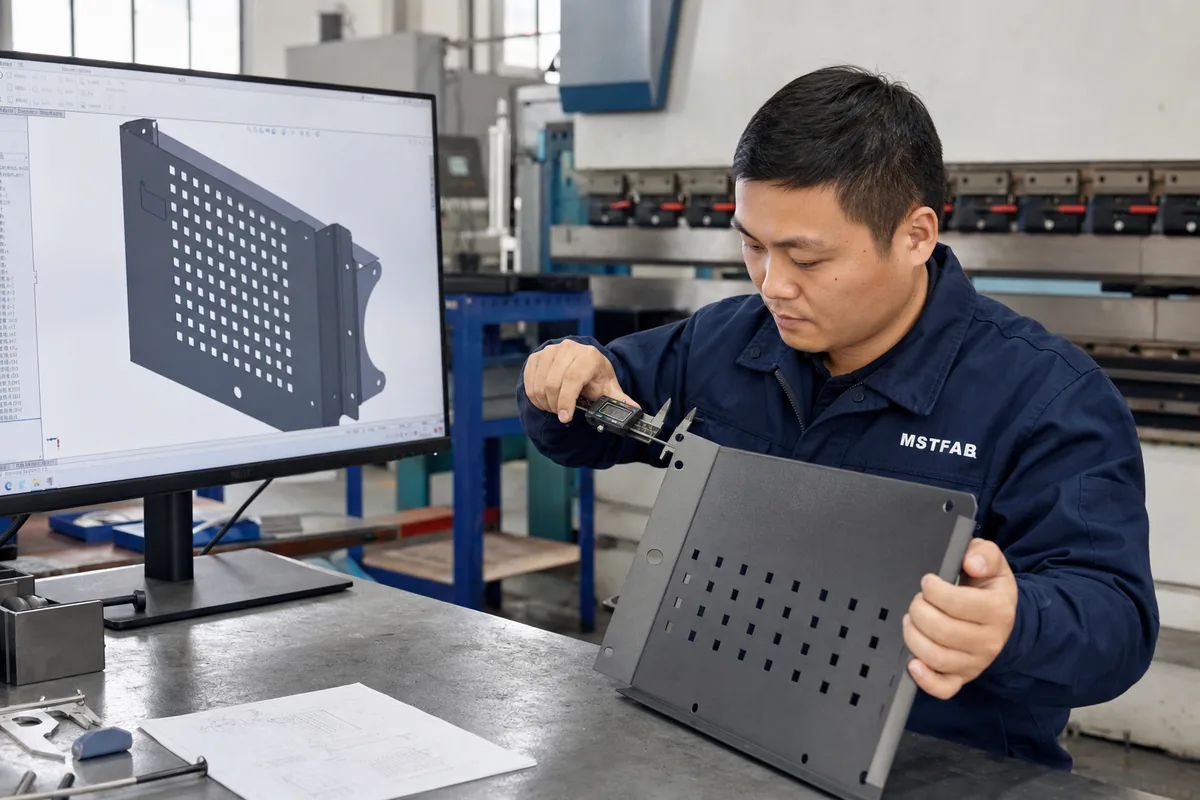
02 / Safety Perforations and Thermal Airflow
Balance cooling open-area ratios against finger-reach safety standards and laser heat distortion.
Removable motor shrouds, belt guards, and compressor covers must exhaust heat while preventing operators from reaching moving hazards under ISO 13857 and OSHA 1910.212 guidelines.
- Aperture width vs. hazard distance (ISO 13857): Keep slot widths or hex/round perforation diameters sized to the distance from the pinch point (for example, <= 6 mm to 8 mm openings when the guard sits close to belts, fans, or gears).
- Open-area thermal management: Hexagonal and staggered obround patterns deliver 45% to 60% open area for high-CFM cooling, whereas stamped louvers shed falling dust and water spray while directing exhaust air downward.
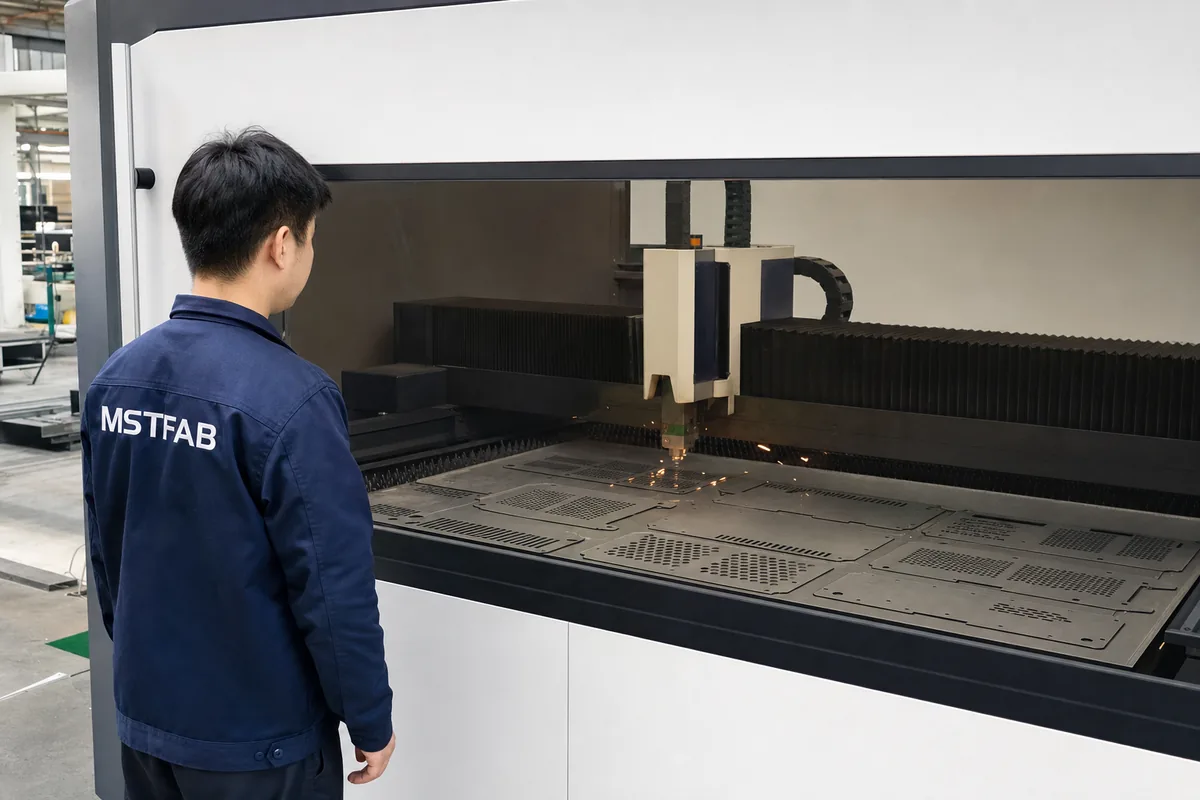
- Unperforated stiffener borders: Maintain a solid, unperforated margin of at least 15 mm to 25 mm between ventilation arrays and bend lines (and intermediate solid webs across large spans) so laser cutting does not warp the sheet.
Our CNC fiber laser cutting and turret punching lines use skip-row thermal cutting sequences and roller leveling to keep densely perforated panels flat.
03 / Return Flanges, Safety Hems, and Acoustics
Eliminate sharp edges and panel drumming with return bends and teardrop safety hems.
Because removable covers are handled repeatedly by technicians reaching near wiring and machinery, exposed raw laser-cut edges pose a cut hazard and thin flat panels drum noisily under machine vibration.
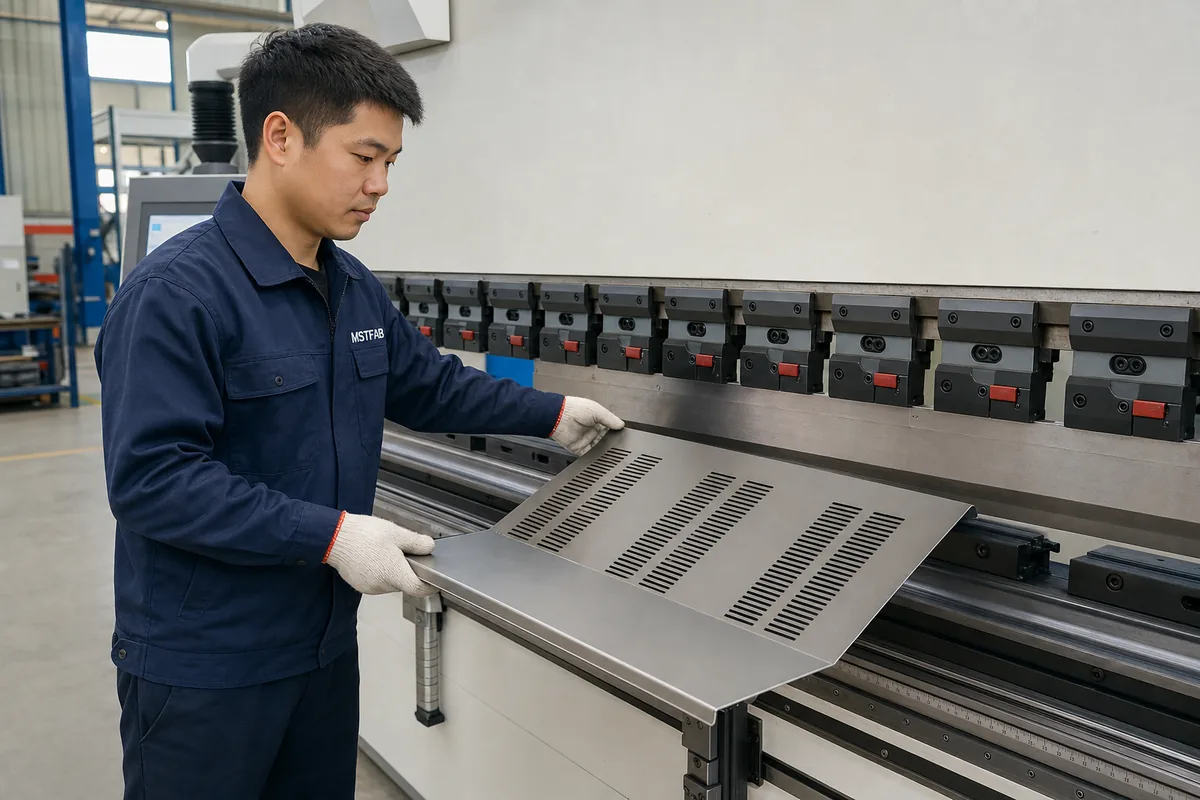
- Form 15 mm to 25 mm 90-degree return flanges around all four edges of the panel to multiply bending stiffness without increasing sheet thickness.
- Specify closed flat hems or teardrop hems (for aluminum and stainless steel) along hand-hold cut-outs and bottom drip edges to give technicians a smooth, double-thickness rolled edge.
- Weld internal hat-section stiffeners or apply constrained-layer acoustic damping foam inside large guards covering high-RPM pumps, blowers, or drives.
Replacing a flat 3.0 mm plate guard with a flange-stiffened and hemmed 1.5 mm sheet metal cover cuts weight in half while improving handling safety.
04 / Captive Hardware and Durable Finishes
Specify captive fasteners and wear-resistant coatings that survive repeated maintenance cycles.
Standard loose M6 bolts and washers inevitably drop into machine sumps or conveyors during routine filter and belt changes, leading to unbolted guards and safety violations (ISO 14120 mandates captive fasteners on fixed guards that are regularly removed).
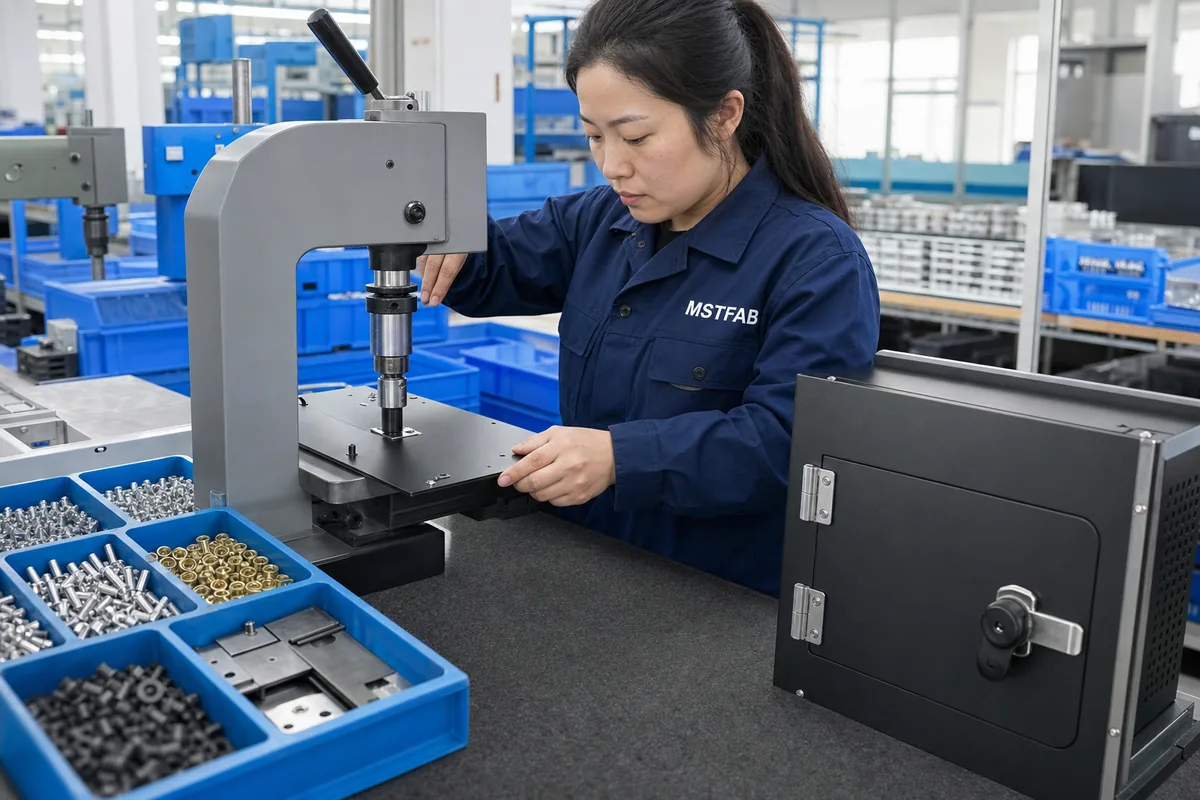
- Captive panel screws and quarter-turn latches: Install spring-loaded captive thumb screws (PEM PF11/PFHV) or quarter-turn cam latches so hardware stays permanently retained in the removable cover.
- Lift-off hinges and locating pins: Pair lift-off bullet or concealed hinges on one edge with two captive fasteners on the opposite edge to cut maintenance access time by 70%.
- Impact- and chemical-resistant coatings: Use fine-texture polyester or epoxy-polyester powder coating (60 um to 90 um) on carbon steel guards to hide fingerprints and resist wrench scuffs, or #4 brushed 304/316L stainless steel for washdown machinery.
Combine precision corner TIG/laser welding with our industrial powder coating and brushing finishes for showroom-grade machine covers.
05 / Buyer Control Matrix
Verify five equipment cover design checkpoints before production release.
Use this checklist during DFM review to ensure your removable covers fit the machine frame on the first build and stand up to daily maintenance.
06 / Trial-Fit and Dimensional Verification
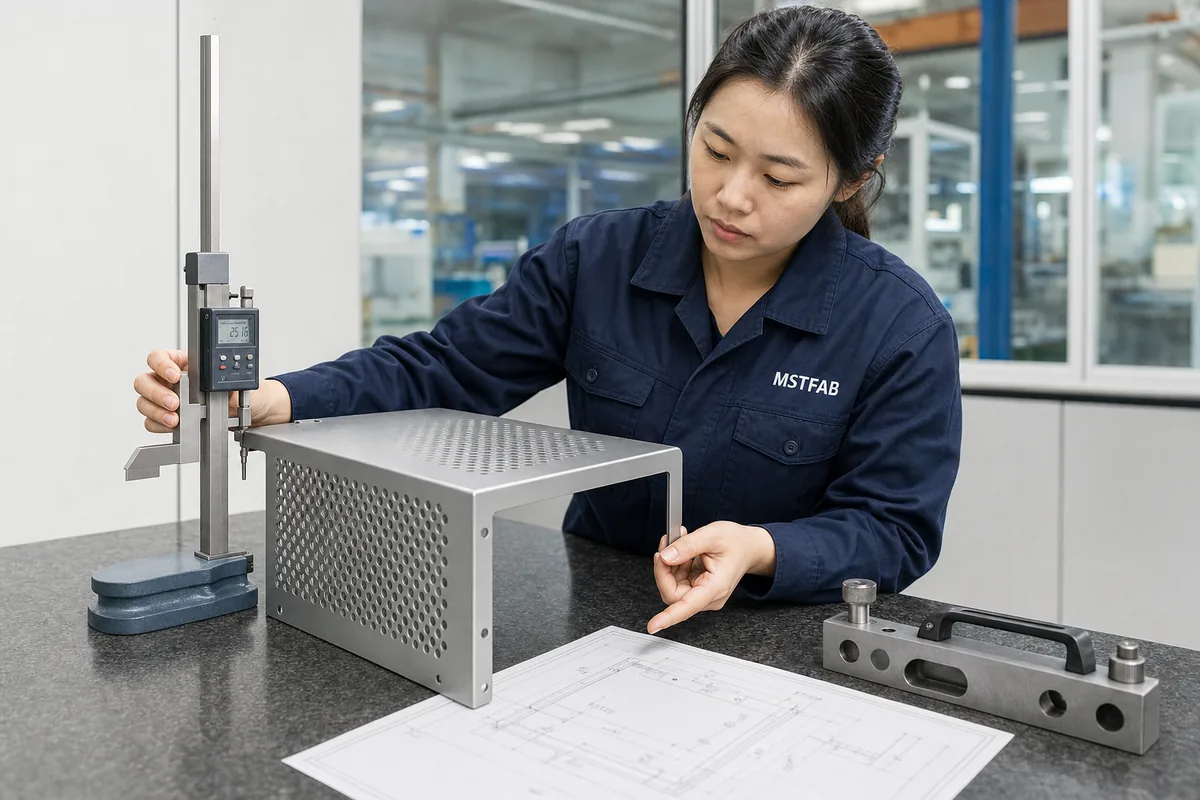
Check diagonal twist, flange return angles, and fastener alignment before coating.
A large U-shaped or L-shaped sheet metal equipment shroud can easily rock on a flat frame if corner welds pull the return flanges out of plane by even 1.5 degrees.
Our inspection team verifies flat-pattern hole positions with optical coordinate scanners, checks formed flange angles and diagonal twist on layout tables, and tests captive fastener engagement with go/no-go thread gauges.
When an OEM orders complete machine enclosure sets, we perform a bare-metal multi-panel trial fit to verify uniform seam reveals and latch compression before moving the batch to the powder-coating line.
See how we inspect sheet metal covers and enclosure assemblies →
07 / Corner-Protected Export Packaging
Pack thin-wall covers with internal bracing and foam corner guards.
Large, hollow sheet metal covers have high volume-to-weight ratios and can flex or dent if heavy crates are stacked on top or if panels nest directly against pre-installed captive screws.
We wrap every finished custom sheet metal cover in protective PE film and EPE foam, install cardboard or wood spreader bars inside wide U-shrouds when needed, and pack panels vertically in slotted cellular dividers inside export-grade plywood crates.
Manufacturing scope: MSTFAB manufactures custom removable sheet metal covers, machine guards, and ventilated shrouds built to customer CAD drawings under ISO 9001, IATF 16949, and ISO 14001 systems. Machine hazard risk assessment, safety interlock wiring, and final machinery compliance remain the responsibility of the OEM.
08 / Ready-to-Review RFQ
Include eight engineering details in your equipment cover RFQ package.
- 3D STEP CAD filesInclude all individual covers and, if possible, the mating frame interface for clearance checks.
- 2D PDF drawings with cosmetic A-sidesClearly mark exterior Class-A surfaces, brush grain direction, and hanging hole locations.
- Material and thickness calloutSpecify CRS A1008, galvanized steel, 304/316L stainless, or 5052-H32 aluminum gauge.
- Ventilation louver or perf geometryProvide exact slot/hole dimensions or louver tooling specs to prevent CAD rebuild delays.
- Hemming and corner weld notesIndicate closed/teardrop safety hems and whether corner seams are full-welded and ground flush.
- Captive hardware BOMList exact PEM captive screws, quarter-turn studs, pull handles, and hinge part numbers.
- Coating color and textureSpecify RAL shade, gloss units, smooth vs. fine-texture powder, and masked ground studs.
- Gaskets, labels, and kittingNote EPDM edge trim, acoustic foam lining, silk-screen warnings, and per-machine kitting.
Providing mating frame context and hardware part numbers allows our engineers to validate seam clearances and tool availability before quoting.
Removable equipment cover questions from machine designers
How much clearance should we leave between adjacent removable sheet metal covers?
For powder-coated industrial machinery covers up to 1,500 mm long, design a nominal 1.5 mm to 2.5 mm gap between adjacent panels and provide slotted mounting holes (+/-1.5 mm adjustment). This accommodates normal welded-frame variation and 0.15 mm–0.25 mm of combined powder-coat build on opposing edges without paint rubbing.
What sheet thickness is best for removable machine guards and shrouds?
Most removable steel covers use 1.2 mm to 2.0 mm (18 ga to 14 ga) cold-rolled steel, or 1.5 mm to 2.5 mm in 5052-H32 aluminum. Adding 15 mm–20 mm return flanges, safety hems, and formed stiffening ribs allows you to use lighter 1.5 mm sheet instead of heavy 3.0 mm plate while keeping the cover rigid and light enough for one-person removal.
Why does ISO 14120 recommend captive fasteners on removable machine guards?
When a fixed guard must be removed periodically for maintenance or cleaning, ISO 14120 specifies that its fasteners should remain attached to the guard or the machinery. Captive screws or quarter-turn latches prevent lost bolts and make it far more likely that technicians will properly re-secure all fasteners after servicing.
Should ventilation patterns be laser cut or turret punched?
For low-to-medium batch volumes or custom decorative hex/slot arrays, high-speed fiber laser cutting requires zero tooling cost and leaves clean edges. For high-volume runs with thousands of standard holes or raised 3D airflow louvers and embosses, CNC turret punching or laser-punch combination processing is faster and forms 3D louvers in one setup.
How do you stop removable sheet metal covers from rattling on vibrating equipment?
We eliminate sheet metal rattle by stiffening flat spans with return flanges or cross-breaks, installing EPDM bulb gaskets or neoprene foam tape along the frame contact perimeter, and using spring-loaded quarter-turn latches or rubber-isolated grommets at the mounting points.
What powder coating finish hides handling marks best on removable access panels?
A fine-texture or micro-wrinkle polyester powder coat (at 60 um to 90 um DFT) is far more forgiving than high-gloss smooth paint. Fine texture diffuses shop lighting to hide minor sheet metal forming transitions, resists fingerprints and grease smudges, and stands up better to repeated wrench and floor contact during maintenance.
Technical references
Reference these machinery safety and sheet metal tolerance standards when designing removable equipment covers and guards.
- ISO 14120 — Safety of Machinery: Guards — General Requirements for the Design and Construction of Fixed and Movable Guards
- ISO 13857 — Safety of Machinery: Safety Distances to Prevent Hazard Zones Being Reached by Upper and Lower Limbs
- OSHA 29 CFR 1910.212 — General Requirements for All Machines (Machine Guarding)
- ISO 2768-1 — General Tolerances for Linear and Angular Dimensions Without Individual Tolerance Indications
Upload your removable cover CAD package for a fit and DFM check.
Send your 3D STEP models, 2D drawings, captive hardware list, and finish specifications. MSTFAB will review clearances, stiffness, and production tooling.
Request Equipment Cover Quote →
Have a question first? caroline@mstfab.com
 WeChat Contact
 WhatsApp Me Directly