
The Short Answer
Fabricating custom ODF (Optical Distribution Frame) and data center network cabinet enclosures requires strict control over frame diagonal squareness, 19-inch or ETSI mounting rail pitch accuracy, smooth burr-free fiber routing radii, masked grounding continuity, and interchangeable door alignment. Reviewing mechanical layout interfaces on your 3D STEP assembly before cutting sheet metal prevents pinched optical fibers, misaligned splice cassettes, and racking doors during data center installation.
Explore this guide
01 / Data Center ODF & Rack Architecture
Design custom ODF and network cabinet enclosures around cable routing and structural accuracy.
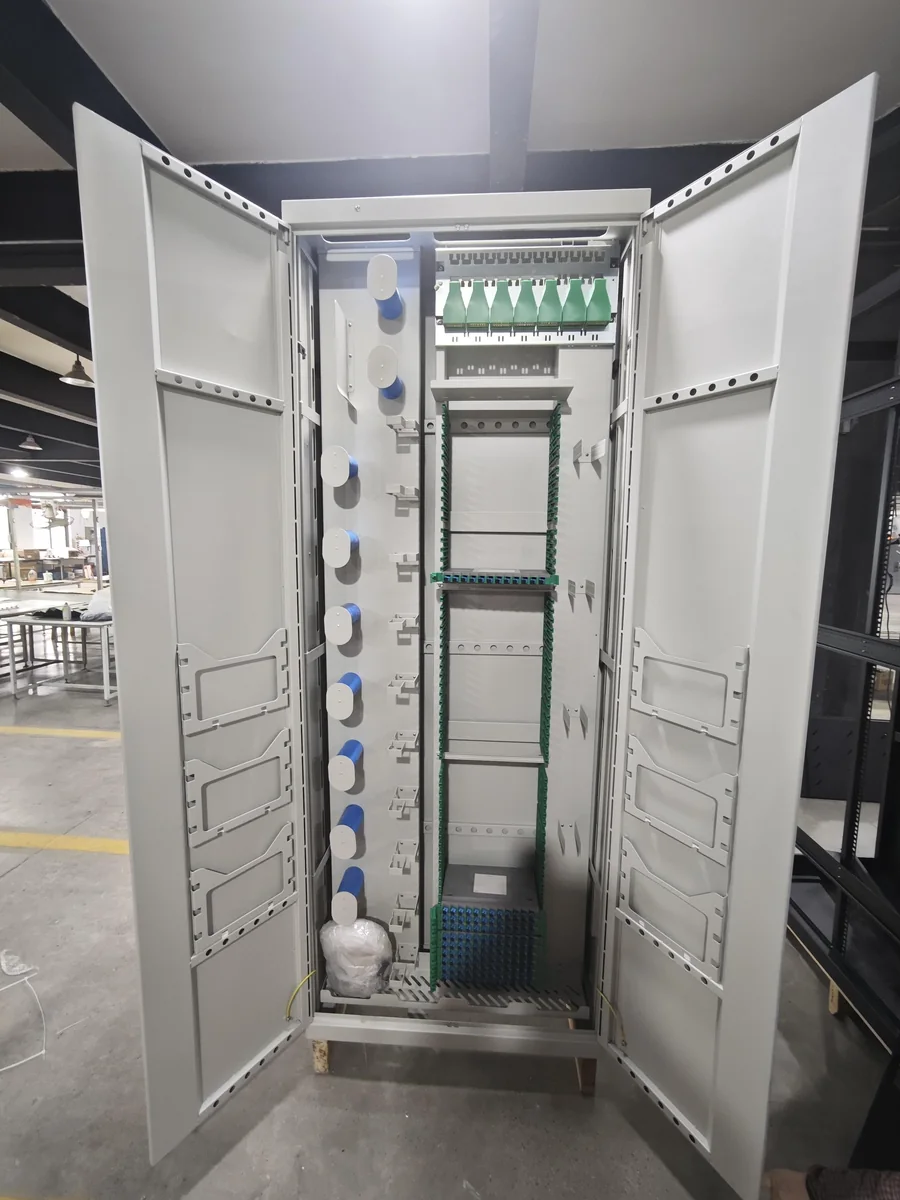
High-density optical distribution frames (such as 720-core to 1,440-core single-sided or double-sided ODF cabinets) and custom data center network racks cannot be treated as generic sheet metal boxes. Off-the-shelf server racks frequently lack the front-access depth, vertical fiber spooling channels, top/bottom trunk gland openings, and custom splice-tray mounting pitches required by telecom OEMs.
Through custom build-to-print network cabinet fabrication, OEM hardware teams can lock exact rack widths (600 mm, 800 mm, 900 mm, or custom footprints), front-to-rear rail setbacks, and internal fiber bend-radius guides directly into the mechanical sheet metal design.
Fiber bend-radius protection
Hemmed edges, radiused cable waterfalls, and deburred vertical routing fingers prevent sharp sheet metal edges from micro-bending or pinching optical patch cords.
Cumulative U-pitch accuracy
Laser-cut 19-inch (EIA-310) or ETSI mounting rails hold non-cumulative 9.5 mm square-hole patterns from 1U to 42U/47U so subracks and splice cassettes drop in cleanly.
Multi-cabinet baying alignment
Fixture-welded main frames keep vertical posts plumb and side baying holes aligned so long rows of data center cabinets bolt together without stepped gaps.
Mechanical scope boundary: MSTFAB manufactures custom empty ODF cabinet shells, network rack frames, mounting rails, splice-unit brackets, doors, and mechanical hardware to customer drawings. Optical fiber pigtails, active switches, PDUs, and system-level certifications remain the responsibility of the OEM.

02 / Buyer Pain Points We Help Solve
Eliminate six mechanical layout failures before releasing cabinet drawings to production.
Data center and telecom deployment teams encounter the same mechanical frustrations when cabinet enclosures are fabricated without a thorough DFM check. Reviewing these six risk areas upfront keeps installation crews on schedule.
- Front vertical cable channels are too narrow: High-core-count ODF cabinets need generous setback between the front mounting rails and the inside face of the front door (plus smooth radiused guide brackets) so patch cords do not crush when the door latches shut.
- Mounting holes miss splice cassettes and accessories: Mixing metric 25 mm pitch and standard 19-inch U-spacing (44.45 mm per U with 15.88–15.88–12.7 mm hole triplets) causes progressive misalignment over 42U if laser nests are not verified against the master CAD.
- Doors sag and side panels bind after coating: Without 0.2 mm per-side clearance allowance for powder coat thickness and rigid frame diagonal welding control, double split doors rub at the center mullion or fail to engage three-point swing handles.
- Grounding studs and bonding pads get insulated by paint: Every door, removable side panel, top gland plate, and vertical rail must maintain low-resistance earth continuity via masked M6/M8 copper-plated weld studs and bare metal contact pads.
Our sheet metal laser cutting and bending services pair high-precision 3000 mm+ laser beds and CNC press brakes with pre-production 3D collision and clearance checks.
03 / Cabinet Fabrication Route & Components
Build rigid frames, interchangeable panels, and internal management accessories under one roof.
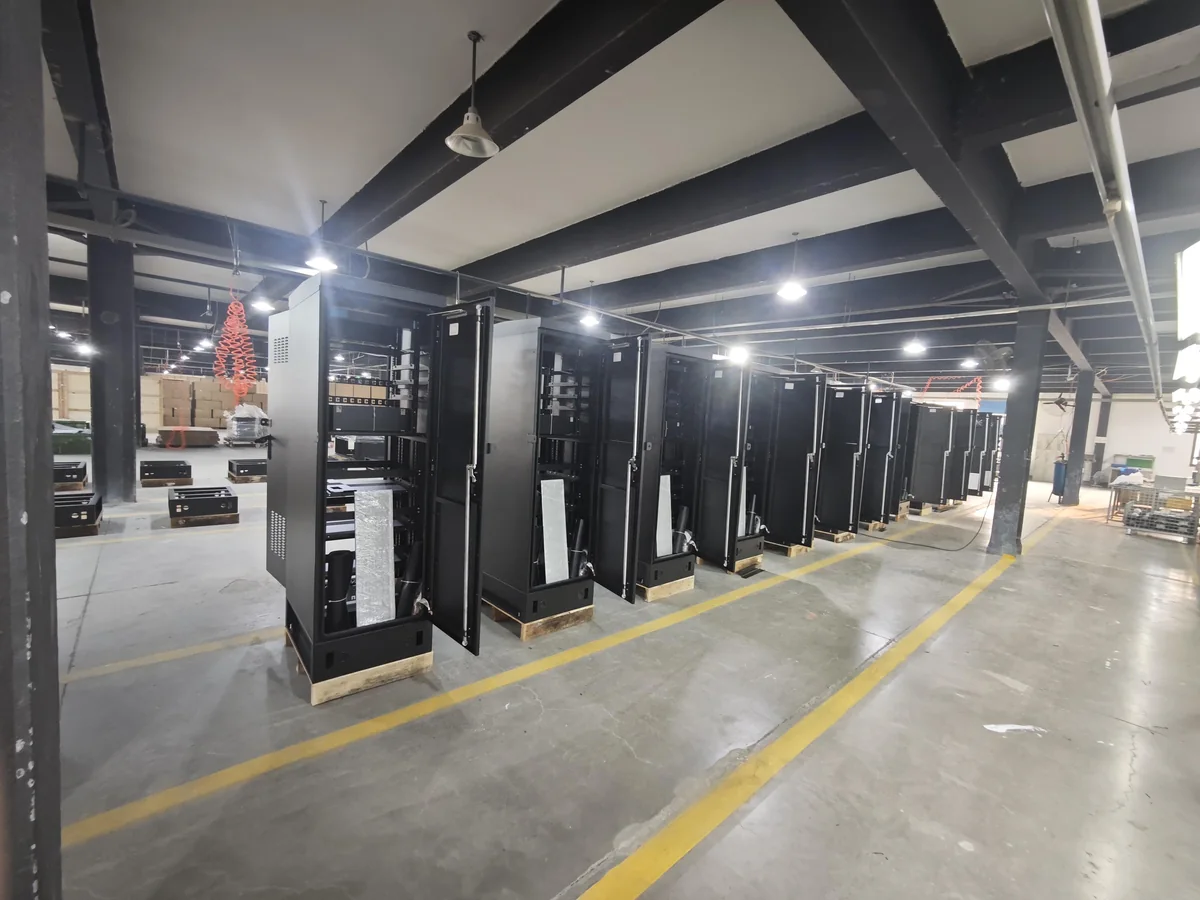
A full-height 2000 mm or 2200 mm data center cabinet requires long-bed laser cutting, multi-bend profile forming for nine-fold or twelve-fold vertical posts, fixture-controlled frame welding, and trial assembly before batch finishing.
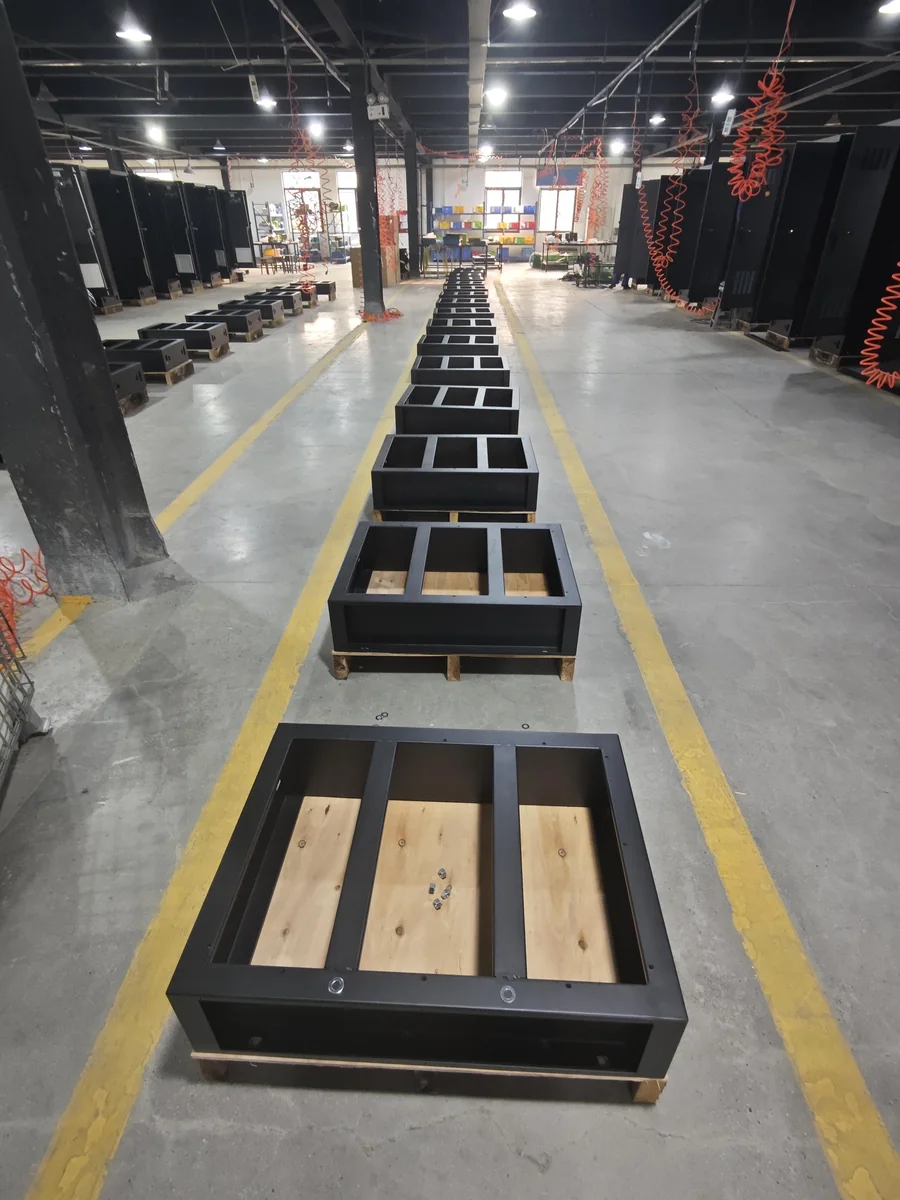
- Welded main structural frames and modular bolted frame kits with heavy-gauge top lifting-eye reinforcement plates and bottom leveling-foot / caster plinth bases.
- Perforated high-airflow hexagon mesh doors, solid steel security doors, split double doors, or tempered-glass viewing doors with swing-handle multi-point locks.
- Removable quick-release side panels, top/bottom sliding or brush-seal cable entry gland plates, and blanking panels.
- Internal vertical L-rails, 19-inch/ETSI mounting angles, fiber storage spools, patch-cord routing rings, earthing bar brackets, and PDU mounting channels.
Fabricating both the main cabinet shell and all internal brackets from the same master 3D assembly guarantees hole alignment during mechanical trial build.
Explore our custom network and ODF cabinet fabrication capabilities →

04 / Material Selection & Surface Treatment
Select the right sheet metal gauges, galvanized rails, and powder-coat specifications.
Data center and telecom cabinets balance structural rigidity on load-bearing posts against lighter removable panels and conductive internal mounting rails. Specifying material grade and thickness by component function optimizes both cabinet weight and unit cost.
- Cold-rolled carbon steel (SPCC / DC01, 1.2 mm to 2.0 mm): Ideal for main welded frames, nine-fold vertical posts, doors, side panels, and top/bottom covers finished with fine-texture RAL 7035 light grey or RAL 9005 matte black polyester/epoxy powder coat.
- Hot-rolled structural steel (SPHC / Q235B, 2.5 mm to 4.0 mm): Used for heavy-duty bottom plinths, seismic anchor bases, corner gussets, and overhead crane lifting brackets.
- Pre-galvanized steel (SGCC / DX51D+Z or SECC, 1.5 mm to 2.0 mm): Frequently specified unpainted for internal 19-inch mounting rails, earthing subplates, and chassis slides to maintain continuous electrical bonding and corrosion protection without paint flaking under cage-nut torque.
- Stainless steel (304 / 316L) and aluminum (5052-H32): Used for outdoor telecom cross-connect cabinets, coastal edge-computing enclosures, or lightweight internal fiber management trays.
All cut edges along cable entry openings and internal management fingers undergo mandatory rotary-brush deburring or smooth hemming so fiber jackets never chafe.
05 / ODF & Network Cabinet Matrix
Audit five mechanical checkpoints before approving cabinet batch production.
Use this engineering matrix during sample review to confirm your custom ODF or network cabinet meets data center installation requirements.
06 / Inspection Handoff
Validate cabinet geometry with a complete mechanical trial assembly during FAI.
Inspecting large cabinet components only as flat individual parts is never sufficient—a 1 mm twist in a 2200 mm vertical post only becomes obvious when the front door and internal 19-inch rails are mounted.
Every new ODF or network cabinet project at MSTFAB undergoes a full mechanical first article inspection and trial build. Our QC engineers assemble the frame, hang the doors and side panels, install internal rails and cable brackets, verify lock operation, and measure overall height, width, depth, diagonal squareness, and hole pitches.
Under our ISO 9001 quality system, we provide a complete dimensional inspection report along with multi-angle trial-assembly photos and video before releasing batch production.
Review our first article inspection and cabinet trial-assembly process →

07 / Packing and Release
Prevent transit racking and paint rub with engineered cabinet export packaging.
Tall network cabinets and wide doors are vulnerable to forklift impacts, container vibration, and strap crushing during international ocean freight. Whether you ship fully welded assembled cabinets or knocked-down flat-pack kits, packaging must immobilize every panel.
Our export packaging team protects powder-coated surfaces with PE film, EPE foam corner bumpers, internal door blocks, and heavy-duty ISPM-15 plywood pallets or enclosed crates designed for safe container loading and unloading.
Manufacturing scope: MSTFAB manufactures custom drawing-based ODF cabinet shells, network rack frames, panels, and internal mechanical brackets under ISO 9001 quality controls. Optical components, active electronics, and end-product telecom certifications remain the responsibility of the OEM.
08 / Ready-to-Review RFQ
Include eight engineering details when quoting custom ODF or network cabinets.
- 3D STEP full cabinet assemblyProvide the master 3D STEP assembly so we can verify frame joints, rail setbacks, door swing clearance, and accessory holes.
- 2D PDF drawings + BOM listInclude part-level 2D PDFs with critical tolerances plus a structured BOM listing part numbers and quantities per cabinet.
- Material grade and gauge by partSpecify sheet thickness (e.g., 2.0 mm posts/rails, 1.2–1.5 mm panels/doors) and material (SPCC, SGCC galvanized, or 304 stainless).
- Welded vs. knocked-down structureState whether the main cabinet frame should be shipped fully welded or as a bolted flat-pack kit for freight savings.
- Mechanical hardware scheduleDetail swing handles, three-point rods, lift-off hinges, quarter-turn latches, leveling feet, casters, and PEM fasteners.
- Surface finish and RAL colorCall out RAL color code (e.g., RAL 7035 or RAL 9005), fine sand texture vs. smooth gloss, and unpainted galvanized rail zones.
- Grounding and masking mapMark all M6/M8 copper-plated earth studs, bonding jumper locations, and bare-metal masking circles on doors and frames.
- Batch quantity and packing modeIndicate prototype sample quantity, batch rollout schedule, pallet height limits, and container loading preferences.
Sending the complete 3D STEP assembly and BOM lets our engineering team audit internal clearances and provide an itemized, production-ready cabinet quotation.
Frequently asked questions about ODF and network cabinet fabrication
Can MSTFAB manufacture a 720-core or 1,440-core ODF cabinet shell from our drawings?
Yes. We fabricate custom single-sided and double-sided ODF cabinet enclosure shells, internal vertical fiber routing channels, radiused cable spools, splice-cassette mounting rails, top/bottom trunk entry plates, and doors strictly to your 3D STEP and 2D PDF drawings.
Can you support custom network cabinet dimensions beyond standard 600 x 1000 mm racks?
Yes. Because we use programmable fiber laser cutting and CNC press brake forming rather than fixed catalog stamping dies, we regularly build custom widths (e.g., 750 mm, 800 mm, 900 mm), custom depths (300 mm shallow wall/floor ODF frames up to 1200 mm deep server racks), and custom U-heights.
How do you ensure 19-inch or ETSI mounting rails align across the entire cabinet height?
We cut full-length mounting rails in a single clamping setup on long-bed fiber lasers using non-cumulative datum programming, verify hole pitch with calibrated gauges prior to bending, and check rail-to-rail squareness with a physical subrack test fixture during trial assembly.
Should we ship custom cabinets fully welded or as bolted flat-pack kits?
Fully welded frames offer maximum out-of-the-box rigidity and zero on-site frame assembly labor, while bolted knocked-down (flat-pack) designs can reduce ocean container volume by 50% to 65%. We fabricate both styles according to your drawing design and logistics goals.
How do you protect optical fiber paths from sharp sheet metal edges inside the ODF cabinet?
All internal cable pass-through cutouts, vertical management comb fingers, and routing brackets are mechanically deburred with rotary brushes, designed with folded hemmed safety edges or radiused waterfall flanges where specified, and inspected before powder coating.
Do you supply populated optical splice trays, pigtails, or active network switches?
No. MSTFAB focuses exclusively on custom mechanical sheet metal fabrication—supplying the empty cabinet frame, doors, panels, mounting rails, sheet metal brackets, and mechanical locks/hinges. Optical connectivity modules and active electronics are integrated by the OEM.
Technical references
Reference these international standards when specifying 19-inch rack mounting dimensions, telecom equipment practice, and general sheet metal tolerances on cabinet drawings.
- IEC 60297-3-100 — Mechanical Structures for Electronic Equipment: Basic Dimensions of Front Panels, Subracks, Chassis, Racks and Cabinets (19-Inch Practice)
- ETSI EN 300 119-3 — Engineering Requirements for Telecommunications Racks and Cabinets
- ISO 2768-1 / 2768-2 — General Tolerances for Linear, Angular and Geometrical Sheet Metal Dimensions
Request a quote for custom ODF and network cabinet enclosures.
Send your 3D STEP cabinet assembly, 2D PDF drawings, and BOM list. MSTFAB will review layout clearances, rail tolerances, and finishing specs to return a detailed quotation.
Request a Cabinet Fabrication Quote →
Have a question first? caroline@mstfab.com
 WeChat Contact
 WhatsApp Me Directly