
Before moving a custom sheet metal enclosure from prototype to production, check the complete door-and-hardware assembly in its intended delivered condition. A bare shell that fits after hand adjustment does not establish that coated doors, hinges, latches, inserts and mounting interfaces will work together in the proposed production route. Record what the sample demonstrates and what remains unverified.
Why can an approved enclosure prototype still have assembly risks?
The prototype may differ from production in finish, hardware model, joining sequence or manual adjustments. These differences are not automatically defects, but they must be identified. An approved sample should not silently authorize a different hinge, a revised cutout or an unreviewed coating process.
This guide focuses on enclosure door and hardware interfaces. Use the separate sample-to-production release checklist for general approval stages. Here, the practical task is to connect each assembly requirement to the actual sample configuration and the intended batch method.
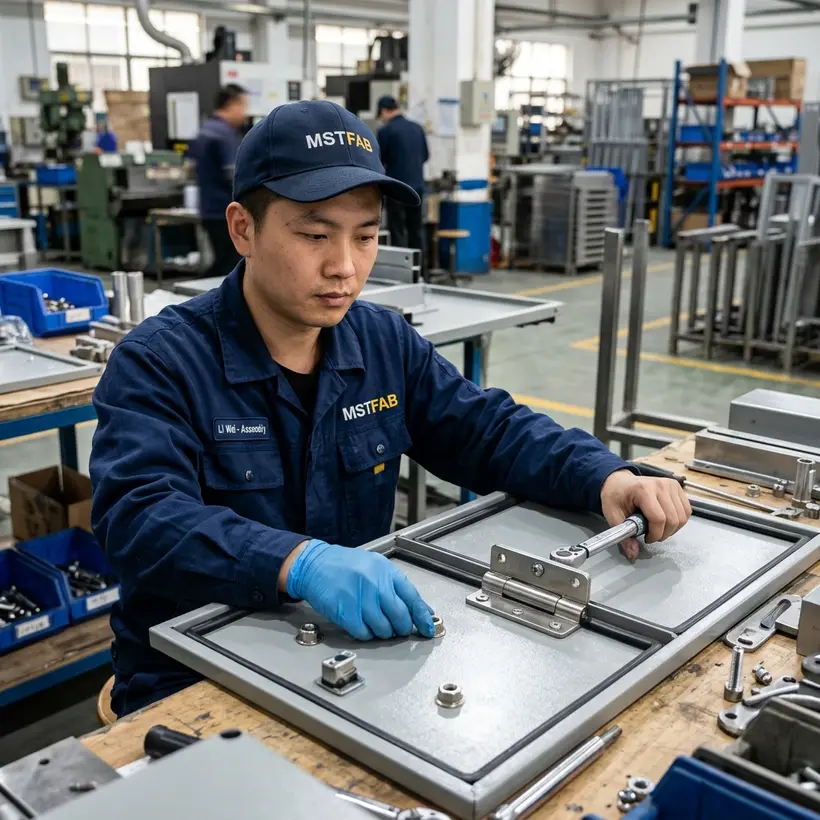
Prototype-to-production door and hardware checklist
| Interface | Review on the representative assembly | Record for production |
|---|---|---|
| Door and frame | Required door gaps, flushness, clearances and shape in the agreed installed or supported condition. | Drawing references, measurement condition and applicable acceptance limits. |
| Hinges | Exact model, orientation, attachment, opening clearance and any interference with adjacent parts. | Controlled hardware identity and approved mounting geometry. |
| Latch and striker | Alignment and operation after finish and assembly, without undocumented filing or bending. | Installation setup and the required operational check. |
| Gasket contact | Specified gasket, contact path and any joints or fasteners crossing the sealing interface. | Agreed assembly condition and any separately specified sealing test. |
| Inserts and removable panels | Fastener compatibility, tool access and mating fit with the specified finish in place. | Hardware specification, finish exclusions and required fit checks. |
| Mounting plate and shell | Support locations, installation access and clearance to the closed door and other mechanical parts. | Released interface dimensions and any agreed mating fixture or component. |
Should the sample include the final surface finish?
If finish affects an interface, evaluate it in the required condition. Coating on a hole, contact land or mating surface can change fit. A bare prototype may remain useful for an early geometry review, but its approval should not be described as a completed assessment of coated assembly.
Identify the finish system, visible faces, masking locations and hardware installation sequence. If only a finish trial is available, state what it represents and which assembly checks remain open. Do not use appearance approval as evidence of electrical continuity, corrosion life or enclosure sealing.
What if the prototype needed hand adjustment?
Record the adjustment and why it was required. Filing a cutout, repositioning a striker or reshaping a flange may allow that sample to assemble, but production needs an agreed disposition. The correction might require a drawing change, a tooling or setup change, or an approved controlled operation. Do not leave it as an undocumented instruction to make every unit fit.
Hypothetical example: a painted door needs its latch opening filed before the lock turns freely. Before batch release, the buyer and supplier identify the affected geometry and finish, agree the correction and repeat the relevant fit check. Approval of the filed sample alone does not establish that unmodified production parts will operate correctly. This is not an actual MSTFAB customer case or claimed production result.
How should the pilot assembly represent production?
Identify differences between the sample and the proposed batch: material, thickness, hardware, finish, manufacturing sequence and any special manual work. Choose the additional checks around those differences and the risk of repeating an unresolved issue. A particular sample count does not, on its own, prove process capability or justify skipping inspection.
The low-volume enclosure pilot guide covers the broader pilot baseline. For this assembly review, retain the sample identifier, drawing and hardware revisions, relevant results, open issues and the authorized disposition. A later change to a hinge or latch should trigger review of the affected interfaces, not an assumption that the old approval covers it.
What does mechanical assembly approval not cover?
A door that closes is not proof of an IP or NEMA rating. A mounting plate that fits is not evidence that the installed electrical system is safe. Define any required equipment-level validation and the party responsible for it. The mechanical fabrication scope, inspection scope and any test requirements should be agreed for the project.
As general engineering background, NASA distinguishes verification against specified requirements from validation of intended use. That distinction is useful here: a dimensional result and a finished equipment validation answer different questions. It is not an assertion that a NASA procedure applies to MSTFAB or that an enclosure is NASA-qualified.
Frequently asked questions
Does approving one enclosure prototype approve every production unit?
No. The approval applies to the identified sample, revision and review scope. Agree how the production configuration and inspection plan will address batch consistency and any differences from the sample.
Can a bare-metal enclosure prove coated door and latch fit?
Not completely. It can support an early geometry review, but finish can affect mating interfaces. Check the affected assembly in the required finished condition and identify any remaining open items.
Can production use a different hinge or lock after sample approval?
Treat the substitution as a controlled change. Confirm the new hardware identity and review affected cutouts, mounting points, clearances and operation before authorizing its use.
Review your enclosure assembly requirements
See custom sheet metal enclosure fabrication for the commercial scope, or send the released drawings, hardware list and sample issues for project-specific review. Identify the delivered finish and the checks you require. This guide does not guarantee batch capacity, tooling availability or a particular qualification.
Engineering background: NASA Systems Engineering Handbook: Product Validation. The reference explains general verification and validation concepts, not MSTFAB capabilities or sample acceptance.
 WeChat Contact
 WhatsApp Me Directly