
⚡ Direct Answer: How to Transition Sheet Metal Parts from Sample Approval to Mass Production?
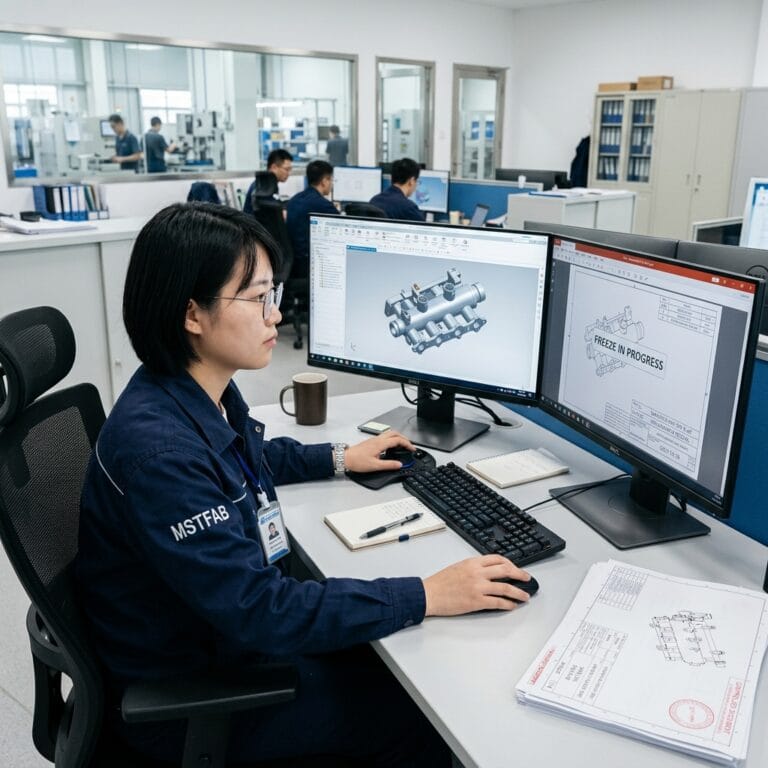
Transitioning custom sheet metal parts from sample sign-off to full-scale mass production requires locking down 5 operational quality gates: 1) Golden Sample Freezing: Dual sign-off on 2 master physical samples (one retained at MSTFAB factory, one at customer QA) establishing visual cosmetic limits; 2) Drawing & CAD Model Freezing: Locking 3D STEP models, bend deductions, and revision letters to prevent unrecorded process modifications; 3) Production Tooling & Fixture Hardening: Replacing temporary prototype clamping setups with dedicated pneumatic/toggle welding fixtures; 4) Statistical Capability (Cpk ≥ 1.33–1.67): Running 30 pilot parts to prove CNC press brake backgauge and hole pitch stability; and 5) Export Packaging Drop-Test Approval: Freezing custom foam insert geometry and ISPM-15 crate designs to eliminate international freight damage.
Phase-Gate Checklist: Sample Approval to Volume Ramp
| Quality Gate | Deliverable Requirement | Pass / Freeze Criteria | Risk Addressed |
|---|---|---|---|
| Gate 1: Drawing Freeze | Signed 2D PDF drawing with all GD&T & finish notes | 100% agreement on critical tolerances and test standards | Prevents unauthorized design changes during production tooling build. |
| Gate 2: Raw Material Lock | Mill Test Certificates (MTC) & spectrometer analysis | Exact alloy grade, temper (e.g. 5052-H32), and thickness verified | Eliminates material substitutions and bending fracture risks. |
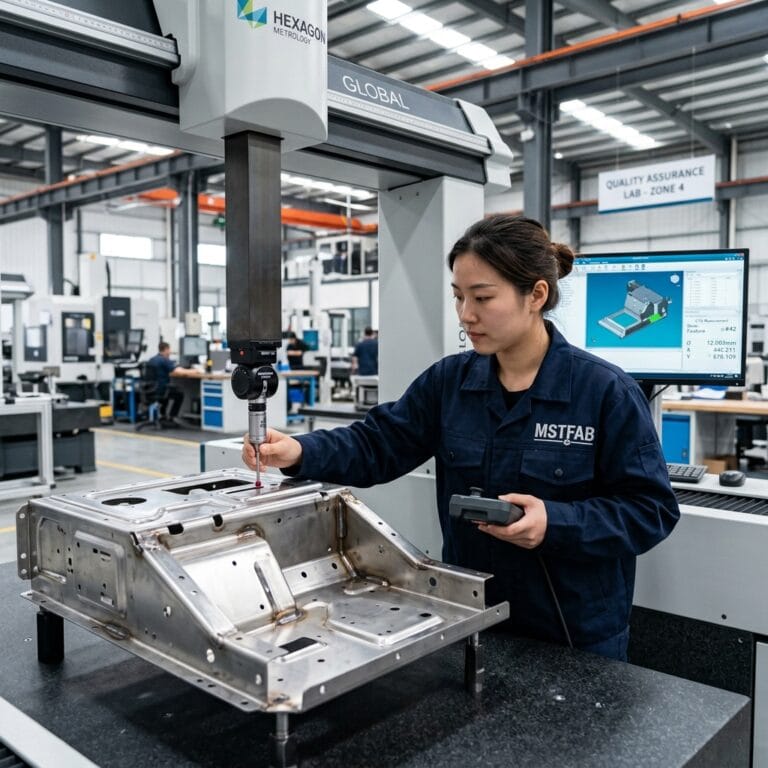
| Gate 3: FAI Sign-Off | AS9102-style dimensional inspection report on 3–5 parts | All ballooned dimensions within tolerance; CMM verified | Eliminates downstream chassis fit-up interference. |
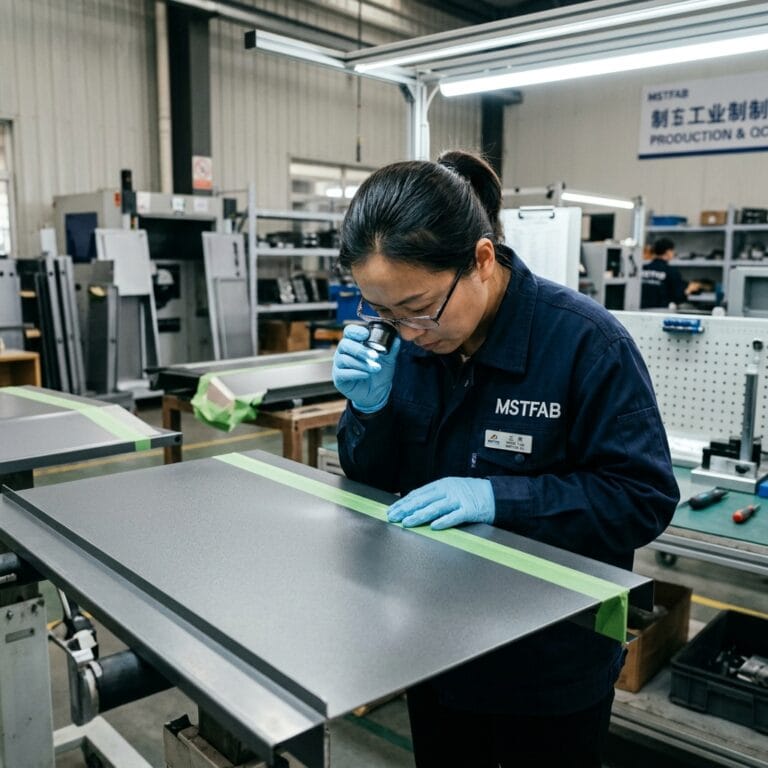
| Gate 4: Finish Standard Lock | Master color & texture plaque signed by both parties | ASTM D3359 cross-hatch 5B, 60–90µm DFT, zero orange peel | Prevents subjective aesthetic rejections on volume shipments. |
| Gate 5: Packaging Freeze | Drop-tested plywood crate with custom CNC foam | Zero transit abrasion; ISTA 1A drop test certified | Guarantees overseas sea/air shipments arrive in pristine condition. |
A common failure in contract sheet metal manufacturing occurs when a prototype sample handmade by an expert toolmaker is approved, but the subsequent volume production run made by production operators suffers from dimensional drift, weld spatter, and scratched paint. To prevent this “prototype trap,” MSTFAB enforces an institutional Sample-to-Production Ramp protocol that audits process repeatability before releasing purchase order volumes.
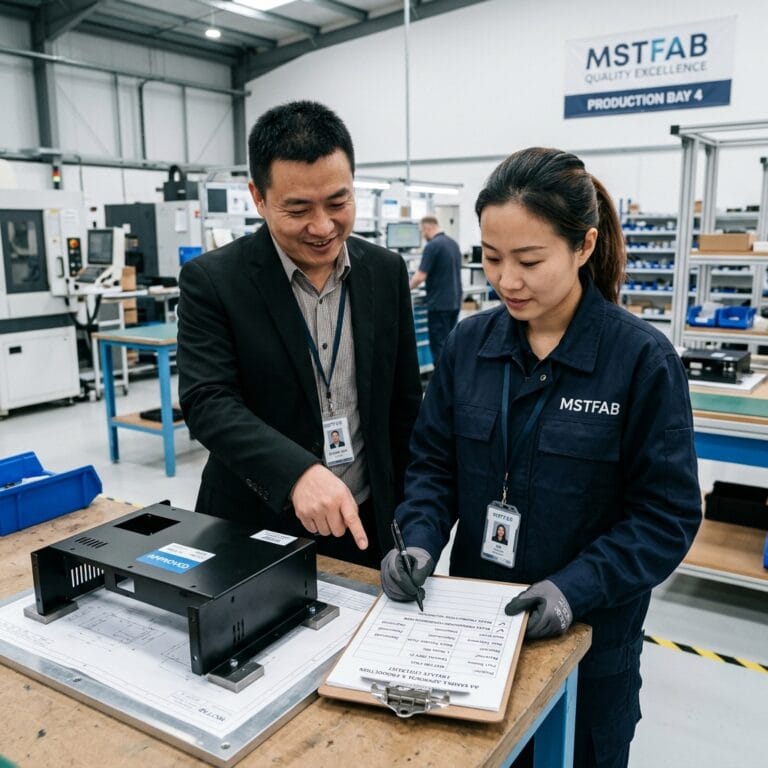
Golden Samples, Surface Coating Lock & Packaging Freeze
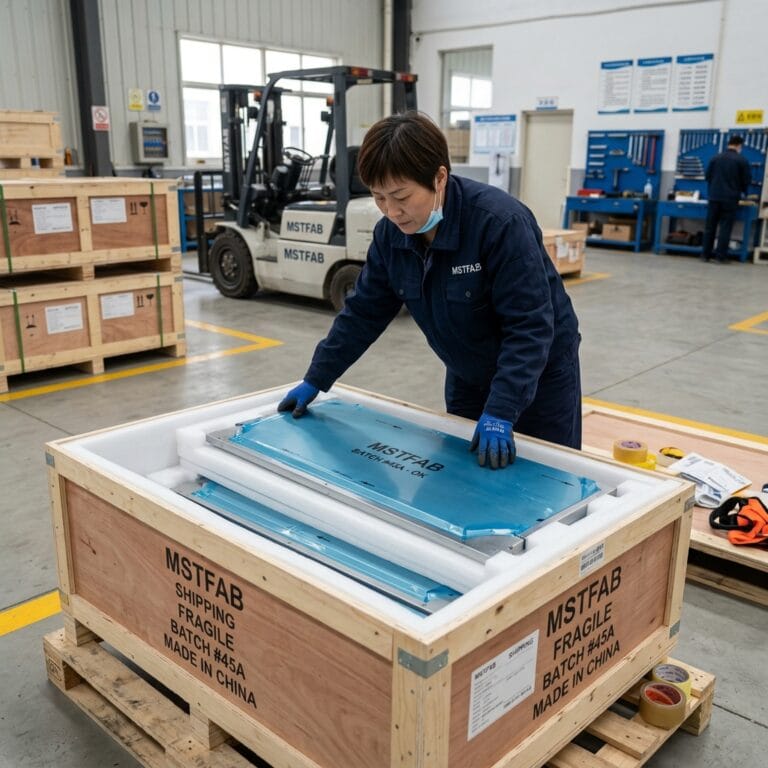
Once initial samples are approved, two sets of Golden Samples are physically labeled and signed. Raw material coils are allocated from certified mills, powder coating formulations are locked with RAL/Pantone color codes, and packaging engineers construct custom foam cavities to protect formed flanges during international transit.

Ready to Scale from Sheet Metal Prototypes to Mass Production?
Partner with MSTFAB for seamless NPI execution. We manage golden samples, FAI validation, statistical Cpk controls, and volume ramp scheduling.
Frequently Asked Questions on Sample Approval & Mass Ramp
What is the primary role of a “Golden Sample” in sheet metal?
A Golden Sample serves as the physical benchmark for non-quantifiable aesthetic attributes—such as powder coat texture, gloss level, weld seam dress smoothness, and corner blending—preventing subjective disputes during final inspection.
How long are master Golden Samples retained?
Master samples are preserved in temperature-controlled quality storage for the entire commercial lifecycle of the product or until superseded by a formal Engineering Change Order (ECO).
 WeChat Contact
 WhatsApp Me Directly