
The PDF Limitation
A 2D PDF drawing is legally binding, but geometrically blind. It tells the factory what the final part should look like, but it fails to prove whether the part can actually be manufactured. For complex OEM assemblies, an isolated PDF forces the factory into a cycle of reverse-engineering and blind assumptions, destroying your quotation accuracy.
Can I Send a STEP File for Sheet Metal Fabrication?
Absolutely. In fact, if you demand absolute cost predictability and rapid lead times, transmitting a native 3D STEP file is the most strategic procurement decision you can make.
Before sharing the production package, you can open the STEP file in your browser to confirm the visible model, orientation and main interfaces. The viewer is for visual inspection; the released STEP model and dimensioned PDF remain the controlled manufacturing files.
For high-stakes sheet metal fabrication projects—such as multi-door telecom cabinets, heavy-duty chassis, or medical device housings—a 3D STEP file empowers the manufacturing matrix to interrogate the true geometry of your design. It eliminates the guesswork inherent in flat 2D blueprints and immediately highlights structural conflicts before steel is ever cut.
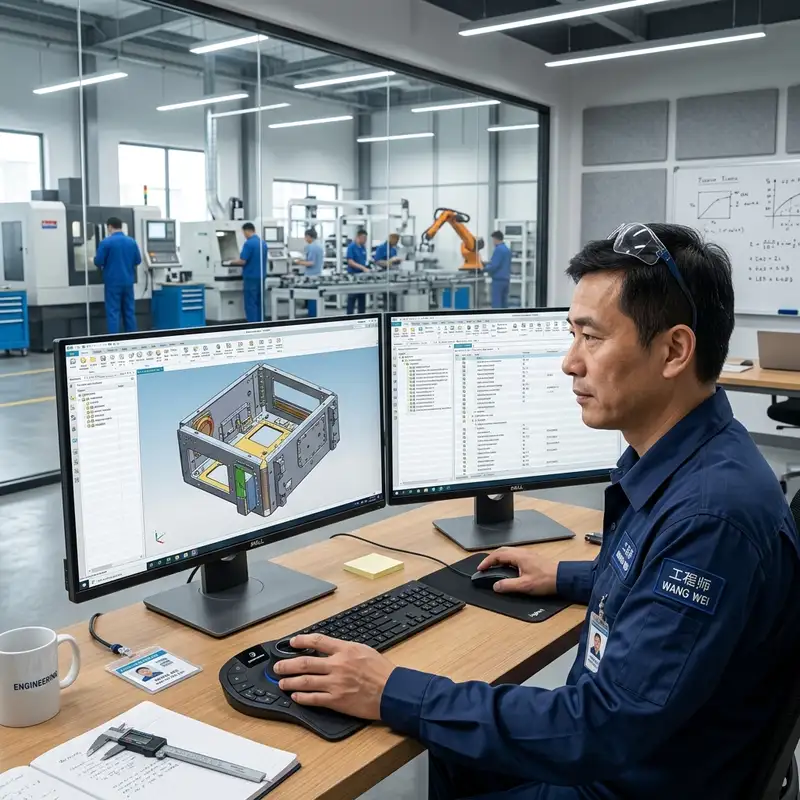
A PDF Dictates the Rules; A STEP File Proves the Physics
A rigorous 2D PDF drawing is indispensable. It serves as the master contract, explicitly defining the material grade, dimensional tolerances, weld bead profiles, and surface finish requirements (e.g., AkzoNobel IP65 powder coating).
However, a PDF is completely incapable of answering the kinetic questions of heavy industrial fabrication:
- Flat-Pattern Viability: Can this 3D model mathematically unfold into a 2D blank without material tearing?
- Tooling Access: Do the CNC press brake V-dies have physical clearance to execute bend #4 without crashing into flange #2?
- Assembly Interference: Will the internal DIN rail brackets physically block the swinging arc of the front door?
For custom sheet metal enclosures, these geometry conflicts are invisible on a flat PDF. A STEP file gives the factory x-ray vision into your product architecture.
How the STEP File Drives the DFM Audit
Design for Manufacturability (DFM) is the firewall between a profitable supply chain and a catastrophic assembly failure. When you supply a STEP file, our engineers execute a brutal structural audit:
1. Bend Radius Verification
We analyze every internal bend radius against the selected alloy’s yield strength. If an AL6061-T6 bracket features a zero-radius bend, the STEP file immediately flags the fracture risk.
2. Flange Collision Detection
Deep U-channels and tight return flanges often look perfect in CAD but are physically impossible to fold. We simulate the bending sequence to ensure the press brake punch does not collide with the chassis walls.
3. Hole Deformation Risks
We digitally verify the distance between mounting holes and adjacent bend lines. If a hole sits within the plastic deformation zone, we mandate a relief cut or a dimensional shift to prevent the hole from stretching into an oval during CNC forming.
| RFQ Submission Format | Factory Engineering Action | Impact on OEM Quotation |
|---|---|---|
| 2D PDF Only (Complex Part) | Must manually reverse-engineer 3D intent. High risk of misinterpretation. | Slower quotation velocity; factory pads the price to absorb geometric risk. |
| 3D STEP Only | Can simulate bending, but must guess tolerances, alloys, and finishing. | Inaccurate costing. Factory assumes cheapest, default manufacturing variables. |
| 3D STEP + 2D PDF | Immediate digital unfolding combined with absolute contractual rules. | Ultra-fast, mathematically precise quotation with zero hidden risk. |
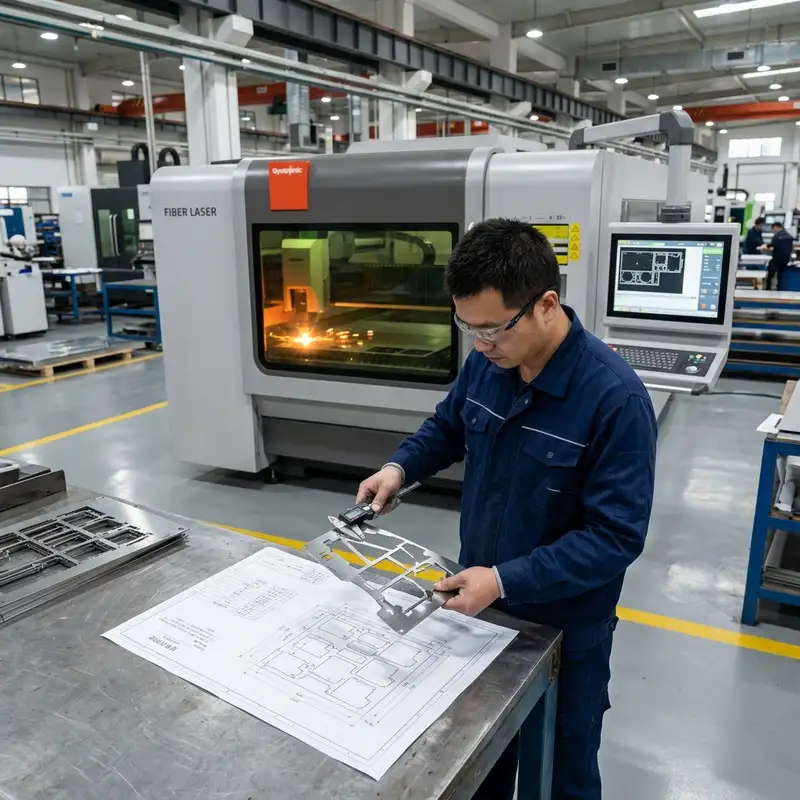
Why PDFs Alone Create Supply Chain Risk
Relying exclusively on a PDF for a complex medical equipment enclosure or a heavily welded server chassis guarantees friction. The factory is forced to interpret hidden lines and manually calculate bend deductions.
Common OEM risks triggered by “PDF-Only” submissions include:
- Misunderstood Bend Directions: “Up” or “Down” can be easily inverted on complex multi-axis parts.
- Incorrect Flat Pattern Assumptions: Leading to massive material scrap rates on the laser bed.
- Protracted Communication: Weeks lost in email chains asking for geometric clarification.
The Ultimate RFQ Package
To secure a rock-solid, zero-risk quotation for your EV charger enclosures or telecom enclosures, your engineering team must deploy the dual-file strategy:
- The 3D STEP File: Submitted to prove the geometry, verify the flat-pattern, and simulate the CNC bend sequence.
- The 2D PDF Drawing: Submitted to enforce the material grade (e.g., SUS316L), dictate the ISO 2768 tolerances, call out PEM hardware, and specify the exact RAL color code.
We do not need your proprietary electronic schematics or internal logic boards. We simply need the absolute truth of your metal structure. You provide the functional design; we forge the flawless physical armor.
Accelerate Your Quotation Velocity
Stop forcing your suppliers to guess your geometry. Upload your 3D STEP and 2D PDF drawings today. Our engineering matrix will execute an immediate digital flat-pattern simulation and deliver a mathematically verified, factory-direct quotation within 24 hours.
FAQ: Using STEP Files in Sheet Metal Fabrication
Is a STEP file better than a PDF for sheet metal fabrication?
They serve entirely different purposes and must be used together. The STEP file proves the 3D geometry and CNC bending feasibility, while the PDF legally defines the material grade, tolerances, and surface finishing rules.
Can you quote OEM production from only a PDF drawing?
Yes, for simple, flat laser-cut parts or basic single-bend brackets. However, for complex enclosures, welded chassis, and multi-panel assemblies, a STEP file is critical to eliminate geometric guesswork and secure an accurate price.
Why do manufacturers need to “unfold” the STEP file?
Every 3D sheet metal part must be unfolded into a 2D flat blank before it can be laser cut from raw steel. The STEP file allows our software to calculate the exact bend deductions required to ensure the final folded part hits your precise tolerances.
CNC sheet metal bending services
MSTFAB provides CNC press brake bending services for precision sheet metal parts, enclosures, brackets and OEM assemblies.
 WeChat Contact
 WhatsApp Me Directly