
NEMA 4X buyer evidence guide
A practical guide to material, sealing geometry, field entries and conformity evidence for drawing-based empty galvanized electrical enclosure shells.

Quick Answer
Can galvanized steel meet NEMA 4X? Yes, potentially, but not because the sheet is galvanized. Galvanized steel can be part of a complete enclosure construction intended to meet NEMA Type 4X. Door geometry, seams, gaskets, closures, entries, accessories, finish, installation and approved changes all affect the claim.
There is another important procurement correction: NEMA writes standards but does not test products, certify enclosures or issue a NEMA label. A buyer must name the required evidence route. That may be a manufacturer declaration supported by testing to NEMA 250, an independent laboratory report, or third-party certification such as a UL program when the project requires it.
MSTFAB fabricates the drawing-defined empty shell. We do not supply the relays, wiring, cable glands or completed electrical equipment, and we do not turn a zinc coating into a certification with enthusiastic wording.
Freeze These Inputs Before Quotation
First, Keep the Manufacturing Scope Honest
MSTFAB may fabricate
- Empty electrical box bodies and doors
- Flat gasket lands and formed returns
- Mounting plates and DIN-rail interfaces
- Blank or cut gland plates
- Reinforcement, hinges and latch interfaces
- Studs, inserts and grounding points
- Specified coating or finish
- Mechanical FAI and export packing
Buyer or responsible party owns
- Electrical architecture and populated equipment
- Field glands, conduit and cable systems
- Final enclosure performance requirement
- Test or certification program
- Finished-product marking
- Site installation and field modifications
- Electrical safety validation
- Completed-equipment compliance
For broader commercial capability, materials and RFQ support, see our custom electrical enclosure fabrication page. For a commercial overview, compare our custom outdoor metal enclosure capability. This guide has a narrower job: preventing the words “galvanized” and “4X” from being treated as synonyms.
The Procurement Pain Is Usually an Evidence Gap
An OEM writes “NEMA 4X galvanized box” on a purchase order. The fabricator reads material plus rough enclosure style. The installer assumes every field hole will preserve the rating. Quality expects a certificate at the end. Four teams have used the same phrase and ordered four different things.
Months later, rust appears at a weld repair, water reaches a poorly compressed corner or a field-cut opening uses the wrong fitting. Everyone owns a PDF. Nobody owns the complete configuration.
Galvanized steel describes a zinc-coated material route. It does not describe door compression, seams or entries.
Type 4X concerns the complete enclosure under defined environmental tests and construction conditions.
The RFQ must state who declares, tests or certifies the configuration and which report or mark is required.
What NEMA Type 4X Actually Means
NEMA 250 defines enclosure Type classifications. Type 4X is an indoor or outdoor classification that includes protection from listed environmental conditions and an additional corrosion-resistance dimension. It is not simply a synonym for “waterproof,” and it is not a metal grade.
The practical buyer question is therefore not only:
It is also: What exact enclosure configuration is being evaluated, what evidence supports the Type claim, and does the delivered drawing match that evaluated configuration?
The official NEMA enclosure standards FAQ makes the conformity boundary clear: NEMA does not test or certify products and does not authorize use of a NEMA label. Manufacturers may make conformity claims, and independent testing or certification can be used when specified.
Three Evidence Routes Buyers Commonly Encounter
Manufacturer declaration
The responsible manufacturer declares conformity to the stated standard and should maintain supporting design, test and change-control evidence appropriate to that claim.
Independent test report
A competent laboratory tests the defined sample and configuration. The report scope, sample identity, accessories and deviations must match what is purchased.
Third-party certification
A certification body evaluates the product under its program and authorizes the applicable mark when requirements are met. The mark and listing scope matter.
Buyer witness or project test
Some OEMs add project-specific inspection or witnessed testing. This can support acceptance but should not be described as a certification unless it actually is one.
These routes are not interchangeable slogans. “Tested,” “certified,” “listed” and “designed for” mean different things. Ask the supplier to name the route in one sentence. If the answer requires smoke, mirrors and a fifteen-slide company introduction, the sentence probably needs more work.
NEMA 4X and UL Are Related, Not Identical
NEMA 250 is a standard. NEMA itself does not certify the product. UL, by contrast, operates third-party certification programs for electrical enclosures and related components under applicable standards such as UL 50 and UL 50E. A UL mark should be verified against the certification scope, construction and accessories, not inferred from a supplier’s use of the phrase “NEMA 4X.”
The official UL enclosure certification service explains that enclosure Type ratings and relevant accessories can be evaluated within its certification program. The buyer should specify the required market evidence rather than asking one acronym to impersonate another.
If a project also compares IEC ingress codes, use the dedicated NEMA versus IP ratings guide. This page will stay focused on galvanized Type 4X construction and evidence.
Galvanized Steel Is a Material System, Not a Magic Shield
The word “galvanized” can describe different supply and fabrication routes. Pre-galvanized sheet is cut, bent and welded after coating. Hot-dip galvanizing after fabrication exposes the completed steelwork to a different process. Zinc-rich repair, chemical pretreatment and powder coating may also be part of a buyer-approved system.
Those routes affect edges, weld zones, appearance, dimensional interfaces and corrosion behavior differently. The drawing should name the material and finish specification that was actually selected. “Galvanized, please” is polite. It is not a complete coating plan.
Galvanized steel can be economical and appropriate for many projects. Aggressive environments may justify another material or protection system, but “harsh equals 316L” is not a complete engineering rule either. Concentration, temperature, cleaning chemistry, exposure time and crevice conditions still get a vote.
Cut Edges and Welds Need an Approved Finish Plan
Laser cutting and welding can interrupt or alter the original zinc protection. Seams may also be ground for fit or appearance. The controlled fabrication package should therefore define how exposed areas, welds and repaired zones are treated before the final finish.

Ask for evidence that matches the risk: incoming material documentation, coating specification, process records, visual criteria, thickness checks or corrosion evidence where contractually required. EN 10204 3.1 and PMI are not universal hard gates for every galvanized electrical box. Require them when the drawing, contract or material risk makes them useful, not because a scorecard needed another impressive acronym.
The Gasket Land Is a Functional Surface
A good gasket cannot rescue a door opening with uncontrolled weld ripple, sharp transitions or poor corner geometry. The body flange, door return, hinge position and latch system must create repeatable contact around the perimeter.

DFM review points
- Continuous, controlled contact land
- Corner transition and weld cleanup
- Door and frame flatness where functional
- Hinge offset and closing path
- Latch position and repeatable compression
- Gasket joint and retention strategy
- Finished coating condition
Do not copy a universal gasket-compression percentage from a blog and put it on every drawing. The selected gasket supplier, section, material, adhesive and closure design should define the approved working range. Rubber is flexible. Technical responsibility should not be.
Closures, Hinges and Door Stiffness Work Together
A latch located correctly in 2D can still produce uneven closing if the door flexes, the hinge axis is wrong or weld pull has changed the frame. Large doors may need reinforcement or multiple closures, but hardware count should follow the approved design and validation route.
Model hardware
Include latch bodies, cams, hinge barrels, fasteners and rear tool envelopes, not only their cutouts.
Control post-weld geometry
Measure the frame and door relationships after joining operations capable of moving them.
Verify the finished cycle
Open, close and latch the coated assembly with the approved gasket and hardware configuration.
Protect substitutions
A new latch or gasket may look equivalent while changing grip, compression, projection or chemical behavior.
Every Opening Is Part of the Configuration
Cable glands, conduit hubs, vents, drains, windows, blanking plugs and removable plates can affect the claimed enclosure performance. A passed bare cabinet with empty holes is not evidence for every accessory the installer may later choose.
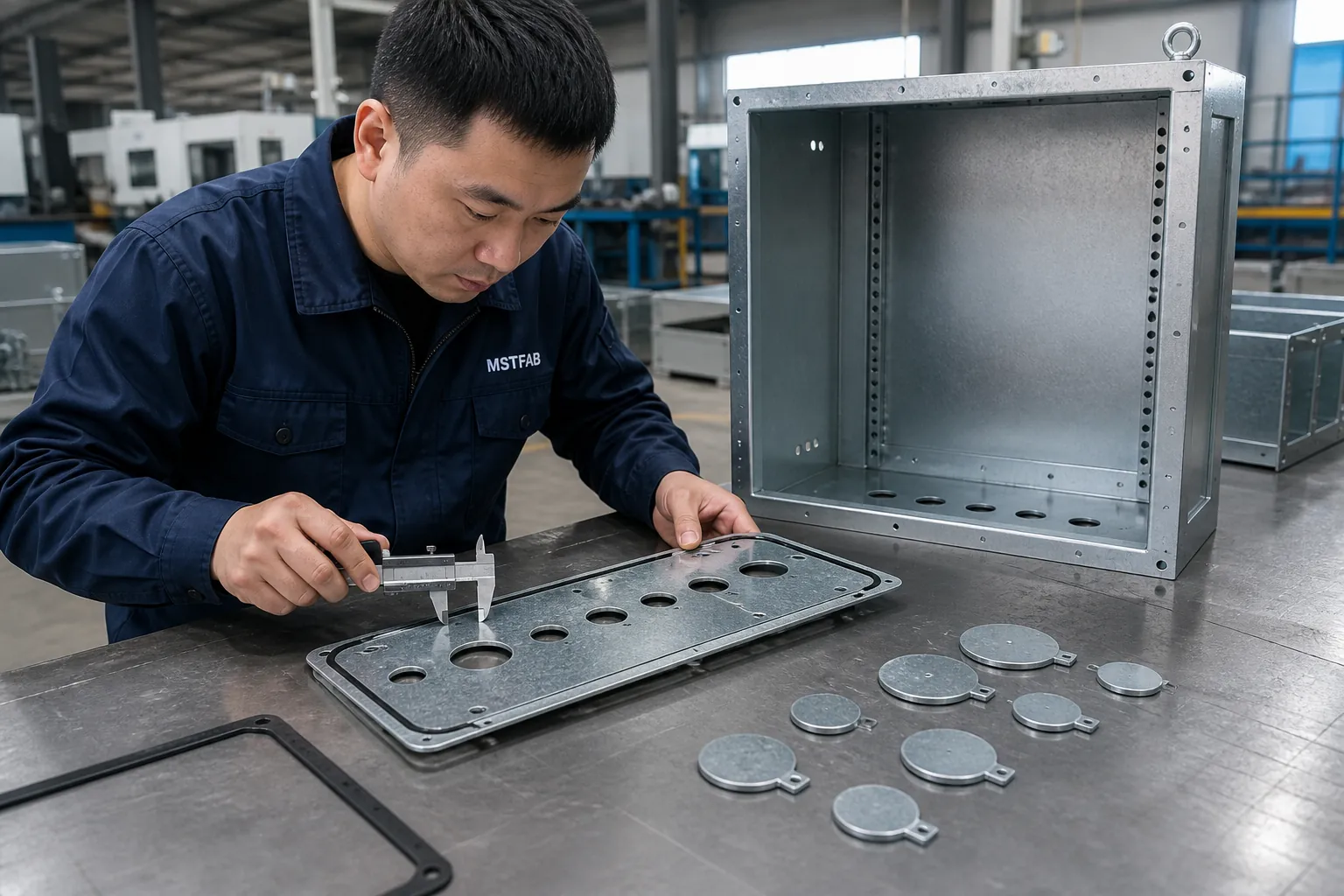
Freeze the entry architecture early. Where field flexibility is required, use an approved removable plate or defined accessory family and control the parts in the BOM. “Drill wherever the cable arrives” is certainly flexible. It is less accomplished at preserving evaluated construction.
Test the Intended Complete Configuration
Test evidence should identify what was actually evaluated: enclosure size or family, door, gasket, closures, seams, finish, entries, plugs, accessories and mounting orientation where relevant. The sample and delivered drawing must be traceable to the same design baseline.

A workshop spray demonstration can be useful process feedback. It should not be marketed as independent certification. A garden hose, confidence and a clipboard do not quietly become a conformity-assessment body when photographed together.
Field Modifications Can Change the Evidence
The enclosure may leave the factory in one configuration and meet a drill, conduit punch or substitute fitting onsite. The buyer’s installation instructions and certification route should define permitted modifications and approved accessories.
Change control should cover at least:
- Material and thickness
- Weld and seam construction
- Door, hinge and latch hardware
- Gasket supplier, section and joint
- Finish and pretreatment
- Gland plates, plugs, windows and other accessories
- Size-family rules and drawing revisions
A purchasing substitution can save two dollars and quietly invalidate the evidence package. Cheap hardware becomes expensive when it needs a new test program.
Do Not Forget Condensation and Internal Heat
Type 4X is not a universal promise against condensation generated by temperature cycles inside a sealed enclosure. The OEM owns the thermal design, internal heat load, anti-condensation strategy and environmental operating conditions of the completed equipment.
MSTFAB can fabricate specified heater brackets, drain interfaces, sun shields or ventilation features. Whether those features are compatible with the target enclosure classification and final product belongs to the responsible design and evaluation route.
Buyer Trust Matrix
Use this table to convert a broad Type 4X request into evidence that procurement, engineering and quality can all recognize.
| Buyer check | Credible evidence | Red flag | Primary owner |
|---|---|---|---|
| Material and finish | Released specification, supplier record and approved finish route | “Galvanized means 4X” | Buyer plus fabricator |
| Complete configuration | Controlled BOM, assembly drawing and accessory list | Only the empty body is identified | Responsible manufacturer |
| Sealing geometry | Post-weld FAI, gasket-land and door-fit records | Inspection stops at flat blanks | MSTFAB for agreed CTQs |
| Type evidence | Named declaration, test report or certification scope | “NEMA approved” with no route | Claim or mark owner |
| Entries and accessories | Approved parts, cutouts and installation instructions | Field drilling has no control | OEM or integrator |
| Material certificates | Contract-specific mill or coating records | PMI demanded without a material risk | Buyer defines; supplier provides |
| Change control | Revision approval and re-evaluation rules | “Equivalent” gasket or latch by email | Responsible manufacturer |
| Completed electrical product | OEM integration and final validation file | Empty shell presented as finished equipment | OEM or panel builder |
What the Documentation Package Should Contain
ISO 9001 can provide useful quality-system context. It does not prove that one enclosure matches Type 4X. A certificate can show the company has a system. The FAI and conformity file still need to know which door was built.
Mechanical FAI and Export Protection
Mechanical first article should focus on features capable of breaking assembly or sealing: enclosure dimensions, door and frame relationship, gasket land, latch and hinge positions, plate fit, welded distortion, protected threads and the completed finish.

Pack loose gland plates and hardware by part number and revision. Protect cosmetic faces and sealing lands from metal-to-metal contact. Shipping is allowed to change the enclosure’s location. Its flatness has not volunteered.
Where This Page Stops
This page owns the general buyer question: can a galvanized sheet metal electrical box support a Type 4X project, and what evidence must be controlled?
Application-specific control-box issues, including dense sensor entries and automation-cell service access, belong in the separate automation NEMA 4X electrical box guide. Distribution boxes, DIN-rail enclosures and IP comparisons remain separate topics. That prevents five articles from wearing the same keyword coat and bumping into one another in search.
RFQ Checklist
Geometry and environment
- STEP/STP assembly and dimensioned PDF
- Drawing revision and enclosure size
- Indoor, outdoor, washdown and chemical exposure
- Material, thickness and galvanizing route
- Secondary finish and cosmetic class
- Gasket land, hinge, latch and door details
- Entry plates and accessory mechanical models
- Prototype and production quantities
Evidence and responsibility
- Target NEMA Type and standard edition
- Declaration, lab report or certification route
- Named gasket, closure and accessory BOM
- FAI dimensions and acceptance criteria
- Required material or coating documents
- Field-entry and installation limits
- Substitution and change-control rules
- Export packing requirements
Useful RFQ note: “MSTFAB shall fabricate the drawing-defined empty galvanized sheet metal enclosure shell, door, plates and mechanical interfaces only. Buyer owns the populated electrical system, selected conformity route, approved accessories, field installation and completed-equipment validation.”
Common Red Flags
Key Takeaways
- Galvanized steel is a material input
- Type 4X belongs to a complete configuration
- NEMA does not certify or issue labels
- UL certification is a separate evidence route
- Gaskets cannot repair poor geometry
- Cut edges and welds need a finish plan
- Entries and accessories must be controlled
- Field changes can alter the evidence
- 3.1 and PMI are project-specific
- FAI follows forming, welding and finishing
- Substitutions require review
- MSTFAB supplies empty shells only
The cheapest time to discover that the coating, gasket and test report describe three different configurations is during RFQ review. The expensive version begins after the enclosures are installed outdoors and the first rainstorm performs an unplanned supplier audit.
Frequently Asked Questions
Can galvanized steel meet NEMA 4X?
Galvanized steel can be used in a complete enclosure construction intended to meet Type 4X. The material alone does not create the rating; the controlled enclosure and its evidence route determine the claim.
Does NEMA certify Type 4X enclosures?
No. NEMA develops standards but does not test, certify, list or label products. A manufacturer declaration, independent test or third-party certification must be identified separately.
Is a galvanized electrical box waterproof?
Galvanized describes corrosion protection for the steel. Water protection depends on the complete door, seams, gasket, closures, entries, accessories and verified configuration. Avoid using “waterproof” as an unlimited promise.
Is NEMA 4X the same as UL certification?
No. NEMA 250 is a standard and NEMA does not certify products. UL operates independent certification programs under applicable UL standards; the listing and mark scope should be checked.
Do I always need stainless steel in a harsh environment?
No universal material rule is reliable. Select the material and protection system from actual chemicals, chloride exposure, cleaning, temperature, service life, appearance and project evidence.
Does MSTFAB supply the complete electrical box?
MSTFAB fabricates drawing-based empty sheet metal shells, doors, plates and mechanical interfaces. Relays, terminals, wiring, field glands and completed electrical integration remain with the buyer.
Can MSTFAB certify my finished enclosure as Type 4X?
Normal fabrication scope does not make MSTFAB the certification owner for the buyer’s completed equipment. State the required declaration, test or certification route in the RFQ so the responsible parties and configuration are clear.
Should every order require EN 10204 3.1 and PMI?
No. Request material and coating evidence appropriate to the drawing, contract and risk. PMI can be valuable for some alloy verification programs but is not a universal gate for ordinary galvanized steel enclosure work.
Why do cut edges and welds matter?
Cutting and welding can interrupt or alter the original zinc protection. The drawing should define repair, pretreatment and final finishing for those areas.
Can field-installed cable glands affect the Type claim?
Yes. Entries, plugs, plates and accessories are part of the installed configuration. Use the approved components and installation route tied to the responsible evidence package.
What should first-article inspection check?
Depending on the project: overall dimensions, door and frame fit, gasket land, hinge and latch relationships, gland-plate fit, post-weld distortion, coating condition, protected threads and hardware installation.
What is the biggest purchasing mistake?
Writing “galvanized NEMA 4X box” without naming the complete construction, evidence route and responsibility owner. One phrase cannot do the work of a specification.
Send the Drawing and Evidence Requirement Together
Upload STEP and dimensioned PDF files with material, finish, gasket, closure, entry plate, quantities and the required Type evidence route. MSTFAB will review the empty shell before quotation.
Editorial note: standards and certification references define responsibility boundaries only. Released drawings, buyer specifications, approved components and the selected conformity route remain the controlling project documents.
 WeChat Contact
 WhatsApp Me Directly