
NEMA vs. IP Enclosure Ratings: Engineering Summary for OEM Buyers
NEMA enclosure Types (NEMA 250 / UL 50E) and IEC 60529 IP codes are not a one-to-one conversion. IP ratings classify ingress protection against solid objects (first digit) and water (second digit), whereas NEMA / UL Type ratings also address broader construction, corrosion resistance, icing and environmental factors within their standard scope. If an OEM project requires both designations, state both on the RFQ and agree how the complete assembly will be validated.
- No automatic relabeling: An IP65 or IP66 label alone does not establish NEMA Type 4 or Type 4X compliance (see our IP66 vs. NEMA 4X Equivalence Guide).
- System-level sealing: Real-world ingress protection depends on door frame flatness, gasket compression geometry, latch pitch, gland plates and louver baffles—not just sheet thickness.
- Empty-shell scope clarity: MSTFAB fabricates drawing-based empty sheet metal enclosure shells and mechanical hardware; final electrical assembly, certification testing and system-level approval must be explicitly assigned in the RFQ.
Why Enclosure Ratings Fail When Treated as a Title-Block Label
A frequent procurement risk in custom outdoor metal enclosures happens when a drawing simply notes “IP65” or “NEMA 4X” in the title block without defining the mechanical sealing details. A low-cost shop may reply “no problem,” bend standard steel panels, apply adhesive foam tape with corner gaps, and ship an unverified box. Once installed outdoors, door frame springback, unsealed cable cutouts or corroded carbon-steel hinges allow water ingress into sensitive power or control electronics.
Preventing field leaks requires translating the target rating into concrete mechanical features—material grade, rain-lip geometry, continuous gasket compression, removable gland plates and louver design—before releasing drawings to your outdoor sheet metal enclosure fabrication partner.
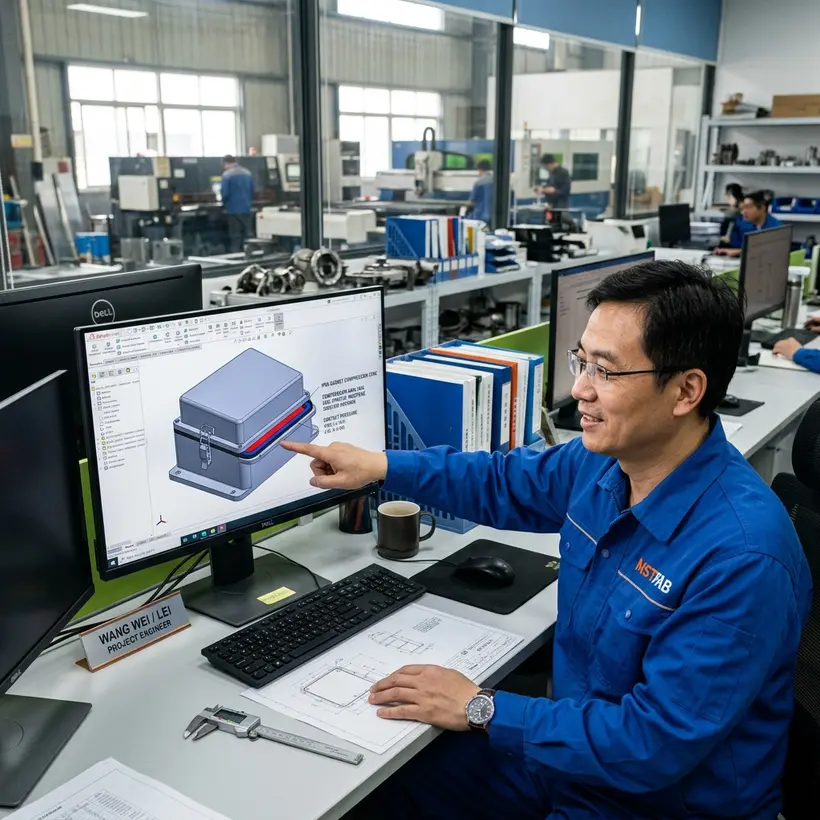
IP vs. NEMA: What Each Standard Actually Covers
While buyers often group IP and NEMA ratings together under “weatherproof” or “waterproof” enclosures, the two standards originate from different bodies and evaluate different criteria:
1. IEC 60529 IP Ratings (Ingress Protection)
Defined under IEC 60529, an IP code consists of two numerals that classify degrees of protection against the intrusion of solid foreign objects/dust (first digit, 0–6) and water ingress (second digit, 0–9K):
- First digit (Solids & Dust): For example,
5indicates dust-protected (limited ingress permitted with no harmful deposits), while6indicates dust-tight (no ingress of dust under test conditions). - Second digit (Water): For example,
4covers splashing water,5covers low-pressure water jets (6.3 mm nozzle), and6covers powerful water jets (12.5 mm nozzle).
Crucial limitation for buyers: Standard IEC 60529 IP codes do not evaluate long-term corrosion resistance, external icing, UV degradation of gaskets, mechanical impact (covered separately by IK ratings), or hazardous locations.
2. NEMA 250 / UL 50E Enclosure Type Ratings
Published by the National Electrical Manufacturers Association (NEMA 250) and harmonized with UL 50E in North America, NEMA Type designations define both ingress protection and broader environmental construction and performance requirements:
- Environmental & construction scope: Depending on the Type (such as Type 1, Type 3R, Type 12, Type 4 or Type 4X), the standard addresses indoor/outdoor exposure, sleet and external ice formation, hose-directed water, and gasket aging/oil resistance.
- Corrosion protection (Type 4X): A Type 4X designation explicitly includes corrosion-resistance requirements alongside watertightness. Specifying ordinary painted steel or non-stainless hardware without verifying corrosion requirements will not satisfy Type 4X expectations (see Can Galvanized Steel Meet NEMA 4X?).
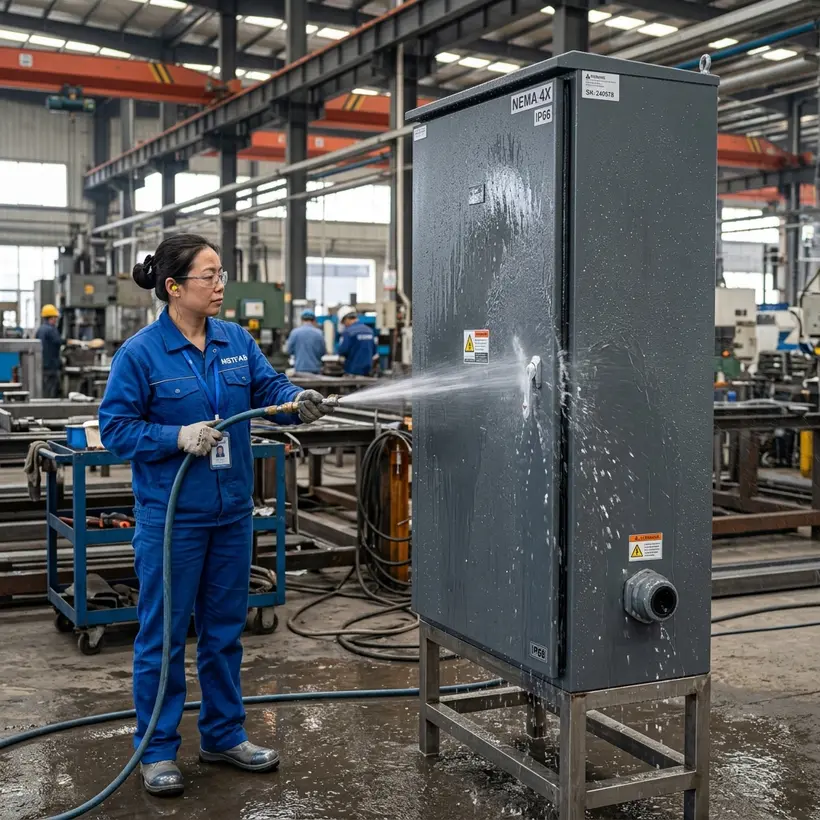
NEMA and IP Specification Checklist: Not a Direct Equivalence Table
Engineering reference charts often map NEMA Types to approximate IP codes for initial scoping, but a cross-reference chart cannot be used to self-certify or relabel an enclosure. Use the table below to structure technical review questions during RFQ preparation:
| Target Designation | Typical OEM Application Context | Common Cross-Reference Pitfall (What Not to Infer) | Mechanical & RFQ Inputs to Confirm |
|---|---|---|---|
| NEMA Type 1 (Often compared with IP20) | General-purpose indoor electrical boxes, dry-room control chassis and rack panels. | Do not assign an IP code from the Type name alone without checking opening sizes against finger/object probes. | Ventilation slot width, knockouts, door latch type, indoor powder-coat specification and grounding studs. |
| NEMA Type 3R (Outdoor rain/sleet protection) | Outdoor utility boxes, power distribution cabinets and ventilated telecom shelters. | Type 3R is not dust-tight or hose-tight; conversely, a basic IP24/IP34 label does not automatically address Type 3R construction details. | Overhanging rain hood/drip shield geometry, baffled louver angle, bottom drainage holes and outdoor corrosion coating. |
| NEMA Type 12 / IP54–IP55 (Indoor industrial dust & drip) | Factory-floor automation cabinets, PLC control panels and machine-tool electrical housings. | Do not substitute an IP54 label for Type 12 without verifying oil-resistant gasketing and unknocked conduit provisions. | Oil-resistant gasket specification, continuous seam welds, sealed gland plates and internal sub-panel mounting datums. |
| NEMA Type 4 / IP65–IP66 (Dust-tight & hose/jet water) | Outdoor industrial cabinets, EV charger enclosures and battery energy storage housings. | Do not treat IP65/IP66 water-jet tests as automatic proof of all UL 50E / NEMA Type 4 hose-down and construction criteria. | Knife-edge or gutter lip around door perimeter, multi-point compression latches, continuous welded corners and gland-plate gaskets. |
| NEMA Type 4X (Watertight + Corrosion Protection) | Coastal/marine installations, wastewater plants, food/Washdown equipment and chemical environments. | Choosing SUS304/SUS316 sheet or an IP66 rating alone does not establish Type 4X compliance for the complete assembly. | Base alloy (e.g., 304/316L stainless or validated coated system), matching stainless hinges/latches, weld passivation and chemical gasket compatibility. |
DIN-rail enclosure project? Review our IP66 Galvanized Steel DIN-Rail Enclosure Guide to translate ingress targets into gasket channel, gland-plate and internal rail clearance callouts before quotation.
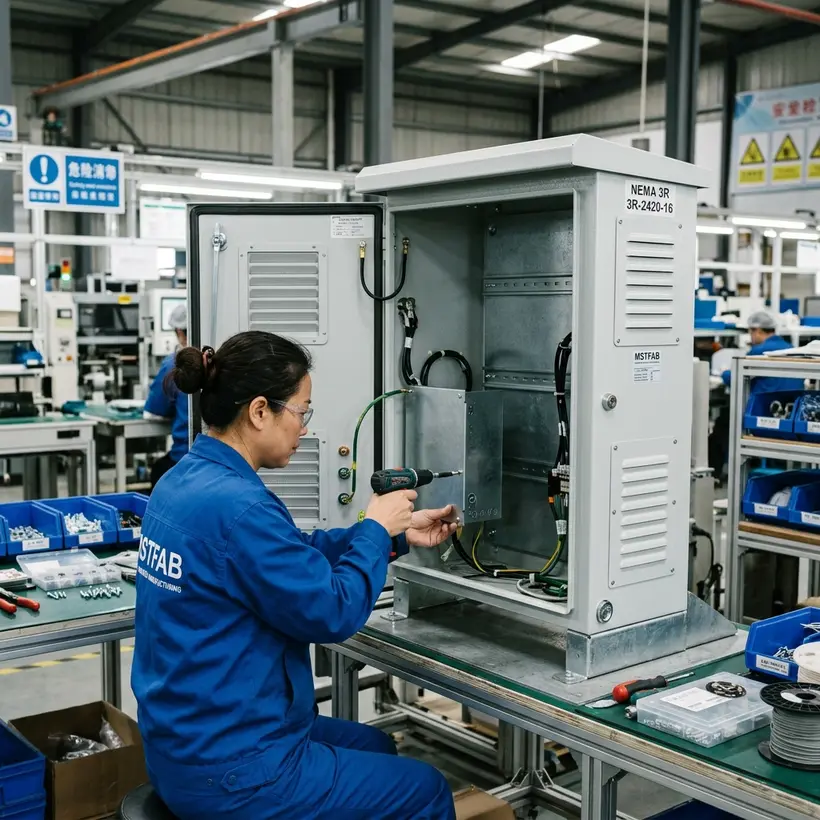
The 3 Mechanical Failure Points in Sealed Sheet Metal Enclosures
Even when an engineer specifies the right standard on the drawing, an enclosure shell will leak if the sheet metal fabrication process fails to control three critical interfaces:
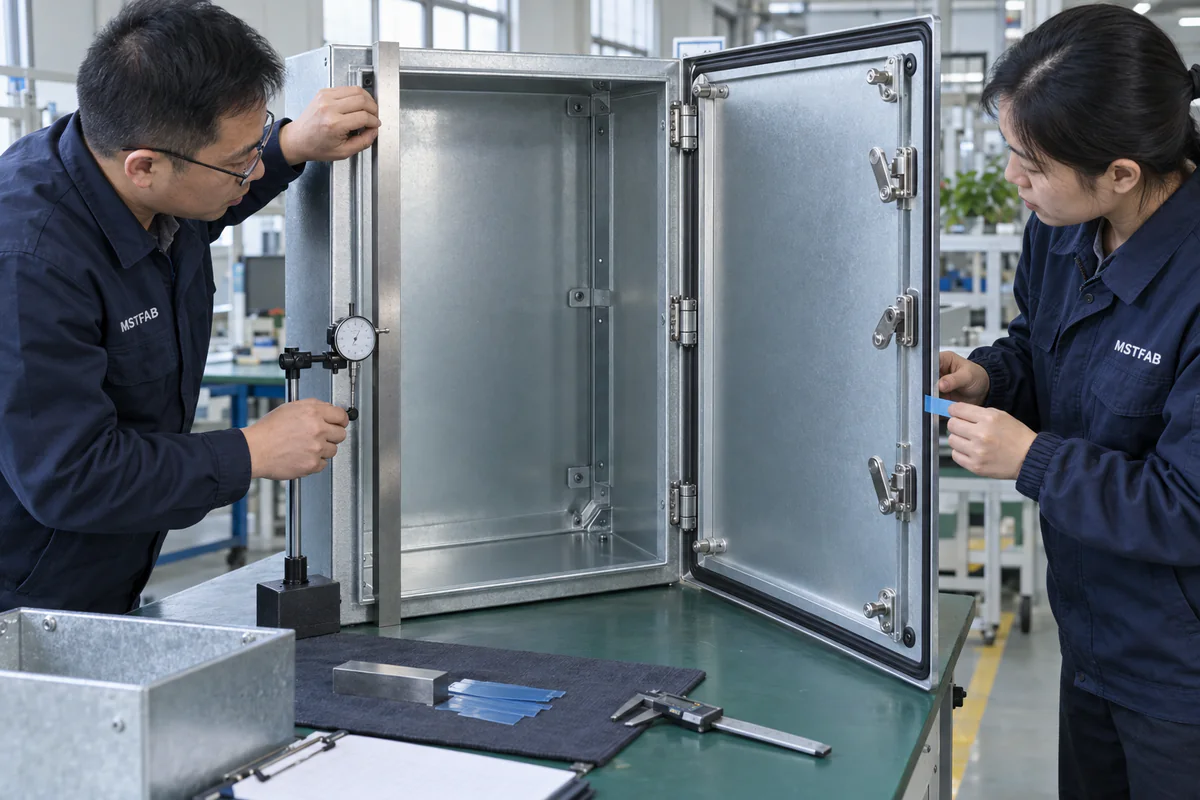
1. Door Frame Flatness, Gasket Compression & Latch Pitch
A foam or elastomeric gasket cannot compensate for a twisted door or bowed cabinet frame. If the fabricator does not control angular springback and bend sequence during CNC press brake bending, or introduces excessive heat distortion during corner welding, the door flange will bow between latch points. When latched, the gasket over-compresses near the lock while leaving a gap along the span.
Engineering control: Specify return-flange stiffeners on wide doors, match latch spacing to door height, and review door-to-frame gap and gasket compression percentage as one integrated assembly.
2. Cable Entry Cutouts & Removable Gland Plates
Many field leaks originate at cable entry points rather than the main door. Drilling or hole-sawing cable openings into a powder-coated steel cabinet on site exposes raw steel edges to rust and often distorts thin bottom panels so cable glands cannot seal flat.
Engineering control: Pre-engineer laser-cut knockouts, connector openings or gasketed removable bottom gland plates during laser cutting and CNC bending so all edges are coated and sealed properly.
3. Thermal Ventilation vs. Water Ingress (Louvers & Baffles)
Power electronics, inverters and battery storage enclosures generate heat, creating a tradeoff between airflow and ingress protection. Cutting simple flat slots into side panels invites wind-driven rain straight onto internal busbars. Where ventilated outdoor designs (such as Type 3R or filtered IP54/IP55 cabinets) are required, drawings should define stamped rain-hood louvers, internal multi-stage water baffles, drain paths and filter-fan mounting cutouts.
OEM DFM Control Matrix: Avoiding Low-Bid Enclosure Pitfalls
| Engineering Factor | Common Low-Bid Job Shop Risk | MSTFAB Drawing-Based DFM Approach |
|---|---|---|
| Rating & Scope Verification | Accepts “IP66 / NEMA 4X” verbally without reviewing flange geometry or clarifying who performs certification testing. | Reviews rain lips, weld seams and gasket seating during DFM, and clearly distinguishes mechanical shell fabrication from third-party certification. |
| Door Frame & Gasket Seating | Applies hand-cut foam strips with butt-joint corner gaps onto un-stiffened doors. | Controls CNC press brake door return flanges and applies buyer-specified gasket systems (FIPG PU foam, EPDM or silicone profiles). |
| Cable Entry & Louvers | Leaves cable holes for field drilling or cuts unbaffled side slots. | Fabricates precision laser-cut gland plates, gasketed access covers and formed louver/baffle assemblies to drawing specs. |
| Material & Corrosion Route | Substitutes indoor cold-rolled steel or mismatched carbon-steel hinges on outdoor cabinets. | Follows specified substrate (SUS304/316L stainless, 5052 aluminum, or galvanized/CRS with outdoor powder coat) and masking callouts. |
What to Include in a NEMA / IP Enclosure RFQ Package
To receive an accurate engineering review and quotation for custom enclosure shells, include these six inputs in your RFQ:
- 1. Target Designation & Standard Edition: State the exact NEMA Type (e.g., Type 3R, Type 12, Type 4, Type 4X) and/or IEC 60529 IP code (e.g., IP54, IP65, IP66), and clarify whether third-party listing/marking is required on the final product.
- 2. Service Environment: Indoor vs. outdoor exposure, coastal salt mist, UV sunlight, washdown pressure/temperature, or chemical exposure.
- 3. Complete Drawing Package (3D STEP + 2D PDF): Overall dimensions, sheet thickness, door return flanges, rain lips, weld seam locations, gland plates, louvers and internal mounting plate datums.
- 4. Gasket & Hardware Specification: Preferred gasket type/material, hinge and compression-latch models (and whether stainless 304/316 hardware is required), plus grounding stud locations.
- 5. Responsibility & Validation Scope: Confirm who supplies and installs gaskets/latches, what factory shop-floor checks are required (see our Quality Control & Inspection Scope), and who arranges formal accredited ingress testing if applicable.
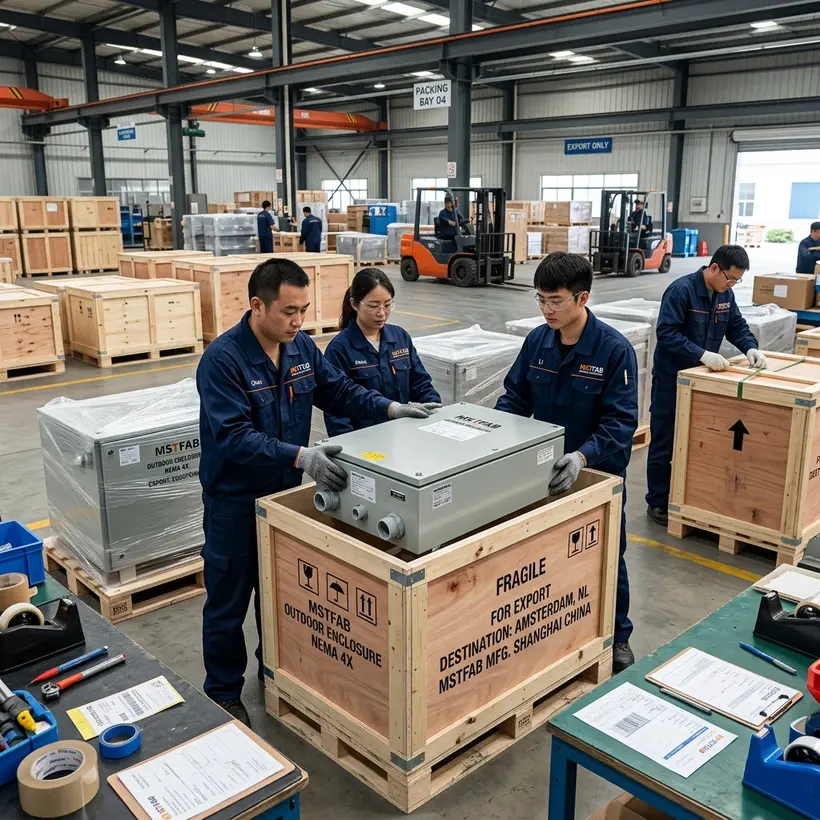
- 6. Commercial & Packaging Scope: Prototype vs. batch quantity, surface treatment (RAL color, texture, film thickness) and export packaging requirements.
Discuss Your Enclosure Rating & Fabrication Requirements
Send your 3D STEP models, 2D PDF drawings, target NEMA/IP specifications and quantity. MSTFAB will review the drawing-based sheet metal fabrication scope, door/gasket geometry and DFM checkpoints.
Frequently Asked Questions on NEMA vs. IP Enclosure Ratings
Can an IP66 enclosure automatically be labeled NEMA 4X?
No. An IEC 60529 IP66 rating only addresses dust-tightness and powerful water jets under specific test conditions. It does not evaluate the corrosion resistance, icing, gasket aging, or construction requirements of UL 50E / NEMA Type 4X. Always specify both ratings if both are required, and never relabel an enclosure using a chart alone (read our detailed IP66 vs. NEMA 4X Equivalence Guide).
What is the difference between NEMA 3R, NEMA 4, and IP65/IP66 for outdoor cabinets?
NEMA 3R is designed for outdoor rain, sleet and external ice protection and often includes baffled ventilation louvers and bottom drainage, meaning it is not dust-tight or watertight against hose jets. NEMA 4 and IP65/IP66 enclosures are sealed against windblown dust and hose-directed or jetting water, requiring continuous perimeter gaskets, sealed cable entries and non-ventilated (or closed-loop cooled) construction.
What gasket material is best for outdoor or NEMA 4X environments?
There is no single gasket material for every temperature, UV and chemical exposure. Closed-cell EPDM, form-in-place polyurethane (FIPG PU) and silicone sponges are commonly specified depending on service temperature and cleaning chemicals. Buyers should specify the required gasket material and compression geometry on the drawing and verify compatibility with the target environment.
Does MSTFAB supply certified electrical equipment or empty sheet metal enclosure shells?
MSTFAB is a drawing-based custom sheet metal fabricator. We manufacture the empty mechanical enclosure shells, mounting plates, doors and specified mechanical hardware to your approved drawings. Internal electrical wiring, electronics integration and completed-equipment UL/IEC certification remain the responsibility of the OEM buyer unless specific testing arrangements are agreed in writing.
Technical Standards & Related MSTFAB Resources
Reference standards include IEC 60529 (Degrees of Protection Provided by Enclosures — IP Code), UL 50E / NEMA 250 (Enclosures for Electrical Equipment, Environmental Considerations), and UL’s Enclosure & Component Certification Overview. Standards citations are provided for engineering reference only and do not constitute a declaration of third-party certification for custom-fabricated parts.
 WeChat Contact
 WhatsApp Me Directly