
AUTOMOTIVE PLANT OT/IT RACK DFM — EXECUTIVE TECHNICAL BRIEF
Deploying industrial Ethernet switches, PLC gateways, and edge servers along body-in-white welding lines, stamping bays, and paint shops exposes commercial IT racks to weld spatter, conductive dust, oil mist, and press vibration that trigger costly line stoppages. Two fabrication defects repeatedly undermine plant rack rollouts: cumulative 1U hole-pitch drift along 42U 19-inch rails that binds switch slide rails, and light corner spot welds that fatigue under heavy floor shock. Although plant network racks are capital factory equipment rather than vehicle production parts, Tier-1 automotive OEM buyers select IATF 16949:2016 certified fabricators like MSTFAB for disciplined PFMEA, Control Plans, Cpk ≥ 1.33 SPC, and strict coil lot traceability across volume plant builds without schedule delays.
- IATF 16949 Quality Governance Scope: Apply IATF 16949:2016 tools—PFMEA, Control Plans, MSA Gauge R&R, and SPC (Cpk ≥ 1.33)—to capital-equipment network rack shells, delivering automotive-grade batch repeatability and root-cause traceability while distinguishing facility racks from vehicle production PPAP.
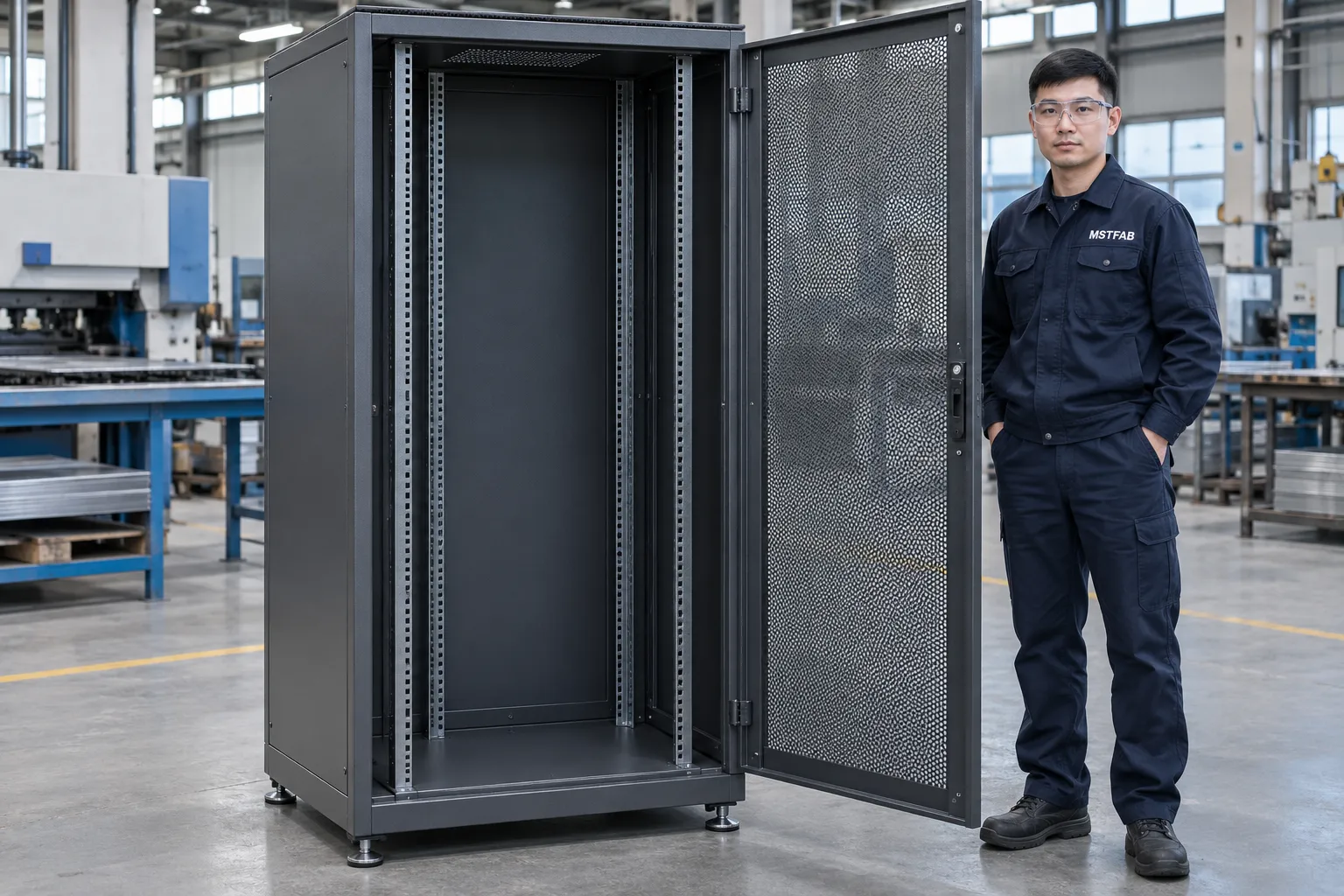
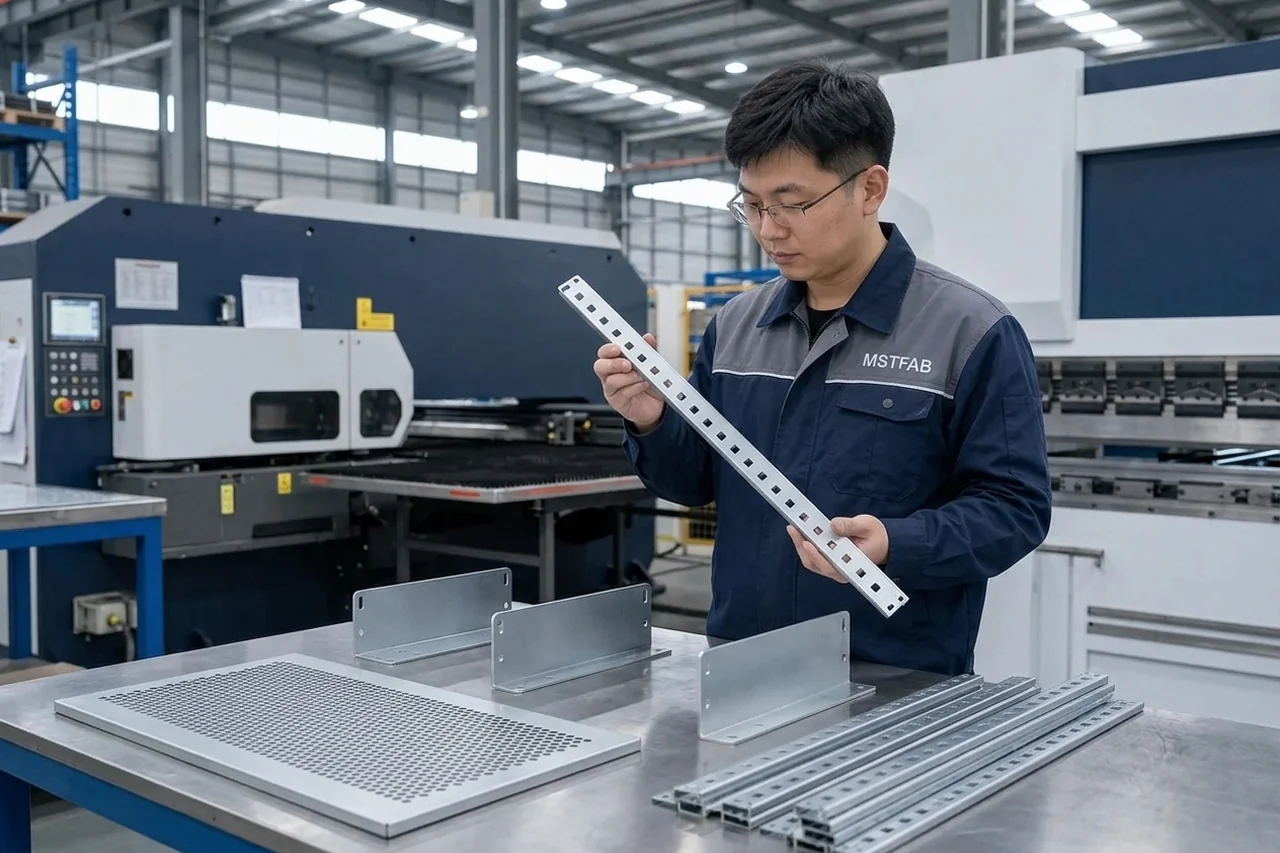
- Non-Cumulative EIA-310-E 19-Inch Rail Pitch: Punch 9.5 mm × 9.5 mm square cage-nut apertures in 2.0 mm SGCC rails at 44.45 mm (1U) pitch holding ±0.10 mm non-cumulative tolerance across 42U (1,866.9 mm) and 450.85 mm center-to-center rail span so heavy switches install without binding.
- Dynamic Vibration & Structural Rigidity: Build 2.0 mm SPCC closed-profile 9-fold tubular frames with gusseted M10 anti-vibration isolator bases rated for 1,000 kg static load and stamping-press floor shock, limiting lateral sway to ≤1.5 mm across 5 Hz–55 Hz operating bands.
- IP54 Weld-Spatter & Mist Filtration: Seal perimeter doors with 2K polyurethane FIPFG gaskets (<0.05 Ω masked ground continuity across rails and busbars) and CNC-punched louvered G4/M5 fan-filter cutouts (or closed-loop heat-exchanger ports) resistant to conductive shop-floor metallic dust.
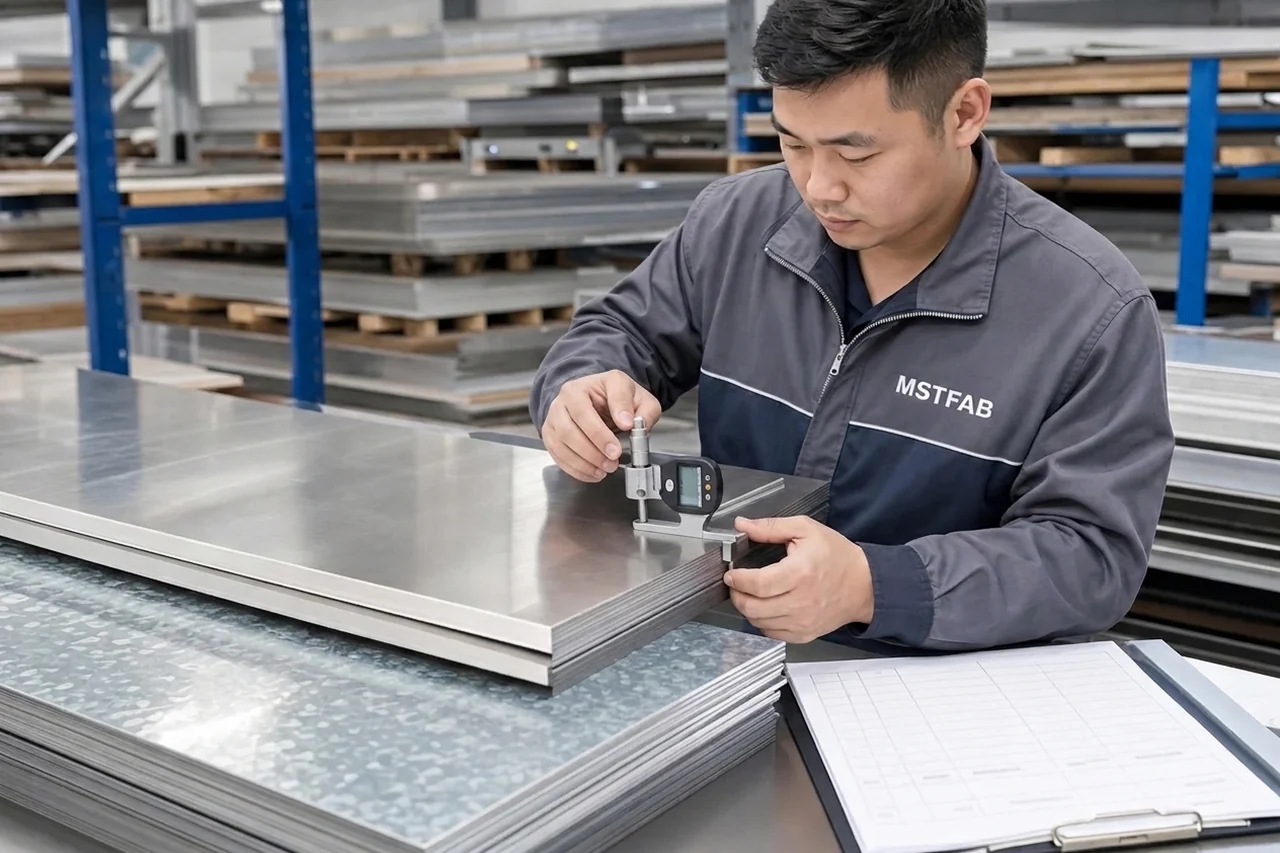
Every project at MSTFAB includes a complimentary 24-hour CAD Design-for-Manufacturing (DFM) audit, heat-number-traceable EN 10204 3.1 mill certificates, and a ballooned First Article Inspection (FAI) report prior to volume release.
01 / Engineering Specifications & Comparison Matrix
Automotive Plant Network Rack Structural & IATF 16949 Control Matrix
Commercial data-center cabinets fail quickly when installed on an automotive assembly floor. Near robotic spot-welding cells and 1,200-ton stamping presses, airborne iron fines enter open perforated doors, coating switch boards in conductive grime while constant floor vibration loosens cage nuts and fatigues spot-welded corner uprights. At the same time, plant controls teams demand strict interchangeability across dozens of 24U to 42U IDF and MDF bays so maintenance crews can swap pre-wired switch sleds within minutes during scheduled line stops without reaming holes, forcing latches, or risking costly field rework across global plants. Meanwhile, Tier-1 corporate quality audits require statistical rail pitch control, impact-resistant finish checks, grounding continuity logs, and steel coil traceability across every production batch. The matrix below links structural frame tolerances, EIA-310-E rail controls, and IATF inspection gates directly to zero-downtime plant deployment.
Each parameter below is verified during incoming raw material quarantine, in-process CNC stage checks, and final First Article Inspection (FAI) before shipment release:
| Engineering Parameter / Zone | Material & Process Specification | Target Tolerance / Performance Standard | Inspection Method & OEM Value |
|---|---|---|---|
| 9-Fold Welded Structural Uprights | 2.0 mm SPCC (JIS G 3141) roll-formed or CNC press-brake bent 9-fold closed tubular corner profiles MIG or laser-welded to 2.5 mm bottom and top frames. | ≤1.5 mm diagonal delta across 2,000 mm cabinet height; ±0.4° frame squareness; 1,000 kg static load rating. | Optical CMM or laser-tracker frame squareness audit paired with calibrated hydraulic static-load deflection and dynamic shake testing on the first-article enclosure: Eliminates cabinet racking during overhead crane lifting and prevents fatigue cracking under continuous body-shop welding cell and stamping-press floor vibration. |
| EIA-310-E 19-Inch Mounting Rails | 2.0 mm SGCC (unpainted clear trivalent chromate passivation) C-channel mounting rails featuring 9.5 mm × 9.5 mm square apertures and laser-etched U markings. | ±0.10 mm non-cumulative 1U (44.45 mm) pitch over 42U; 450.85 mm ±0.25 mm mounting center span; SPC Cpk ≥ 1.33. | Optical CMM pitch-accumulation scan with SPC data logging per production lot plus calibrated 42U full-height Go/No-Go rack-mount master fixture verification: Guarantees drop-in mechanical fitment for heavy industrial PoE switches, 4U UPS chassis, and telescopic slide rails across multi-plant global automotive rollouts. |
| IP54 Door Seal & Weld-Spatter Protection | 1.5 mm to 2.0 mm SPCC front and rear doors with 20 mm double-return lips, 2K PU FIPFG gasket, and flush 3-point swing-handle compression locks. | 30%–35% uniform gasket compression; ±0.30 mm/m door flatness; optional 4 mm tempered safety glass or polycarbonate viewing window. | Full-perimeter chalk-transfer compression contact check, dark-room weld-spatter and dust ingress light-seal audit, and swing-handle torque repeatability verification: Blocks conductive metal grinding dust, machining coolant mist, and airborne weld spatter from contaminating sensitive fiber-optic transceivers and industrial switch fans. |
| Filtered Airflow & Heat-Exchanger Cutouts | Downward-angled 45° CNC hood louvers backed by IP54 G4/M5 pleated filter retainers, or gasketed side and door cutouts for closed-loop air-to-air heat exchangers. | ±0.15 mm fan-mount bolt pattern; ≥65% free louver open area without direct horizontal weld-splash line-of-sight. | Digital caliper bolt-pattern verification, snap-in filter-cassette retention checking, and airflow pressure-drop validation performed on prototype louver test coupons: Prevents thermal throttling of managed Ethernet switches in 45°C paint-shop and body-shop mezzanines while maintaining positive-pressure shop-floor dust exclusion. |
| Impact Coating & Grounding Busbar Grid | RAL 7035 or RAL 7016 textured epoxy-polyester powder coat (70–90 µm DFT) plus masked copper earthing bar bosses and 6 mm² braided bonding straps. | 70–90 µm DFT; ≥80 kg·cm Gardner impact resistance (ASTM D2794); <0.05 Ω rail-to-frame-to-door DC resistance. | Five-point eddy-current DFT gauge audit per face, ASTM D2794 impact coupon test per coating batch, and 4-wire Kelvin milliohmmeter continuity check: Withstands forklift-aisle knocks without coating chipping and bonds every 19-inch rail directly to plant ground to protect OT Ethernet links from EMI. |
| Anti-Vibration Plinth & Isolator Base | 3.0 mm SPCC heavy-duty 100 mm or 200 mm bolted plinth featuring internal cable-sweep openings, rodent brushes, and M10 elastomer vibration-isolator pads. | ±0.30 mm floor-anchor bolt centers; flatness ≤0.5 mm across all four isolator mounting pads on base corner plates. | Calibrated torque-checked isolator assembly verification and four-corner coplanarity flatness measurement performed on a leveled granite inspection surface plate: Damps 5 Hz–55 Hz structural floor vibration from heavy stamping lines and shields armored fiber and power cables entering from sub-floor trenches. |
02 / Sheet Metal DFM & Structural Controls
Top 3 Automotive Plant Network Rack Failure Modes & Engineering Fixes
Plant-floor IT and OT rack deployments fail primarily when fabricators treat 42U industrial enclosures like light-duty commercial office server cabinets. Controlling cumulative turret-punch pitch error, welded corner frame torsion, and louver weld-spatter ingress paths during upfront DFM review eliminates costly field retrofits, schedule slips, and unplanned automotive assembly line stoppages.
Cumulative 1U Hole-Pitch Drift Binding Heavy 19-Inch Switch Rails Across 42U
Failure Mechanism: Punching 126 square apertures sequentially along a 1,900 mm mounting rail without pitch compensation accumulates ±0.03 mm step error per U. By 42U, hole centers drift 3.5 mm off target, forcing plant technicians to drill out factory rail slots on the line.
Engineering Solution: Cut 2.0 mm SGCC rails on an absolute-datum CNC fiber laser or servo turret referenced to a single 1U origin rather than incremental stepping, and inspect every production lot with a 42U full-span Go/No-Go gauge tracked under SPC (Cpk ≥ 1.33).
Verified Outcome: Holds non-cumulative 42U pitch within ±0.10 mm, enabling effortless cage-nut and slide-rail installation across every U position.
Spot-Welded Corner Frame Fatigue Cracking Under Heavy Stamping Press and Floor Vibration
Failure Mechanism: Relying solely on light sheet-metal resistance spot welds at top and bottom frame corners causes weld-nugget cracking, frame racking, and door sagging after months of continuous 10 Hz to 40 Hz floor shock near body-shop welding robots and heavy stamping presses.
Engineering Solution: Form structural uprights as 2.0 mm SPCC 9-fold closed tubular profiles joined to 2.5 mm gusseted corner brackets via continuous robotic MIG/TIG perimeter welds and M10 grade-8.8 lock-nut tie bolts mounted onto a rigid 3.0 mm vibration-damped steel floor plinth.
Verified Outcome: Supports 1,000 kg static load cleanly and eliminates door-latch misalignment under continuous automotive plant floor vibration.
Conductive Metallic Shop Dust Bypassing Flat Laser-Cut Door Cooling Louver Slots
Failure Mechanism: Flat punched ventilation slots on commercial rack doors permit glowing weld spatter and conductive grinding fines to shoot straight into PoE switch intakes, coating circuit boards in metallic grime and shorting backplanes whenever internal cabinet cooling fans pull ambient shop air.
Engineering Solution: Replace flat ventilation slots with downward-angled 45° CNC hood louvers backed by an internal gasketed IP54 G4/M5 pleated filter cassette frame, or engineer sealed door and side panel cutouts for bolt-on closed-loop air-to-air enclosure heat exchangers with continuous perimeter gaskets.
Verified Outcome: Blocks direct weld-spatter trajectory and maintains clean, positive-pressure internal cooling under harsh body-in-white shop conditions.
Manufacturing Scope Boundary: IATF 16949 Scope Boundary: Capital Plant Racks vs. Vehicle Production Parts: Automotive OEM procurement teams frequently insert blanket 'full vehicle PPAP Level 3' clauses into RFQs for factory-floor network racks, inadvertently treating capital plant IT, PLC, and OT infrastructure cabinets like serial automotive chassis, interior trim, powertrain components, or automated assembly tooling. — Engineering Fix: MSTFAB holds IATF 16949:2016, ISO 9001:2015, and ISO 14001:2015 certifications. While plant network racks are capital facility shells outside vehicle-part PPAP scope, we apply our IATF 16949 shop-floor discipline—PFMEA, Control Plans, MSA, Cpk ≥ 1.33 SPC on 19-inch rail pitch, and EN 10204 3.1 traceability—without unnecessary vehicle-homologation overhead. MSTFAB manufactures custom sheet metal parts and empty mechanical enclosure shells strictly to your 3D STEP and 2D PDF drawings.
03 / Representative Engineering Scenario & Process Control
Representative OEM Project: 42U Body-Shop Plant Network & Edge Rack
Project Profile: Batch: 120 racks/program | Alloy: 2.0 mm SPCC 9-fold frame + 2.0 mm SGCC 19-inch rails + 3.0 mm plinth | Finish: RAL 7035 textured powder coat (80 µm DFT)
OEM Engineering Challenge: A Tier-1 automotive powertrain and body-in-white systems integrator experienced recurring OT switch failures across three assembly plants caused by conductive welding dust ingress and a 2.8 mm cumulative 19-inch rail pitch drift that blocked rapid hot-swap of 4U industrial UPS units. In addition, their global corporate quality group mandated IATF-aligned process documentation, statistical rail pitch capability data, and full coil-to-rack lot traceability before approving any replacement enclosure vendor for the rollout.
MSTFAB Manufacturing Solution: MSTFAB engineered a 9-fold 2.0 mm SPCC welded tubular frame seated on a 3.0 mm vibration-damped M10 plinth, paired with unpainted 2.0 mm SGCC 19-inch rails laser-cut from absolute datum coordinates to preserve EIA-310-E pitch across all 42U. Front and rear doors incorporated 20 mm double-return flanges, 2K PU FIPFG gaskets, masked copper ground-bar bosses, and downward IP54 G4/M5 fan-filter hoods. Volume production ran under a formal Control Plan with automated optical SPC pitch tracking and lot-linked steel material certificates.
- 1.64 Cpk Rail Pitch: Maintained ±0.09 mm non-cumulative 1U pitch across all 42U on 120 production racks, eliminating switch slide-rail binding during rapid automotive plant floor commissioning across all bays.
- 1,000 kg Load Pass: Validated zero permanent frame deformation under 1,000 kg static load testing and continuous 5 Hz–55 Hz vibration-table screening on prototype validation network cabinets prior to release.
- 0.032 Ω Earthing: Verified <0.05 Ω bonding continuity across unpainted SGCC rails, vertical copper busbar mounts, and 6 mm² braided door ground straps on 100% of shipped network racks.
- 100% Traceable Lots: Delivered full PFMEA, Control Plan, FAI CMM dimensional reports, and EN 10204 3.1 steel certificates passing Tier-1 automotive supplier quality audits smoothly across multi-plant deployments.
Every production lot is archived with locked CNC laser nests, press-brake bend programs, weld fixture setups, and signed golden samples to guarantee identical repeatability across multi-year reorders.
04 / Quality Verification, Traceability & Surface Finishing
4-Stage Manufacturing Workflow, Surface Treatment & Metrology Control
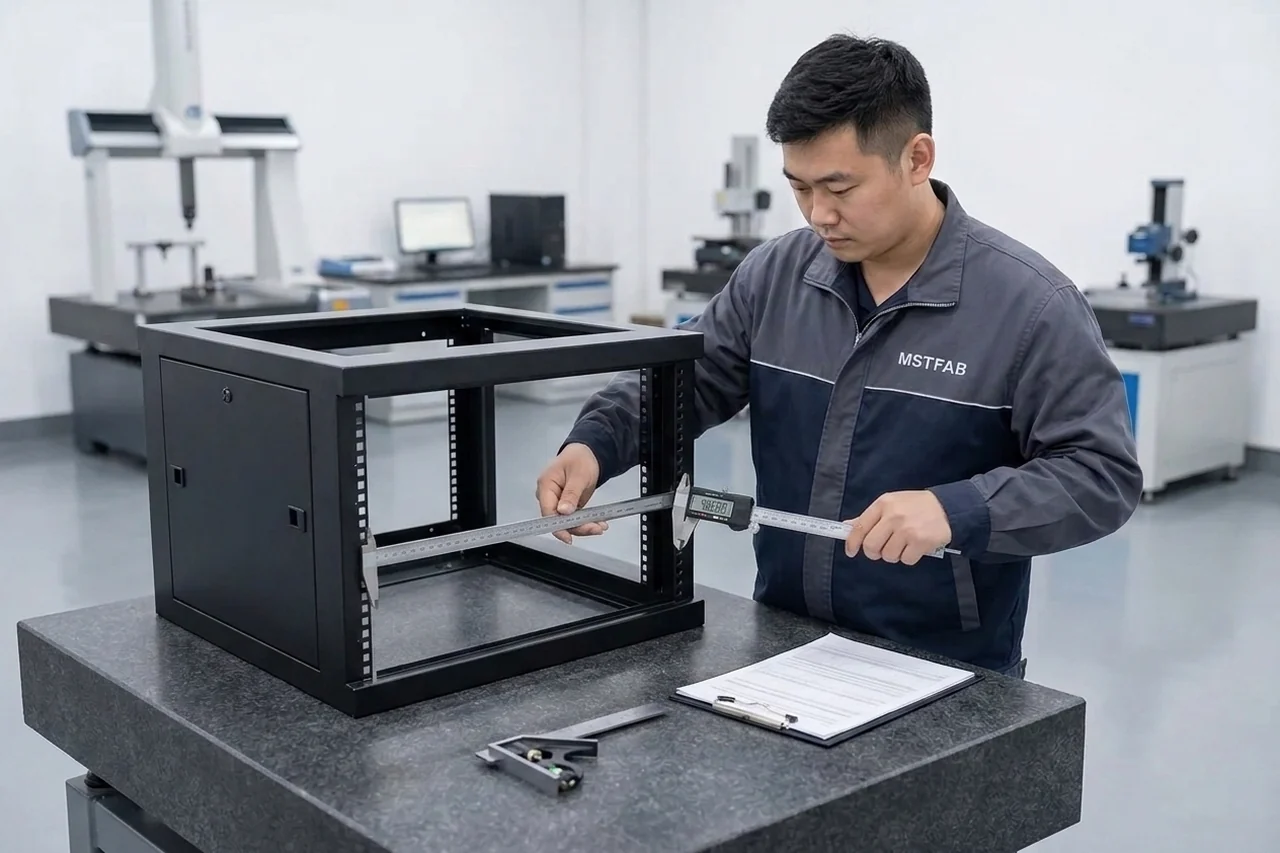
To maintain Cpk ≥ 1.33 on critical-to-quality (CTQ) dimensions from prototype through series production, MSTFAB executes a closed-loop four-stage fabrication protocol:
Step 01 — EIA-310-E Pitch, Load & PFMEA DFM Review: Inspect customer 3D STEP rack models for 450.85 mm rail-center tolerances, 44.45 mm non-cumulative U-pitch datums, 1,000 kg frame gusset load paths, and heat-exchanger or fan-filter clearances while drafting a dedicated manufacturing PFMEA and Control Plan. Any unsupported wide panel spans or hinge loads are reinforced prior to laser nesting.
Step 02 — Absolute-Datum Laser Blanking & 9-Fold Forming: Cut 2.0 mm SGCC 19-inch rails from a single absolute origin to eliminate incremental pitch drift, form 9-fold 2.0 mm SPCC tubular uprights on synchronized CNC press brakes, and clamp corner joints in rigid fixtures for continuous robotic MIG/TIG structural welding with controlled heat input.
Step 03 — Impact-Grade Powder Coat, Masking & FIPFG Sealing: Mask copper ground-bar bosses, lock-cam seats, and rail contact pads with high-temp Kapton and silicone caps, run zinc-phosphate pretreatment and cure 70–90 µm RAL 7035 or RAL 7016 textured powder coat, then robotically dispense continuous 2K polyurethane FIPFG seals with consistent bead geometry along door and roof perimeters prior to bake.
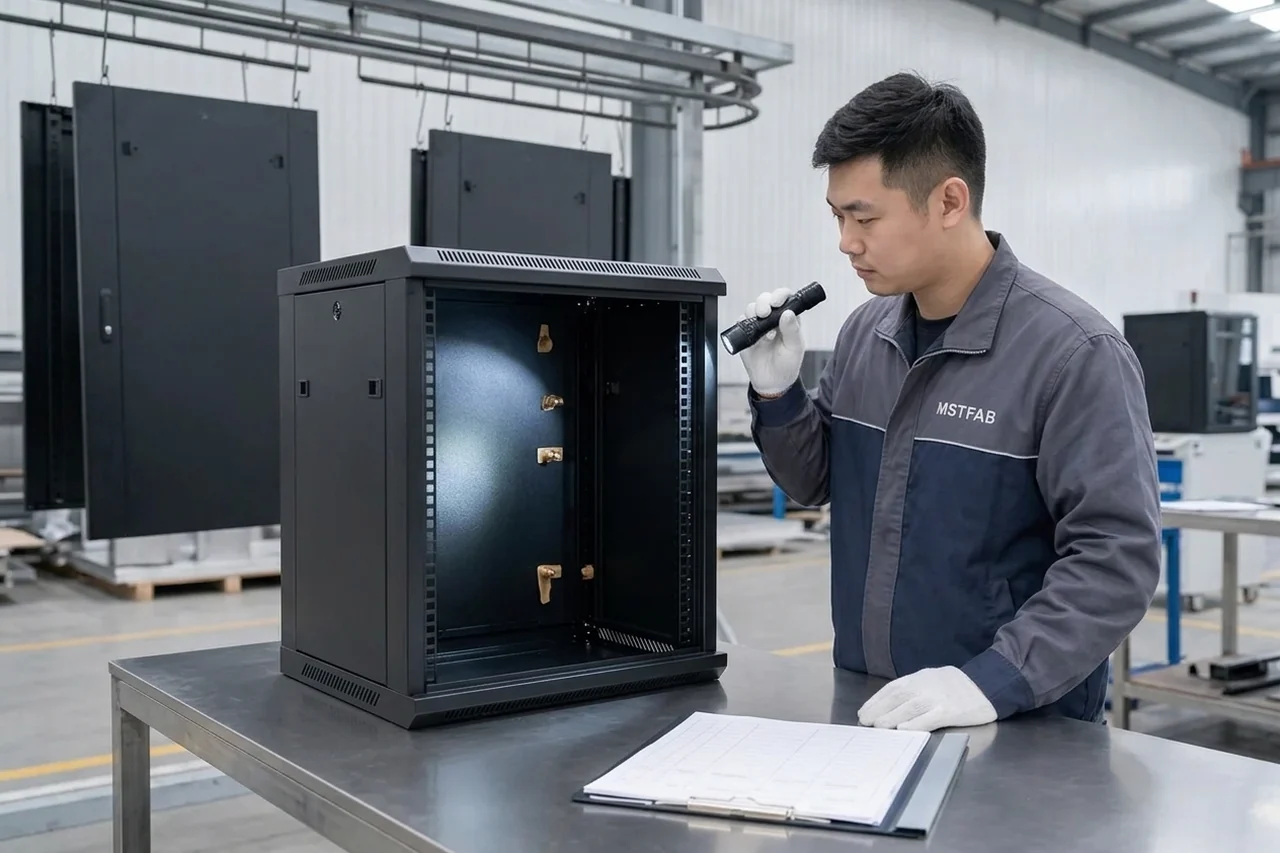
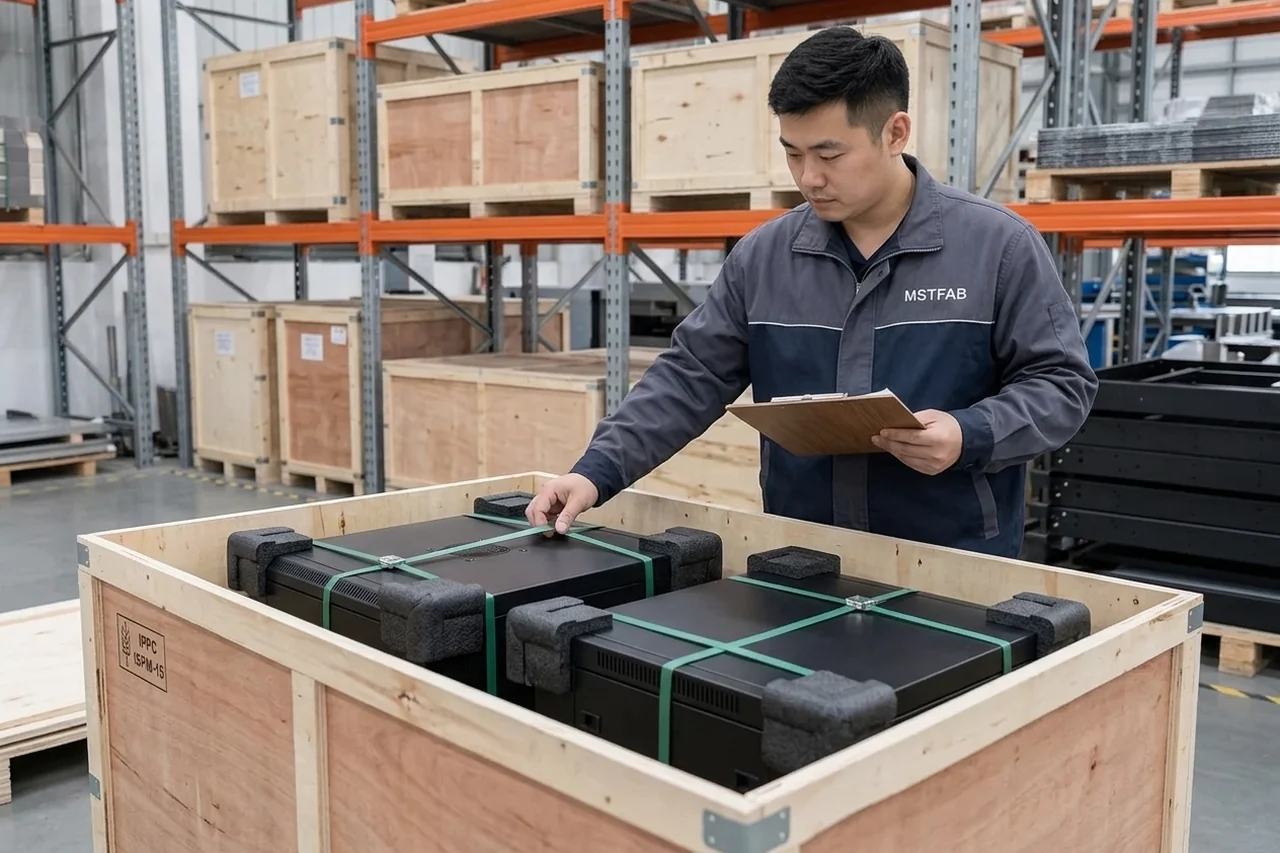
Step 04 — SPC Rail Audit, Grounding Check & Export Palletizing: Run statistical SPC pitch checks using calibrated optical CMM and 42U Go/No-Go rail master gauges, verify <0.05 Ω grounding continuity and IP54 louver/filter cassette retention, and pack either fully welded frames or modular bolted kits onto reinforced ISPM-15 shock-absorbing export pallets for safe global plant delivery.
All raw sheets (SPCC, SGCC, SECC, SUS304/316L, Al 5052-H32/6061-T6) are verified via optical emission spectrometry (OES) or XRF upon arrival and linked by barcode to your purchase order.
Prior to export crating in ISPM-15 fumigated plywood boxes, our quality lab conducts ballooned dimensional FAI checks, dry-film thickness (DFT) mapping, ASTM D3359 cross-hatch adhesion testing, and ground-continuity verification.
05 / 8-Point OEM RFQ Checklist & Topic Cluster Hub
OEM Engineering RFQ Checklist & Connected Fabrication Hubs
Include these eight drawing and specification controls in your RFQ package so our engineering team can lock down tooling, material traceability, and inspection fixtures on day one:
- RFQ Requirement 01Native 3D STEP assembly and 2D PDF drawings specifying EIA-310-E / IEC 60297 19-inch rail center span (450.85 mm) and non-cumulative ±0.10 mm 1U pitch tolerances across full height.
- RFQ Requirement 02Structural static and dynamic load rating (e.g., 800–1,000 kg), upright profile gauge (2.0 mm SPCC 9-fold tubular), and 3.0 mm anti-vibration plinth or floor-anchor interface dimensions.
- RFQ Requirement 03Ingress protection target (IP54 or NEMA 12) detailing 2K PU FIPFG door seals, downward 45° weld-spatter hood louvers, and G4/M5 filter cassettes or heat-exchanger cutouts.
- RFQ Requirement 04Internal 19-inch rail finish specification (unpainted SGCC clear trivalent chromate for <0.05 Ω grounding) plus laser-etched or permanent silk-screened U-height numbering callouts from 1U to 42U.
- RFQ Requirement 05Outer shell powder-coat RAL color (RAL 7035 or RAL 7016), texture grade, target cured DFT range (70–90 µm), and ASTM D2794 impact and cross-hatch adhesion resistance requirements.
- RFQ Requirement 06Equipotential grounding BOM specifying vertical copper busbar mounting bosses, M6/M8 masked earth studs, serrated star washers, and 6 mm² braided door-to-frame bonding straps across every panel.
- RFQ Requirement 07Quality documentation scope clearly stating IATF-modeled deliverables (Control Plan, PFMEA, SPC Cpk ≥ 1.33 rail pitch report, optical CMM FAI, and EN 10204 3.1 steel mill certificates) prior to shipment release.
- RFQ Requirement 08Shipping format preference (fully welded upright frame on shock-absorbing ISPM-15 pallet versus modular bolted knock-down frame kit) and quarterly multi-plant rollout delivery schedule with target dock dates.
Explore Connected Sheet Metal Fabrication Services & Enclosure Hubs
06 / OEM Buyer & Engineer FAQ
Engineering FAQ: Automotive Plant Network Racks & IATF 16949 Scope
Does a factory-floor network rack technically fall under IATF 16949:2016 certification?
Strictly speaking, IATF 16949:2016 governs serial production and service parts installed on vehicles, whereas plant-floor IT and OT network cabinets are capital manufacturing infrastructure governed by ISO 9001:2015 and EIA-310-E / IP54 specifications. However, automotive OEMs and Tier-1 integrators strongly favor IATF 16949:2016 certified fabricators like MSTFAB because our shop floor natively executes PFMEA, Control Plans, MSA gauge studies, SPC Cpk tracking, and coil-to-part lot traceability—eliminating the dimensional drift and quality escapes common at general commercial sheet metal shops.
How does MSTFAB prevent cumulative 1U hole-pitch error across 42U 19-inch mounting rails?
Cumulative pitch drift occurs when turret punches step incrementally from hole to hole without re-referencing a master origin. We cut 2.0 mm SGCC 19-inch rails on absolute-coordinate CNC fiber lasers or servo turrets referenced to a single 1U datum, holding every 44.45 mm U-step within ±0.10 mm non-cumulative tolerance from 1U through 42U (1,866.9 mm total span). Every production batch undergoes full-height 42U Go/No-Go rail-gauge verification and optical CMM SPC logging (Cpk ≥ 1.33) before rail installation.
Why use unpainted SGCC 19-inch rails instead of powder-coated SPCC rails inside automotive network racks?
Industrial Ethernet switches, PoE injectors, and PLC chassis depend on direct metallic contact through 19-inch mounting ears and cage nuts for protective grounding and high-frequency EMI drainage. Powder-coated rails act as dielectric insulators, forcing installers to grind paint or rely on star washers that loosen under press-line vibration. Unpainted SGCC hot-dip galvanized steel with RoHS clear trivalent passivation provides reliable corrosion resistance while maintaining <0.05 Ω ground continuity directly into the cabinet's vertical copper busbar grid.
Can IP54 filtered plant network racks handle hot automotive paint shops and stamping lines?
Filtered forced-air designs using downward-angled 45° louvers and G4/M5 pleated filter cassettes perform reliably up to roughly 38°C ambient in general assembly and stamping bays, provided positive internal fan pressure blocks dust entry cleanly. In hotter 45°C+ roof-truss mezzanines or heavy paint-mist corridors where ambient shop air cannot enter the cabinet, MSTFAB fabricates fully sealed NEMA 12 / IP55 door and side cutouts engineered for bolt-on closed-loop air-to-air heat exchangers or thermoelectric enclosure coolers fitted with continuous perimeter gaskets preventing dust or mist ingress.
Should automotive plant racks be shipped fully welded or flat-packed?
For heavy 1,000 kg-rated welded 9-fold structural racks headed straight into OEM panel-builder integration, shipping fully assembled on reinforced ISPM-15 pallets guarantees factory-verified frame squareness (≤1.5 mm diagonal delta) and undisturbed FIPFG door seals. When ocean freight container density is the priority for multi-plant global rollouts, MSTFAB also manufactures precision bolted 9-fold modular frame kits with alignment dowel pins and pre-gasketed doors that assemble cleanly on-site in under 25 minutes using standard shop torque tools and fasteners.
International Standards & Engineering References
- ISO 2768-1 / 2768-2 — General Linear, Angular and Geometrical Tolerances for Sheet Metal Fabrication
- IEC 60529 / NEMA 250 — Degrees of Protection Provided by Enclosures (IP Code & Environmental Sealing)
- ISO 9001:2015 & IATF 16949:2016 — Quality Management Systems & Production Part Approval Process (PPAP)
Ready to Quote Your Custom Sheet Metal Enclosure or Fabrication Project?
Upload your 3D STEP models and 2D PDF drawings. MSTFAB will review your tolerances, material specs, and DFM details to deliver a transparent factory quote within 24 hours.
Request Your 24-Hour DFM & Custom Quote →
Direct engineering desk: caroline@mstfab.com | ISO 9001 & IATF 16949 Certified Factory in Guangzhou, China
 WeChat Contact
 WhatsApp Me Directly