
Written by: Frank, Sheet Metal Manufacturing Specialist
Technical Review: David Chen, Senior Quality Engineer
Last Reviewed: August 2026
Manufacturing Scope: Custom empty sheet metal distribution box shells only. No breakers, no wiring, no finished electrical distribution boards.
If you need a RoHS galvanized steel distribution box manufacturer for electrical equipment sold into Europe, here is the simple version:
Do not buy a “RoHS box.”
Buy a well-controlled metal enclosure with RoHS evidence for the materials and finishes that are actually inside the supplier’s scope.
That sounds less exciting. It is also how you avoid getting a nice-looking gray box that creates three problems the moment your electrical assembly team opens the carton.
RoHS currently restricts ten hazardous substances in electrical and electronic equipment, with concentration limits applied at the homogeneous-material level. But RoHS is not a magic sticker for a metal cabinet, and not every industrial installation automatically falls inside the Directive’s scope. Certain large-scale stationary industrial tools and large-scale fixed installations are among the exclusions defined in the legislation.
For MSTFAB, the responsibility is straightforward: We make the metal shell.
That can include the galvanized steel body, doors, mounting plates, gland plates, brackets, welded studs, PEM hardware, grounding points, cutouts, powder coating, dimensional inspection and export packaging.
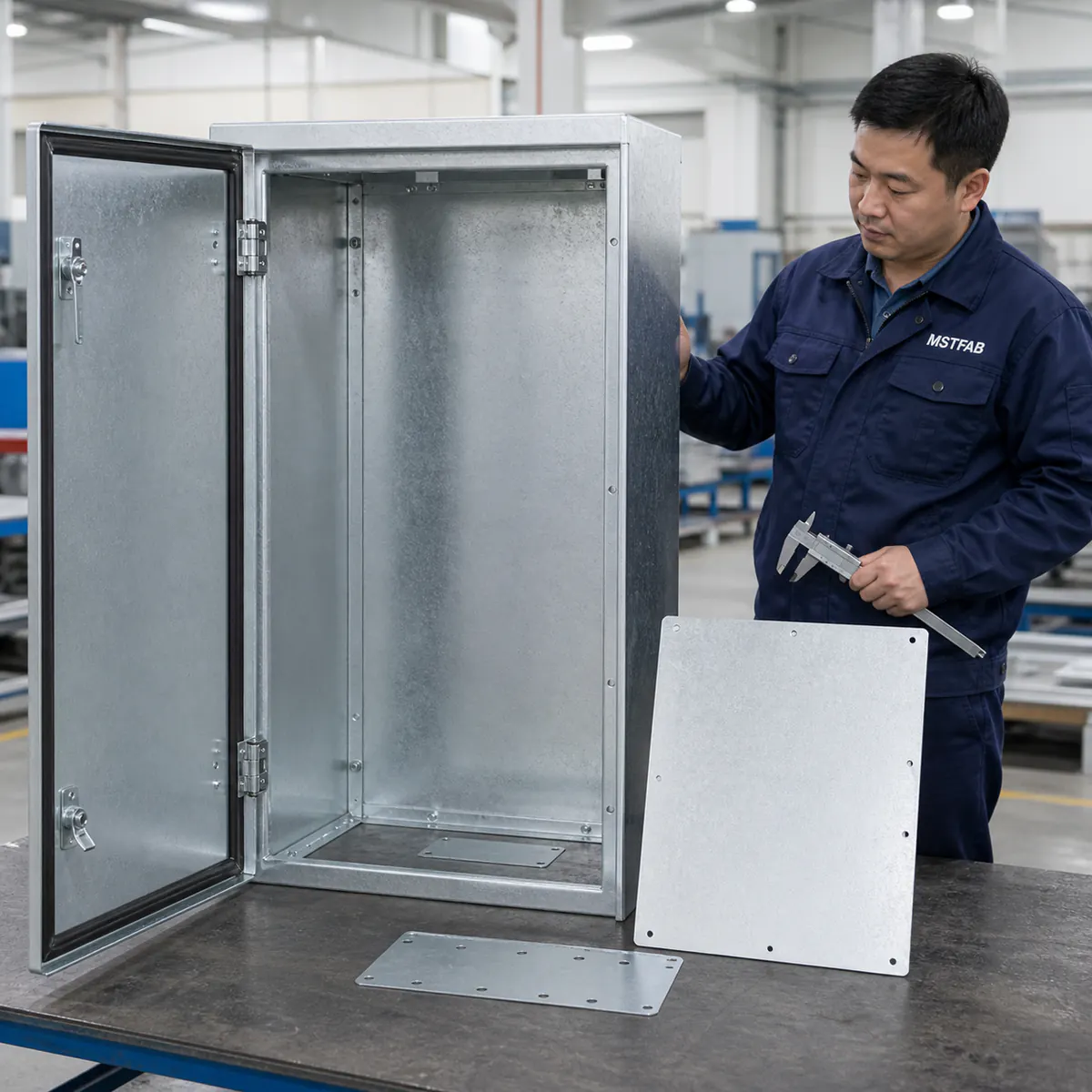
We do not supply the completed electrical distribution system.
- No breakers.
- No busbar system.
- No live wiring.
- No protection devices.
- No mysterious electricity hiding inside the shipping crate.
Your electrical team builds the electrical product. MSTFAB builds the metal housing that should make their job easier, not more interesting.
First Question: Is the Finished Equipment Actually in RoHS Scope?
Before asking a metal factory for seventeen certificates, confirm that the finished product is actually covered by EU RoHS.
The European Commission says RoHS applies broadly to electrical and electronic equipment unless specifically excluded. The Directive also contains exclusions including certain large-scale stationary industrial tools and large-scale fixed installations.
That means these two statements are both bad:
- “Everything electrical in Europe needs exactly the same RoHS paperwork.”
- “Industrial equipment is automatically exempt.”
Neither is a safe assumption. The responsible electrical-equipment manufacturer or compliance team should determine the actual scope. Then tell the sheet metal supplier what evidence you need. Otherwise procurement can spend a week chasing a document nobody actually needed. That is technically still work. Just not very productive work.
For more details on EU scope and DIN rail components, see our guide on RoHS DIN Rail Enclosure requirements.
RoHS Does Not Mean the Empty Box Is a Finished Electrical Product
This distinction matters for MSTFAB. A fabricated galvanized distribution box shell is normally a passive mechanical structure.
Later, the electrical panel builder may install: breakers, terminal blocks, wiring, busbars, contactors, meters, DIN rails, power supplies and other electrical components.
MSTFAB does not control those components. So our practical job is: control the material and fabrication scope we actually supply.
The manufacturer responsible for covered finished EEE handles the overall conformity assessment, technical documentation and applicable EU declaration for that finished product. Your metal supplier should support that process. It should not pretend to replace it. A sheet metal factory issuing a grand declaration for electrical components it has never seen would be very confident. Possibly too confident.
This Article Is Not Another RoHS Certificate Guide
MSTFAB already has a dedicated article called RoHS Technical Documentation for Galvanized Distribution Box Shells in Automation Equipment.
That article goes deep into: homogeneous materials, restricted substances, zinc/passivation, powder coating, PEM hardware, EN IEC 63000-style technical evidence, BOM control and supplier change control. So we are not going to repeat all of that here.
This article answers a much more physical question: Once your RoHS requirements are known, how do you make sure the actual galvanized distribution-box shell works when the electrical assembly starts?
Because a compliant material declaration does not fix a mounting plate that is 4 mm out of position.
The Metal Box Has to Fit Before Anybody Cares About the Certificate
MSTFAB’s distribution-board enclosure fabrication page already makes the real manufacturing problem clear: buyers need doors, mounting plates, cable entries, grounding studs and enclosure geometry to work before expensive electrical assembly begins.
A typical distribution enclosure looks simple. Metal box. Door. Plate. Some holes. Done.
Until the buyer discovers:
- the mounting plate cannot be removed,
- the cable gland holes are too close together,
- the door hits a breaker handle,
- the ground stud disappeared under powder coating,
- or the second batch uses a different plated fastener.
Then the humble metal box becomes the star of several meetings. Usually not in a good way.

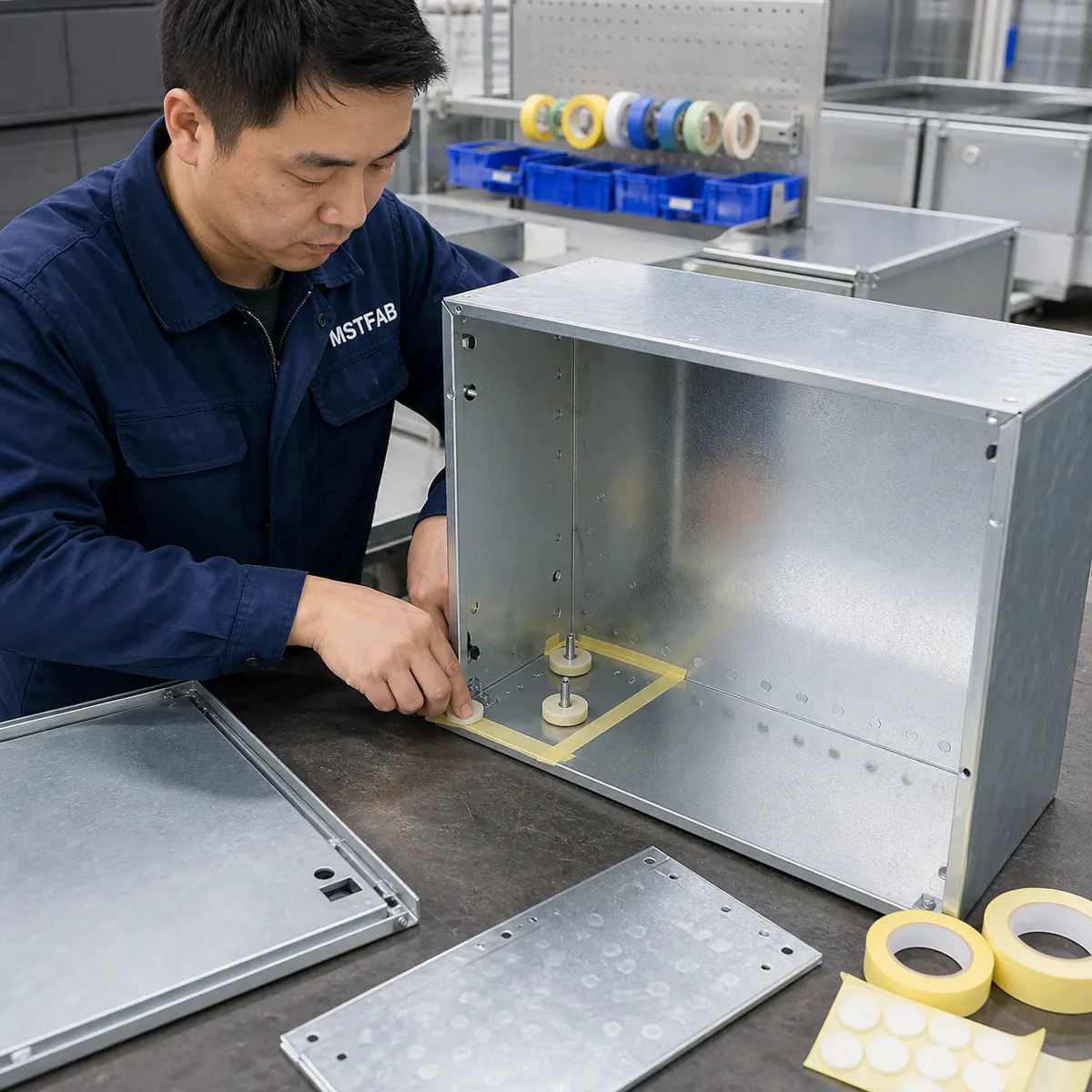
1. Start With the Mounting Plate
The mounting plate is where your electrical system eventually lives. Treat it like an important part. Check the actual: plate size, thickness, flatness, mounting position, stand-off height, bolt pattern and removal path.
The question is not simply: “Does the mounting plate fit inside the cabinet?” It also has to be installable. And removable. Preferably without bending it into the shape of a taco.
Watch the door and electrical depth: Your electrical team may later install deep breakers, contactors or other devices. Make sure the real component envelope does not crash into the door, door reinforcement, lock mechanism, gland plate, or another component.
MSTFAB makes the metal plate. The electrical OEM determines what equipment sits on it. That division works well when both sides tell each other what is happening.
2. Cable Gland Holes Are Cheap Until They Are Wrong
Laser cutting a cable hole is easy. Moving the hole after powder coating and international shipping is considerably less elegant.
Before release, check: hole diameter, hole spacing, edge clearance, cable-gland body size, tightening-tool clearance and internal cable space.
Do not send: “Bottom: 12 cable holes.” That is technically information, but production will still have questions: Which size? Which gland? What spacing? Can the installer fit a wrench between them? Will the gland body hit the mounting plate? Will the cable bend radius work?
The laser does exactly what the drawing says. This is both its greatest strength and occasionally its sense of humor.
3. Grounding Points: Do Not Powder-Coat the Part You Need Conductive
This is a classic enclosure problem. The cabinet looks beautiful. RAL color is perfect. Surface is smooth. Customer opens the box: The protective bonding point is buried under powder. Congratulations. The coating department has been extremely thorough.
If the buyer’s design uses mechanical grounding or bonding interfaces, the drawing should clearly define: grounding stud location, masked area, bare-metal contact surface, washer interface and any coating exclusion zone.
MSTFAB can manufacture and mask these drawing-defined mechanical features. The electrical designer remains responsible for the finished grounding and bonding system. RoHS does not solve electrical bonding. And powder coating definitely does not.
4. “Same RAL Color” Does Not Mean “Same Material”
This one sounds silly until it happens. Your first article uses one powder coating product. The customer approves it. Six months later someone says: “We changed powder supplier. Don’t worry, RAL 7035 is still RAL 7035.”
Mechanically, the cabinet may look identical. Chemically and document-wise, it may be a different material system entirely.
For this article, the manufacturing rule is easier: freeze the approved finish system after FAI, or use a controlled approval process when it changes. Color is appearance. It is not chemistry.
5. Galvanized Steel Is Not One Single Thing
Buyers often write: Material: Galvanized steel.
Then Supplier A quotes one sheet. Supplier B quotes another. Supplier C asks no questions whatsoever. Supplier C is often the one to worry about.
A proper RFQ should identify the approved material route, such as the applicable: grade, thickness, zinc coating requirement, surface condition and additional finish. If the enclosure is also powder coated, define that too. The goal is simple: sample material = production material, unless somebody approves a change.
6. RoHS Problems Can Hide in Small Hardware
The cabinet body weighs 20 kg. The little plated nut weighs almost nothing. Guess which part can still make your documentation annoying? The little nut.
RoHS restrictions apply to homogeneous materials, not by averaging a questionable coating across the total weight of a large steel cabinet. That means buyers should pay attention to purchased mechanical hardware that becomes part of the supplied shell:
| Part | What Procurement Should Control |
|---|---|
| PEM nut / stud | Exact part or approved equivalent, plating/finish evidence |
| Hinge | Base material and finish |
| Latch | Material, plating or coating |
| Screw / washer | Approved hardware family |
| Gasket | Polymer identity where included |
| Plastic plug | Supplier/material identity where controlled |
| Adhesive label or foam | Evidence where required by the buyer’s RoHS plan |
This is why “the steel is RoHS compliant” is not the end of the conversation. The enclosure is more than a steel sheet. Tiny parts have excellent career ambitions.
7. Hexavalent Chromium: Ask About the Surface System, Not Just “Zinc”
As of August 2026, EU RoHS continues to restrict ten substances, including hexavalent chromium, subject to applicable concentration limits and exemptions.
For galvanized electrical enclosure purchasing, the useful question is not: “Is zinc RoHS?”
Ask: What exact zinc coating, passivation, conversion coating and finishing system is being supplied?
This matters because the finished surface system can contain more than the base steel and zinc layer. If you have a controlled specification, use it. If you need supplier declarations, say so before the first article. Do not wait until the EU compliance team asks the question three months after delivery. That is when simple PDFs develop premium pricing.

8. Do Not Forget the Cut Edges and Weld Areas
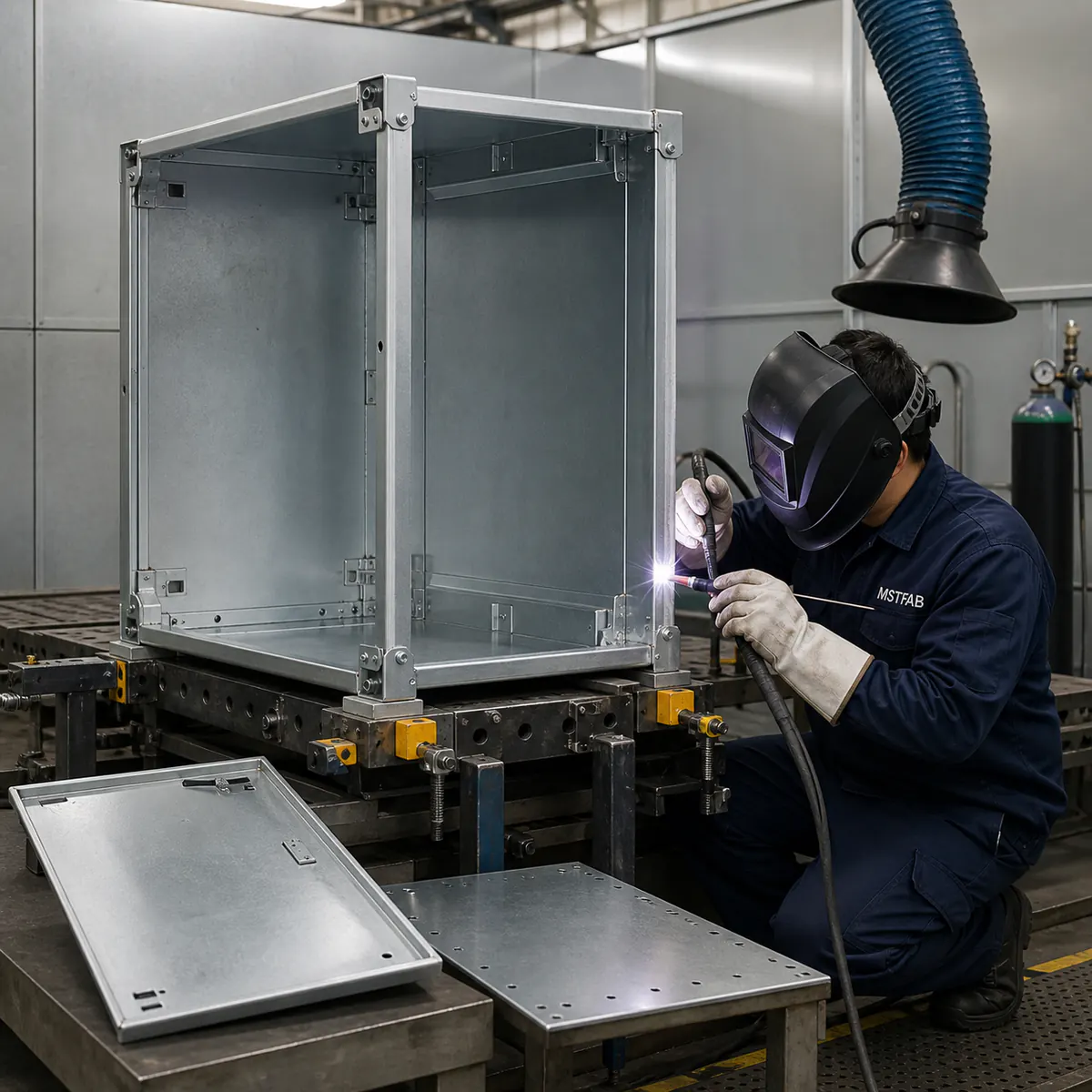
Pre-coated galvanized sheet is fabricated after the coating is already present. Then the factory cuts it. Bends it. Sometimes welds it. Sometimes grinds it.
The buyer therefore needs to think about the finished fabricated condition, not just the original sheet certificate. Depending on the project, specify what should happen at: laser-cut edges, welded areas, ground surfaces and repaired coating areas.
RoHS is one question. Corrosion protection is another. Do not assume a RoHS declaration means the enclosure has good corrosion performance. A compliant rusty cabinet would still be a rusty cabinet.
9. Door Fit Is Still More Important Than Marketing Language
A distribution box door has an important job: close. It sounds easy. Welding and bending occasionally disagree.
Before volume production, check the finished: door gap, hinge alignment, lock position, flatness, frame squareness and opening angle.
If the electrical OEM later installs door-mounted devices, also check the weight and rear component envelope. A door that closes perfectly when empty may behave differently after the buyer mounts several kilograms of equipment onto it. The hinge should not have to improvise.
10. Do Not Drill “Just One More Hole” After Everything Is Finished
One of the fastest ways to create both a corrosion issue and a documentation issue is: “We forgot one cable entry. Just drill it on site.”
Sometimes field modification is unavoidable. But if the design is still under your control, put the hole into the released drawing before production. Why? Because adding an opening after finishing can affect: coating integrity, edge treatment, environmental protection, component clearance and the approved configuration.
For repeat production, freeze the external cutout strategy as early as possible. The cheapest hole is usually the one cut before bending and finishing. The most expensive hole is the one made beside an installed electrical cabinet while somebody is asking why it wasn’t on Revision C.
11. First Article Inspection: Check What Can Ruin Electrical Assembly
Do not turn FAI into a contest to see who can measure the most dimensions. Measure the things that can stop your assembly line.
| FAI Check | Why the Electrical OEM Cares |
|---|---|
| Correct part number/revision | Prevents manufacturing the wrong design |
| Material/thickness | Confirms approved shell structure |
| Mounting plate fit | Electrical devices need a stable platform |
| Cable-entry pattern | Prevents on-site drilling |
| Grounding interface | Prevents coating/bonding surprises |
| Door alignment | Prevents service and assembly problems |
| Hinge/latch location | Keeps access repeatable |
| Stud/PEM locations | Prevents hardware rework |
| Powder/masking | Confirms finished configuration |
| Hardware identity | Supports physical fit and controlled material evidence |
| Packaging | Stops good parts arriving damaged |
Nobody has ever stopped a production line because the inspection report did not contain enough decorative dimensions.
12. The FAI Needs to Match the RoHS Evidence
Here is where physical configuration and documentation meet.
Suppose the FAI sample contains: Powder A, Hinge A, PEM Nut A, and Gasket A. Then your material evidence also describes: Powder A, Hinge A, PEM Nut A, and Gasket A. Excellent.
Now production silently changes to Powder B and Hinge B. The cabinet still fits. But the documentation package may now describe something the factory no longer ships. That is why physical configuration control and RoHS documentation control need to talk to each other. The FAI proves the box works. The material file describes what the box contains. They should be talking about the same box.
13. Repeat Orders Are Where Good Suppliers Earn Their Money
Making ten nice prototypes is one skill. Making another 1,000 pieces six months later without creative surprises is another.
For repeat orders, keep the approved production baseline clear: drawing revision → material → hardware → finish → masking → important manufacturing setup → CTQs → inspection → packaging.
If something controlled changes, use the agreed approval process. Do not rely on: “Basically the same.” “Basically the same” is a wonderfully efficient phrase. It can replace several hours of technical explanation. Unfortunately, it cannot replace buyer approval.
14. RoHS and REACH Are Not the Same Thing
Buyers often write: RoHS / REACH compliant please.
Fair request. Different regulations. RoHS focuses on restricted substances in electrical and electronic equipment, while REACH is broader EU chemicals legislation. So if your project requires both: ask for both. Do not assume one declaration automatically answers the other.
15. RoHS Does Not Mean CE Compliance Is Finished
Another common email: “You provide RoHS, so the box is CE certified, right?”
Not that simple. For covered EEE, RoHS sits within the EU conformity framework, but the completed electrical equipment may also fall under other applicable EU legislation depending on its design and intended use.
MSTFAB does not manufacture the finished electrical system. We provide the enclosure shell and scoped material/fabrication evidence for what we supply. The responsible finished-equipment manufacturer determines the overall EU conformity route. This is an important responsibility boundary. Otherwise a sheet metal factory gets asked to declare conformity for a breaker, power supply and control circuit it never purchased.
What MSTFAB Actually Manufactures
MSTFAB’s business model is clear: the factory supplies the sheet metal cabinet body, doors, blank mounting plates, gland plates, hinge/lock positions, grounding studs, welding, finishing and export packing; the buyer installs the electrical components afterward.
| MSTFAB Fabrication Scope | Buyer / Panel Builder Scope |
|---|---|
| Galvanized steel cabinet body | Electrical architecture |
| Door / removable cover | Circuit protection design |
| Blank mounting plate | Breakers and contactors |
| DIN-rail support features | Rail-mounted electrical components |
| Gland plate | Cable glands and cable system |
| Cable / conduit cutouts | Wiring design |
| Ground studs / masked areas | Protective bonding design |
| PEM nuts / welded hardware | Electrical device selection |
| Hinge and latch locations | Final operating requirements |
| Powder coating / finish | Finished equipment conformity |
| Dimensional FAI | Electrical functional test |
| Export packaging | Final panel integration |
We do not buy a pile of generic breakers and hide them inside your custom enclosure so the quotation looks more impressive. We make the metal properly. Your electrical team can then install the components it actually specified.

Eight Things to Check Before You Approve the Supplier
- RoHS scope: confirm whether the finished equipment is actually subject to RoHS and what evidence the OEM requires.
- Metal specification: define galvanized grade, thickness, coating and finish.
- Mechanical layout: confirm mounting plate, cable entry, door, hardware and service space.
- Grounding interfaces: clearly show masking and mechanical bonding features.
- First article: inspect the features that can stop electrical assembly.
- Material evidence: make sure it matches the actual supplied configuration.
- Change control: no quiet substitution of controlled powder, plating, polymer or hardware.
- Packaging: make sure good enclosures remain good after international shipping.
There is no ninth item called: “Supplier wrote RoHS in green letters on the website.”
FAQ
Is galvanized steel automatically RoHS compliant?
No useful blanket conclusion should be made from the word “galvanized” alone. The RoHS assessment needs to consider the actual material and surface system supplied, including the zinc coating, passivation/conversion layer and any additional finishes.
Is the RoHS limit calculated across the weight of the complete cabinet?
No. The Directive applies maximum concentration values by weight in homogeneous materials. You cannot simply average a questionable coating across a heavy steel enclosure.
Does MSTFAB manufacture the complete electrical distribution box?
No. MSTFAB manufactures the custom sheet metal enclosure shell. The buyer installs the electrical components and wiring afterward.
If a powder-coating supplier changes but the RAL color stays the same, does anything matter?
Yes. The physical appearance may remain similar while the chemical/material evidence changes. Review the new coating according to your agreed RoHS and change-control procedure. RAL is a color reference. It is not a family tree.
Request a RoHS Distribution Box Shell DFM Review
Before you send your RFQ, consider checking our Custom Distribution Board Enclosure Shell Fabrication page for more detailed guidelines.
Send MSTFAB your: STEP + PDF drawing + revision + galvanized steel specification + coating/finish + grounding/masking requirements + cable-entry details + hardware + quantity + required RoHS supplier evidence.
You build the electrical equipment. MSTFAB builds the metal around it.
 WeChat Contact
 WhatsApp Me Directly