
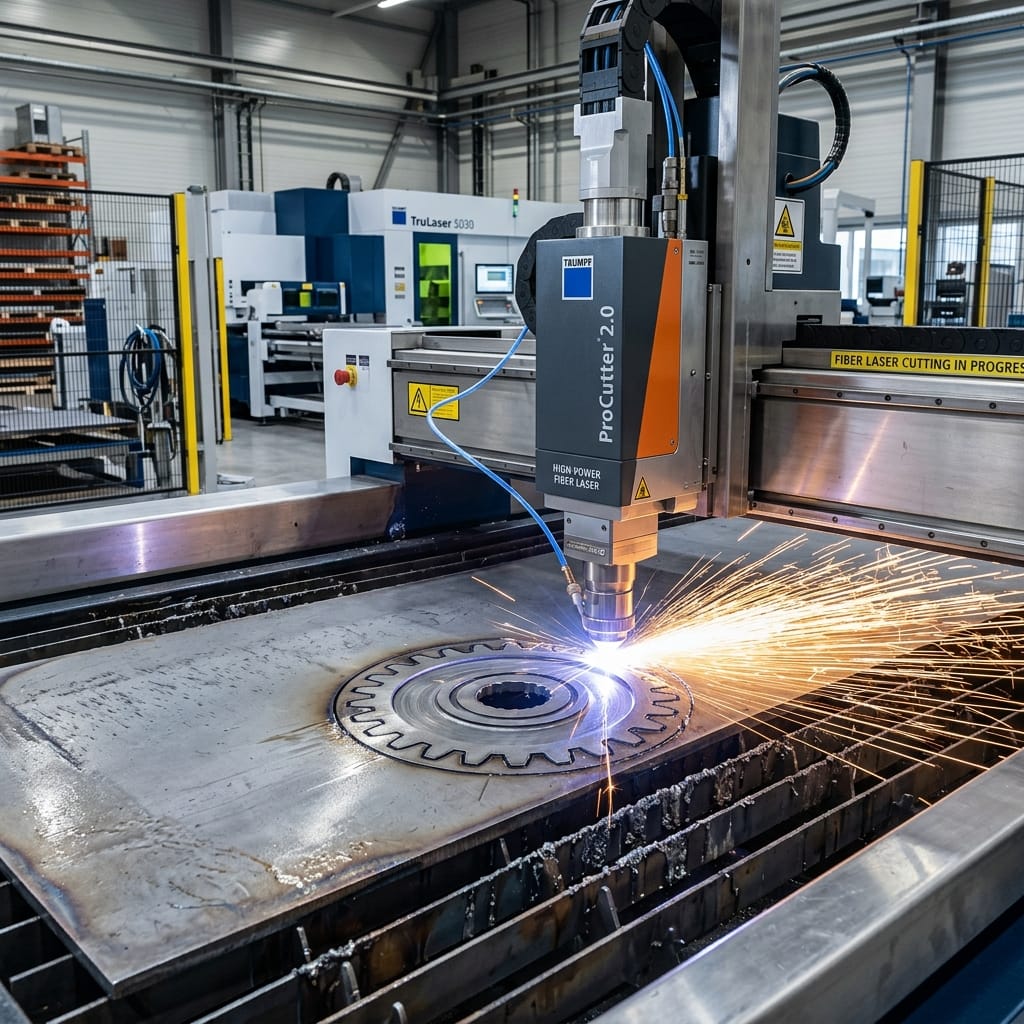
Quick answer: Evaluate a fiber laser cutting workshop against the finished part requirements: material, dimensions, holes, edge condition, flatness and downstream work. A machine’s positioning specification is not a guarantee for every cut feature. Agree deburring, inspection and any forming or finishing separately before ordering.
Start with the part you need to receive
A laser-cut blank, a deburred panel and a finished bent bracket are different deliverables. List the required operations and supplied condition so competing quotations cover the same work. MSTFAB’s scope is drawing-defined mechanical sheet metal fabrication, not complete electrical or electronic equipment.
This guide focuses on purchasing and acceptance. For commercial process scope, see our sheet metal laser cutting service. Material, thickness, geometry, quantity and required quality should be reviewed for the actual project; no universal cutting capacity or tolerance is promised here.
Check these requirements before comparing workshop claims
| Requirement | Define in the RFQ | Evidence to agree |
|---|---|---|
| Material | Grade, thickness, surface condition and document requirements | Material identification and specified records |
| Dimensions | Controlling drawing, datums and critical features | Measurements using the agreed method |
| Holes and slots | Position, size and intended mating hardware | Dimensional or agreed fit checks |
| Cut edges | Permitted burrs, sharp edges and cosmetic restrictions | Inspection against the approved edge criteria |
| Flatness | Requirement and support condition during inspection | Agreed measurement, not a photograph alone |
| Further work | Deburring, tapping, forming, welding or finishing | Acceptance in the specified final condition |
Separate machine specifications from part acceptance
A workshop may quote positioning accuracy or repeatability for its machine. That does not define all finished-part results. Material condition, geometry, setup and the measurement method matter too. Ask the supplier to confirm the particular features that control assembly rather than accepting a blanket precision figure.
For a small hole or narrow slot, identify whether the feature is a clearance opening, a locating feature or requires a later operation. Do not assume that every hole can be accepted directly from the cutting process. Any proposed machining or design change should be included in the quotation and approved drawing.
Define cut-edge quality and deburring explicitly
Do not infer “no deburring needed” from the phrase fiber laser cutting. Specify the edge condition required for handling, cable contact, welding, coating and appearance. Identify edges that need rounding or additional treatment, and any surfaces where tool marks are restricted.
Ask the supplier to explain the proposed route for the selected material and thickness. Assist gas and cutting conditions are process decisions that need to support the required result; naming a gas does not establish that every edge is ready for painting or assembly.
Supply controlled files, not conflicting instructions
Provide the available geometry files together with a controlled drawing defining material, tolerances, finish and inspection notes. Identify the controlling revision and resolve differences between files before cutting. Our sheet metal drawing guide explains the information buyers should review.
If you supply a flat pattern for a part that will later be bent, clarify who owns the development and bend data. A supplier should not silently alter the blank to suit its tooling, and a buyer-supplied pattern should not be assumed suitable for every forming route without review.
Inspect the condition that matters to your assembly
A flat blank inspection does not establish the dimensions of a finished bent or welded assembly. Identify which characteristics are checked after cutting and which need checking after subsequent operations. Account for finishing where it affects a fit.
Illustrative example: a cable-entry panel needs a cutout, fastening holes and safe cable-contact edges. Agree the critical dimensions, edge treatment and finished inspection condition before the sample is made. If a gland or mating plate is required for a fit check, state who supplies it. This is an acceptance-planning example, not a customer test record.
Ask for evidence relevant to the order
Request a sample inspection format, a drawing-specific DFM response or an agreed first article. Do not treat a machine photograph as a dimensional report. Where a certification is required, verify the current certificate, legal entity, site and scope rather than relying on a badge or an article’s wording.
For the order itself, specify required records, identification and packaging. Thin panels, cosmetic faces and projecting features may need separation or support in transit. A batch should arrive in the condition that was accepted, not merely match the drawing before shipment.
Questions buyers ask
Is a fiber laser always the best process?
Choose the route against material, geometry, edge requirements, further operations and order quantity. A process label alone is not a substitute for a project-specific review.
Can every laser-cut feature meet the same tolerance?
Do not assume so. Identify critical features and ask for feasibility and inspection confirmation against the actual drawing.
Does cutting include forming or coating?
Only when those operations are stated in the quotation. Separate the cut-part condition from the finished-part scope.
Request a drawing-based cutting review
Send your files, material, thickness, quantity, edge requirements and critical dimensions. State whether the order ends at cutting or includes downstream operations. Timing and feasibility should be confirmed for the agreed scope.
 WeChat Contact
 WhatsApp Me Directly