
Two incubators can have the same chamber capacity and completely different shelf mounting patterns. Liters are useful for buying an incubator, not for ordering its support rails.
Quick answer: Custom incubator shelf support rails are drawing-defined metal components that locate and support removable or adjustable shelves inside laboratory equipment. The requested metalwork may include formed mounting rails, separate shelf brackets, retaining plates and suitable customer-designed perforated shelves.
The equipment OEM defines the chamber interfaces, loading, cleaning and operating requirements. MSTFAB reviews the specified metal fabrication scope; shelf load validation, chamber airflow and temperature performance, safety and complete-equipment qualification remain with the OEM or responsible integrator.
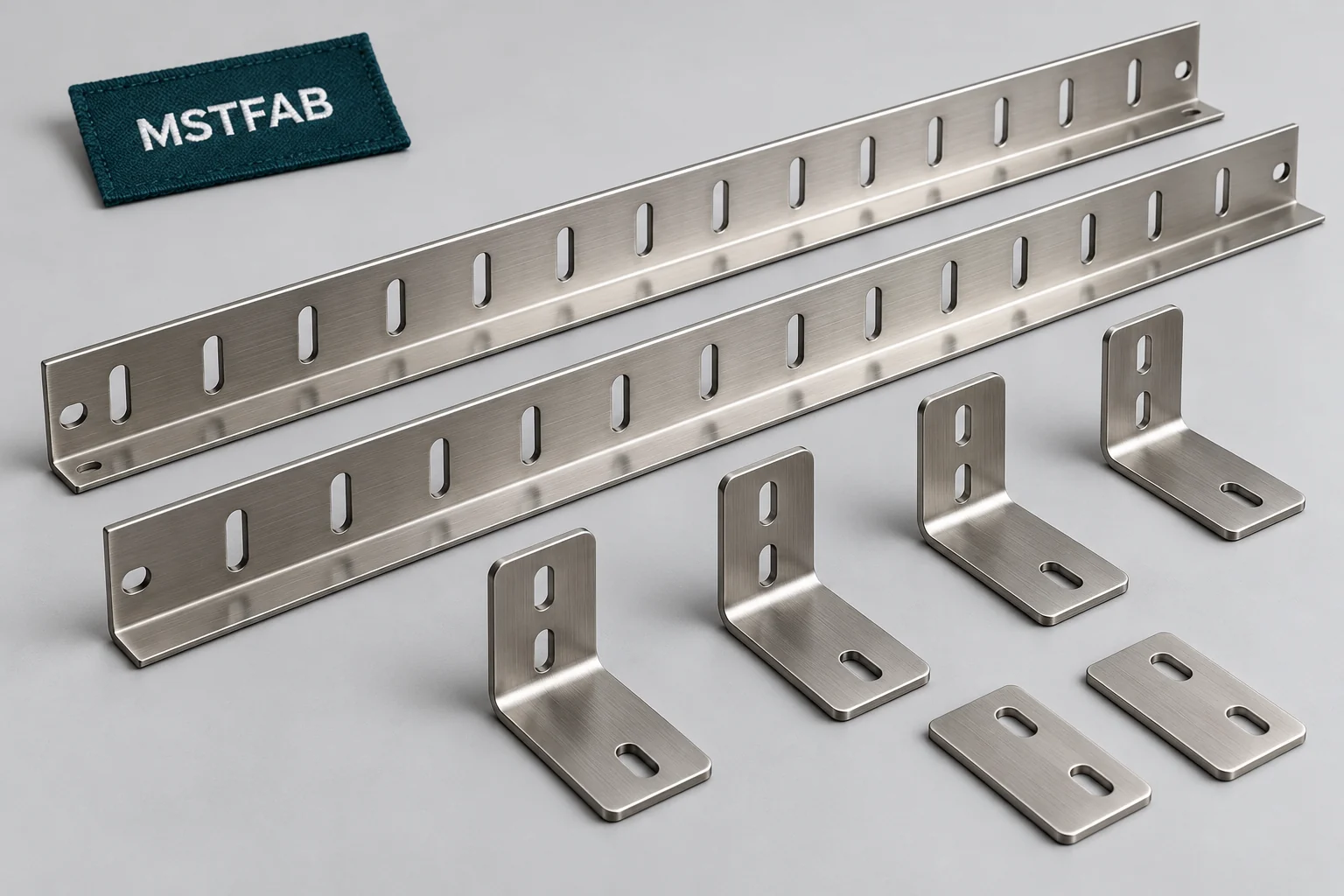
Define the Metal Parts You Are Buying
A rail, a support bracket and a complete shelving accessory are different purchasing units. List the actual delivered components before comparing prices.
- Mounting rails: flat or formed parts with the approved mounting and support positions.
- Shelf brackets: separate formed pieces that engage the rail and support the shelf.
- Retaining plates or stops: drawing-defined features used in the OEM’s selected retention arrangement.
- Shelves: optional customer-designed panels, with any perforations and formed edges specified separately.
- Purchased accessories: slides, fasteners or latches only where expressly identified in the BOM and quotation.
This is an internal component topic. The broader laboratory equipment sheet metal scope covers other chassis, panels and empty structures; it does not define a particular incubator’s shelf system.
What the Product References Establish
NuAire’s NU-1557 accessory listing describes a stainless steel shelf with guide brackets for a specified incubator series and gives equipment-specific capacities. Hettich’s HettCube accessories page shows shelf and tray options, including a tray system with telescopic rails. These are examples of real shelving arrangements, not interchangeable designs.
The references do not establish a load rating, standard mounting pitch or approved cleaning procedure for a new custom part. MSTFAB is not presented as a supplier to either brand. No proprietary geometry is reproduced, and this article is not an installation or maintenance procedure for those products.
Start With the Chamber Interface, Not Its Nominal Volume
Provide the relevant chamber assembly or controlled mating geometry. The fabricator needs the mounting surfaces, attachment points, shelf envelope and installation direction, not just the equipment name or capacity.
A STEP/STP assembly can show the relationships; a dimensioned PDF should identify the datums, tolerances and acceptance requirements. Mark chamber parts and purchased accessories as reference-only unless they are part of the requested supply.
If the design is still being developed, say which dimensions are provisional and who will approve them. A concept image can start a discussion, but it cannot settle the production interface.
Control Pitch and Alignment After Forming
Repeated holes or slots may define the available shelf positions. Specify their size, spacing and relationship to the mounting datums. Confirm whether matching rails use the same pattern or a deliberate offset.
- Define the first support position from an approved datum, not an ambiguous end of a sketch.
- Show which dimensions apply to a flat blank and which apply after bending or finishing.
- Identify the surfaces and features that align opposite sides of the shelf.
- State the bracket’s mating geometry and any critical insertion or engagement requirements.
- Define the relevant installation and removal envelope around adjacent parts.
A correct flat pattern does not prove a bent rail will fit. If the mounting face is formed, check the finished relationship between that face, the holes and the shelf-support feature.
Do Not Quote a Formed Rail as a Complete Slide Mechanism
The OEM chooses the architecture and approves any substitute. Identify accessory model numbers, supply responsibility, installed hardware and whether delivery is loose parts or a mechanical assembly.
Specify Material, Surface and Cleaning Inputs Together
Stainless steel is a common option for these components, but a grade name alone does not settle suitability. Specify the approved grade, condition, thickness and surface requirements for the actual chamber and cleaning procedure. Do not substitute 304, 316 or another material without the buyer’s approval.
State the required edge condition, visible surfaces, brushing direction where relevant, and any treatment or joining requirements. Review bends and tool access against the chosen material rather than assuming a material change leaves the route unchanged.
For cleaning access, the OEM should assess joints, crevices, removable features and compatibility with the intended procedure. A visually clean stainless steel part is not automatically sterile, biocompatible or validated for a disinfection or sterilization cycle.
Aluminum or another approved material can be reviewed where the design calls for it. This guide does not select a universal grade, sheet thickness, roughness or cleaning process.
Separate Drawing Conformity From Shelf Load Validation
The complete load path may include the shelf, brackets, rails, fasteners and chamber structure. The equipment designer must define the intended load, its distribution, support spacing, retention and relevant operating or handling conditions.
A concentrated load and a distributed load are not the same input. Neither a thick bracket nor a stainless steel label establishes an assembly rating. Any published carrying capacity needs an appropriate engineering or testing basis for the defined configuration.
For a mechanical fit review, agree the mating reference and acceptance conditions: engagement, aligned support positions, stops, removal access, installed hardware and finished edge condition. Identify what the fixture or sample represents. Passing a dimensional or fit check does not replace the OEM’s load and retention validation.
Quote Perforated Shelves as Separate Parts
If shelves are included, provide the outer envelope, opening pattern, material, formed edges and quantities. Dense small perforations can change the manufacturing route and cost; laser cutting is not automatically the best choice for every pattern.
Suitable pre-perforated sheet, cutting or another feasible process can be reviewed for the drawing and quantity. Tooling, availability and forming behavior need confirmation. Punching or a purchased perforated blank should not be assumed to be available or included.
The OEM retains responsibility for the selected perforation pattern, shelf position, airflow and chamber performance. Manufacturing an opening pattern does not demonstrate temperature uniformity, humidity control or operating stability.
Agree the Route From Blank to Finished Rail
- Review the released files: reconcile models, PDFs, units, BOM and critical interfaces.
- Cut and deburr: produce the approved outline, holes, slots and reliefs to the required edge condition.
- Form and join where specified: review radius, flange length, tooling access, sequence and any distortion-sensitive relationships.
- Apply the agreed finish and hardware: confirm external finishing, purchased components and supply responsibilities before pricing.
- Inspect and protect: check the specified finished features and pack long rails and small brackets without mixing revisions or damaging surfaces.
See the broader CNC sheet metal bending scope for process context. Welding, specialized finishing, extra reports and checking fixtures are project-specific items, not automatic inclusions.
Buyer Evidence and Inspection Handoff
Agree what must be checked, in what condition, on how many parts and in which record. Use this table to define the requested evidence; it is not a completed inspection report or a validated shelf design.
| Control point | What to agree | Useful project evidence |
|---|---|---|
| Released configuration | Matching models, dimensioned drawings, part numbers, revisions and a controlled metal-parts BOM. | An agreed file set with open drawing questions resolved. |
| Finished mounting pattern | Datums, hole or slot pitch, position and alignment in the specified formed or finished state. | Agreed dimensional readings and the measurement setup. |
| Bracket engagement | Mating profiles, orientation, support positions, retention features and removal access. | A defined mechanical fit check with the approved mating reference where requested. |
| Material and surface | Grade, thickness, finish, edge condition, joining and approved cleaning-related design requirements. | Specified material records and dimensional or appearance checks. |
| Loading inputs | OEM-defined loads, distribution, support spacing, operating conditions and acceptance responsibility. | OEM engineering or test basis where required; not a rating inferred from a loose part. |
| Kit identification | Individual or kit pricing, handed parts, quantities, hardware and loose or assembled delivery. | BOM-based counts and agreed part or pack labels. |
| Repeat orders and packing | Change approval, current revision and protection of long rails, brackets and visible surfaces. | Release reference, packing instructions and any requested shipment records. |
A first-article report, material record or trial fit must be included in the agreed scope when required. Identify the approval owner and the next release condition; a generic product picture is not acceptance evidence.
Count Rails, Handed Parts and Complete Kits Correctly
Two identical rails installed on opposite sides are not automatically two different part numbers. Conversely, similar-looking left- and right-hand parts may have different features. The drawing and BOM must resolve that distinction.
Hypothetical eight-piece metalwork kit:
- 1 left rail
- 1 right rail
- 4 support brackets
- 2 retaining plates
For 100 complete kits, the order contains 100 left rails, 100 right rails, 400 brackets and 200 retaining plates: 800 fabricated pieces. Shelves, fasteners and purchased mechanisms are excluded unless separately listed.
This is a quantity example, not an actual MSTFAB order, approved design, minimum order or delivery promise. The cover does not establish handedness or an engineered assembly.
Ask for the same BOM, finish, inspection, packing and delivery basis from each supplier. Keep setup, fixtures, purchased items and recurring part charges clear without counting included costs twice.
Send a Drawing Package That Can Be Quoted
- Matching released STEP/STP and dimensioned PDF revisions, units and the controlling document if files conflict.
- Chamber mounting references, shelf envelope, support positions, mating profiles and removal direction.
- A BOM with part numbers, handedness, per-kit quantities and reference-only or purchased components.
- Approved material, thickness, surface, edge, hardware and joining requirements.
- OEM-defined loading inputs, required mechanical fit review and separately assigned validation responsibilities.
- Prototype and repeat-order quantities, required records, approval gate, packing, destination and requested dates.
Illustrative RFQ wording: Please quote the shelf support metalwork defined by the attached released files and kit BOM. Confirm cutting, bending, any joining, finish, hardware, inspection and packing inclusions. Identify proposed lead time, fixture or report costs and open drawing questions. Complete incubators, controls and equipment-level validation are excluded.
For a trial fit, state whether the buyer supplies a chamber sample, fixture or controlled mating model. Do not leave the fabricator to guess which reference represents the approved equipment.
MSTFAB’s Drawing-Based Metalwork Scope
MSTFAB is operated by Guangzhou Maisituo Sheet Metal Manufacturing Co., Ltd. Its custom sheet metal fabrication scope includes drawing-defined rails, brackets, support plates, chassis components and empty mechanical structures. Processes, finish coordination, inspection and packing are reviewed against the actual parts and order.
Prototype and small-batch requests can be evaluated by geometry, material, route and quantity. Specialized perforated material, purchased slides, special fixtures or extra documentation need confirmation; they are not included merely because the part is intended for a laboratory.
Scope boundary: The standard metalwork service does not include complete incubators, heaters, refrigeration systems, CO2 or humidity controls, sensors, electronics or operating temperature-control equipment. The OEM retains shelf load and retention validation, cleaning suitability, chamber performance, safety and complete-product compliance.
Buyer Questions Before Ordering
Can MSTFAB fabricate incubator shelf rails and support brackets?
MSTFAB can evaluate customer-defined sheet metal rails, bent brackets, retaining plates and suitable shelf components from released drawings. Confirm material, geometry, quantity, finish, inspection and the delivered set. Complete incubators and operating temperature-control equipment are outside the standard fabrication scope.
Are shelf support rails the same as telescopic drawer slides?
No. A formed support rail or bracket is not automatically a complete telescopic mechanism. Identify any purchased slide, bearing, latch or other accessory separately, including its approved model and supply responsibility. Do not assume it is included in a metal rail quotation.
Can stainless steel thickness establish the shelf load rating?
No. The complete arrangement includes the shelf, brackets, rails, fasteners and chamber support structure. The equipment OEM defines the loading conditions, acceptance requirements and validation. Manufacturing individual metal parts to drawing does not establish a carrying capacity for the assembly.
Can perforated shelves be included in the RFQ?
Yes, a customer-defined metal shelf can be evaluated separately. Provide the perforation pattern, material, formed edges, quantity and inspection requirements. Cutting, pre-perforated material or another suitable route must be confirmed; thermal and airflow performance remain with the equipment OEM.
Does stainless steel make the part sterile or suitable for every cleaning process?
No. Specify the material, finish, edge and joint requirements against the intended chamber conditions and cleaning procedure. The OEM must determine suitability and any required validation; a clean appearance or stainless steel grade alone is not evidence of sterility or validated cleaning.
Should the quotation use a price per rail or per kit?
State the purchasing unit explicitly. A controlled kit BOM should identify every part number, revision and quantity, including any separate left- and right-hand items. List hardware, shelves, purchased mechanisms, assembly and packing inclusions separately so quotations cover the same supply scope.
Send the Rail Drawings and Metalwork BOM
Share the chamber interfaces, finished dimensions, quantities and required checks. We will review the proposed fabrication scope and identify details to confirm before quotation.
Reference and Editorial Boundaries
The NuAire and Hettich pages linked above provide application context only. Their brand names, equipment-specific accessories and capacities do not establish an MSTFAB customer relationship, endorsement or permission to copy protected designs. Use current manufacturer documentation for the actual equipment.
Prepared with AI assistance from the supplied draft and identified references. The cover is an AI-generated structural illustration, not an actual product photograph, production drawing, inspection record or load test. Confirm project feasibility, documentation and commercial terms before ordering.
 WeChat Contact
 WhatsApp Me Directly