
⚡ Direct Answer: Why Is Surface Finishing Necessary After Laser Cutting?
Surface finishing after laser cutting is the mechanical and chemical conditioning of cut metal parts to remove micro-burrs, dross, sharp edges, and the hard oxide scale formed when using oxygen assist gas. Even on high-end fiber laser machines, untreated laser-cut edges possess microscopic sharp corners that cause premature paint flaking (edge peeling) and wire insulation abrasion, making edge rounding (R0.5–R1.0mm) and chemical pre-treatment essential for industrial durability.
Post-Laser Finishing Processes Comparison
| Finishing Process | Primary Function | Target Materials | Edge Condition Result |
|---|---|---|---|
| Automated Rotary Brush Deburring | Uniform double-sided deburring & edge rounding | Carbon steel, aluminum, stainless steel | R0.5mm – R1.5mm uniform edge radius; safe for technician handling |
| Vibratory Tumbling | Batch deburring and surface smoothing for small parts | Small stamped brackets, clips, laser-cut gussets | Matte isotropic surface finish with rounded perimeters |
| Laser Oxide Layer Stripping | Chemical pickling or abrasive blasting to remove scale | O2-cut carbon steel before powder coating | Ensures 100% paint adhesion (prevents edge peeling) |
| Nitric/Citric Acid Passivation | Restores passive chromium-oxide corrosion layer (ASTM A967) | 304 / 316 Stainless steel parts | Free iron removed; prevents tea-staining & pitting corrosion |
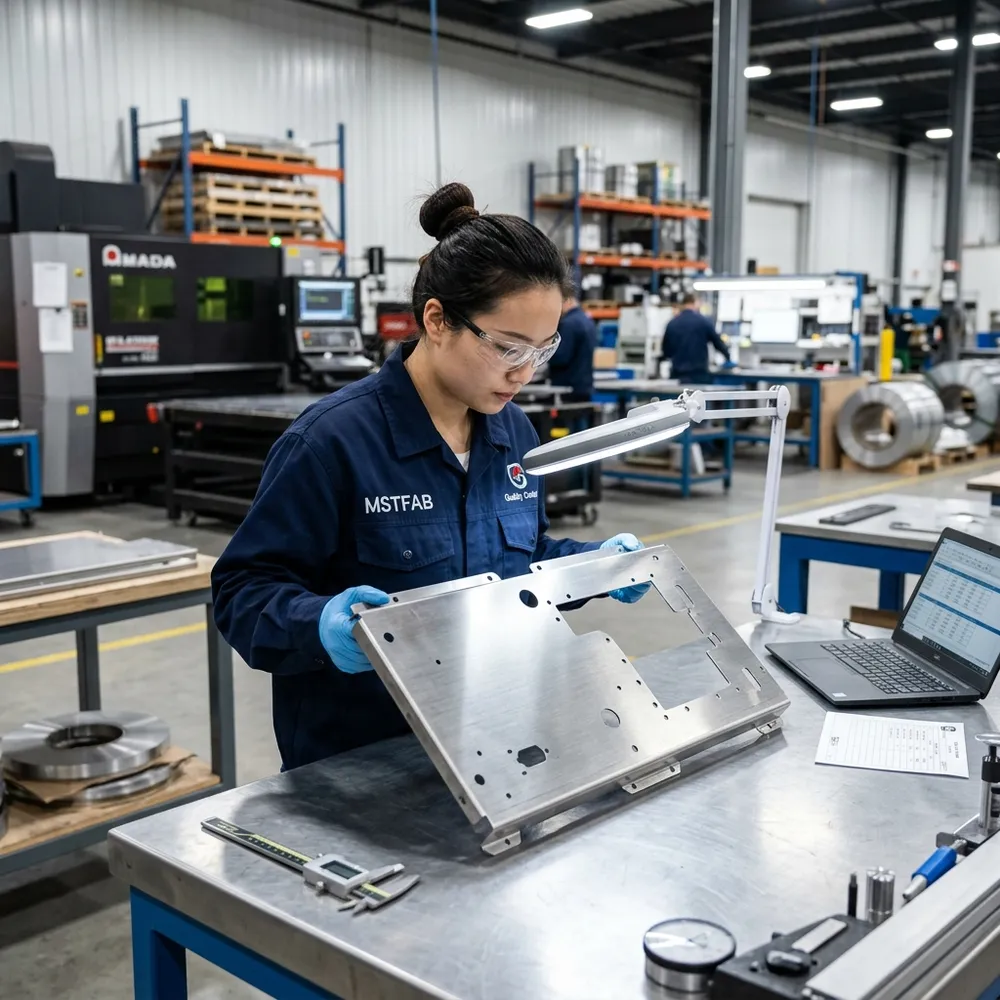
Eliminate Sharp Edges & Paint Peeling
Partner with MSTFAB for full in-house deburring, sandblasting, chemical pre-treatment, and high-durability powder coating.
Frequently Asked Questions on Laser Finishing
Why does powder coating peel off laser-cut steel edges?
When steel is cut with oxygen assist gas, a microscopic brittle iron oxide film forms along the cut edge. Powder coating sticks to this oxide layer rather than the base metal. During temperature cycling, the oxide flakes off, taking the paint with it. MSTFAB uses high-pressure nitrogen cutting or mechanical rotary deburring to strip this layer before coating.
 WeChat Contact
 WhatsApp Me Directly