
⚡ Direct Answer: How to Eliminate Weld Distortion in Galvanized Enclosures?
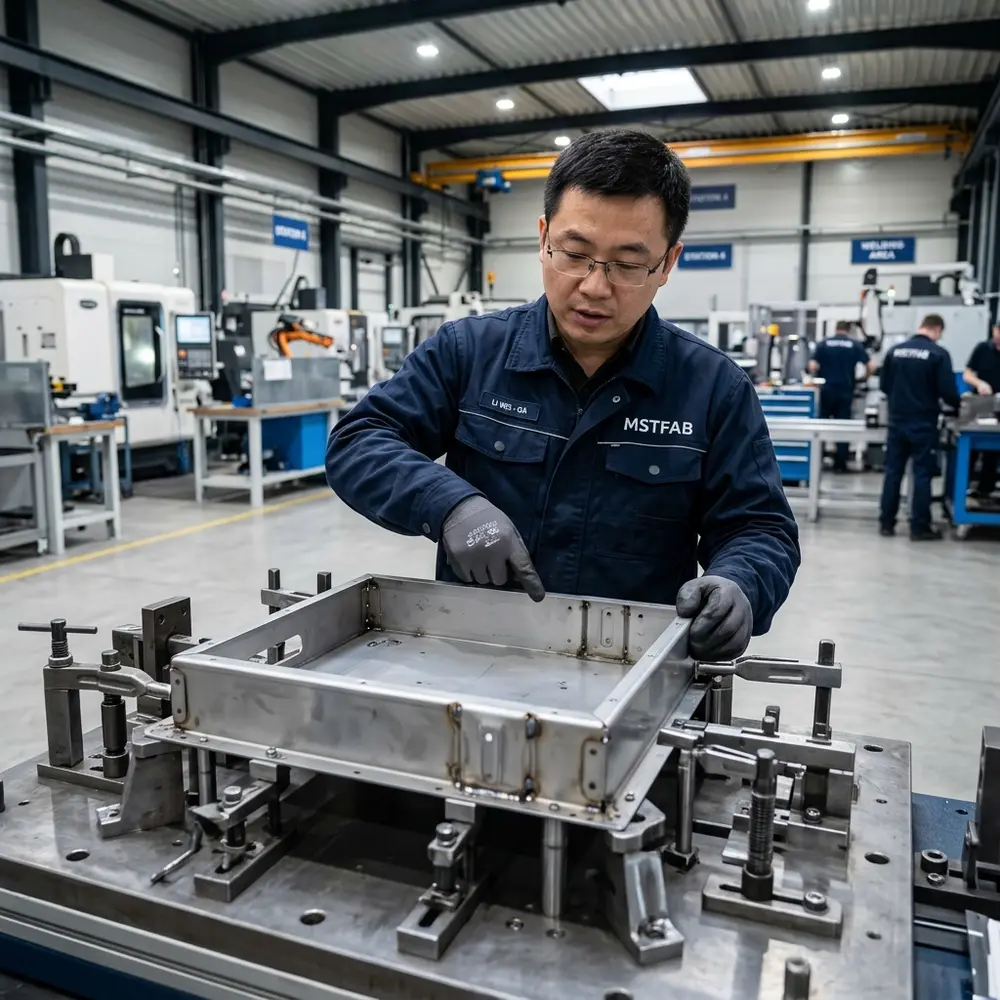
Preventing galvanized enclosure weld distortion in small DIN rail junction boxes requires mitigating both thermal shrinkage stress and zinc vapor embrittlement: 1) Implement tab-and-slot self-aligning laser cutouts that mechanically constrain sheet metal movement before welding; 2) Utilize intermittent pulse TIG or fiber laser welding rather than high-heat continuous MIG; 3) Mechanically grind away or laser-ablate the zinc coating 10mm from the weld zone to eliminate zinc volatilization explosive spatter; 4) Clamp parts in high-conductivity copper chill block fixtures that rapidly sink excess heat; and 5) Alternate diagonal welding passes to balance residual stress vectors.
Welding Methods & Thermal Distortion Comparison on Galvanized Steel
| Welding Process | Heat Input & Distortion Risk | Zinc Vapor & Porosity Behavior | Enclosure Angular Tolerance (90°) |
|---|---|---|---|
| Standard MIG / GMAW | Very High heat input; severe corner pulling (>1.5° C angular error). | Violent zinc vapor outgassing (Zn boils at 907°C); heavy spatter and root porosity. | ±1.2° to ±1.8° (Requires manual torch straightening). |
| Manual TIG / GTAW | Moderate heat input; localized distortion along flange edges. | Tungsten electrode contamination from zinc fumes requires frequent electrode regrinding. | ±0.6° to ±0.8° with skilled operator. |
| Pulsed TIG with Copper Chill Blocks (MSTFAB) | Low heat input; high peak current for rapid puddle freeze; chill blocks sink 70% of heat. | Clean weld puddle after localized edge zinc laser ablation; zero porosity. | ±0.3° (Maintains tight door seal alignment). |
| Precision Fiber Laser Seam Welding | Ultra-low heat input; micro-focused beam with extremely narrow heat-affected zone (HAZ). | High travel speed (1.5 m/min) prevents zinc overheating; minimal spatter. | ±0.15° (Virtually zero measurable distortion). |
5 DFM Rules to Design Out Weld Warpage Before Production
- Incorporate Interlocking Tab-and-Slot Joints: Laser cut 2mm micro-tabs on vertical side walls that snap into mating slots on bottom flanges. This mechanically locks the 90° corner squareness before any arc is struck.
- Replace Welded Seams with Deep Bends: Whenever possible, bend a continuous 4-sided enclosure body from a single cruciform sheet metal blank. You reduce welded seams from four down to just corner corner-weld joints, cutting heat input by 75%.
- Specify Staggered Skip Welding: For internal DIN rail mounting brackets, avoid continuous fillet welds. Specify 15mm stitch welds every 60mm on alternating sides to distribute cooling stress evenly.
- Formed Stiffening Cross-Breaks: Add shallow 5° diagonal X-breaks or embossed stiffening ribs across large flat panels. This increases panel planar stiffness by over 300%, preventing “oil-canning” dish deformation during weld cooling.
- Post-Weld Zinc Cold Galvanizing Touch-Up: In zones where zinc was ablated for welding, apply high-purity (96% dry zinc dust) aerosol cold galvanizing per ASTM A780 to restore complete sacrificial corrosion protection before powder coating.
Eliminate Weld Warpage with MSTFAB DFM Engineering
Send us your 3D models. We optimize weld joint geometry, clamping fixtures, and bending layouts to ensure perfectly square, distortion-free enclosures.
Frequently Asked Questions on Weld Distortion Control
Why does galvanized steel warp more than uncoated cold-rolled steel?
Zinc boils at 907°C, well below the melting point of steel (1538°C). During welding, rapid zinc vapor expansion disturbs the arc stability and requires higher heat inputs or slower travel speeds to allow gas escape, magnifying the thermal gradient across adjacent cold sheet metal.
How do you measure enclosure squareness and distortion after welding?
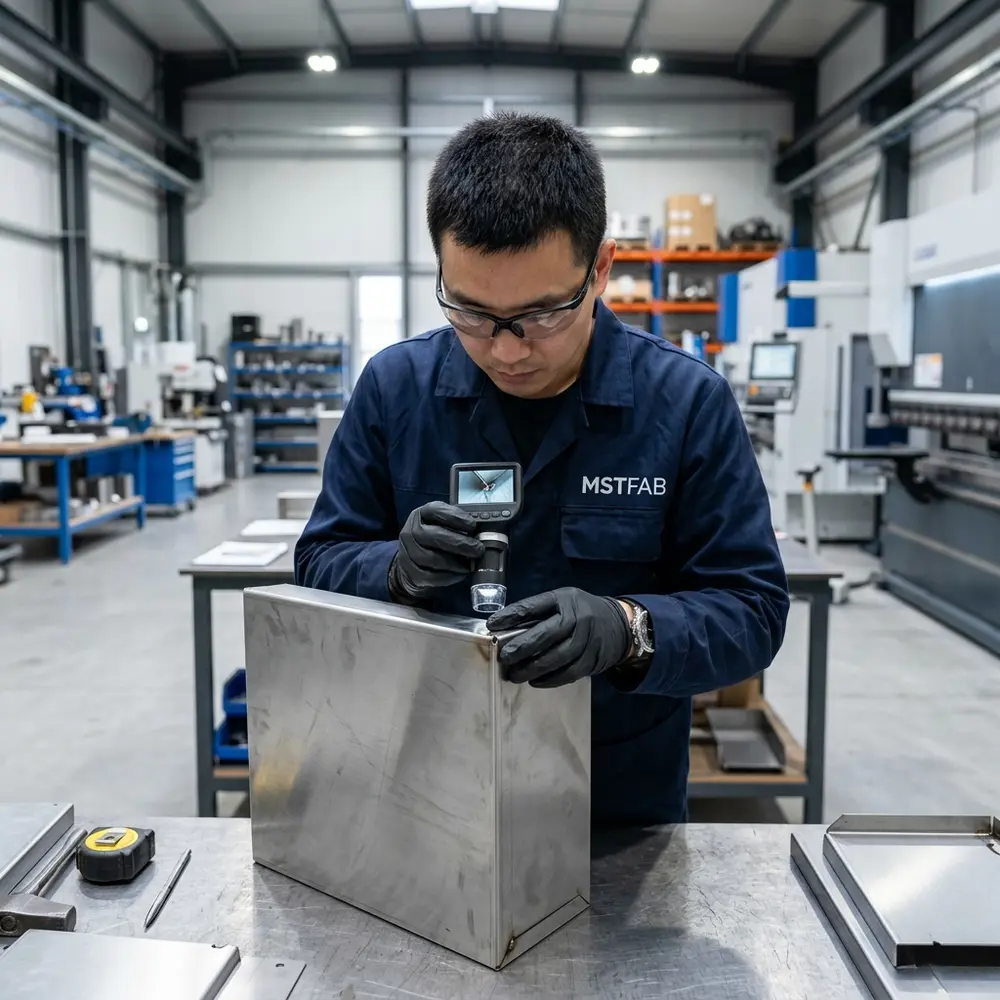
We place finished welded shells on precision Grade A granite surface plates and sweep perimeter sealing flanges with Mitutoyo dial indicators, verifying that total flatness deviation does not exceed 0.30mm across the entire gasket plane.
 WeChat Contact
 WhatsApp Me Directly