
⚡ Direct Answer: How to Audit the Financial Stability of a Sheet Metal Fabricator?
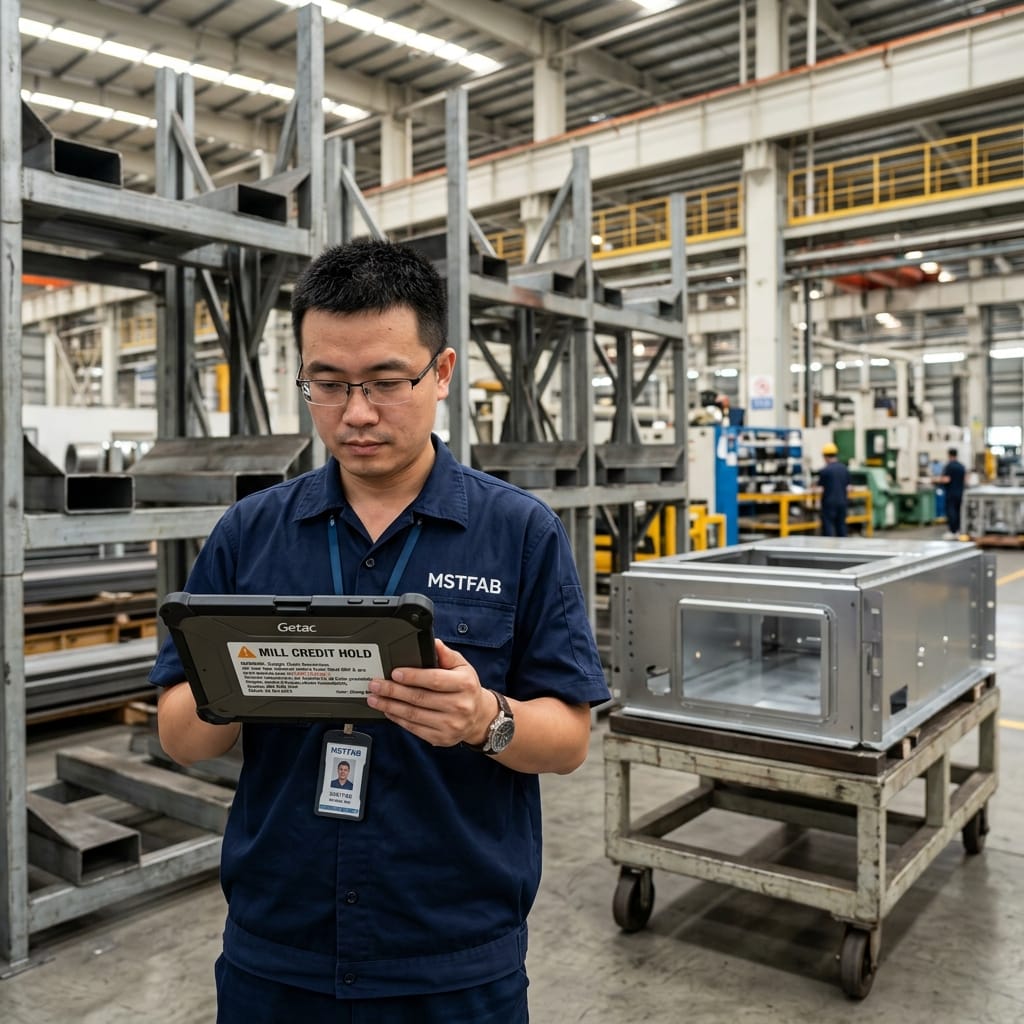
Auditing a custom sheet metal fabricator’s financial viability requires analyzing 4 interconnected operational and financial pillars: 1) Raw Material Mill Credit Standing: Inquiring whether primary steel/aluminum service centers extend 30–60 day credit lines or demand cash-before-delivery (CBD), which indicates liquidity distress; 2) Capital Asset Ownership vs. Heavy Debt Leverage: Confirming whether CNC fiber lasers, panel benders, and powder coating lines are company-owned or encumbered by high-interest equipment lease liens; 3) Customer Concentration Ratio: Ensuring that no single OEM client accounts for more than 40% of the fabricator’s total annual revenue; and 4) Contractual “Insolvency Kill Switch” Protection: Incorporating an immediate termination right with automatic repossession of proprietary tooling, CAD data, and work-in-progress (WIP) upon any bankruptcy filing or creditor reorganization.
Purchasing managers often focus exclusively on piece-part unit cost while overlooking the financial foundation of the manufacturer. A vendor that underbids competitors by 20% is frequently operating on negative operating margins to generate immediate cash flow. When that fabricator runs out of working capital, your mission-critical production stops dead in its tracks.

The 4-Pillar Financial Stability Audit Framework
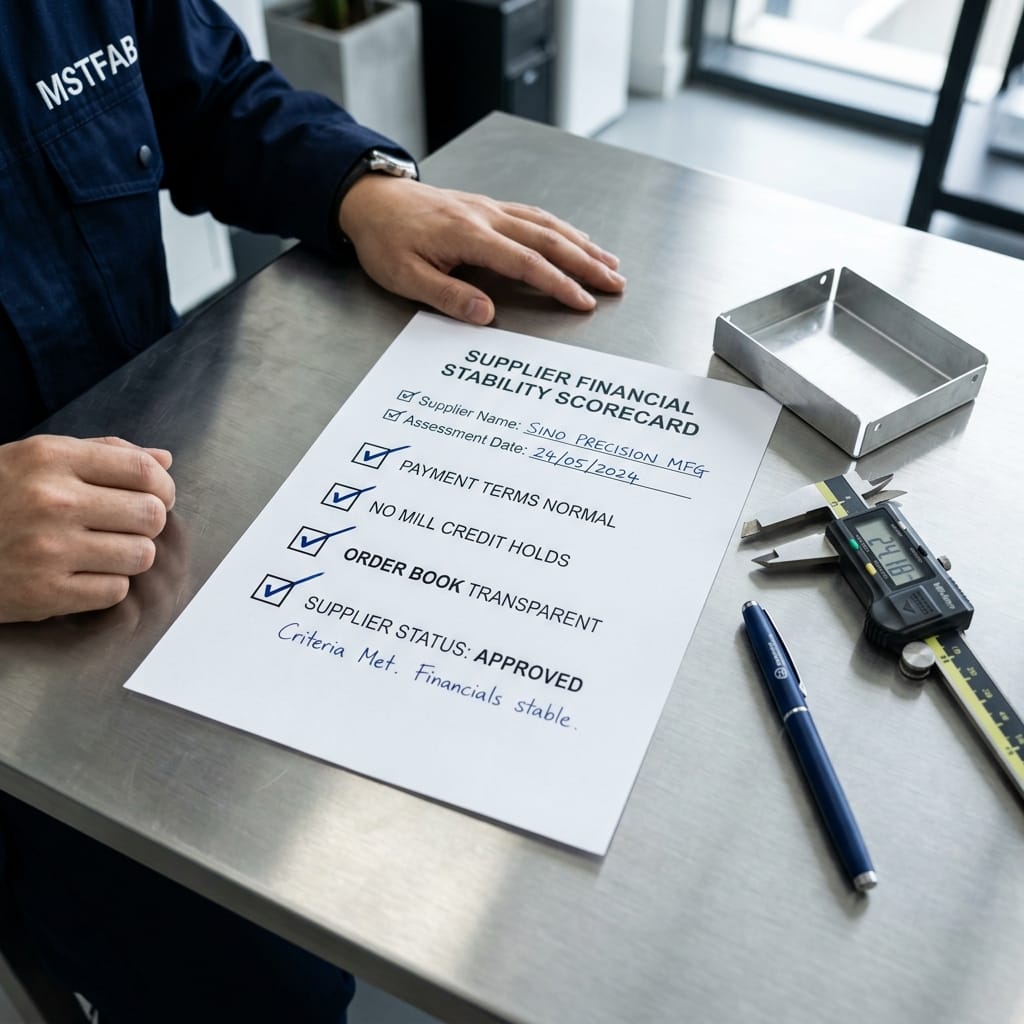
Score potential sheet metal fabrication partners using this objective risk assessment matrix before onboarding:
| Audit Pillar | High Financial Risk (Red Flag) | Moderate Risk (Acceptable) | Low Risk Benchmark (MSTFAB) |
|---|---|---|---|
| 1. Mill Credit Standing | Cash Before Delivery (CBD); frequent material holds | 30-day revolving credit with local metal distributors | Direct Tier-1 mill allocation (Baosteel/Chalco) with large credit facilities and multi-ton raw coil stock in-house |
| 2. Equipment Capital Structure | Heavily leveraged third-party leases; aging machines | Mix of bank-financed and owned machinery | 100% company-owned plant real estate and advanced CNC laser/brake equipment with zero lien encumbrances |
| 3. Customer Concentration | >60% revenue tied to a single client or cyclical market | Top client represents 30%-40% of revenue | Diversified revenue across medical, telecom, EV infrastructure, power distribution, and aerospace (<20% max concentration) |
| 4. Labor & Wage Stability | Delayed wage payments; high turnover of skilled programmers | Standard market wages; seasonal turnover | Above-market compensation; dedicated 10+ year veteran engineering staff; zero wage arrears |

The Contractual “Insolvency Kill Switch” Clause
Protect your proprietary assets by incorporating an explicit Insolvency Termination & Immediate Extraction Clause into your Master Supply Agreement (MSA):
Upon the occurrence of an Insolvency Event (including bankruptcy filing, appointment of a receiver, general assignment for creditors, or suspension of business operations), Buyer shall have the immediate right to terminate this Agreement without penalty. Buyer shall have an irrevocable license to enter Supplier’s premises immediately, without court order, to take custody and remove: (a) all tooling, stamping dies, fixtures, and gauges bearing Buyer’s asset tags; (b) all proprietary CAD files, drawings, and NC programs; and (c) all finished goods and WIP for which Buyer has remitted payment.


Secure & Scalable Financially Sound Sheet Metal Manufacturing Sourcing With MSTFAB
MSTFAB combines direct factory manufacturing, China-enforceable NNN IP security, transparent tooling ownership, and flexible low-MOQ rapid prototyping. Protect your designs and streamline precision production.
Frequently Asked Questions (FAQ)
How can international buyers verify the financial health of a Chinese fabricator?
Buyers can order official credit reports through Dun & Bradstreet or Sinosure, request audited financial statements, verify business registration status on the official National Enterprise Credit Information Publicity System (GSXT) to check for court litigation or tax defaults, and conduct on-site physical audits.
Why is customer concentration a dangerous risk in sheet metal fabrication?
If a sheet metal shop depends on one primary customer for 70% of its volume and that customer experiences a downturn or moves tooling, the fabricator faces an immediate liquidity crisis, leading to sudden bankruptcy that halts production for all remaining smaller customers.
Does MSTFAB provide financial and facility transparency to prospective OEM buyers?
Yes. We provide complete commercial and operational transparency to OEM partners, including proof of facility title ownership, ISO 9001:2015 audit reports, Sinosure export credit ratings, and direct access for third-party engineering audits.
 WeChat Contact
 WhatsApp Me Directly