
⚡ Direct Answer: How to Choose the Right Sheet Metal for Your Enclosure?
Sheet metal enclosure material selection requires balancing environmental exposure, structural strength, weight, thermal conductivity, and total cost:
1) Cold Rolled Steel (SPCC / 1018): Most cost-effective with high rigidity for indoor enclosures, requiring powder coating for corrosion protection;
2) 5052-H32 Aluminum: Lightweight (1/3 the density of steel), highly corrosion-resistant, and thermally conductive, ideal for outdoor telecom and pole-mounted electronics;
3) Galvannealed Steel (SGCC / A40): Steel base with zinc-iron coating, offering built-in edge rust protection and excellent powder paint adhesion;
4) AISI 304 / 316 Stainless Steel: Maximum corrosion resistance, hygiene, and chemical durability for marine NEMA 4X and sanitary medical environments.
Comprehensive Material Property & Application Comparison
| Material Alloy | Density & Relative Weight | Tensile / Yield Strength (MPa) | Corrosion Resistance Rating | Relative Cost Factor |
|---|---|---|---|---|
| Cold Rolled Steel (SPCC) | 7.85 g/cm³ (1.0x baseline) | Tensile: 270–410; Yield: ~210 | Poor (Requires powder coating or electroplating) | 1.0x (Lowest cost) |
| Galvannealed Steel (SGCC / A40) | 7.85 g/cm³ (1.0x baseline) | Tensile: 310–450; Yield: ~240 | Good (Galvanic sacrificial zinc barrier) | 1.15x |
| Aluminum 5052-H32 | 2.68 g/cm³ (0.34x light we) | Tensile: 210–260; Yield: ~195 | Excellent (Self-passivating aluminum oxide) | 1.45x |
| Stainless Steel 304 (1.4301) | 7.93 g/cm³ (1.01x baseline) | Tensile: 515–690; Yield: ~205 | Superior (18% Cr / 8% Ni passive layer) | 2.80x |
| Stainless Steel 316L (1.4404) | 8.00 g/cm³ (1.02x baseline) | Tensile: 485–620; Yield: ~170 | Maximum (2–3% Mo for chloride & salt spray) | 3.60x |
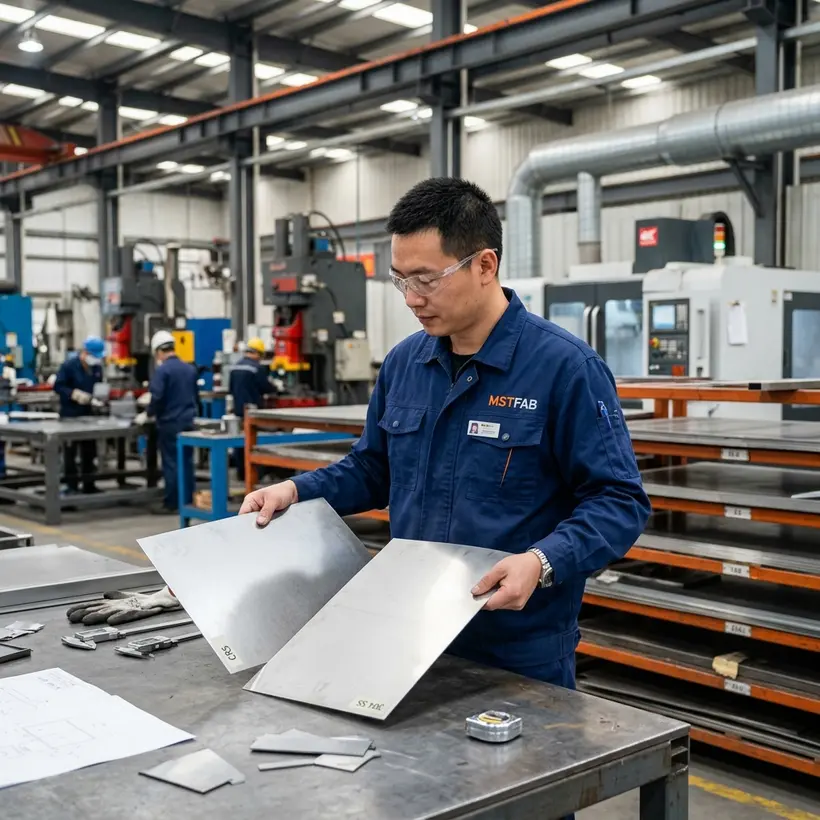
Detailed Engineering Analysis by Application Environment
1. Indoor Controlled Environments (Offices, Data Centers, Factory Automation)
When atmospheric humidity is controlled and enclosures are sheltered from chemicals and rain, Cold Rolled Steel SPCC (1.2mm to 2.0mm) delivers the optimum price-to-performance ratio. It forms easily with minimal springback and provides rigid magnetic mounting capabilities.
2. Outdoor Commercial & Infrastructure (EV Chargers, Traffic Control, Telecom)
Outdoor installations face solar heating, rain, and snow. 5052-H32 Aluminum is the industry standard due to its high strength-to-weight ratio and natural oxide layer that prevents corrosion even if the paint layer is scratched.

3. Harsh Maritime, Chemical & Food Processing Facilities
Wash-down environments with caustic detergents, chlorine, or offshore salt fog degrade ordinary metals rapidly. AISI 316L Stainless Steel with passivated grain finishes ensures decades of maintenance-free operation without coating degradation.
Need Help Choosing the Best Material for Your Enclosure?
Consult with MSTFAB metallurgists and fabrication engineers. We analyze structural loads, corrosion exposure, and target unit costs to optimize your design.
Frequently Asked Questions on Enclosure Material Selection
Can 6061-T6 aluminum sheet be used for formed enclosures?
6061-T6 has high structural yield strength but cracks easily along tight bend radii (R < 3 × T). For bent sheet metal enclosures, 5052-H32 is the vastly preferred alloy because it bends smoothly without cracking while maintaining high fatigue strength.
Why is galvannealed steel preferred over standard galvanized for powder coating?
Galvannealed steel (A40/ZF) undergoes thermal annealing after zinc dipping, creating a zinc-iron alloy surface with a matte microscopic tooth that provides superior paint adhesion and eliminates paint blistering.
 WeChat Contact
 WhatsApp Me Directly