
Executive Summary: Precision Sheet Metal Telecom Enclosure Procurement
Procuring custom outdoor telecom enclosures requires balancing environmental ingress protection (IP55 to IP67 / NEMA 4X), structural loading under severe wind shear, and effective thermal dissipation against total manufacturing cost. Unlike off-the-shelf indoor server racks, an outdoor telecom cabinet serves as a ruggedized protective envelope for mission-critical 4G/5G baseband units (BBU), power rectifiers, backup lithium battery banks, and fiber distribution systems deployed in harsh ambient environments (-40° C to +55° C).
This technical guide provides mechanical engineers, EPC project managers, and global procurement teams with comprehensive engineering parameters, sheet metal material trade-offs (5052-H32 Aluminum vs. SUS304 Stainless vs. Galvanized Steel), thermal isolation strategies, and a standardized RFQ drawing checklist to eliminate fabrication discrepancies before full-scale production release.
1. Outdoor Telecom Enclosure Engineering Specification Matrix
When issuing a Request for Quotation (RFQ) for custom outdoor telecom enclosures, establishing verified mechanical benchmarks prevents costly prototyping revisions. Below are the industry-standard baseline parameters for carrier-grade outdoor telecommunication cabinets:
| Engineering Parameter | Standard Baseline | Heavy-Duty / Coastal Baseline | Governing Standards |
|---|---|---|---|
| Ingress Protection | IP55 / NEMA 3R | IP65 / IP66 / NEMA 4X | IEC 60529 / NEMA 250 |
| Primary Shell Material | Hot-Dip Galvanized DX51D+Z (2.0mm) | Marine 5052-H32 Aluminum (2.5-3.0mm) or SUS304/316 | ASTM B209 / EN 10346 |
| Internal Mounting Standard | 19-inch / 21-inch ETSI Standard Rack | Heavy-Duty Adjustable Rail Pitch (1.75″ / 1U steps) | EIA-310-D / ETSI EN 300 019 |
| Static & Dynamic Load Rating | 600 kg to 800 kg static payload | 1,200 kg to 1,500 kg (Full battery bank payload) | Telcordia GR-487-CORE Issue 5 |
| Thermal Architecture | Single-wall + Top Sunshield (Forced fan cooling) | Double-wall insulated (20-40mm PU/PE) + Closed-loop HVAC | ASHRAE Class A3 / GR-487 Section 3.26 |
| Surface Finishing | Architectural Polyester Powder Coating (80-120μm) | TGIC Anti-UV Polyester with Zinc Primer (ISO 12944 C5-M) | ASTM B117 (1,000h – 2,000h Salt Spray) |
| Door Latching & Security | 3-point rod latch with Euro-profile lock | 4-point compression locking with padlock hasp & anti-drill | DIN EN 1627 (RC2 / RC3 Vandal Resistance) |

2. Sheet Metal Material Selection: 5052-H32 Aluminum vs. Stainless Steel vs. Galvanized Steel
Selecting the optimal sheet metal substrate is the single largest factor determining enclosure weight, thermal performance, corrosion longevity, and manufacturing unit cost. Most global telecom rollouts utilize one of three primary metal alloys:
5052-H32 Aluminum Alloy
Lightweight • Superior Thermal- Density / Weight: ~2.68 g/cm³ (Approx. 65% lighter than steel).
- Thermal Conductivity: ~138 W/m·K (Rapidly conducts heat away from internal electronics).
- Corrosion Resistance: Outstanding natural oxide barrier; highly resistant to marine salt air and industrial sulfur.
- Best Applications: Rooftop telecommunication towers, pole-mounted 5G remote radio heads (RRU), and remote power distribution boxes where weight and shipping freight are primary constraints.
Stainless Steel (SUS304 / SUS316L)
Maximum Durability • C5-M Environment- Mechanical Strength: High tensile strength (≥520 MPa), superior puncture and vandalism resistance.
- Corrosion Resistance: SUS316L (with 2-3% Molybdenum) withstands severe offshore marine spray, coastal splashes, and chemical processing zones.
- Thermal Conductivity: Low (~16 W/m·K); requires active thermal management (air conditioning).
- Best Applications: Coastal telecommunication huts, harbor crane automation, and critical roadside highway emergency cabinets.
Galvanized / Aluzinc Steel (DX51D+Z / Galvalume)
Cost Effective • High Rigidity- Economy: 30% to 50% lower raw material cost compared to aluminum and stainless steel.
- Structural Stiffness: High Young’s Modulus (210 GPa); excellent deflection resistance under heavy battery storage loads.
- Corrosion Protection: Sacrificial zinc coating (Z275, 275 g/m²) combined with multi-stage pretreatment powder coating.
- Best Applications: Large ground-mount telecom base stations, telecom battery backup cabinets, and utility power enclosures.
| Engineering Property | 5052-H32 Aluminum | SUS304 Stainless Steel | Hot-Dip Galvanized (DX51D+Z) |
|---|---|---|---|
| Typical Shell Thickness | 2.5 mm – 3.0 mm | 1.5 mm – 2.0 mm | 1.8 mm – 2.5 mm |
| Weight Impact (Relative) | Lightest (Baseline 1.0x) | Heavy (2.85x) | Heavy (2.80x) |
| Thermal Dissipation Rate | Excellent (Fast passive heat sink) | Poor (Requires active cooling) | Moderate |
| Weldability & Distortion | Requires AC TIG/MIG with fixture clamps | Clean TIG; heat control critical | Zinc fume extraction; MIG/TIG seam sealing |
| Cost Index (Raw Metal) | Medium-High | Highest (2.2x – 3.0x GI) | Lowest (Economical baseline) |
3. Ingress Protection (IP) vs. NEMA Standards: Sealing Architecture
A frequent mistake in outdoor enclosure procurement is treating NEMA and IP ratings as interchangeable. NEMA ratings incorporate corrosion resistance, oil submersion, and ice build-up tests, whereas IEC IP ratings evaluate solely solid particle ingress (dust) and liquid ingress (water). The table below clarifies the exact technical conversion:
| IP Rating (IEC 60529) | Closest NEMA Equivalent | Protection Scope | Typical Enclosure Application |
|---|---|---|---|
| IP55 | NEMA 3R / NEMA 12 | Dust protected (limited ingress); low-pressure water jet from any angle (6.3mm nozzle at 12.5 L/min). | Vented telecom cabinets with filtered intake fans & rain louvers in temperate climates. |
| IP65 | NEMA 4 / NEMA 4X | Dust-tight (zero particle ingress under vacuum); water projected in powerful jets (12.5mm nozzle at 100 L/min). | Completely sealed cabinets with air-to-air heat exchangers or closed-loop AC in desert/dust environments. |
| IP66 / IP67 | NEMA 4X / NEMA 6 | Dust-tight; heavy seas or temporary water immersion up to 1 meter depth for 30 minutes. | Substation trackside units, flood-zone pole mount enclosures, offshore radar power nodes. |
Critical Sealing Construction Details:
- Formed-in-Place Foam Gasket (FIPFG): Instead of manually glued neoprene sponge strips (which suffer from corner joint peeling and UV embrittlement), high-reliability telecom doors utilize automated robotic polyurethane (PU) dispensing. The continuous, seamless gasket cures directly onto the sheet metal flange, ensuring zero joint leakage.
- Labyrinth Rain Gutter Channel: The door frame features a double-folded return flange (drip rail). Even if rain breaches the external door gap, gravity directs water along the peripheral channel down to bottom weep holes, never contacting the compression gasket land.
- Three-Point Compression Cam Latches: To achieve uniform gasket deflection (typically 30% to 40% compression ratio), tall telecom doors (>1,200mm) must incorporate upper, central, and lower locking rods operated by a heavy-duty quarter-turn swing handle.

4. Thermal Management Architecture: Passive Cooling, Double-Wall Insulation & HVAC
Telecom power supplies, inverters, and lithium-ion batteries degrade rapidly when operating temperatures exceed 45° C. An unshielded single-wall metal enclosure exposed to solar irradiance (1,120 W/m² under Telcordia GR-487 benchmarks) can experience internal temperature rises of +25° C to +35° C above ambient. Implementing strategic thermal containment is non-negotiable:
Double-Wall Insulated Construction
The cabinet shell consists of an outer structural skin, an inner skin, and a 20mm–40mm cavity filled with fire-retardant expanded polyethylene (PE) or polyurethane (PU) insulation foam. This creates a thermal barrier that reduces solar radiation transfer by up to 70%, keeping internal electronics stabilized in extreme desert and equatorial heat.
Detachable Convection Sunshields
Sunshields mounted to the roof and side panels with a 15mm–25mm air gap block 90% of direct UV exposure. Rising hot air escapes naturally through the gap via chimney effect (stack ventilation), preventing the enclosure skin from absorbing direct radiant thermal energy.
Air-to-Air Heat Exchanger (HEX)
Ideal for IP55/IP65 environments where internal heat loads are between 300W and 1,500W. Counter-flow aluminum heat exchange cores transfer internal waste heat to the outside ambient air without any physical mixing of internal and external airflow streams.
Thermoelectric (TEC) & DC Inverter AC
When internal thermal loads exceed 2,000W or when ambient temperatures reach +50° C (such as Middle East utility deployments), a door-mounted closed-loop industrial air conditioning unit (500W to 3,500W cooling capacity, DC 48V or AC 220V) provides precision climate control down to ±1° C.

5. Precision Sheet Metal Fabrication Process & Factory Quality Gates
Fabricating reliable outdoor telecom enclosures demands high-precision CNC machinery and strict dimensional tolerances (ISO 2768-m). Below is MSTFAB’s standardized 6-stage fabrication workflow:
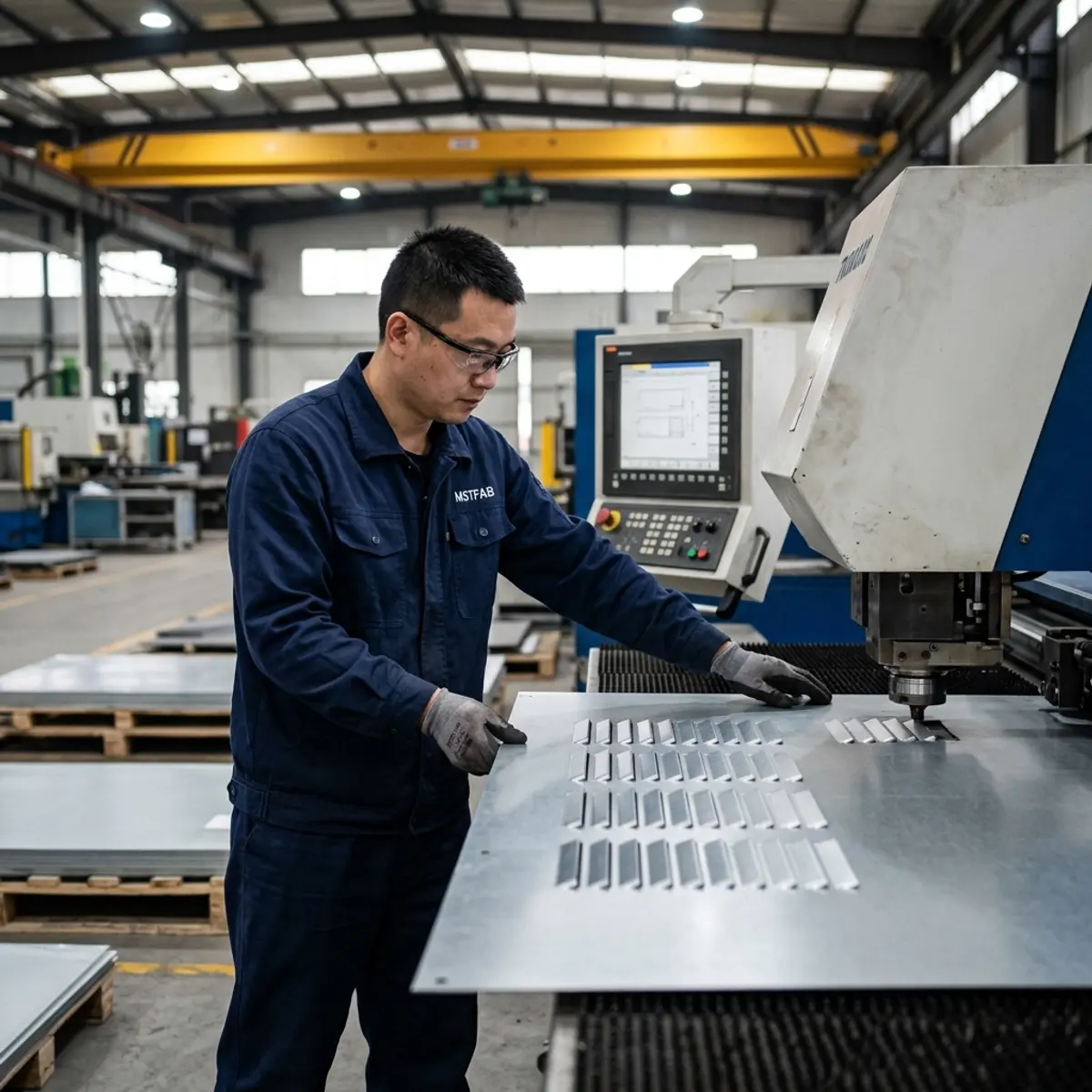
Fiber Laser Blanking & CNC Punching
High-speed 12kW fiber laser cutting produces clean, burr-free blanks for panels, doors, and sub-assemblies with ±0.05mm positioning accuracy. CNC punching centers form specialized louvers, countersinks, and embossed cable knockouts in a single operation.
CNC Multi-Axis Press Brake Bending
Using precision-ground segmented tooling and automatic crowning systems, press brakes execute multi-bend profiles (e.g., 4-bend water gutter channels and C-channel frame posts) with tight angle tolerances (±0.5°) to guarantee exact squareness upon final welding.
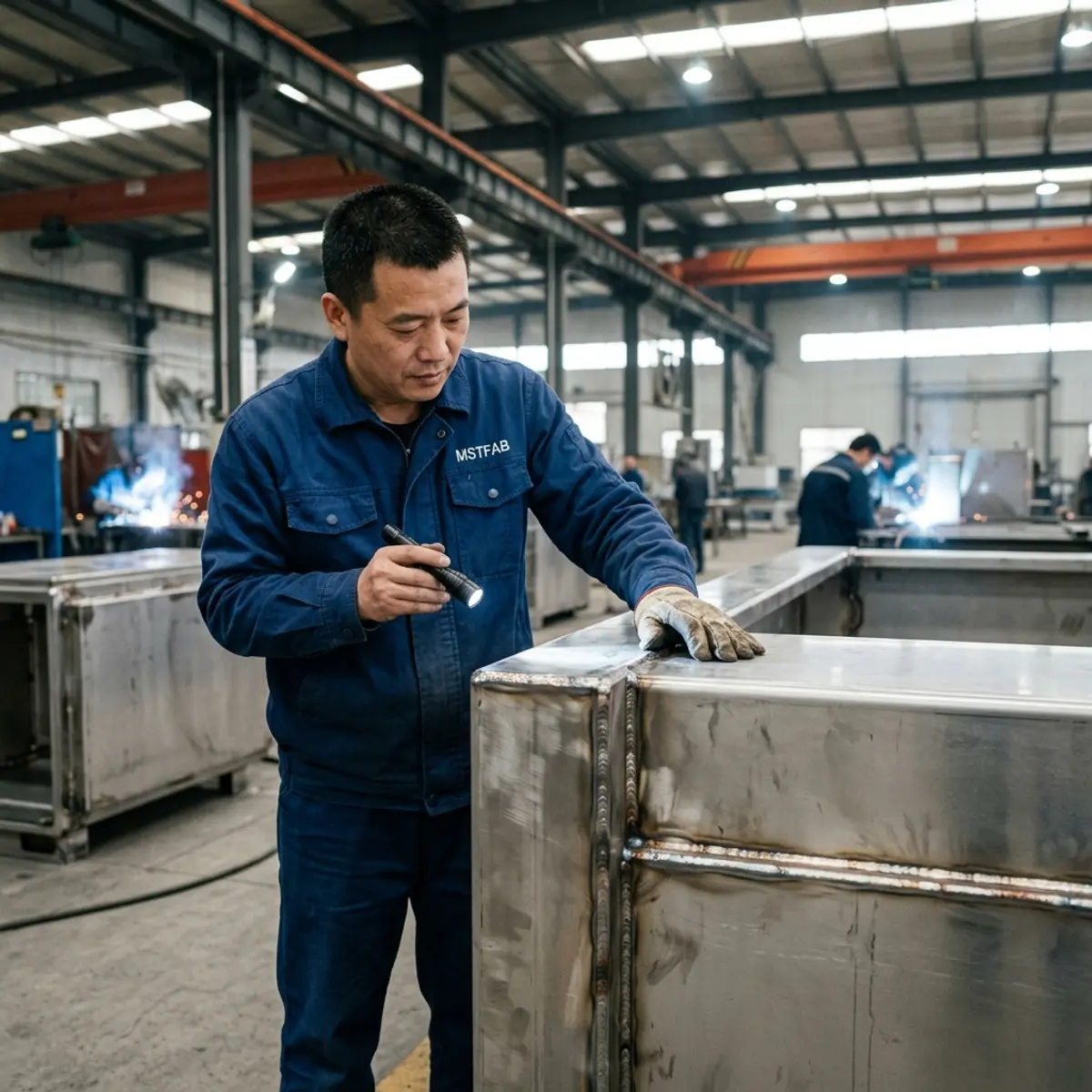
Seam Welding & Structural Assembly
Enclosure bodies undergo continuous gas tungsten arc welding (TIG) on external corner joints to create hermetic seams. Heavy-duty bottom plinths and lifting lug brackets are robotic MIG welded to sustain 1,500 kg crane hoist loads. Welds are dressed and ground flush on cosmetic surfaces.
Hardware Insertion & Clinching
Pneumatic insertion presses install PEM-equivalent blind clinch nuts, grounding studs (M6/M8 copper-plated), and heavy-duty cage nut rails without puncturing outer weather-facing surfaces.
Multi-Stage Pretreatment & Powder Coating
Parts pass through a 7-stage automated chemical wash (alkaline degrease, deoxidation, silane nanoceramic conversion) followed by electrostatic architectural polyester powder coating (AkzoNobel / Tiger Drylac). Cured at 200° C to achieve 80–120μm thickness, passing 1,000+ hours ASTM B117 salt spray testing (ISO 12944 C4/C5 classification).
Integration, Sealing & Pre-Shipment Inspection
FIPFG robotic gasket dispensing, three-point swing handle latch assembly, hinge torque adjustment, internal ground continuity testing (<0.1Ω), and full dimensional CMM validation against customer 3D master CAD models.
6. Internal 19-Inch Rack Configuration & Cable Gland Ingress
The interior architecture of an outdoor telecom enclosure determines equipment density, field maintenance ergonomics, and thermal airflow paths. Carrier deployments mandate standard interfaces:
- Standard 19-Inch / 21-Inch ETSI Mounting Rails: Manufactured from 2.0mm galvanized steel with standardized 1U (44.45mm) incremental square punching for M6 cage nuts. Rails feature depth-adjustable slotted brackets to accommodate deep rectifiers or shallow fiber patch trays.
- Cable Ingress & Gland Plates: Bottom cable entry plates feature modular knockouts (PG16, PG21, PG29, PG36) or multi-cable transit frames (Roxtec-compatible) fitted with rubber grommets and compression glands to prevent dust and moisture suction through conduit entries.
- Earth Grounding Busbar (Equipotential Bonding): A dedicated electro-tinned copper grounding busbar (typically 25mm x 3mm with M6 tapped holes) provides star-grounding for doors, side panels, equipment racks, and surge protection devices (SPD) in compliance with ITU-T K.27.
7. Cost Drivers & Global RFQ Drawing Checklist
To obtain an accurate, competitive manufacturing quotation from an OEM sheet metal fabricator, procurement teams must understand what drives enclosure unit price:
1. Raw Material Choice & Thickness
5052-H32 Aluminum and SUS304 carry a 2x–3x raw material cost premium over galvanized steel, but drastically reduce lifetime corrosion maintenance and freight costs.
2. Sealing & Gasket Technology
Automated CNC robotic FIPFG foam gaskets require programmed path setup, but offer superior seal repeatability and zero labor scrap compared to manual peel-and-stick foam tape.
3. Thermal Architecture Complexity
Double-wall construction involves double sheet blanking, insulation lamination, and additional bending processes, increasing shell cost by 35% to 50% over single-wall units.
4. Hardware & Locking Mechanism
Heavy-duty stainless steel 3-point or 4-point cam latches with master-keyed Euro profile cylinders represent a significant portion of enclosure hardware BOM cost.
Comprehensive RFQ Checklist for Telecom Buyers:
Include the following documentation when requesting an OEM fabrication quote from MSTFAB:
8. Frequently Asked Questions (FAQ): Telecom Enclosure Sourcing
What is the difference between IP55 and IP65 outdoor telecom enclosures?
An IP55 enclosure provides protection against dust deposits (limited ingress permitted without damaging internal electronics) and low-pressure water sprays from any direction. It typically uses filtered intake fans and louvered vents for cooling. An IP65 enclosure is 100% dust-tight (zero particle penetration under negative pressure) and withstands powerful high-pressure water jets. Because an IP65 cabinet cannot have open air louvers, it mandates closed-loop cooling systems such as air-to-air heat exchangers or sealed DC air conditioning units.
Why choose 5052-H32 aluminum over galvanized steel for outdoor telecom cabinets?
5052-H32 marine-grade aluminum is approximately 65% lighter than steel, significantly reducing dead load on rooftop telecommunication towers and lowering international air/sea freight shipping costs. Furthermore, aluminum has a thermal conductivity rate almost three times higher than carbon steel (138 W/m·K vs. 50 W/m·K), allowing the cabinet body itself to act as a large passive heat sink. It also develops a natural corrosion-resistant aluminum oxide layer that resists salt spray in coastal deployments.
When is double-wall insulation necessary for telecom cabinets?
Double-wall insulated construction is recommended when telecom enclosures are installed in regions with high solar radiation (desert, equatorial, or tropical regions where solar flux exceeds 1,000 W/m²) and when housing heat-sensitive components like lithium-ion battery packs. The insulating core (expanded PE or polyurethane foam) prevents external solar radiant heat from conducting into the internal equipment compartment, cutting HVAC energy consumption by up to 40%.
What is the standard manufacturing lead time for custom prototype telecom enclosures?
At MSTFAB, custom sheet metal prototype telecom enclosures typically require 10 to 15 business days from approved 3D CAD drawings to ready-to-ship product. Batch production runs (50 to 500 units) generally require 20 to 30 days, depending on coating specifications and hardware availability.
What quality documentation is provided with an export telecom enclosure order?
Standard export quality deliverables include: First Article Inspection (FAI) dimensional report, Raw Material Mill Test Certificates (MTR) confirming steel/aluminum grade, Coating Dry Film Thickness (DFT) and Cross-Hatch Adhesion test reports, Grounding Continuity test records, and pre-packaging photologs.
Partner with China’s Premier Custom Telecom Enclosure OEM
MSTFAB operates a 15,000 m² precision sheet metal manufacturing facility equipped with Trumpf fiber lasers, robotic press brakes, automated TIG welding cells, and architectural powder coating lines. Upload your CAD drawings for a comprehensive DFM review and factory-direct quotation within 24 hours.
 WeChat Contact
 WhatsApp Me Directly