
NEMA & IP RATED ELECTRICAL ENCLOSURE MANUFACTURING — EXECUTIVE TECHNICAL BRIEF
When electrical engineers search for a “NEMA 4X galvanized steel junction box,” they are balancing two critical requirements: NEMA 4/IP66 high-pressure hose-down watertightness and NEMA 4X 200-to-1,000 hour salt-spray corrosion resistance. This manufacturer guide explains when a duplex-coated Z275 galvanized box (zinc primer + UV polyester) meets your corrosion budget and when you should step up to 304/316L stainless steel.
- 100% Continuous Seam Welding & Labyrinth Gutter Geometry: Every nema 4x galvanized steel junction box electrical manufacturer shell is fabricated with continuous TIG/laser corner welds and an 18–20 mm double-bent rain gutter to prevent water or cutting-oil wicking.
- CNC Foam-in-Place (FIP) Polyurethane Gasketing: Robotic two-part PU foam dispensing creates a jointless 360° perimeter seal with 30%–40% compression recovery—outperforming hand-spliced strip tape.
- Conductive EMC Sub-Plates & Masked Earth Studs: Supplied with unpainted 2.0–2.5 mm trivalent-passivated galvanized mounting plates and silicone-masked M6/M8 copper ground studs (<0.05 Ω continuity).
- RoHS 3, REACH SVHC & ISO 9001:2015 Lot Traceability: Shipped with EN 10204 3.1 mill certificates, XRF/DFT coating logs, and ballooned First Article Inspection (FAI) documentation.
Every project at MSTFAB includes a complimentary 24-hour CAD Design-for-Manufacturing (DFM) audit, heat-number-traceable EN 10204 3.1 mill certificates, and a ballooned First Article Inspection (FAI) report prior to volume release.
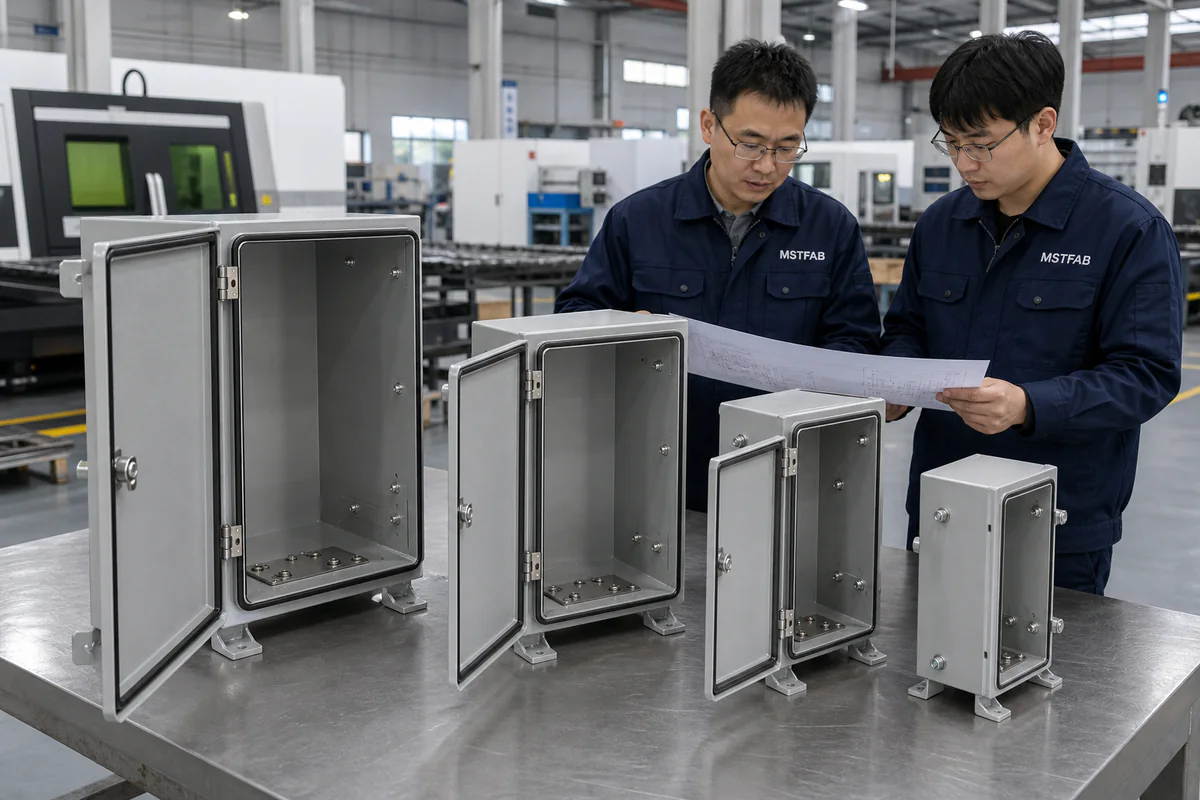
01 / Engineering Specifications & Comparison Matrix
Engineering Specifications, Tolerances & Verification Matrix: NEMA 4X Equivalent Duplex-Coated Galvanized vs Stainless Junction Box Manufacturer Guide (2026)
When electrical engineers search for a “NEMA 4X galvanized steel junction box,” they are balancing two critical requirements: NEMA 4/IP66 high-pressure hose-down watertightness and NEMA 4X 200-to-1,000 hour salt-spray corrosion resistance. This manufacturer guide explains when a duplex-coated Z275 galvanized box (zinc primer + UV polyester) meets your corrosion budget and when you should step up to 304/316L stainless steel. When sourcing custom sheet metal components and enclosures at industrial OEM scale, verbal assurances cannot substitute for drawing-locked process controls. Below is the engineering specification matrix governing raw material selection, dimensional tolerances (per ISO 2768-mK / fH), surface treatment durability, and metrology verification at MSTFAB.
Each parameter is verified during incoming raw material quarantine, in-process CNC stage checks, and final First Article Inspection (FAI) before shipment release:
| Engineering Parameter / Zone | Material & Process Specification | Target Tolerance / Performance Standard | Inspection Method & OEM Value |
|---|---|---|---|
| Enclosure Body & Door Skin | 1.5mm–2.0mm Duplex-Coated SGCC (Z275) OR SUS304 / SUS316L Stainless Steel | Diagonal squareness ≤ 1.0 mm; Door flatness ≤ 1.0 mm/m | CMM / Caliper + Chalk Contact Audit: Ensures uniform gasket compression around all four perimeter edges |
| Gutter & Sealing Flange | 18–20 mm Double-Returned Labyrinth Gutter (R = 1.5 mm crest) | Zero sharp edge cutting into foam; 360° continuous track | Optical Profile Gauge: Diverts washdown water, oil mist, and airborne conductive dust |
| Gasket & Ingress System | NEMA 4 / 4X & IP66 Hose-Directed Water Jet + 750–1,000h Salt-Spray Resistance | Shore 00 45–55; -40°C to +85°C continuous rating | IEC 60529 Jet Spray & Compression Set Log: Eliminates corner butt-splice leaks during pressure washdowns |
| Internal Sub-Plate & Ground | 2.0mm–2.5mm Unpainted GI Backplate + Masked M6 Earth Studs | Earth bond resistance < 0.05 Ω; hemmed wire-safe edges | 4-Wire Micro-Ohmmeter + Pull Torque Test: Provides plug-and-play DIN rail mounting and high-frequency EMC bonding |
| Exterior Duplex Coating | Nano-Zirconium / Zinc-Phosphate + Primer + UV Polyester (RAL 7035) | DFT 80–130 μm; ASTM D3359 5B adhesion; RoHS/REACH compliant | Elcometer DFT Map + Salt-Spray Coupon: Combines sacrificial zinc under-protection with chemical/UV durability |
02 / Sheet Metal DFM & Structural Controls
Critical Sheet Metal DFM Rules & Field Failure Prevention
Most cost overruns, assembly fit-up delays, and field corrosion failures originate from subtle CAD geometry details or ambiguous drawing notes. Implementing these Design-for-Manufacturing (DFM) controls before releasing your files eliminates tool collisions, thermal warpage, and rework:
Field Cutout Modifications Destroying Corrosion Protection
Failure Mechanism: Drilling or jigsawing connector holes on site leaves raw un-coated steel edges that rust and deform door flatness
Engineering Solution: Include all HMI, M12/M20 gland, and pushbutton cutouts (with +0.25 mm paint allowance) in the factory fiber-laser program or use bolt-on modular gland plates
Verified Outcome: Preserves 100% factory coating coverage and ±0.10 mm cutout precision
Knife-Edge 90° Flanges Slicing Into Door Gaskets
Failure Mechanism: A single-bent 90° rim cuts through soft sponge gaskets within 25 maintenance openings
Engineering Solution: Form a 180° hemmed or R1.5 mm U-channel crest along the door gutter perimeter
Verified Outcome: Extends gasket compression life across 10+ years of service
Unsealed Rear Wall Mounting Holes
Failure Mechanism: Through-holes in the back wall wick wall condensation directly behind the sub-plate
Engineering Solution: Specify welded external 3.0 mm stainless/galvanized mounting ears or O-ring sealed mounting bosses
Verified Outcome: Maintains true NEMA 12 / 4X / IP65 cavity isolation
Manufacturing Scope Boundary: Painted Ground Studs & Sub-Plates Blocking EMC Continuity: Full powder coating insulates protective earth paths and VFD heat sinks — Engineering Fix: Use unpainted galvanized sub-plates and mask all M6/M8 earth studs with die-cut silicone caps (Delivers <0.05 Ω ground continuity with zero line-side paint scraping). MSTFAB manufactures custom sheet metal parts and empty mechanical enclosure shells strictly to your 3D STEP and 2D PDF drawings.
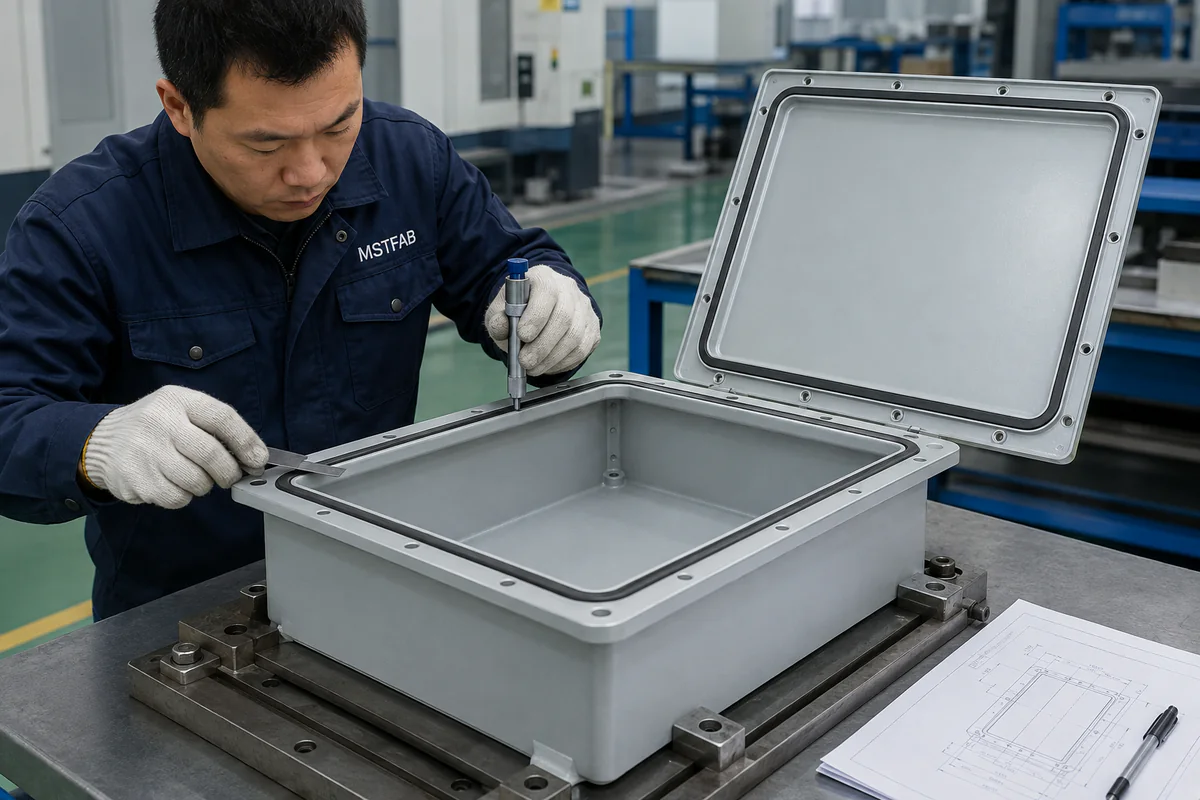
03 / Real Production Case Study & Process Control
Real Production Case Study: Outdoor Highway Tunnel Lighting & Sensor Junction Box Rollout (450 Units)
Project Profile: Dimensions: 350×300×160 mm | Material: 1.5mm SGCC (Z275) + ISO 12944 C4 Duplex Coating + 2.0mm GI Sub-Plate
OEM Engineering Challenge: A transportation electrical contractor needed 450 watertight junction boxes able to pass NEMA 4 / IP66 hose-down jets and 1,000-hour de-icing salt-spray tests at 30% lower cost than 316L stainless steel.
MSTFAB Manufacturing Solution: MSTFAB fabricated the boxes from heavy Z275 galvanized steel with CuSi3 silicon-bronze brazed corners, rotary-rounded all edges, applied a 60 μm zinc-rich epoxy primer + 80 μm super-durable UV polyester topcoat (140 μm total duplex DFT), and installed 316SS latches with CNC FIP polyurethane gaskets.
- ASTM B117 Salt-Spray Endurance: 1,000 hours passed with < 1.0 mm scribe creep
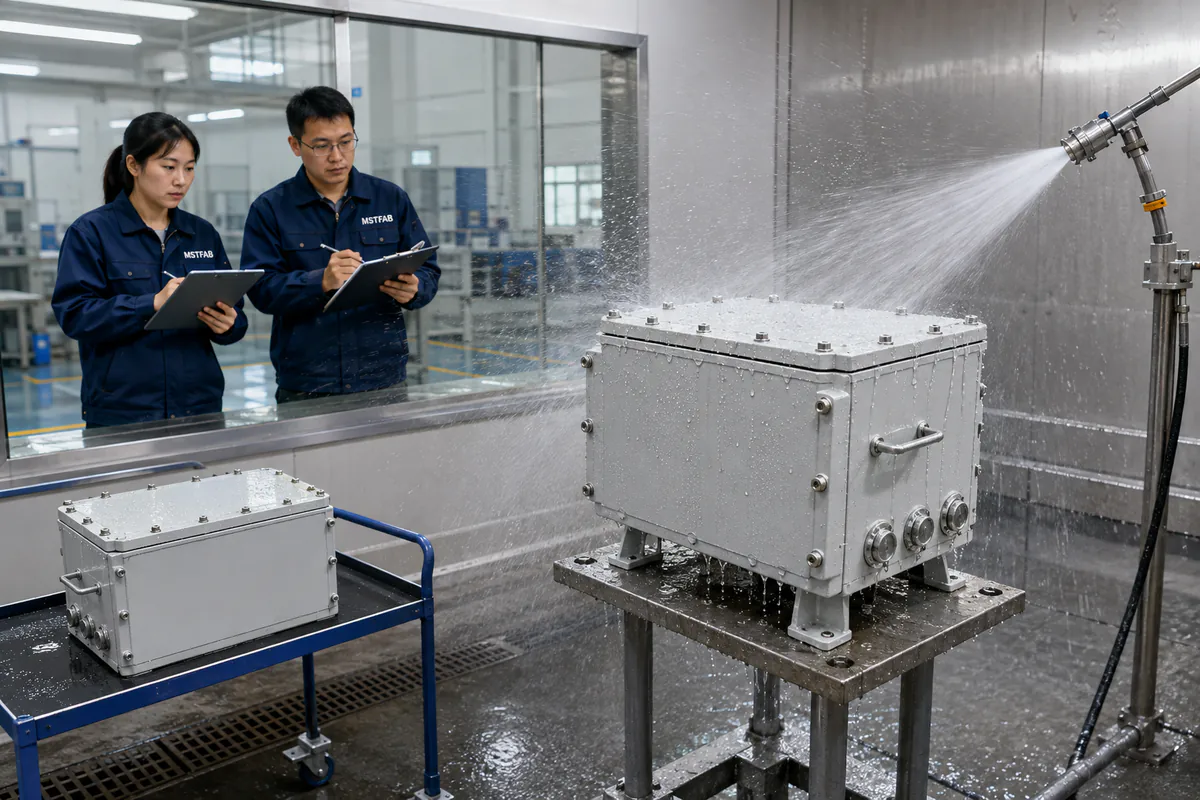
- NEMA 4 / IP66 Hose-Down Test: 100% pass rate (65 GPM / 100 L/min jet verification)
- Unit Cost Savings vs 316L Stainless: 34.5% BOM cost reduction across 450 units
- Ground Stud Continuity: < 0.02 Ω at masked M6 copper earth studs
Every production lot is archived with locked CNC laser nests, press-brake bend programs, weld fixture setups, and signed golden samples to guarantee identical repeatability across multi-year reorders.
04 / Quality Verification, Traceability & Surface Finishing
4-Stage Manufacturing Workflow, Surface Treatment & Metrology Control
To maintain Cpk ≥ 1.33 on critical-to-quality (CTQ) dimensions from prototype through series production, MSTFAB executes a closed-loop four-stage fabrication protocol:
Step 01 — 3D STEP CAD Unfold & Gland/Cutout Verification: MSTFAB engineers verify HMI/pushbutton cutouts, removable gland plate sealing paths, and internal sub-plate insertion clearances before locking the router.
Step 02 — Nitrogen Fiber Laser Blanking & Rotary Edge Rounding: Galvanized or stainless sheets are cut with high-pressure nitrogen (±0.10 mm) and mechanically deburred/edge-rounded so cables and coatings are protected.
Step 03 — CNC Press Brake Gutter Forming & Continuous Seam Welding: Labyrinth gutters and box returns are formed on 6-axis CNC press brakes, followed by continuous TIG or CuSi3 braze welding and leak inspection.
Step 04 — Masked Powder Coating, Robotic FIP Gasketing & FAI Release: Ground studs are masked, shells are powder coated or passivated, CNC polyurethane gaskets and latches are installed, and a ballooned FAI is completed.
All raw sheets (SPCC, SGCC, SECC, SUS304/316L, Al 5052-H32/6061-T6) are verified via optical emission spectrometry (OES) or XRF upon arrival and linked by barcode to your purchase order.
Prior to export crating in ISPM-15 fumigated plywood boxes, our quality lab conducts ballooned dimensional FAI checks, dry-film thickness (DFT) mapping, ASTM D3359 cross-hatch adhesion testing, and ground-continuity verification.
05 / 8-Point OEM RFQ Checklist & Topic Cluster Hub
OEM Engineering RFQ Checklist & Connected Fabrication Hubs
Include these eight drawing and specification controls in your RFQ package so our engineering team can lock down tooling, material traceability, and inspection fixtures on day one:
- RFQ Requirement 01Clarify corrosion environment: Duplex-Coated Z275 Galvanized (NEMA 4 + 1,000h salt spray) vs Bare/Coated 304/316L Stainless (true NEMA 4X)
- RFQ Requirement 02Provide 3D STEP model and 2D PDF drawing with external mounting ear coordinates and gland hole sizes
- RFQ Requirement 03Specify corner joining method: Continuous TIG welding (stainless) or low-heat CuSi3 MIG brazing (galvanized)
- RFQ Requirement 04Call out 18–20 mm double-bent labyrinth gutter flange and CNC FIP polyurethane or silicone sponge gasket
- RFQ Requirement 05Confirm hardware material: 304 or 316 stainless steel quarter-turn latches, clamp screws, and hinges
- RFQ Requirement 06Include internal 2.0 mm unpainted galvanized sub-plate, DIN-rail standoffs, and masked M6 earth studs
- RFQ Requirement 07Define factory verification required (IP66 water-jet video, 20-point DFT log, ASTM B117 salt-spray cert)
- RFQ Requirement 08State prototype validation quantity and batch production schedule
Explore Connected Sheet Metal Fabrication Services & Enclosure Hubs
CNC Press Brake Sheet Metal Bending & Forming
TIG / MIG / Robotic Sheet Metal Welding Services
Powder Coating, Passivation & Anodizing Finishes
Precision CNC Machining & Hybrid Metal Assemblies
Custom Electrical Enclosures & OEM Equipment Shells
Upload 3D STEP + 2D PDF for 24-Hour DFM & Price Quote
ISO 9001 & IATF 16949 Certified Factory Fact Sheet
06 / OEM Buyer & Engineer FAQ
Frequently Asked Questions: NEMA 4X Equivalent Duplex-Coated Galvanized vs Stainless Junction Box Manufacturer Guide (2026)
Can galvanized steel be used for a NEMA 4X junction box, or is stainless steel required?
Strictly speaking under UL 50E / NEMA 250, NEMA 4 provides the exact same watertight hose-down protection as NEMA 4X, while the “X” adds corrosion resistance (historically met by 304/316L stainless, 5052 aluminum, or polymers passing 200+ hours of salt spray). However, when Z275 galvanized steel is edge-rounded and coated with a 140 μm ISO 12944 C4/C5 duplex system (zinc-rich epoxy primer + UV polyester topcoat), it exceeds 1,000 hours of ASTM B117 salt spray—giving OEMs NEMA 4X-level corrosion performance at ~30% lower cost than 316L stainless.
Does MSTFAB fabricate both duplex-coated galvanized and 304/316L stainless NEMA 4X junction boxes?
Yes! We manufacture both options side-by-side in our Guangzhou factory and often quote both materials on the same RFQ so your engineering and procurement teams can compare exact unit pricing and corrosion specs.
Why is silicon-bronze (CuSi3) brazing superior to standard MIG welding on galvanized junction boxes?
Standard steel MIG welding burns at ~1,500°C, vaporizing the protective zinc layer around the corner seam (since zinc boils at 907°C). Silicon-bronze (CuSi3) MIG brazing melts at a much lower ~980°C, creating a dense, corrosion-proof bronze corner fillet while keeping the surrounding zinc coating intact.
How do you seal cable gland entries on a NEMA 4 / 4X junction box?
For fixed conduit layouts, we fiber-laser cut precision M16/M20/M25/M32 or NPT knockout holes directly in the bottom wall before coating so the hole edges are 100% sealed. If a removable bottom gland plate is used, we dispense a continuous CNC FIP gasket onto the gland plate and secure it with captive stainless nuts.
Do your junction boxes ship with the internal mounting sub-plate and grounding studs?
Yes. Every junction box includes an unpainted 2.0 mm galvanized or stainless sub-plate, pre-welded M6 copper earth studs on both the door and body (masked during coating), and pre-installed stainless hinges and latches.
What is the lead time for custom NEMA 4 / 4X electrical junction boxes?
Prototypes ship in 7–10 business days, and production orders of 50–1,000+ units ship in 15–20 business days.
International Standards & Engineering References
- ISO 2768-1 / 2768-2 — General Linear, Angular and Geometrical Tolerances for Sheet Metal Fabrication
- IEC 60529 / NEMA 250 — Degrees of Protection Provided by Enclosures (IP Code & Environmental Sealing)
- ISO 9001:2015 & IATF 16949:2016 — Quality Management Systems & Production Part Approval Process (PPAP)
Ready to Quote Your Custom Sheet Metal Enclosure or Fabrication Project?
Upload your 3D STEP models and 2D PDF drawings. MSTFAB will review your tolerances, material specs, and DFM details to deliver a transparent factory quote within 24 hours.
Request Your 24-Hour DFM & Custom Quote →
Direct engineering desk: caroline@mstfab.com | ISO 9001 & IATF 16949 Certified Factory in Guangzhou, China
 WeChat Contact
 WhatsApp Me Directly