
NEMA & IP RATED ELECTRICAL ENCLOSURE MANUFACTURING — EXECUTIVE TECHNICAL BRIEF
When panel builders buy generic off-the-shelf NEMA 12 boxes and spend 3 hours per box sawing HMI windows, punching M20 conduit holes, and drilling sub-plates by hand, they introduce metal shavings, raw rust-prone edges, and warped doors. Ordering factory-customized NEMA Type 12 machinery electrical box shells from MSTFAB eliminates field modifications while cutting total installed cost by 35%.
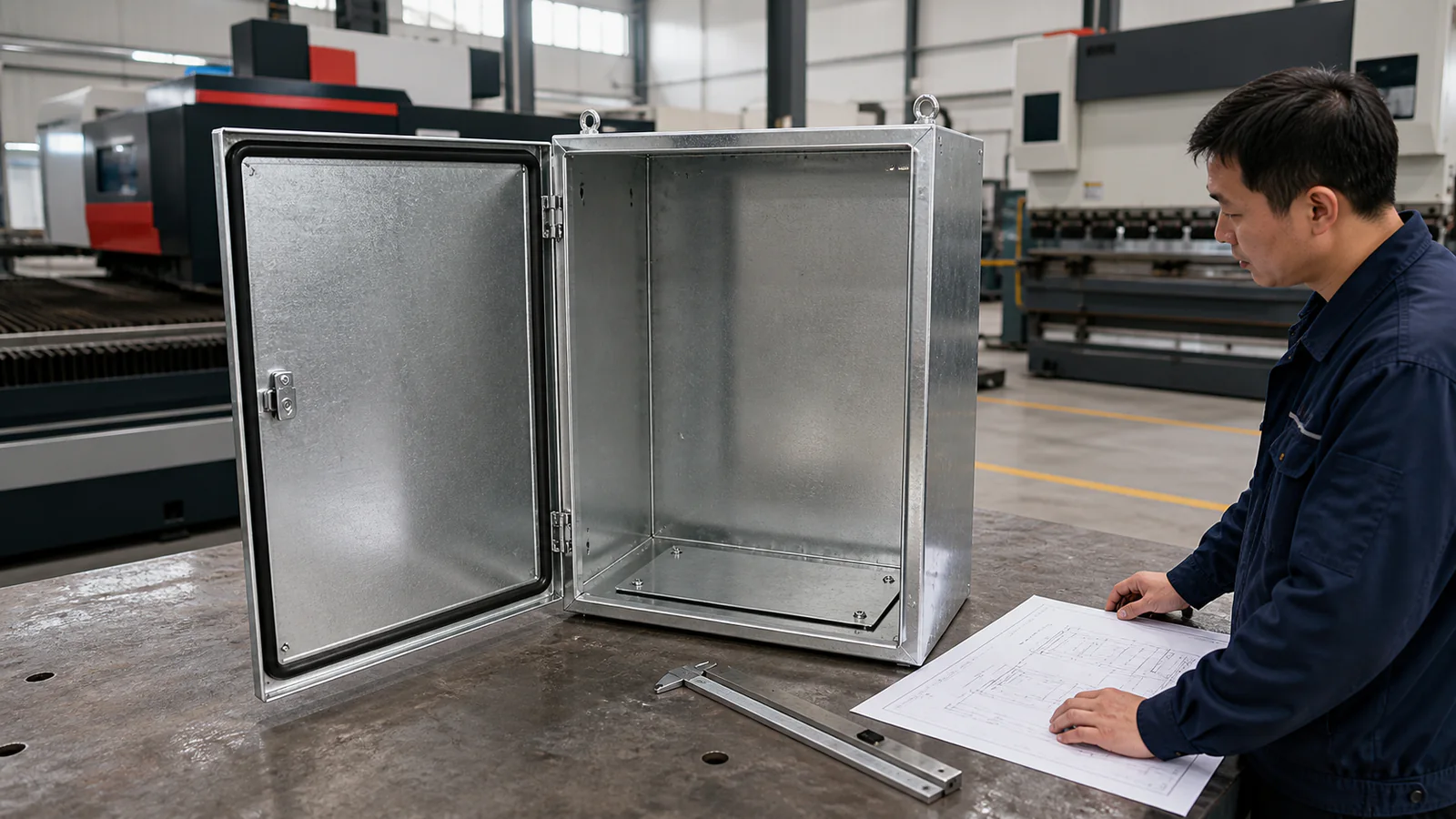
- 100% Continuous Seam Welding & Labyrinth Gutter Geometry: Every nema 12 machinery electrical box field modification shell is fabricated with continuous TIG/laser corner welds and an 18–20 mm double-bent rain gutter to prevent water or cutting-oil wicking.
- CNC Foam-in-Place (FIP) Polyurethane Gasketing: Robotic two-part PU foam dispensing creates a jointless 360° perimeter seal with 30%–40% compression recovery—outperforming hand-spliced strip tape.
- Conductive EMC Sub-Plates & Masked Earth Studs: Supplied with unpainted 2.0–2.5 mm trivalent-passivated galvanized mounting plates and silicone-masked M6/M8 copper ground studs (<0.05 Ω continuity).
- RoHS 3, REACH SVHC & ISO 9001:2015 Lot Traceability: Shipped with EN 10204 3.1 mill certificates, XRF/DFT coating logs, and ballooned First Article Inspection (FAI) documentation.
Every project at MSTFAB includes a complimentary 24-hour CAD Design-for-Manufacturing (DFM) audit, heat-number-traceable EN 10204 3.1 mill certificates, and a ballooned First Article Inspection (FAI) report prior to volume release.
01 / Engineering Specifications & Comparison Matrix
Engineering Specifications, Tolerances & Verification Matrix: NEMA Type 12 Machinery Electrical Box Shells
When panel builders buy generic off-the-shelf NEMA 12 boxes and spend 3 hours per box sawing HMI windows, punching M20 conduit holes, and drilling sub-plates by hand, they introduce metal shavings, raw rust-prone edges, and warped doors. Ordering factory-customized NEMA Type 12 machinery electrical box shells from MSTFAB eliminates field modifications while cutting total installed cost by 35%. When sourcing custom sheet metal components and enclosures at industrial OEM scale, verbal assurances cannot substitute for drawing-locked process controls. Below is the engineering specification matrix governing raw material selection, dimensional tolerances (per ISO 2768-mK / fH), surface treatment durability, and metrology verification at MSTFAB.
Each parameter is verified during incoming raw material quarantine, in-process CNC stage checks, and final First Article Inspection (FAI) before shipment release:
| Engineering Parameter / Zone | Material & Process Specification | Target Tolerance / Performance Standard | Inspection Method & OEM Value |
|---|---|---|---|
| Enclosure Body & Door Skin | 1.5mm–2.0mm SPCC / SGCC Shell + 2.0mm–2.5mm Unpainted GI Sub-Plate | Diagonal squareness ≤ 1.0 mm; Door flatness ≤ 1.0 mm/m | CMM / Caliper + Chalk Contact Audit: Ensures uniform gasket compression around all four perimeter edges |
| Gutter & Sealing Flange | 18–20 mm Double-Returned Labyrinth Gutter (R = 1.5 mm crest) | Zero sharp edge cutting into foam; 360° continuous track | Optical Profile Gauge: Diverts washdown water, oil mist, and airborne conductive dust |
| Gasket & Ingress System | NEMA Type 12 / IP54–IP55 Industrial Dust, Lint & Cutting-Oil Mist Tight | Shore 00 45–55; -40°C to +85°C continuous rating | IEC 60529 Jet Spray & Compression Set Log: Eliminates corner butt-splice leaks during pressure washdowns |
| Internal Sub-Plate & Ground | 2.0mm–2.5mm Unpainted GI Backplate + Masked M6 Earth Studs | Earth bond resistance < 0.05 Ω; hemmed wire-safe edges | 4-Wire Micro-Ohmmeter + Pull Torque Test: Provides plug-and-play DIN rail mounting and high-frequency EMC bonding |
| Exterior Duplex Coating | Nano-Zirconium / Zinc-Phosphate + Primer + UV Polyester (RAL 7035) | DFT 80–130 μm; ASTM D3359 5B adhesion; RoHS/REACH compliant | Elcometer DFT Map + Salt-Spray Coupon: Combines sacrificial zinc under-protection with chemical/UV durability |
02 / Sheet Metal DFM & Structural Controls
Critical Sheet Metal DFM Rules & Field Failure Prevention
Most cost overruns, assembly fit-up delays, and field corrosion failures originate from subtle CAD geometry details or ambiguous drawing notes. Implementing these Design-for-Manufacturing (DFM) controls before releasing your files eliminates tool collisions, thermal warpage, and rework:
Field Cutout Modifications Destroying Corrosion Protection
Failure Mechanism: Drilling or jigsawing connector holes on site leaves raw un-coated steel edges that rust and deform door flatness
Engineering Solution: Include all HMI, M12/M20 gland, and pushbutton cutouts (with +0.25 mm paint allowance) in the factory fiber-laser program or use bolt-on modular gland plates
Verified Outcome: Preserves 100% factory coating coverage and ±0.10 mm cutout precision
Knife-Edge 90° Flanges Slicing Into Door Gaskets
Failure Mechanism: A single-bent 90° rim cuts through soft sponge gaskets within 25 maintenance openings
Engineering Solution: Form a 180° hemmed or R1.5 mm U-channel crest along the door gutter perimeter
Verified Outcome: Extends gasket compression life across 10+ years of service
Unsealed Rear Wall Mounting Holes
Failure Mechanism: Through-holes in the back wall wick wall condensation directly behind the sub-plate
Engineering Solution: Specify welded external 3.0 mm stainless/galvanized mounting ears or O-ring sealed mounting bosses
Verified Outcome: Maintains true NEMA 12 / 4X / IP65 cavity isolation
Manufacturing Scope Boundary: Painted Ground Studs & Sub-Plates Blocking EMC Continuity: Full powder coating insulates protective earth paths and VFD heat sinks — Engineering Fix: Use unpainted galvanized sub-plates and mask all M6/M8 earth studs with die-cut silicone caps (Delivers <0.05 Ω ground continuity with zero line-side paint scraping). MSTFAB manufactures custom sheet metal parts and empty mechanical enclosure shells strictly to your 3D STEP and 2D PDF drawings.

03 / Real Production Case Study & Process Control
Real Production Case Study: CNC Machine Tool Auxiliary Coolant & Servo Box Standardization (120 Units/Quarter)
Project Profile: Dimensions: 500×400×200 mm | Material: 1.5mm SPCC + 2.5mm GI Sub-Plate | Labor Saved: 2.8 Hrs/Box
OEM Engineering Challenge: A CNC machine tool builder was buying standard catalog NEMA 12 boxes for $68 and spending $145 in electrician labor per box punching 18 Harting/M20 holes, jigsawing an 8-inch HMI cutout, and touching up raw steel edges with spray paint.
MSTFAB Manufacturing Solution: MSTFAB delivered custom laser-cut NEMA 12 shells with all 18 connector cutouts, the stiffened HMI aperture, and pre-tapped M5 DIN-rail holes on the 2.5 mm galvanized sub-plate— plus 3 interchangeable bottom gland plate SKUs for different machine options—at $64/unit complete.
- Panel Shop Modification Labor: Reduced from 2.8 hours to 0 minutes per box
- Net Installed Cost Savings: $149 saved per enclosure ($71,500/year)
- Cutout Edge Corrosion Protection: 100% factory powder-coated cutout edges
- NEMA 12 Oil-Mist Seal Integrity: 100% pass with CNC FIP polyurethane gaskets
Every production lot is archived with locked CNC laser nests, press-brake bend programs, weld fixture setups, and signed golden samples to guarantee identical repeatability across multi-year reorders.
04 / Quality Verification, Traceability & Surface Finishing
4-Stage Manufacturing Workflow, Surface Treatment & Metrology Control
To maintain Cpk ≥ 1.33 on critical-to-quality (CTQ) dimensions from prototype through series production, MSTFAB executes a closed-loop four-stage fabrication protocol:
Step 01 — 3D STEP CAD Unfold & Gland/Cutout Verification: MSTFAB engineers verify HMI/pushbutton cutouts, removable gland plate sealing paths, and internal sub-plate insertion clearances before locking the router.
Step 02 — Nitrogen Fiber Laser Blanking & Rotary Edge Rounding: Galvanized or stainless sheets are cut with high-pressure nitrogen (±0.10 mm) and mechanically deburred/edge-rounded so cables and coatings are protected.
Step 03 — CNC Press Brake Gutter Forming & Continuous Seam Welding: Labyrinth gutters and box returns are formed on 6-axis CNC press brakes, followed by continuous TIG or CuSi3 braze welding and leak inspection.
Step 04 — Masked Powder Coating, Robotic FIP Gasketing & FAI Release: Ground studs are masked, shells are powder coated or passivated, CNC polyurethane gaskets and latches are installed, and a ballooned FAI is completed.
All raw sheets (SPCC, SGCC, SECC, SUS304/316L, Al 5052-H32/6061-T6) are verified via optical emission spectrometry (OES) or XRF upon arrival and linked by barcode to your purchase order.
Prior to export crating in ISPM-15 fumigated plywood boxes, our quality lab conducts ballooned dimensional FAI checks, dry-film thickness (DFT) mapping, ASTM D3359 cross-hatch adhesion testing, and ground-continuity verification.

05 / 8-Point OEM RFQ Checklist & Topic Cluster Hub
OEM Engineering RFQ Checklist & Connected Fabrication Hubs
Include these eight drawing and specification controls in your RFQ package so our engineering team can lock down tooling, material traceability, and inspection fixtures on day one:
- RFQ Requirement 01Export your EPLAN / AutoCAD Electrical cutout layout as a 3D STEP or 2D DXF/PDF so all holes are laser-cut before coating
- RFQ Requirement 02Include +0.25 mm powder-coat clearance on 22.5 mm pushbutton holes (cut at Ø22.75 mm with 3.2 mm anti-rotation keyway)
- RFQ Requirement 03Design bolt-on removable bottom/top gland plates with FIP gaskets so one main box shell supports multiple cable options
- RFQ Requirement 04Specify laser-cut pilot holes or factory-tapped M4/M5/M6 DIN-rail and wire-duct holes on the unpainted galvanized sub-plate
- RFQ Requirement 05Add laser-cut + gasketed blanking cover plates over future expansion HMI or fan cutouts
- RFQ Requirement 06Confirm oil-resistant CNC Foam-in-Place (FIP) polyurethane gasket chemistry for factory cutting-fluid mist
- RFQ Requirement 07Specify masked M6 copper earth studs on door, body, and removable gland plates
- RFQ Requirement 08State batch quantity per machine variant and quarterly release schedule
Explore Connected Sheet Metal Fabrication Services & Enclosure Hubs
CNC Press Brake Sheet Metal Bending & Forming
TIG / MIG / Robotic Sheet Metal Welding Services
Powder Coating, Passivation & Anodizing Finishes
Precision CNC Machining & Hybrid Metal Assemblies
Custom Electrical Enclosures & OEM Equipment Shells
Upload 3D STEP + 2D PDF for 24-Hour DFM & Price Quote
ISO 9001 & IATF 16949 Certified Factory Fact Sheet
06 / OEM Buyer & Engineer FAQ
Frequently Asked Questions: NEMA Type 12 Machinery Electrical Box Shells
Why is factory laser cutting before powder coating so much better than modifying a standard NEMA 12 box in the shop?
Three reasons: (1) Fiber laser cutting in the flat sheet takes 15 seconds and holds ±0.10 mm with zero burrs, whereas manual hydraulic knockout punching or jigsawing a finished box takes 2+ hours and warps thin doors; (2) Laser cutting BEFORE pre-treatment and powder coating seals 100% of the cutout edges against rust; and (3) It eliminates dangerous conductive metal shavings inside your electrical shop.
How can we handle machine options where different customers need different connector holes on the same NEMA 12 box?
Instead of cutting connector holes directly into the welded enclosure wall, we design a large standardized opening on the bottom or side wall covered by a bolt-on, FIP-gasketed removable gland plate. We then supply 3 or 4 low-cost interchangeable gland plate SKUs (e.g., Option A: 8x M20; Option B: 2x Harting Han-24B; Option C: Blank) that swap in 60 seconds!
Can you pre-drill and tap our exact DIN-rail and wire-duct layout onto the internal sub-plate?
Yes! Send us the sub-plate DXF from EPLAN or SolidWorks Electrical. We fiber-laser cut the exact hole coordinates and run automated multi-spindle tapping (M4, M5, M6) or press PEM nuts into the 2.0–3.0 mm unpainted galvanized sub-plate.
What gasket material is best for NEMA 12 machinery boxes exposed to CNC cutting oils?
Standard EPDM rubber swells and degrades when exposed to petroleum-based metalworking fluids and synthetic coolants. For NEMA Type 12 machinery boxes, MSTFAB dispenses oil-resistant closed-cell thixotropic polyurethane (PU) or nitrile (Buna-N) gaskets.
What if we need a fan/filter cutout on high-power models but a sealed wall on low-power models?
We laser-cut the fan aperture and PEM mounting nuts on all shells, and include a matching powder-coated + FIP-gasketed bolt-on blanking cover plate for the low-power models—giving you 1 common enclosure SKU.
Is there a minimum order quantity to get custom cutouts on NEMA 12 boxes?
No hard tooling is used—even for 5 to 10 enclosures, factory-lasered custom NEMA 12 shells cost less than buying catalog boxes and modifying them by hand.
International Standards & Engineering References
- ISO 2768-1 / 2768-2 — General Linear, Angular and Geometrical Tolerances for Sheet Metal Fabrication
- IEC 60529 / NEMA 250 — Degrees of Protection Provided by Enclosures (IP Code & Environmental Sealing)
- ISO 9001:2015 & IATF 16949:2016 — Quality Management Systems & Production Part Approval Process (PPAP)
Ready to Quote Your Custom Sheet Metal Enclosure or Fabrication Project?
Upload your 3D STEP models and 2D PDF drawings. MSTFAB will review your tolerances, material specs, and DFM details to deliver a transparent factory quote within 24 hours.
Request Your 24-Hour DFM & Custom Quote →
Direct engineering desk: caroline@mstfab.com | ISO 9001 & IATF 16949 Certified Factory in Guangzhou, China
 WeChat Contact
 WhatsApp Me Directly