
NEMA & IP RATED ELECTRICAL ENCLOSURE MANUFACTURING — EXECUTIVE TECHNICAL BRIEF
Industrial conveyor networks, automotive assembly lines, and packaging machines rely on NEMA 12 galvanized steel junction boxes to protect terminal blocks and fieldbus I/O modules from airborne dust and cutting-oil drip. This manufacturer guide explains the critical difference between NEMA Type 12 and Type 12K, how to specify gasketed gland plates vs knockouts, and how to guarantee <0.05 Ω protective bonding.
- 100% Continuous Seam Welding & Labyrinth Gutter Geometry: Every nema 12 galvanized steel junction box electrical manufacturer shell is fabricated with continuous TIG/laser corner welds and an 18–20 mm double-bent rain gutter to prevent water or cutting-oil wicking.
- CNC Foam-in-Place (FIP) Polyurethane Gasketing: Robotic two-part PU foam dispensing creates a jointless 360° perimeter seal with 30%–40% compression recovery—outperforming hand-spliced strip tape.
- Conductive EMC Sub-Plates & Masked Earth Studs: Supplied with unpainted 2.0–2.5 mm trivalent-passivated galvanized mounting plates and silicone-masked M6/M8 copper ground studs (<0.05 Ω continuity).
- RoHS 3, REACH SVHC & ISO 9001:2015 Lot Traceability: Shipped with EN 10204 3.1 mill certificates, XRF/DFT coating logs, and ballooned First Article Inspection (FAI) documentation.
Every project at MSTFAB includes a complimentary 24-hour CAD Design-for-Manufacturing (DFM) audit, heat-number-traceable EN 10204 3.1 mill certificates, and a ballooned First Article Inspection (FAI) report prior to volume release.
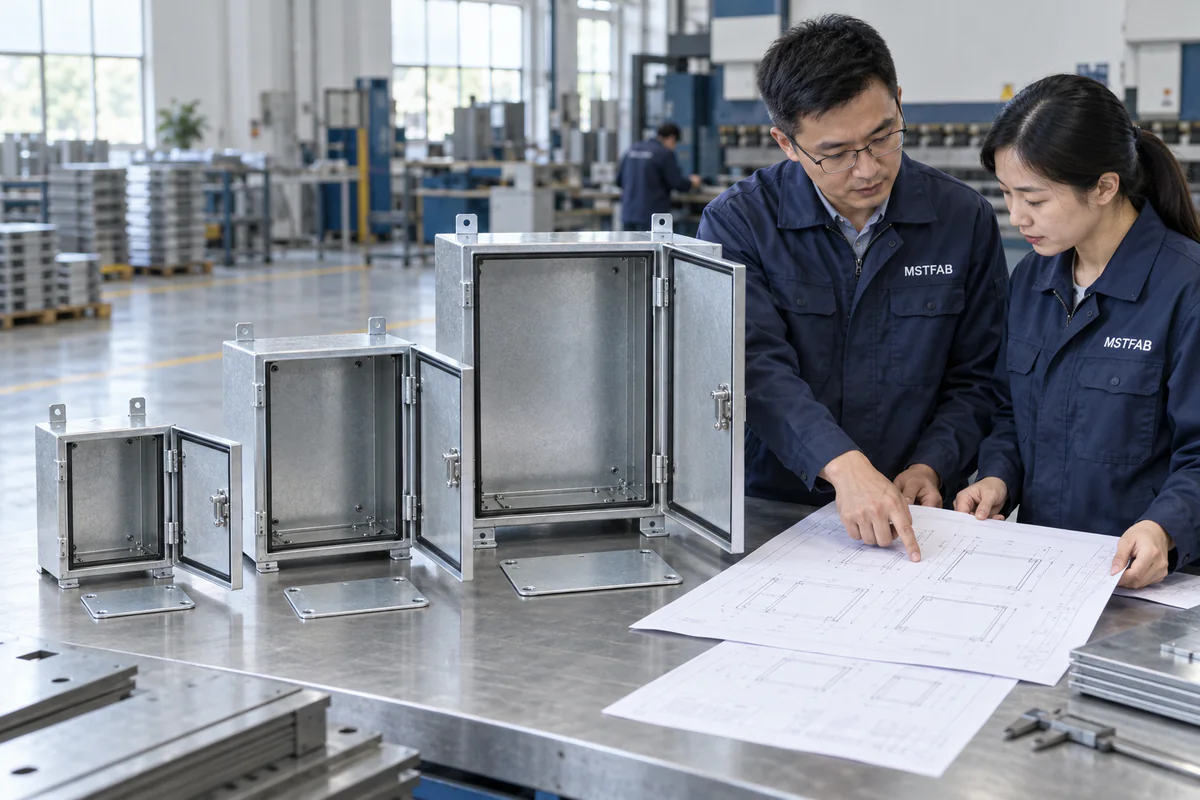
01 / Engineering Specifications & Comparison Matrix
Engineering Specifications, Tolerances & Verification Matrix: NEMA 12 Galvanized Steel Junction Box Manufacturer
Industrial conveyor networks, automotive assembly lines, and packaging machines rely on NEMA 12 galvanized steel junction boxes to protect terminal blocks and fieldbus I/O modules from airborne dust and cutting-oil drip. This manufacturer guide explains the critical difference between NEMA Type 12 and Type 12K, how to specify gasketed gland plates vs knockouts, and how to guarantee <0.05 Ω protective bonding. When sourcing custom sheet metal components and enclosures at industrial OEM scale, verbal assurances cannot substitute for drawing-locked process controls. Below is the engineering specification matrix governing raw material selection, dimensional tolerances (per ISO 2768-mK / fH), surface treatment durability, and metrology verification at MSTFAB.
Each parameter is verified during incoming raw material quarantine, in-process CNC stage checks, and final First Article Inspection (FAI) before shipment release:
| Engineering Parameter / Zone | Material & Process Specification | Target Tolerance / Performance Standard | Inspection Method & OEM Value |
|---|---|---|---|
| Enclosure Body & Door Skin | 1.5mm–2.0mm SGCC / SECC Galvanized Steel + 2.0mm Unpainted GI Sub-Plate | Diagonal squareness ≤ 1.0 mm; Door flatness ≤ 1.0 mm/m | CMM / Caliper + Chalk Contact Audit: Ensures uniform gasket compression around all four perimeter edges |
| Gutter & Sealing Flange | 18–20 mm Double-Returned Labyrinth Gutter (R = 1.5 mm crest) | Zero sharp edge cutting into foam; 360° continuous track | Optical Profile Gauge: Diverts washdown water, oil mist, and airborne conductive dust |
| Gasket & Ingress System | NEMA Type 12 / 12K & IP54–IP55 Industrial Oil/Dust-Tight Junction Boxes | Shore 00 45–55; -40°C to +85°C continuous rating | IEC 60529 Jet Spray & Compression Set Log: Eliminates corner butt-splice leaks during pressure washdowns |
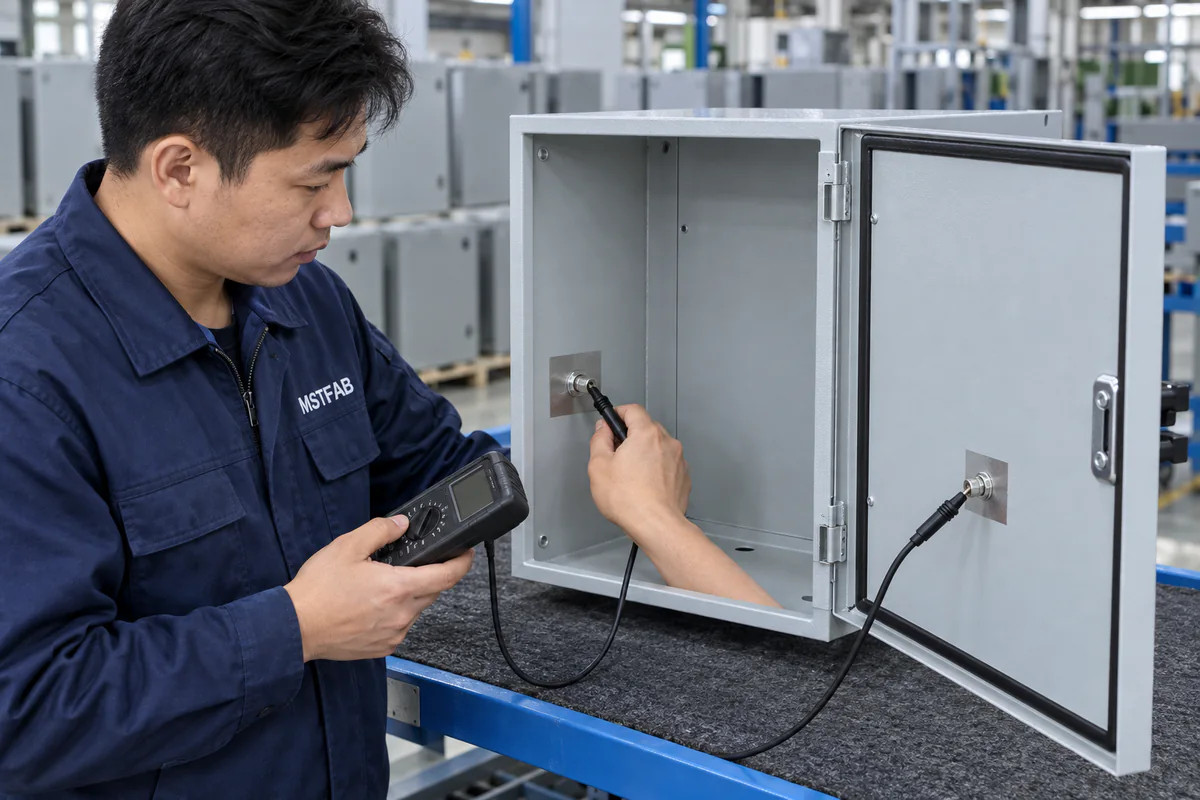
| Internal Sub-Plate & Ground | 2.0mm–2.5mm Unpainted GI Backplate + Masked M6 Earth Studs | Earth bond resistance < 0.05 Ω; hemmed wire-safe edges | 4-Wire Micro-Ohmmeter + Pull Torque Test: Provides plug-and-play DIN rail mounting and high-frequency EMC bonding |
| Exterior Duplex Coating | Nano-Zirconium / Zinc-Phosphate + Primer + UV Polyester (RAL 7035) | DFT 80–130 μm; ASTM D3359 5B adhesion; RoHS/REACH compliant | Elcometer DFT Map + Salt-Spray Coupon: Combines sacrificial zinc under-protection with chemical/UV durability |
02 / Sheet Metal DFM & Structural Controls
Critical Sheet Metal DFM Rules & Field Failure Prevention
Most cost overruns, assembly fit-up delays, and field corrosion failures originate from subtle CAD geometry details or ambiguous drawing notes. Implementing these Design-for-Manufacturing (DFM) controls before releasing your files eliminates tool collisions, thermal warpage, and rework:
Field Cutout Modifications Destroying Corrosion Protection
Failure Mechanism: Drilling or jigsawing connector holes on site leaves raw un-coated steel edges that rust and deform door flatness
Engineering Solution: Include all HMI, M12/M20 gland, and pushbutton cutouts (with +0.25 mm paint allowance) in the factory fiber-laser program or use bolt-on modular gland plates
Verified Outcome: Preserves 100% factory coating coverage and ±0.10 mm cutout precision
Knife-Edge 90° Flanges Slicing Into Door Gaskets
Failure Mechanism: A single-bent 90° rim cuts through soft sponge gaskets within 25 maintenance openings
Engineering Solution: Form a 180° hemmed or R1.5 mm U-channel crest along the door gutter perimeter
Verified Outcome: Extends gasket compression life across 10+ years of service
Unsealed Rear Wall Mounting Holes
Failure Mechanism: Through-holes in the back wall wick wall condensation directly behind the sub-plate
Engineering Solution: Specify welded external 3.0 mm stainless/galvanized mounting ears or O-ring sealed mounting bosses
Verified Outcome: Maintains true NEMA 12 / 4X / IP65 cavity isolation
Manufacturing Scope Boundary: Painted Ground Studs & Sub-Plates Blocking EMC Continuity: Full powder coating insulates protective earth paths and VFD heat sinks — Engineering Fix: Use unpainted galvanized sub-plates and mask all M6/M8 earth studs with die-cut silicone caps (Delivers <0.05 Ω ground continuity with zero line-side paint scraping). MSTFAB manufactures custom sheet metal parts and empty mechanical enclosure shells strictly to your 3D STEP and 2D PDF drawings.

03 / Real Production Case Study & Process Control
Real Production Case Study: Automotive Body-in-White Weld Line Distributed I/O Junction Box (300×250×150 mm)
Project Profile: Volume: 500 Units/Quarter | Material: 1.5mm SGCC (Z180) + RAL 7035 Powder | Rating: NEMA Type 12
OEM Engineering Challenge: An automotive tier-1 integrator experienced oil seepage through half-punched conduit knockouts and high-frequency PROFINET ground noise on junction boxes bought from a commodity hardware catalog.
MSTFAB Manufacturing Solution: MSTFAB fabricated a true NEMA Type 12 (non-knockout) galvanized steel box with pre-lasered M12 bulkhead connector ports (+0.20 mm paint allowance), an unpainted trivalent-chromated SECC internal sub-plate, masked M6 copper earth studs, and an oil-resistant CNC FIP polyurethane door gasket.
- Cutting-Oil & Weld-Dust Ingress: 0% ingress across 1,500 deployed line-side boxes
- PROFINET Shield Ground Impedance: < 0.015 Ω via bare trivalent SECC backplate
- Integration Wiring Time Saved: 22 minutes per box (no knockout punching required)
- Unit Price at 500-Pc Batch: 19% lower than modified catalog boxes
Every production lot is archived with locked CNC laser nests, press-brake bend programs, weld fixture setups, and signed golden samples to guarantee identical repeatability across multi-year reorders.
04 / Quality Verification, Traceability & Surface Finishing
4-Stage Manufacturing Workflow, Surface Treatment & Metrology Control
To maintain Cpk ≥ 1.33 on critical-to-quality (CTQ) dimensions from prototype through series production, MSTFAB executes a closed-loop four-stage fabrication protocol:
Step 01 — 3D STEP CAD Unfold & Gland/Cutout Verification: MSTFAB engineers verify HMI/pushbutton cutouts, removable gland plate sealing paths, and internal sub-plate insertion clearances before locking the router.
Step 02 — Nitrogen Fiber Laser Blanking & Rotary Edge Rounding: Galvanized or stainless sheets are cut with high-pressure nitrogen (±0.10 mm) and mechanically deburred/edge-rounded so cables and coatings are protected.
Step 03 — CNC Press Brake Gutter Forming & Continuous Seam Welding: Labyrinth gutters and box returns are formed on 6-axis CNC press brakes, followed by continuous TIG or CuSi3 braze welding and leak inspection.
Step 04 — Masked Powder Coating, Robotic FIP Gasketing & FAI Release: Ground studs are masked, shells are powder coated or passivated, CNC polyurethane gaskets and latches are installed, and a ballooned FAI is completed.
All raw sheets (SPCC, SGCC, SECC, SUS304/316L, Al 5052-H32/6061-T6) are verified via optical emission spectrometry (OES) or XRF upon arrival and linked by barcode to your purchase order.
Prior to export crating in ISPM-15 fumigated plywood boxes, our quality lab conducts ballooned dimensional FAI checks, dry-film thickness (DFT) mapping, ASTM D3359 cross-hatch adhesion testing, and ground-continuity verification.
05 / 8-Point OEM RFQ Checklist & Topic Cluster Hub
OEM Engineering RFQ Checklist & Connected Fabrication Hubs
Include these eight drawing and specification controls in your RFQ package so our engineering team can lock down tooling, material traceability, and inspection fixtures on day one:
- RFQ Requirement 01Specify NEMA Type 12 (solid walls + exact factory laser holes or gasketed gland plate) vs NEMA Type 12K (with knockouts)
- RFQ Requirement 02Provide 3D STEP and 2D PDF drawings showing exact M12/M16/M20/NPT conduit hole locations and keyways
- RFQ Requirement 03Substrate choice: 1.5 mm–2.0 mm Hot-Dip SGCC or Electro-Galvanized SECC with RoHS trivalent passivation
- RFQ Requirement 04Gasket specification: Oil-resistant CNC Foam-in-Place (FIP) polyurethane over an 18 mm folded gutter lip
- RFQ Requirement 05Bonding & grounding: Masked M6 copper-plated weld studs on door/body + unpainted galvanized DIN-rail sub-plate
- RFQ Requirement 06Cover attachment style: Continuous hinged door with quarter-turn cam latch vs screw-clamp lift-off cover
- RFQ Requirement 07Exterior powder coat: RAL 7035 fine texture (or safety yellow/orange) with masked internal ground zones
- RFQ Requirement 08Prototype validation quantity and quarterly rollout volume
Explore Connected Sheet Metal Fabrication Services & Enclosure Hubs
CNC Press Brake Sheet Metal Bending & Forming
TIG / MIG / Robotic Sheet Metal Welding Services
Powder Coating, Passivation & Anodizing Finishes
Precision CNC Machining & Hybrid Metal Assemblies
Custom Electrical Enclosures & OEM Equipment Shells
Upload 3D STEP + 2D PDF for 24-Hour DFM & Price Quote
ISO 9001 & IATF 16949 Certified Factory Fact Sheet
06 / OEM Buyer & Engineer FAQ
Frequently Asked Questions: NEMA 12 Galvanized Steel Junction Box Manufacturer
What is the difference between a NEMA 12 and a NEMA 12K junction box?
Under NEMA 250, a standard NEMA Type 12 enclosure is not permitted to have half-punched conduit “knockouts” because oil mist and dust can seep through the unsealed knockout seams. A NEMA Type 12K enclosure is identical to NEMA 12 except it includes knockouts on the top/bottom walls. With MSTFAB’s custom laser cutting, you get the best of both worlds: we laser-cut the exact conduit/connector holes you need with clean solid edges (true NEMA 12) or provide a gasketed removable gland plate!
Why use galvanized steel (SGCC/SECC) beneath the powder coat on an indoor NEMA 12 junction box?
Factory floors have high humidity, corrosive coolant mist, and frequent forklift/tool impacts. Using galvanized steel beneath the polyester powder coat ensures that even if the exterior paint is scratched during conduit installation, the sacrificial zinc layer prevents red rust—and allows bare masked interior zones to serve as corrosion-free EMC grounding pads.
How do you ensure reliable electrical bonding between the hinged door and the junction box body?
We weld an M6 copper-plated capacitive-discharge earth stud onto the inside of both the door and the main body, and cover the stud threads and a Ø20 mm surrounding galvanized contact pad with high-temp silicone caps during powder coating. Every production lot is audited with a 4-wire micro-ohmmeter (<0.05 Ω).
Can you pre-install DIN rails and terminal block standoffs inside the junction box?
Yes! We can supply the unpainted 2.0 mm galvanized sub-plate pre-fitted with slotted 35×7.5 mm DIN rails, PEM standoffs, and cable tie-down lances so your electricians can snap in terminal blocks immediately.
How do you mount a NEMA 12 junction box without leaking oil through the back wall?
We weld external 3.0 mm galvanized or stainless mounting feet (with Ø8–10 mm bolt slots) onto the top/bottom or four corners of the rear wall, keeping the internal enclosure cavity 100% sealed.
What is the lead time for custom NEMA 12 galvanized junction boxes?
Prototypes ship in 7–10 business days, and production orders of 50–1,000+ units ship in 14–18 business days.
International Standards & Engineering References
- ISO 2768-1 / 2768-2 — General Linear, Angular and Geometrical Tolerances for Sheet Metal Fabrication
- IEC 60529 / NEMA 250 — Degrees of Protection Provided by Enclosures (IP Code & Environmental Sealing)
- ISO 9001:2015 & IATF 16949:2016 — Quality Management Systems & Production Part Approval Process (PPAP)
Ready to Quote Your Custom Sheet Metal Enclosure or Fabrication Project?
Upload your 3D STEP models and 2D PDF drawings. MSTFAB will review your tolerances, material specs, and DFM details to deliver a transparent factory quote within 24 hours.
Request Your 24-Hour DFM & Custom Quote →
Direct engineering desk: caroline@mstfab.com | ISO 9001 & IATF 16949 Certified Factory in Guangzhou, China
 WeChat Contact
 WhatsApp Me Directly