
⚡ Direct Answer: What Distinguishes Medical Sheet Metal Fabrication?
Medical device sheet metal enclosure fabrication requires stringent hygiene, cosmetic perfection, and dimensional reliability. Housings for diagnostic analyzers, mobile surgical carts, and laboratory centrifuges demand sanitary-grade austenitic stainless steel (AISI 304/316L) or lightweight 5052-H32 aluminum. Crucial manufacturing requirements include: 100% full-penetration seamless TIG corner welds ground completely flush (Ra < 0.8μm) to eliminate bacterial harbor traps, chemical passivation per ASTM A967, hospital-grade antimicrobial powder coatings resistant to quaternary ammonium disinfectants, and complete material traceability under ISO 13485 compliance.
Medical Enclosure Standards & Fabrication Requirements
| Design Attribute | Medical Device Standard | MSTFAB Engineering Execution |
|---|---|---|
| 1. Cleanability & Hygiene | Zero crevices, cracks, or exposed threads where fluids can pool. | Seamless continuous TIG corner welds ground flush and blended to #4 sanitary grain finish. |
| 2. Chemical Resistance | Resist daily wipe-downs with bleach, isopropyl alcohol, and Virex. | High-durability antimicrobial polyester/epoxy hybrid powder coatings baked at 200°C. |
| 3. Cosmetic Surface Criteria | Class A aesthetic surfaces under 1000 lux illumination at 500mm distance. | Zero scratch, orange peel, or pitting defects; protective film maintained throughout assembly. |
| 4. EMI / EMC Shielding | IEC 60601-1-2 medical EMC compliance for sensitive biosensors. | Selective conductive plating (Alodine / Electroless Nickel) and beryllium copper finger stock gaskets. |
| 5. Material Traceability | 100% heat lot tracking back to original certified steel mills. | Full material test reports (MTR) archived with batch certificates of conformance (CoC). |

Flush Seam Welding and Surface Blending for Medical Housings
Unlike industrial power cabinets where cosmetic weld ripples are acceptable, medical diagnostic housings demand seamless exterior joints. Our welders use micro-TIG pulse welding to minimize the heat-affected zone (HAZ), preventing thin-gauge stainless steel warping.
Following welding, technicians use multi-stage pneumatic orbital sanders progressing through 80, 120, 240, and 320 grit abrasives before applying a directional Scotch-Brite™ grain match. The finished corner appears as a solid contiguous piece of metal with no detectable seam.
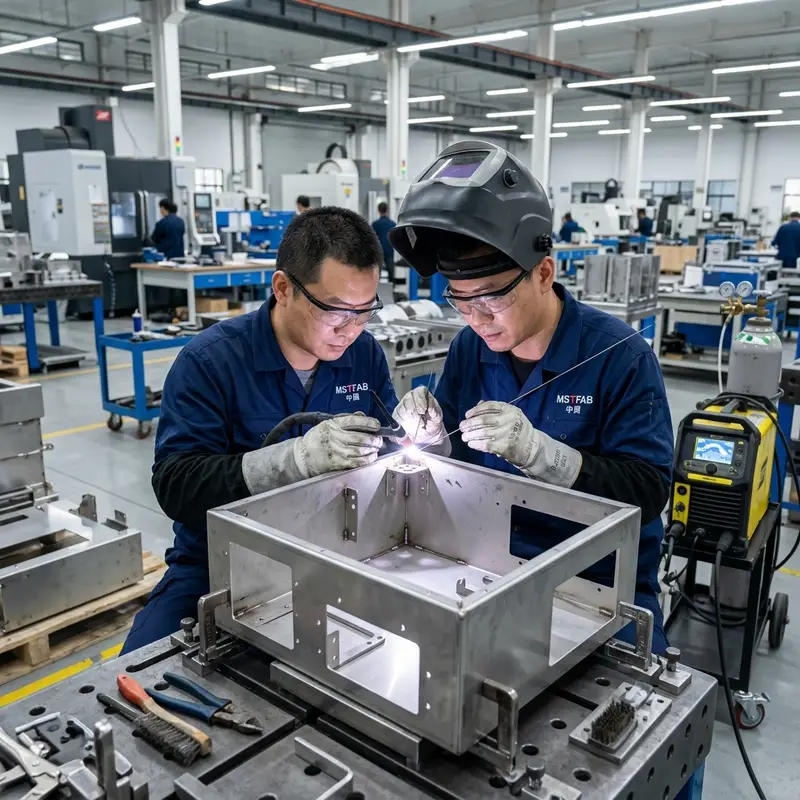
Precision Medical Sheet Metal Enclosures Fabricated to Spec
Trust MSTFAB for sanitary stainless steel and aluminum medical housings. Complete material traceability, Class A cosmetic inspection, and full ISO 9001 quality systems.
Frequently Asked Questions on Medical Enclosures
Why is passivation essential for stainless steel medical enclosures?
Laser cutting, forming, and welding contaminate the surface with free iron and deplete chromium. Passivation (citric or nitric acid treatment per ASTM A967) chemically removes free iron particles and accelerates the formation of a continuous chromium-oxide passive barrier, preventing rust during sterilization cycles.
How do you protect internal electronic modules from ESD inside medical carts?
We use conductive grounding hardware, selective chromate conversion under mounting standoffs, and apply static-dissipative powder coatings with surface resistivity between 106 and 109 ohms/sq.
 WeChat Contact
 WhatsApp Me Directly