
How should OEM hardware teams manage drawing revisions from prototype to production?
OEM teams successfully manage drawing revisions by implementing a strict bifurcation between preliminary (e.g., REV X1, X2) and released production revisions (e.g., REV A, B), establishing automated Product Lifecycle Management (PLM) system-of-record controls, requiring First Article Inspection (FAI) sign-off prior to status promotion, and executing physical scrap/purge protocols on the shop floor to prevent obsolete drawings and parts from mingling with volume builds.
The transition between New Product Introduction (NPI) prototypes and mass production is the most vulnerable phase of hardware manufacturing. During rapid prototyping, design engineers frequently release interim drawing iterations to test fitment, connector clearance, or airflow dynamics. However, if these provisional files are not systematically controlled, suppliers will accidentally cut volume sheet metal chassis using obsolete prototype CAD files, leading to tens of thousands of dollars in scrapped parts and catastrophic assembly delays.

The 4 Pillars of Prototype-to-Production Revision Control
1. Distinct Revision Numbering Schemes
Never use numeric or sequential alpha revisions across both prototype and production phases. Best-in-class OEMs adopt a two-tier revision convention:
- Prototype Stage: Numbered with an explicit prefix or suffix (e.g.,
REV P01,REV P02, orREV X.1). The drawing border is watermarked with large 45-degree text: “PRELIMINARY / PROTOTYPE ONLY – NOT FOR VOLUME FABRICATION”. - Production Stage: Released strictly as clean alphabetic revisions (e.g.,
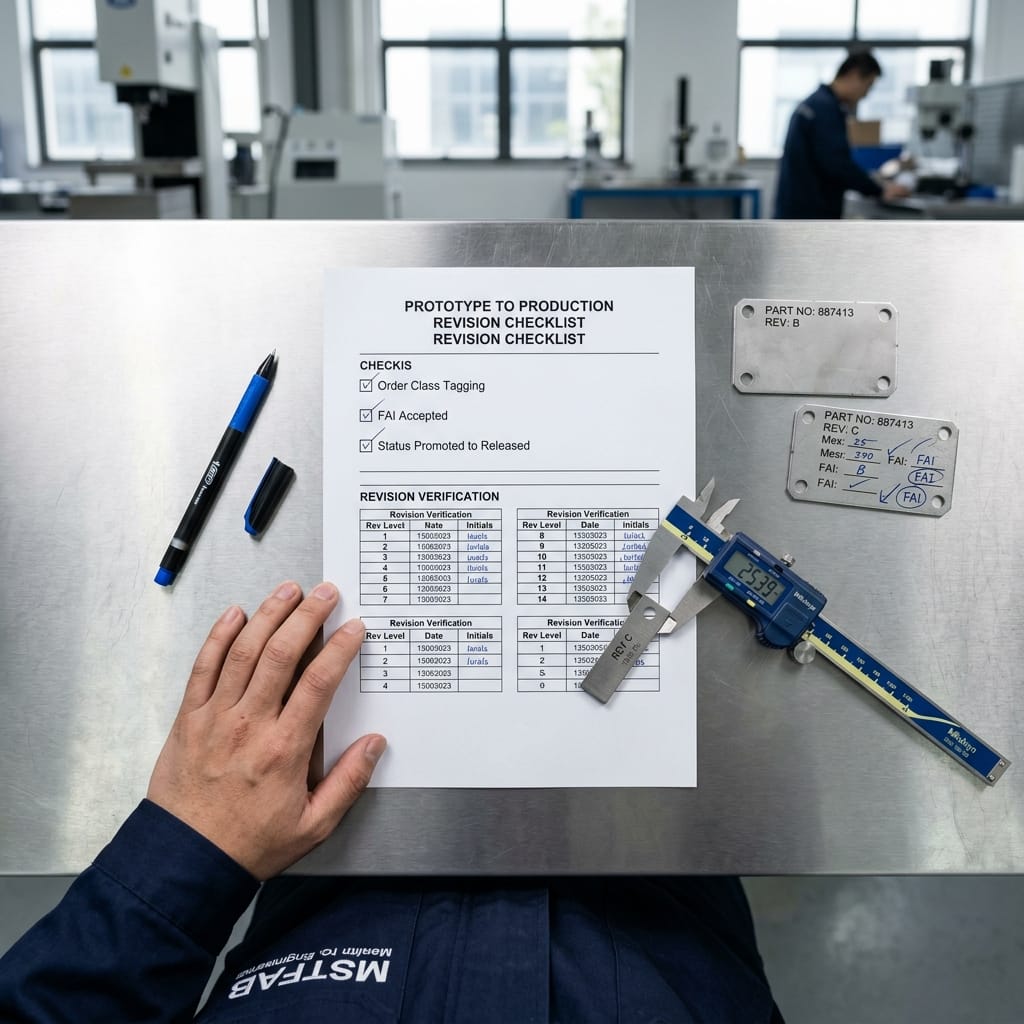
REV A,REV B). A part cannot achieve REV A until a cross-functional Engineering Change Order (ECO) is signed and an FAI report is approved.
2. Purchase Order & ERP Metadata Binding
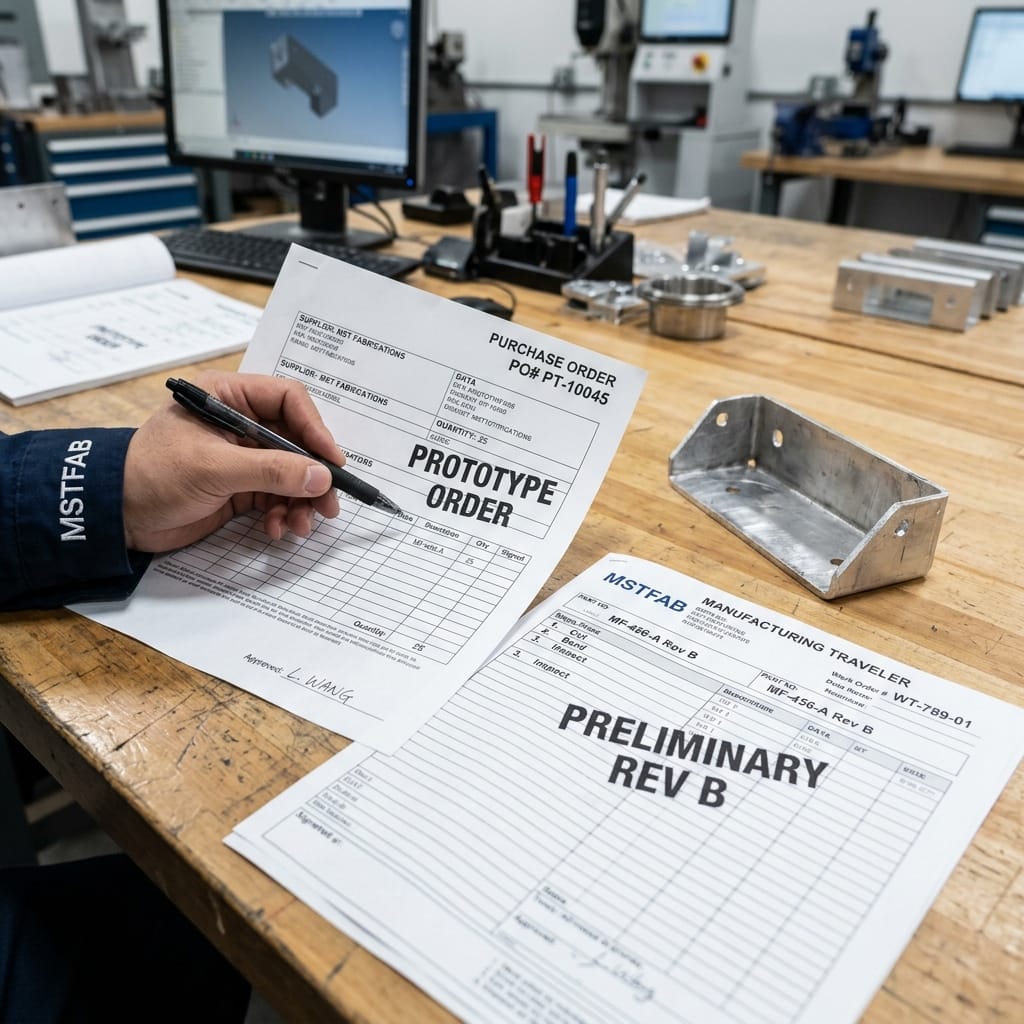
A fatal mistake in hardware procurement is placing a purchase order that specifies only the base part number without hardcoding the revision level. Every PO line item, work traveler, and supplier order confirmation must bind the three critical identifiers:
Part Number: MST-7042 // Revision: REV C // ECO Number: ECO-2026-0842
If the supplier’s order acknowledgment lists REV B while the buyer’s PO specifies REV C, the ERP system must automatically trigger a purchasing freeze until the revision mismatch is reconciled.
3. Effectivity Dates & Scrap Disposition Rules
When an engineering change occurs mid-production, the ECO must explicitly define how legacy inventory is handled using standard disposition codes:
- Scrap: Obsolete parts cannot be reworked and must be destroyed under supervision to prevent accidental assembly insertion.
- Rework: Existing parts can be brought up to the latest revision (e.g., secondary CNC milling of an enlarged connector cutout).
- Use-As-Is (Phase-Out): Legacy revision parts are structurally safe and may be consumed until inventory hits zero before cutting the new revision.

Stage-Gate Revision Management Workflow
MSTFAB enforces a disciplined stage-gate workflow from initial prototype quote through full-scale production ramp:
| Lifecycle Stage | Drawing Revision Tag | PLM State | Fabrication Authorization | Quality Verification Gate |
|---|---|---|---|---|
| Proof of Concept (POC) | REV X1 – X3 | In-Work / Draft | Prototyping cell only (1–5 pcs) | Basic fit-check and critical flange dimensions |
| Design Verification (DVT) | REV P01 – P03 | Prototype Review | NPI pilot batch (10–50 pcs) | Pilot CMM inspection & environmental chamber fitment |
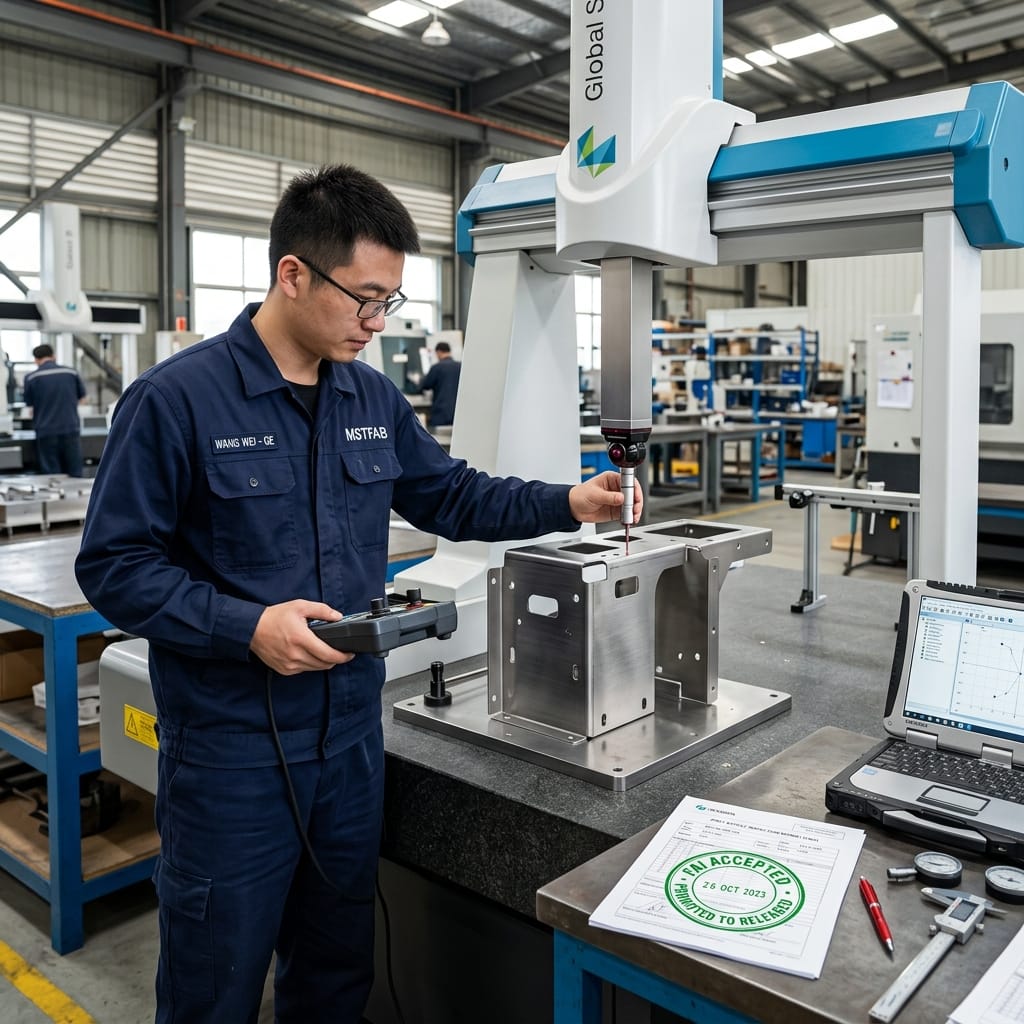
| Production Release (PVT) | REV A | RELEASED | Production floor authorized | Full Level 3 PPAP / 100% First Article Inspection (FAI) |
| Mass Production Change | REV B, C… | RELEASED (ECO Bounded) | Volume production cutover | Delta FAI on modified dimensions & scrap audit of REV A |
| End-of-Life / Superseded | Any Legacy Rev | OBSOLETE | STRICTLY PROHIBITED | Floor purge audit, delete local CNC laser/brake code |
Shop Floor Quarantine & Digital CNC Purging
Document control is useless if obsolete paper drawings linger next to press brakes or outdated G-code sits in CNC laser cutting controllers. A robust revision transition protocol includes:
- Digital CNC Program Locking: When an ECO is released, the central CAM server immediately archives and deletes outdated nesting programs. Machine operators cannot load superseded CNC cut paths.
- Physical Prototype Segregation: Prototype parts must never be stored in standard warehouse pallet racks. MSTFAB utilizes locked, yellow-wire storage cages dedicated exclusively to NPI orders.
- Three-Way Dock Verification: During receiving inspection, incoming quality technicians check that the PO revision, packing slip revision, and physical laser-etched part marking match the latest released PLM revision exactly.

Scale Seamlessly From Prototype to Full Production
Avoid costly revision mix-ups and production delays. MSTFAB offers end-to-end PLM drawing integration, rapid NPI prototype fabrication, and seamless production ramp-up backed by ISO 9001:2015 quality gates. Talk with our manufacturing engineers today to review your CAD revisions.
 WeChat Contact
 WhatsApp Me Directly