
Quick Answer: What Should an Electrical OEM Actually Expect From an ISO 9001 Junction Box Supplier?
If you are sourcing a custom galvanized steel junction box shell, the most useful question is not “Do you have ISO 9001?” Ask instead: “Can you prove that the junction box arriving at our electrical assembly line matches the released mechanical configuration we approved?”
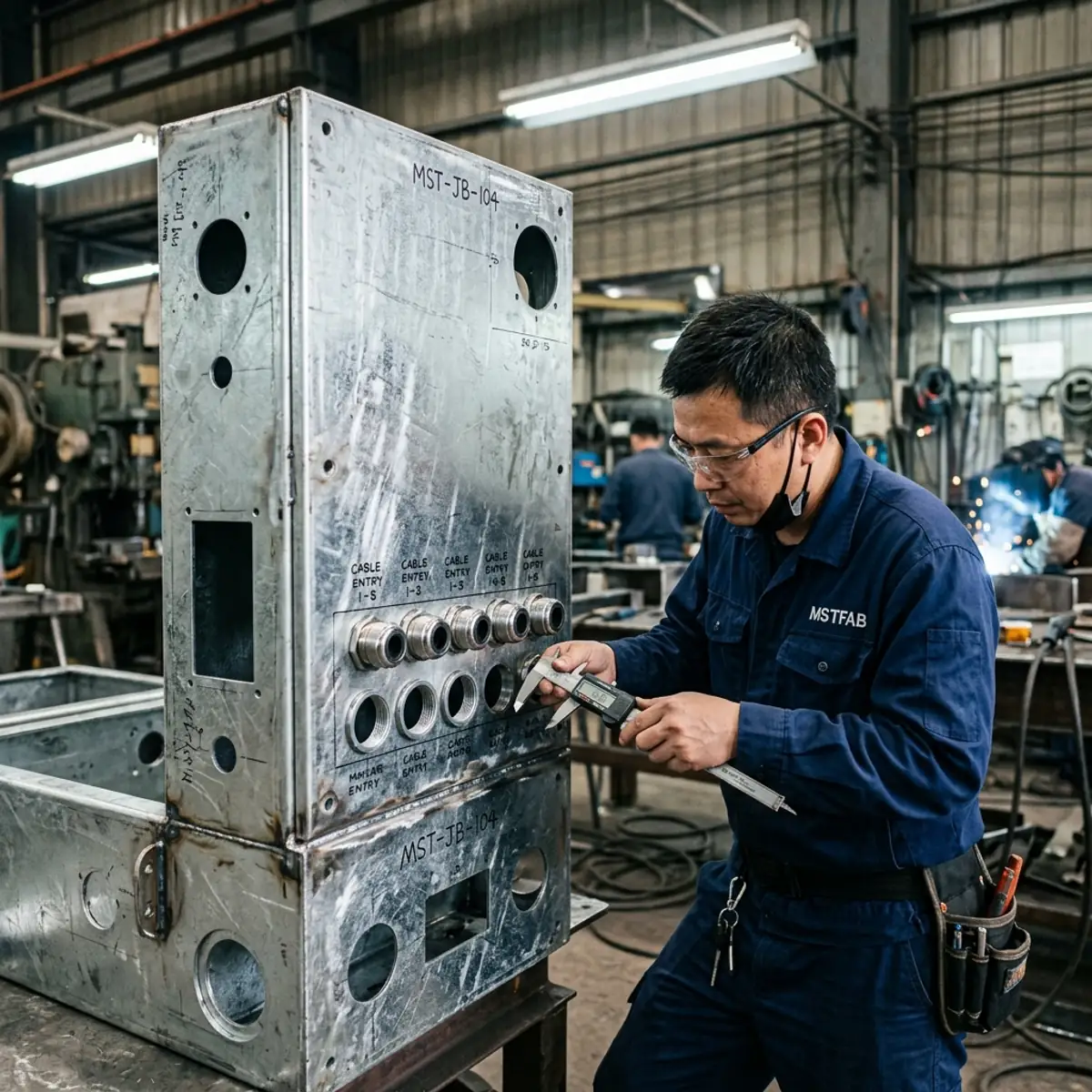
That means checking correct drawing revision, correct galvanized material, correct sheet thickness, cable-entry locations, terminal mounting interfaces, grounding studs, mounting plate, cover screw pattern, PEM hardware, weld geometry, burr condition, coating masks, first article dimensions, approved deviations, and engineering changes.
ISO describes ISO 9001 as a quality management system standard used to help organizations consistently provide products and services that meet customer and applicable requirements. It does not turn an individual galvanized junction box into an “ISO 9001-certified product.”
A certificate can tell you something about the supplier’s management system. It cannot tell you whether your M20 gland hole was laser cut 6 mm too close to a bend. For that, unfortunately, we still need drawings, measuring equipment and humans.
What MSTFAB Supplies—and What We Do Not
MSTFAB manufactures custom sheet metal parts from buyer-controlled drawings. For an electrical junction box project, our scope may include the empty galvanized enclosure body, covers, blank mounting plates, terminal mounting brackets, DIN rail mounting provision, cable-entry plates, gland plates, connector cutouts, welded grounding studs, PEM hardware, mounting feet, and powder coating.
MSTFAB does not supply the finished wired junction box. We do not automatically provide terminal blocks, contactors, relays, breakers, PLCs, wiring, cable glands, electrical design, energized testing, or field installation. Our job is to make the metal ready for your electrical assembly process.
Your electrician should receive a junction box. Not an unfinished metal puzzle.
1. Build an “Electrical Integration Readiness” Checklist
The box should not merely be dimensionally attractive when it leaves MSTFAB. It should be mechanically ready for the buyer’s next electrical assembly stage.
| Mechanical Feature | Fabricator Verifies | Electrical OEM Owns |
|---|---|---|
| Terminal mounting holes | Position/thread | Terminal selection |
| Mounting plate | Size/flatness/hole pattern | Component layout |
| Cable entries | Cutout geometry | Cable/gland selection |
| Connector openings | Drawing position | Connector electrical specification |
| Ground stud | Size/position/mask | Protective-earth design |
| Cover | Fit/fastener pattern | Access strategy |
| Finish | Spec/masking | Environmental requirement |
This responsibility matrix prevents one of the most common sourcing failures: Everyone thought someone else had checked it.
2. Terminal Mounting Interfaces Must Follow the Actual Electrical Layout
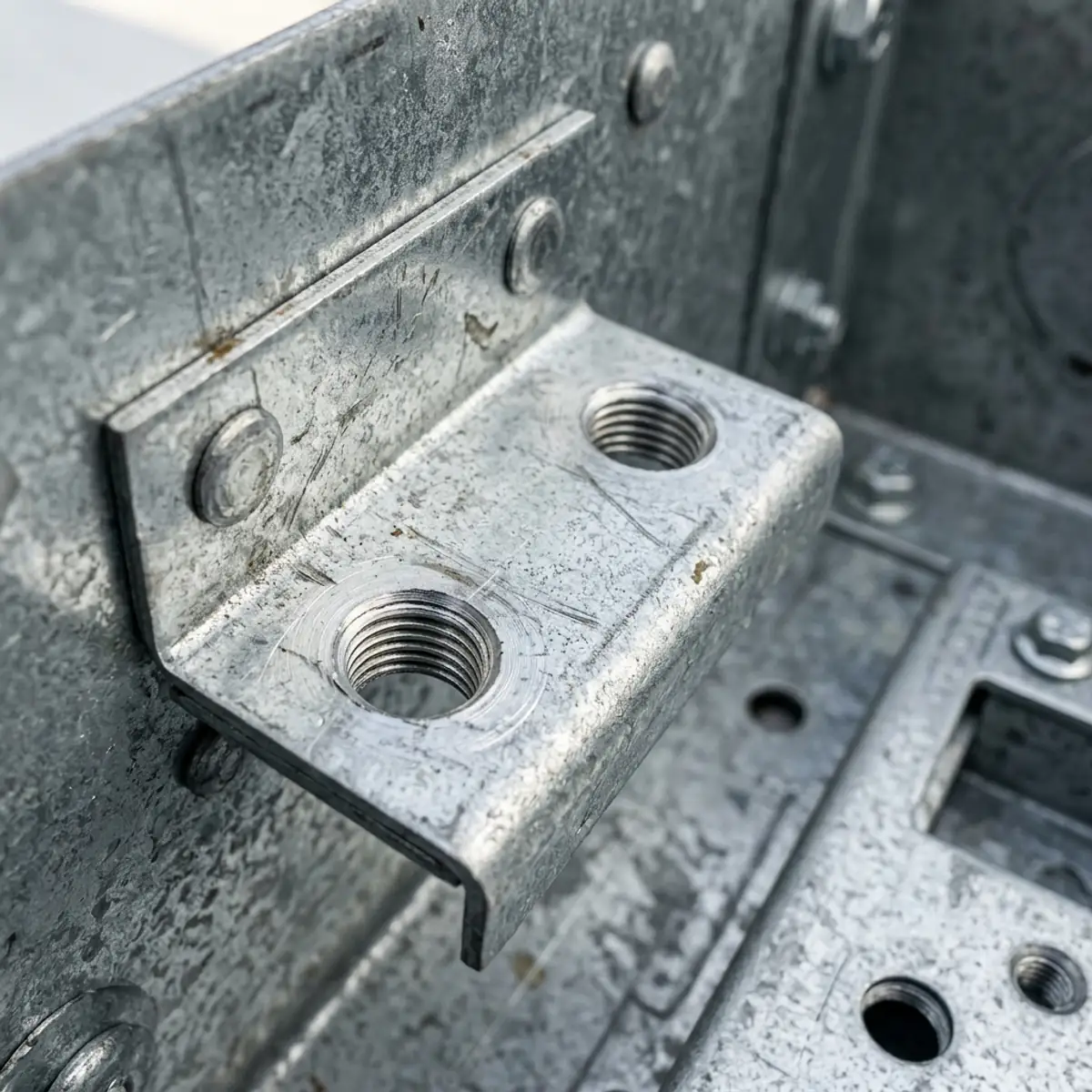
If the box supports terminal blocks or another buyer-installed assembly, define the mechanical mounting method. Possible interfaces include DIN rail holes, threaded standoffs, PEM nuts, welded studs, or a blank internal plate. For MSTFAB, the relevant questions are mechanical: Where is it? What size? What thread? The electrical OEM determines the terminal type, capacity, and conductor arrangement.
3. Mounting Plate Fit Should Be Checked Through the Finished Opening
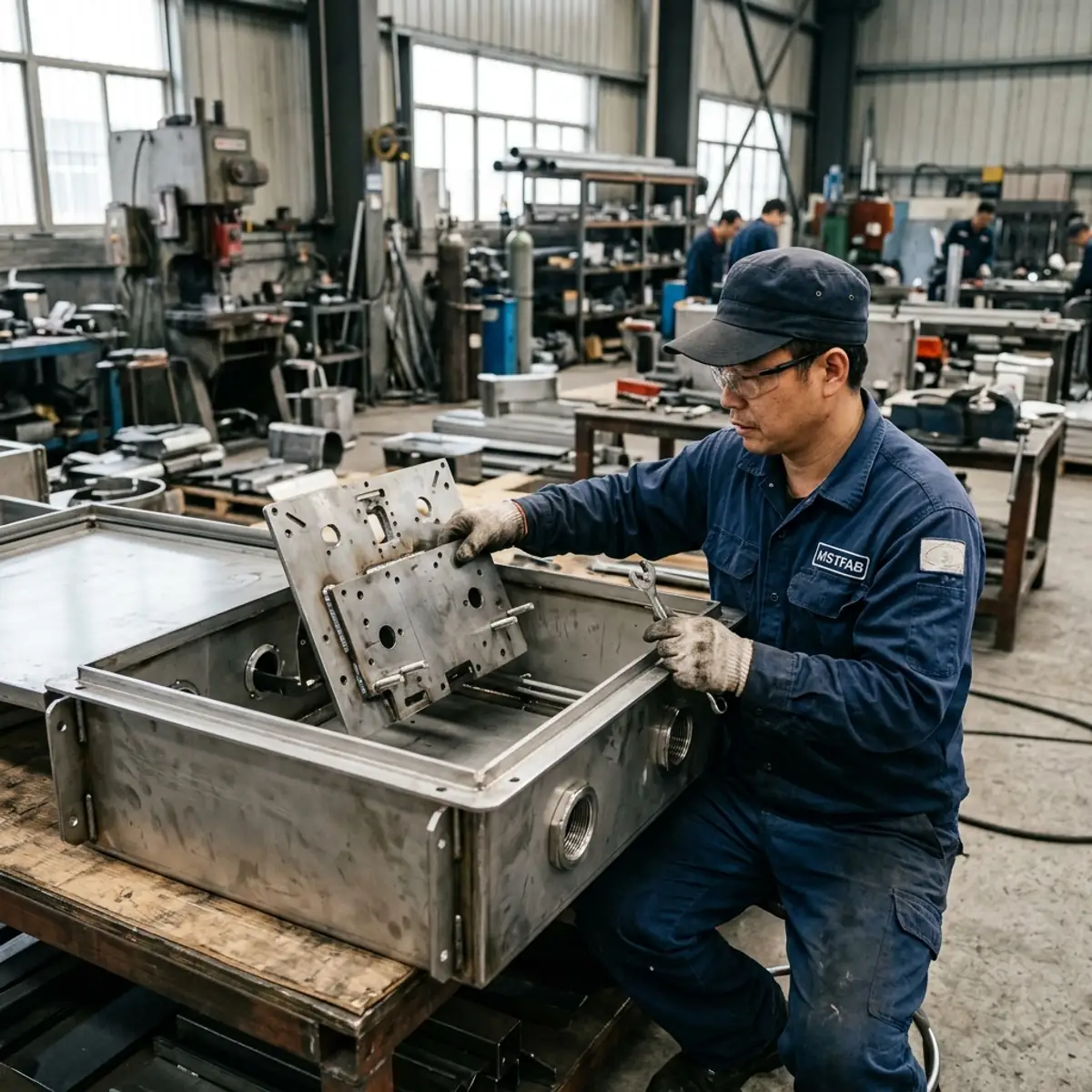
A mounting plate may fit perfectly inside the overall CAD envelope and still fail during real assembly because the finished box contains folded flanges, cover lips, welded studs, or internal brackets. Before release, check mounting plate width, height, installation angle, removal path, and tool access.
CAD says yes. Reality says please rotate it another 37 degrees.
4. Grounding Studs Must Be Treated as Controlled Mechanical Features
For metal electrical enclosures, grounding or bonding provisions may be part of the buyer’s electrical safety architecture. The electrical OEM remains responsible for protective-earth architecture and completed electrical testing.
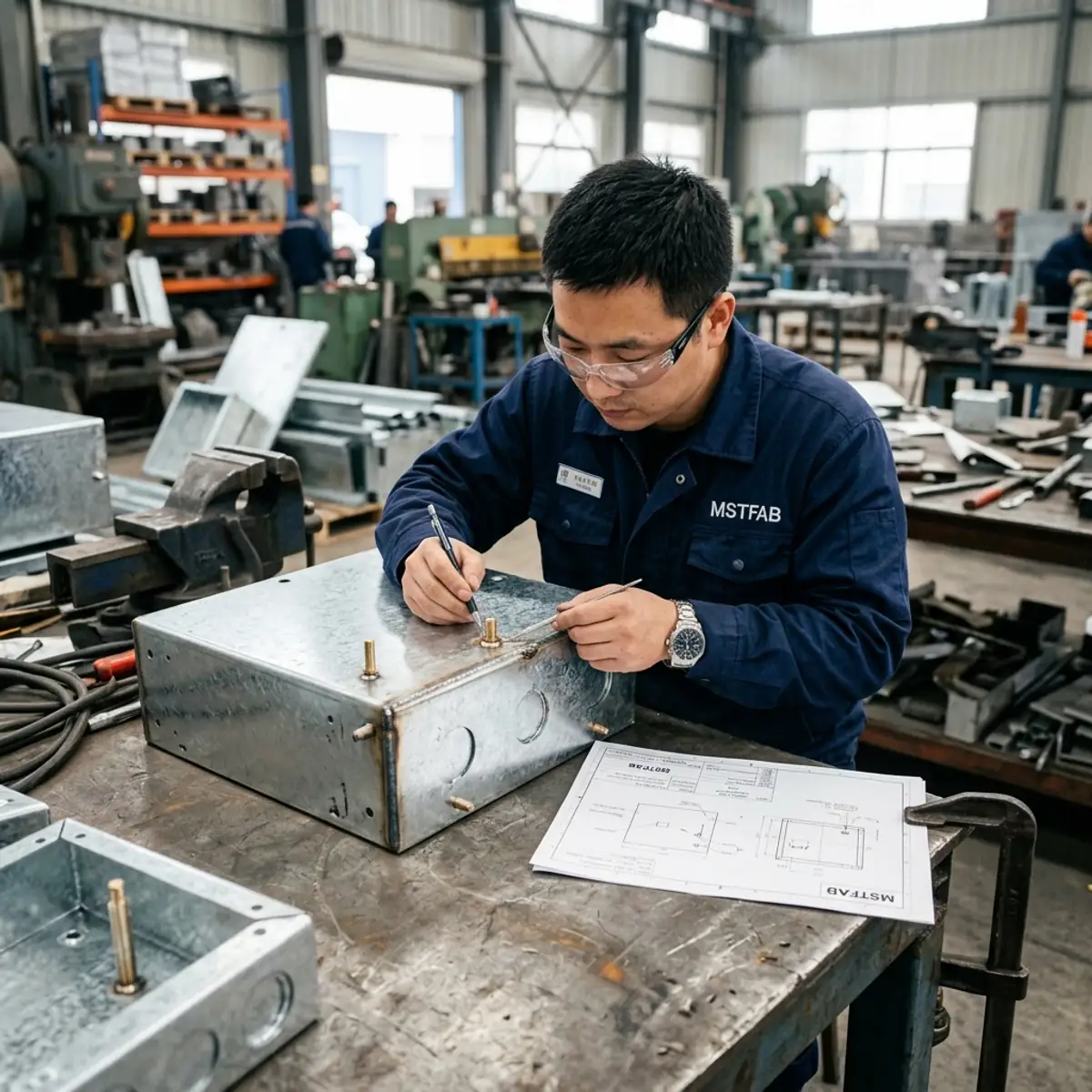
MSTFAB can fabricate drawing-defined mechanical interfaces such as welded studs, threaded bosses, or coating-free contact areas. Do not rely on the powder-coating operator to identify your electrical grounding architecture by intuition. Drawings should identify where coating is required, prohibited, or masked.
5. Cover Retention Is More Important Than “The Lid Fits”
For a fabricated shell, verify fastener quantity, position, thread, cover-hole alignment, and cover flatness. A cover that requires an operator to push sideways while inserting Screw #4 is technically installable. It is not good repeat production. The objective should be align → fasten → close.
6. Captive Hardware Needs Presence and Position Checks
Small hardware creates disproportionate assembly problems. Inspection should verify correct part, thread, quantity, side, position, and installation security. If a box has 24 perfect fabricated features and one missing M5 insert, the customer’s assembler will remember the missing insert.
7. Edge and Burr Control Matters Before Wiring
Cable and conductor routes may pass through or near laser-cut openings, gland holes, cover edges, formed flanges, or internal bracket edges. The released mechanical requirements should define relevant deburring, edge breaking, corner condition, and cutout finishing. A burr that is “only 0.5 mm” can be very persuasive when someone’s hand finds it.
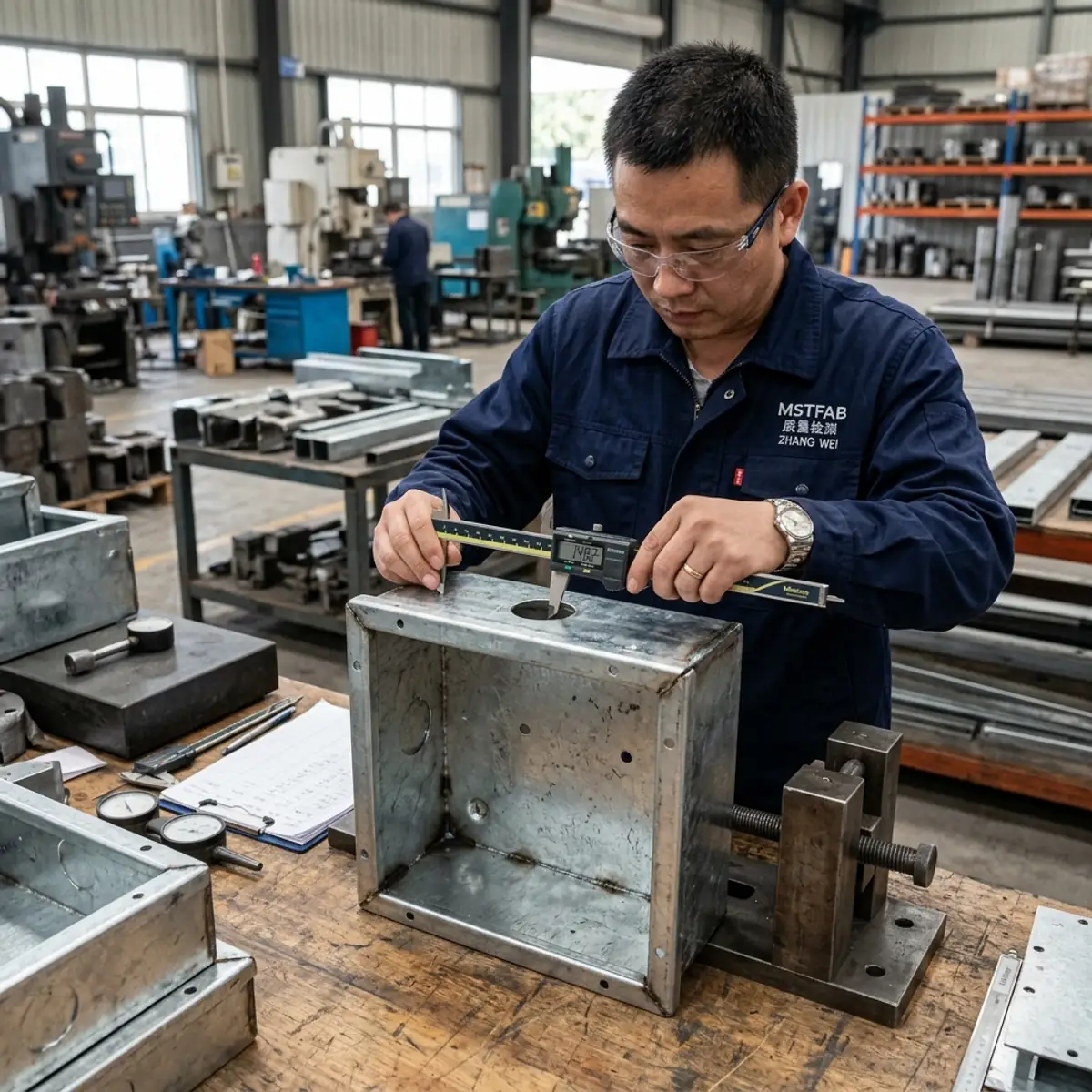
8. First Article Inspection Should Simulate the Electrical Handoff
A useful FAI should answer: Is this shell mechanically ready for the buyer’s integration process?
Measure what can stop integration. The other dimensions still need to meet the drawing. They just may not all deserve their own biography.
9. Engineering Changes Need an Approval Path
For electrical junction boxes, common changes may include cable-entry relocation, mounting plate change, ground stud relocation, material change, or new PEM hardware. Define who can approve them.
A good flow is: Change requested → Design owner reviews → Drawing updated → Supplier acknowledges → FAI → Production released. A less effective flow is: “Customer asked on WhatsApp, so we drilled it.” Very efficient. Very difficult to audit.
The 7-Dimension Supplier Scorecard
| Dim | What to verify | MSTFAB position |
|---|---|---|
| D1 Video audit | HARD GATE: real factory video walkthrough, not a stock photo | Live video audit on request; we show the line, not a brochure |
| D2 Fit gate | Does the supplier control the electrical integration baseline? | We strictly control CAD/PDF revisions to protect your assembly |
| D3 Capability | Laser cut, CNC bent, precision welded, masked for grounding | Full in-house sheet metal fabrication |
| D4 Quality + FAI | Mounting plate fit, grounding stud mask, hardware presence | FAI on first article; dimensional report shipped |
| D5 Material cert | HARD GATE — EN 10204 3.1 mill cert + PMI | Supplied with every order; no cert, no ship |
| D6 Certs | ISO 9001 baseline; verifiable engineering change (ECO) control | ISO 9001; strict change notification process |
| D7 Commercial | Build-to-print pricing without finished assembly assumptions | Priced from your CAD for empty metal shells only |
Final Buyer Takeaway
Buying a galvanized steel junction box shell should not be reduced to: “Factory has ISO 9001. Price is good. Order 1,000.” The actual OEM risk begins when the boxes reach your electrical assembly line.
- Buyer designs the electrical system.
- Buyer defines the mechanical interfaces it needs.
- MSTFAB manufactures those interfaces into the empty galvanized sheet metal shell.
- Electrical integrator installs and validates the equipment.
No mysterious electronics. No pretending the enclosure shell is a finished electrical product. Just custom metalwork that arrives ready for the next stage.
Frequently Asked Questions
Is MSTFAB an ISO 9001 galvanized steel junction box electrical manufacturer?
MSTFAB manufactures custom drawing-defined galvanized steel junction box shells and other sheet metal enclosure parts for electrical OEM projects within its quality-managed fabrication workflow. ISO 9001 concerns our quality-management system; it should not be presented as product certification for the finished electrical equipment.
Does ISO 9001 certify the junction box?
No. ISO 9001 specifies requirements for a quality-management system. It does not certify the electrical safety, ingress protection or completed configuration of an individual junction box.
Can MSTFAB fabricate the shell but leave electrical assembly to us?
Yes. That is exactly the intended scope. MSTFAB can fabricate the box body, cover, plate, brackets, cutouts, grounding studs and specified mechanical hardware. The buyer or integrator installs and validates the electrical equipment.
Can MSTFAB make cable gland and connector openings?
Yes, from buyer-controlled drawings. Provide the exact cutout, position, tolerance, orientation, and applicable component drawing where useful. MSTFAB manufactures the metal opening.
Can MSTFAB provide grounding studs?
MSTFAB can fabricate drawing-defined mechanical grounding provisions such as welded studs and coating-mask zones. Electrical grounding architecture and completed-equipment testing remain with the electrical OEM or integrator.
What should FAI include?
Depending on the project: drawing revision, material, overall dimensions, terminal mounting interfaces, mounting plate, cable-entry positions, connector openings, grounding studs, PEM hardware, cover fit, finish and masking.
Does MSTFAB supply a completed wired electrical junction box?
No. MSTFAB’s core service is custom sheet metal fabrication. Electrical components, wiring, system design, commissioning and finished-product conformity remain with the customer or electrical integrator.
Request a Custom Electrical Junction Box Shell Quote
Send MSTFAB your STEP/STP, controlled 2D PDF, galvanized steel specification, thickness, quantity, finish, hardware, electrical-interface CTQs, and required inspection documents.
Request a Quote WeChat Contact
 WhatsApp Me Directly