
Quick Answer: Do Not Release the Box to Electrical Assembly Just Because It Looks Good
A galvanized control box arrives at your medical equipment factory. The powder coating looks clean. The door closes. There are no obvious dents. Purchasing says: “Great. Send it to electrical assembly.”
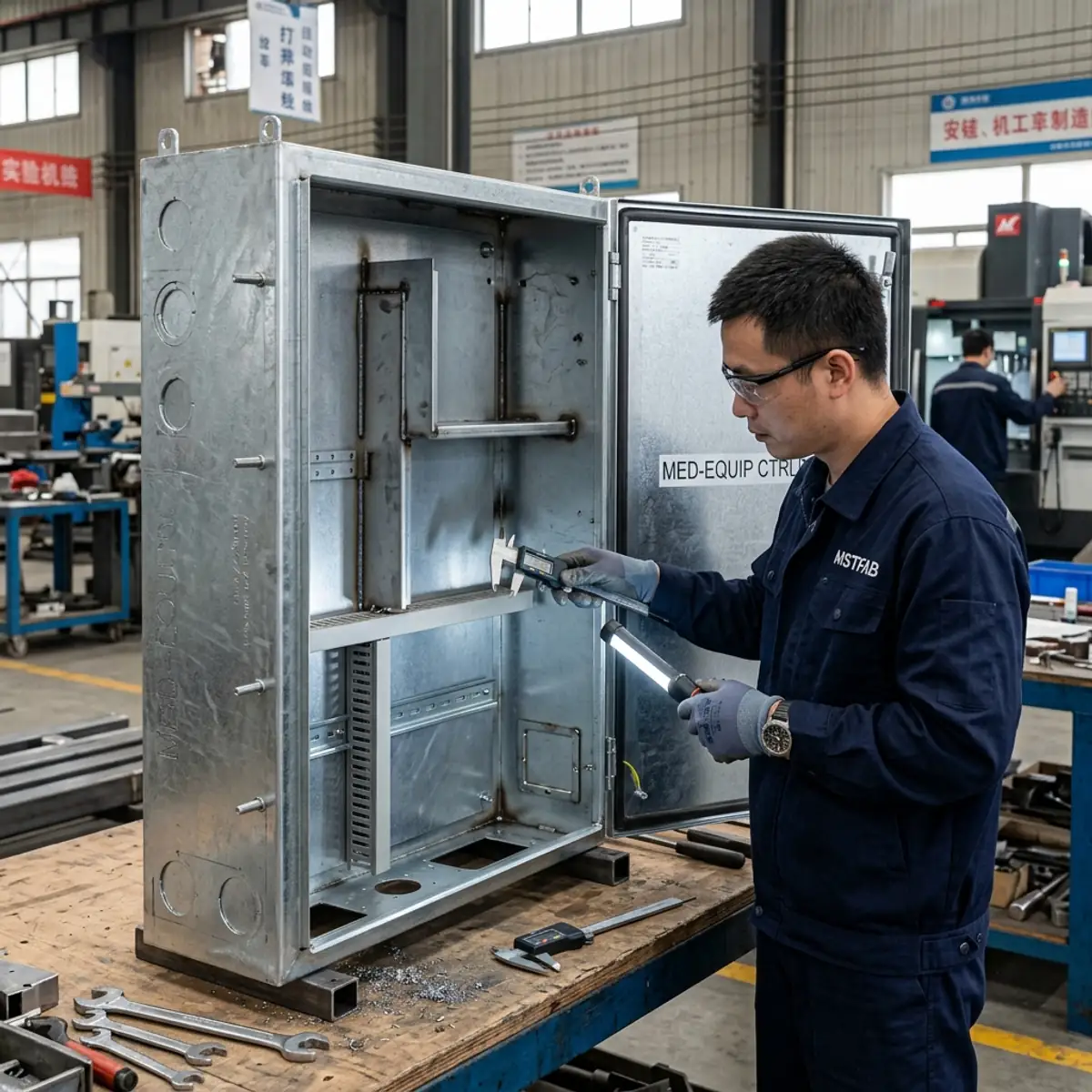
Not so fast. Before an empty control box shell becomes expensive medical electrical equipment, the OEM should confirm that the physical enclosure and its supplier evidence match the approved mechanical configuration. For an ISO 13485-controlled medical equipment program, a practical pre-wiring release can verify correct part number, correct drawing revision, material thickness, critical dimensions, mounting plate geometry, electrical component cutouts, grounding studs, coating-free bonding areas, PEM hardware, internal burr condition, approved deviations, and supplier change status.
ISO 13485:2016 remains the current international quality-management-system standard for medical devices after being reviewed and confirmed by ISO in 2025. That does not mean an empty galvanized control box becomes an “ISO 13485-certified product.” The useful question is: What requirements has the medical OEM flowed down to this fabricated component, and what objective evidence proves the delivered shell meets them?
1. First Separate Three Different Products
An OEM project can contain three very different things.
Product A — Empty Control Box Shell: This is MSTFAB’s scope. It may include the galvanized steel body, door, mounting plate, internal brackets, gland plate, welded studs, and PEM hardware.
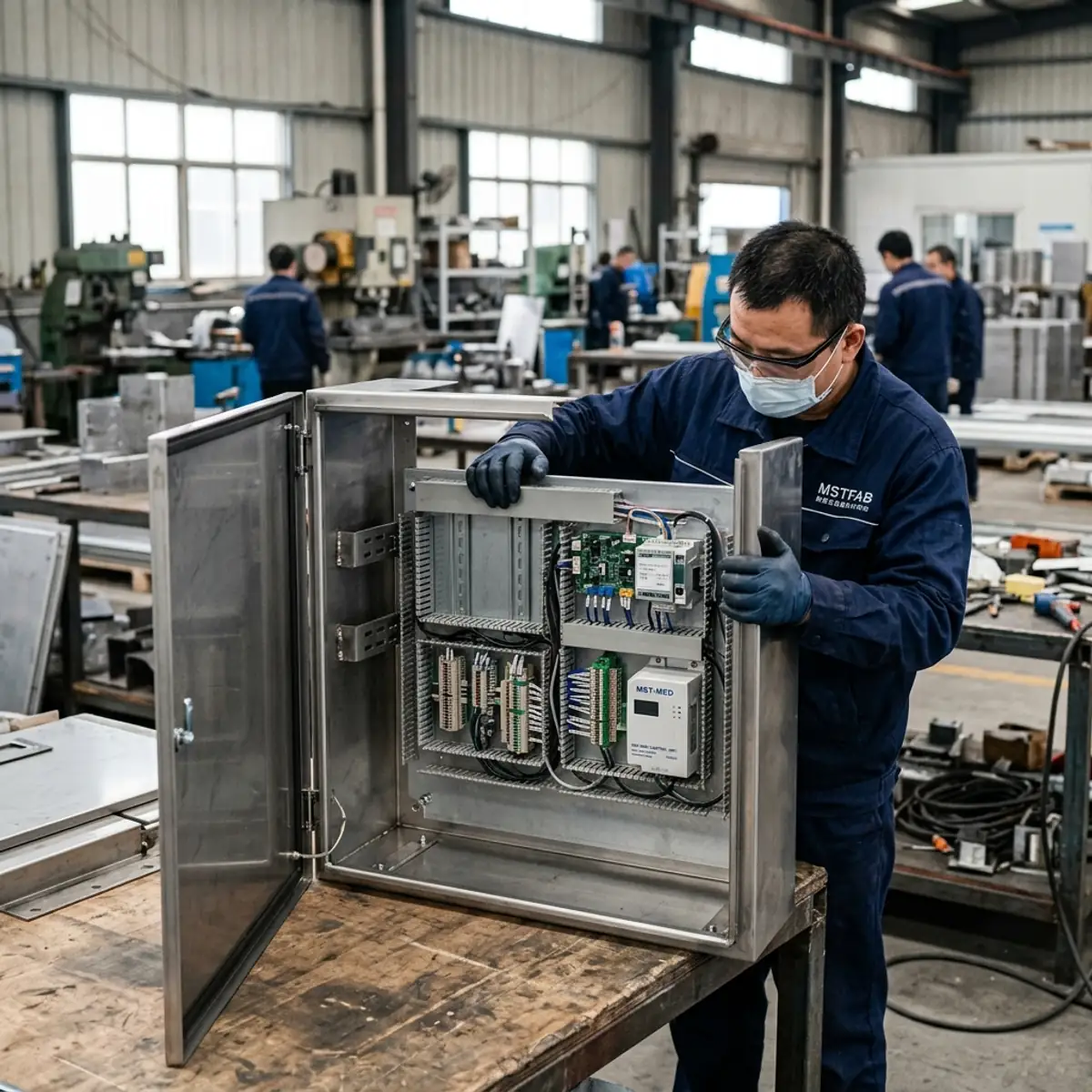
Product B — Electrically Integrated Control Assembly: The buyer or integrator adds power supplies, terminals, relays, PCBs, wiring, and DIN rail components.
Product C — Finished Medical Electrical Equipment: The completed medical equipment includes software, sensors, medical functions, and safety controls, governed by standards like IEC 60601-1.
An empty galvanized shell is therefore not the finished medical electrical equipment. MSTFAB manufactures Product A. Your OEM transforms it into Product B or integrates it into Product C.
2. ISO 13485 Controls the Quality System—Your Drawing Controls the Metal
ISO 13485 provides a medical-device quality-management framework. But your press brake cannot bend “ISO 13485 compliant.” It can bend: 1.5 mm galvanized steel, 90°, R1.5, drawing Rev D. So translate your quality-system expectations into physical requirements.
3. Create a Pre-Wiring Release Gate
A useful medical electrical control-box workflow can contain a formal gate: Supplier shipment → Receiving verification → Mechanical release → Electrical integration.
Do not allow electrical assembly to begin until the shell passes the agreed acceptance criteria. Because once the OEM installs a €600 power supply, custom wiring, and PCB assemblies, discovering that the enclosure is wrong becomes considerably more expensive.
4. Measure the CTQs That Can Stop Electrical Assembly
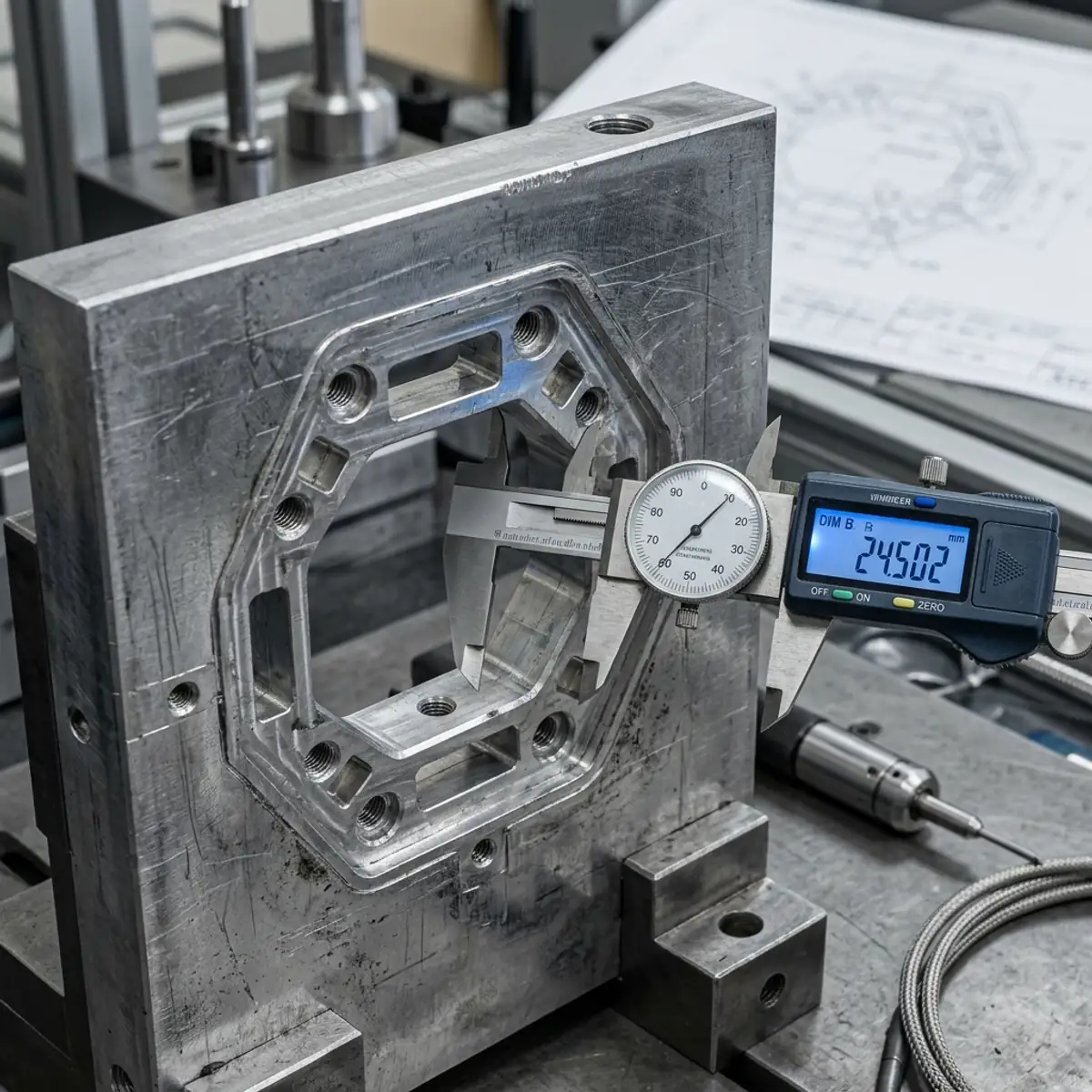
Not every dimension deserves equal inspection intensity. For a medical electrical control box shell, potential Critical-to-Quality mechanical characteristics can include mounting plate datum, PCB tray interface, connector opening position, cable-entry position, grounding stud position, and cover screw pattern.
Do not apply ±0.1 mm to the entire enclosure because tighter tolerances sound reassuring. Tolerances should follow function. Decimal places do not improve medical safety through intimidation.
5. Trial-Fit the Mounting Plate
This is one of the most practical checks in the entire article. A mounting plate can have correct dimensions and still be difficult or impossible to install. Check plate width, insertion path, fastener access, tool clearance, and bracket interference. The best inspection question is sometimes not: “Is this 437.0 mm?” It is: “Can the customer actually assemble it?”
6. Verify Grounding and Bonding Features Before Coating Hides the Problem
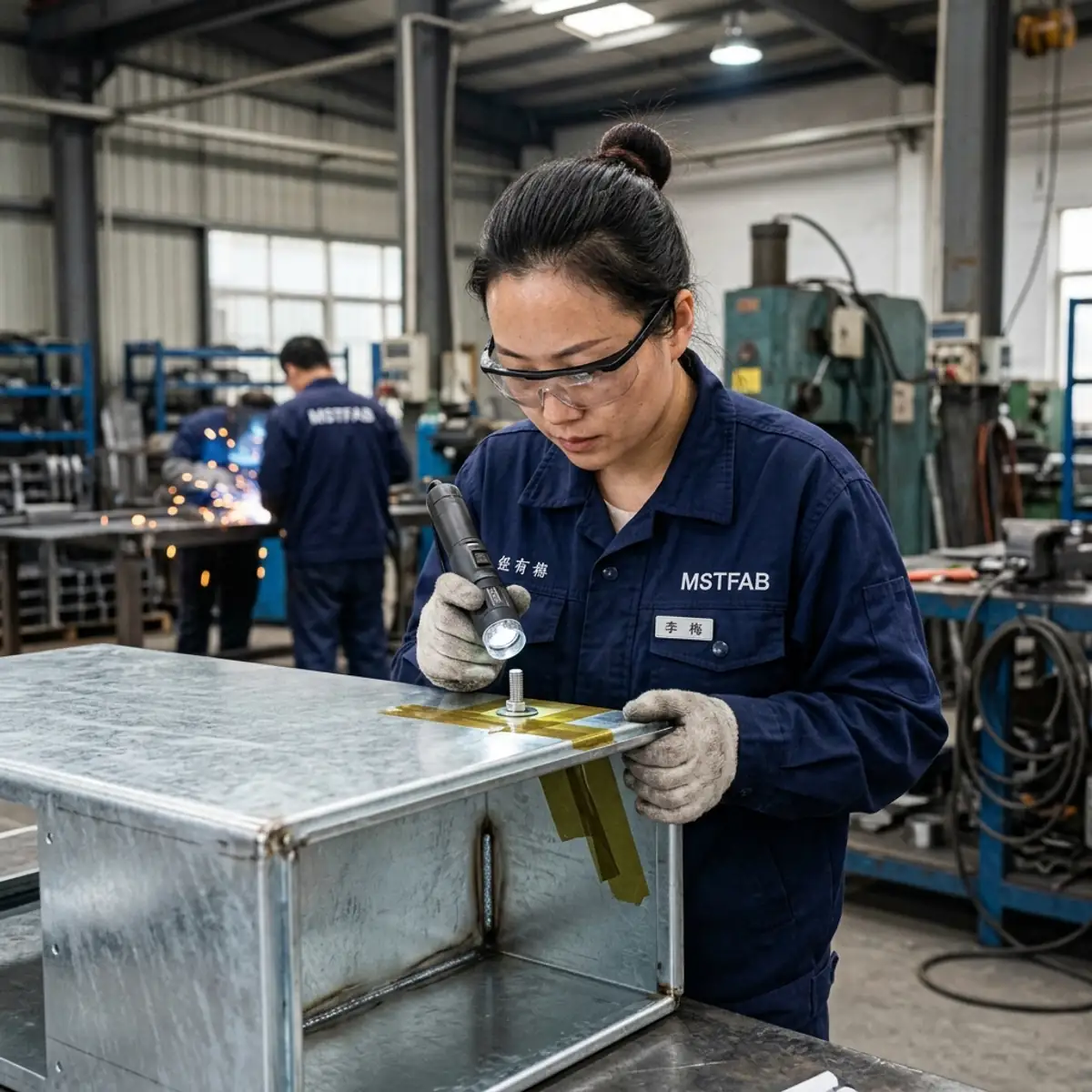
A metal medical-equipment enclosure may contain mechanical provisions used by the OEM’s protective-earth or bonding design, such as welded studs, threaded studs, or coating-free contact areas.
Powder coating is very good at electrically isolating metal surfaces. Therefore drawings should identify where coating is required, prohibited, or masked. Do not rely on the powder-coating operator to identify your electrical grounding architecture by intuition. They have powder. You have the electrical design.
7. Verify Every PEM Nut, Stud and Insert
A control box can contain dozens of small mechanical hardware items. Your receiving or release plan should verify correct part, thread, location, orientation, quantity, and installation security. One missing insert can stop a complete electrical assembly station. Its purchase price may be $0.20. Its ability to create a production meeting is priceless.
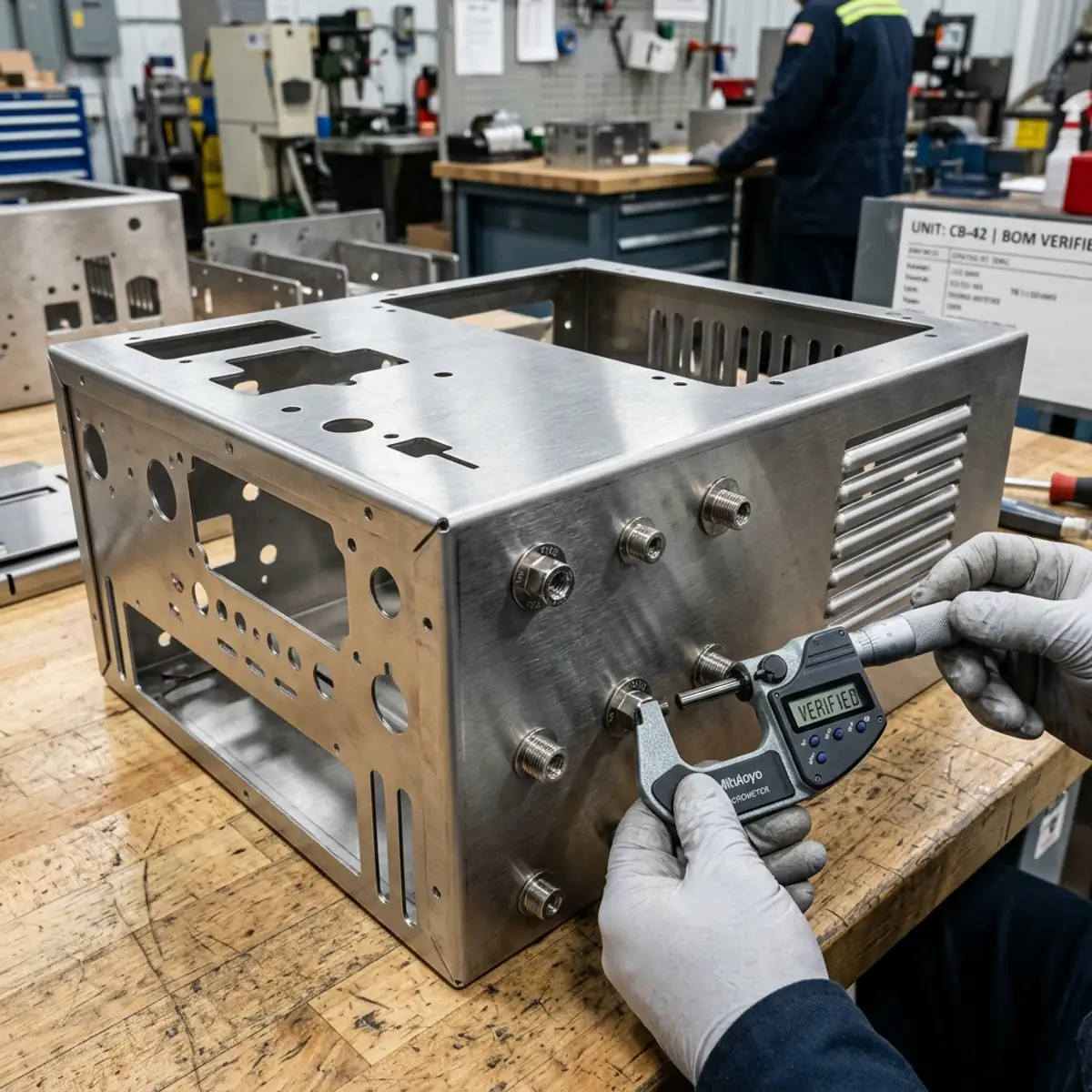
8. Check Burrs and Sharp Edges Before Wires Enter the Box
An empty metal enclosure may look clean externally while internal cutouts still contain burrs, sharp corners, or weld spatter. Once wires and harnesses are installed, correcting those conditions becomes more difficult. Therefore, define edge requirements for cable-entry edges, connector cutouts, and access-panel edges before production.
The 7-Dimension Supplier Scorecard
| Dim | What to verify | MSTFAB position |
|---|---|---|
| D1 Video audit | HARD GATE: real factory video walkthrough, not a stock photo | Live video audit on request; we show the line, not a brochure |
| D2 Fit gate | Does the supplier control the exact integration baseline? | We strictly control CAD/PDF revisions to protect your assembly |
| D3 Capability | Laser cut, CNC bent, precision welded, masked for grounding | Full in-house sheet metal fabrication |
| D4 Quality + FAI | Mounting plate fit, grounding stud mask, hardware presence | FAI on first article; dimensional report shipped |
| D5 Material cert | HARD GATE — EN 10204 3.1 mill cert + PMI | Supplied with every order; no cert, no ship |
| D6 Certs | ISO 9001 baseline; verifiable engineering change (ECO) control | ISO 9001; strict change notification process |
| D7 Commercial | Build-to-print pricing without finished assembly assumptions | Priced from your CAD for empty metal shells only |
Final Buyer Takeaway
The most expensive moment to discover a bad medical electrical control box is after the electronics are installed. So do not make electrical integration the first serious inspection. Create a release gate:
Supplier shipment → Correct part and revision → Correct material → CTQ dimensional verification → Mounting plate fit → Grounding and coating-mask verification → Hardware check → Burr and cleanliness check → FAI → Approved for electrical integration.
We make the box ready for your electronics. We do not install the electronics and suddenly discover a medical degree in the powder-coating oven.
Frequently Asked Questions
Is MSTFAB an ISO 13485 galvanized steel control box electrical manufacturer?
MSTFAB is a custom sheet metal fabrication manufacturer producing drawing-defined galvanized control box shells and mechanical enclosure parts for medical electrical equipment OEMs. ISO 13485:2016 should not be presented as product certification for an individual empty metal enclosure.
Does FDA QMSR use ISO 13485?
Yes. FDA’s QMSR became effective on February 2, 2026 and incorporates ISO 13485:2016 by reference into the medical-device quality-system regulation. However, FDA states that it does not require or issue ISO 13485 certificates.
Can MSTFAB fabricate control boxes for medical electrical equipment?
Yes, MSTFAB can fabricate drawing-defined empty enclosure bodies, covers, mounting plates, brackets, panels and hardware interfaces for medical equipment OEM projects.
Does MSTFAB install PCBs, terminals and electrical wiring?
No. This fabrication scope covers mechanical sheet metal enclosure components. Electrical integration remains with the medical OEM or electrical/system integrator.
What should I inspect before wiring begins?
Prioritize: part/revision identity, material, CTQs, mounting plate, component cutouts, grounding interfaces, hardware, door/cover fit, edge/burr condition, finish/masking, deviations, and change status.
Does IEC 60601-1 apply directly to the empty metal shell?
IEC 60601-1 addresses basic safety and essential performance of medical electrical equipment. The empty enclosure supports the OEM’s safety design, but MSTFAB does not claim that fabrication of the shell itself certifies the completed medical electrical equipment.
Request a Custom Medical Electrical Control Box Shell Quote
Send MSTFAB your STEP/STP, controlled 2D drawing, galvanized steel specification, thickness, finish, quantity, CTQs, hardware schedule, and inspection requirements.
Request a Quote WeChat Contact
 WhatsApp Me Directly