
The Short Answer
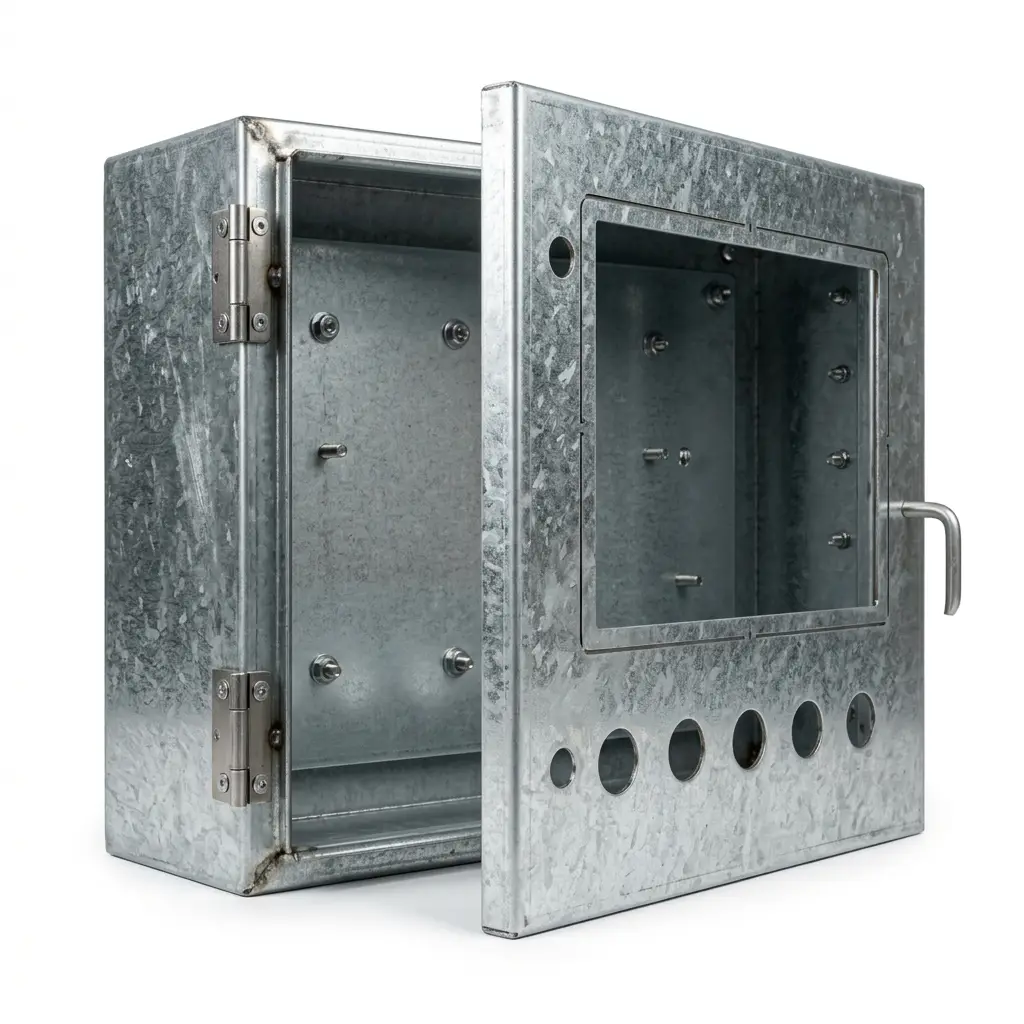
Sourcing automation control box shells for regulated medical and laboratory equipment requires translating your device risk controls into explicit mechanical drawing specifications executed under an ISO 9001 quality management system. Because MSTFAB manufactures custom empty sheet metal shells and internal chassis plates to print, your drawing and RFQ package should lock down five physical controls: burr-free cable pass-through edges, masked low-resistance grounding studs, disinfectant-resistant powder coating or passivated stainless steel, ballooned First Article Inspection (FAI), and strict revision and material lot traceability.
Explore this guide
01 / Supplier Scope & ISO 9001 Governance
Translate medical device mechanical requirements into auditable sheet metal specs.
In diagnostic analyzers, surgical robotics carts, and laboratory automation systems, the control box shell protects sensitive motion controllers, power supplies, and safety relays. While the medical OEM owns device design history files and system-level regulatory approvals, the sheet metal fabricator must deliver 100% drawing-compliant mechanical hardware with zero unapproved process changes.
Operating under an ISO 9001 quality management system, MSTFAB controls custom empty control box shells through locked CAD/CAM revision routing, traceable raw material lots, documented in-process inspections, and formal first-article sign-off.
Traceable material lots
Every batch of cold-rolled steel, 5052/6061 aluminum, or 304L/316L stainless steel is backed by EN 10204 3.1 mill certificates linked to the shop traveler.
Locked process travelers
Laser cutting parameters, press brake V-dies, PEM hardware specs, and finish masking maps are frozen after first-article approval.
Documented change control
No flat-pattern tweak, weld substitution, or coating change occurs without written OEM engineering authorization and delta FAI verification.
Sourcing clarity: Rather than placing a vague regulatory note in the title block, specify the exact edge radius, surface roughness, masking zone, and inspection report deliverables directly on the 2D part drawing.
02 / Electrical Safety & Harness Protection DFM
Eliminate internal wire abrasion hazards and high-resistance grounding joints.
Inside a compact medical automation control box, high-flex sensor harnesses and power cables route tightly around sheet metal bulkheads and connector cutouts. A microscopic laser burr or a paint-covered grounding stud can trigger insulation chafing or protective-earth continuity failures during final OEM hipot and ground-bond testing.
- Deburred and hemmed wire pass-throughs: Specify mechanical edge rounding, coined edges, or 180-degree flattened safety hems on internal bulkhead routing slots so cable jackets never touch a sharp metal edge.
- Dedicated grounding stud masking: Identify every protective-earth (PE) weld stud and chassis bonding pad on a dedicated masking view so silicone caps and base washers keep the contact ring bare and conductive.
- Verified fastener torque & push-out: Install self-clinching standoffs and captive panel screws into accurately laser-cut holes prior to or after finishing per drawing spec so PCB and DIN-rail mounts never spin loose.
Clean nitrogen fiber laser cutting paired with automated deburring and fixture-controlled stud and seam welding protects internal wiring harnesses and grounding integrity.
03 / Forming Accuracy & Subassembly Alignment
Hold tight datum relationships between PCB standoffs and rear I/O panel cutouts.
Medical automation control boxes frequently combine a formed outer shell with a removable internal component subplate or multi-tier card cage. If press brake flange angles or bend deductions drift, board-mounted D-sub, RJ45, and optical ports will misalign with the rear bulkhead cutouts.
- Dimension critical I/O connector cutouts and PCB mounting standoffs from a single common datum corner rather than chaining tolerances across multiple bends.
- Add laser-cut bend relief slots next to return flanges so material does not tear or bulge near corner mating surfaces.
- Use tab-and-slot self-locating geometry on welded chassis brackets so subplate mounting bosses remain parallel and coplanar.
Multi-axis CNC press brake forming with optical angle verification keeps multi-bend chassis trays flat and square for automated board assembly.
04 / Disinfectant-Resistant Finishes & Cleanliness
Select coatings and stainless finishes that withstand clinical wipe-downs.
Hospital and laboratory surfaces undergo repeated wipe-downs with quaternary ammonium compounds, isopropyl alcohol, hydrogen peroxide, and diluted bleach solutions. Standard utility paints can chalk, yellow, or soften under clinical cleaning protocols.
- Chemical-resistant powder coatings: Specify cross-linked epoxy, polyurethane, or hybrid medical-grade polyester powder coatings with controlled dry film thickness (typically 60–90 um) and verified ASTM D3359 5B adhesion.
- Passivated 304L / 316L stainless steel: For unpainted laboratory chassis and internal shields, call out fine brushed or bead-blasted finishes followed by citric/nitric passivation per ASTM A967 to remove free iron.
- Chromate / trivalent conversion on aluminum: Use RoHS-compliant trivalent passivation (MIL-DTL-5541 Type II) on 5052-H32 aluminum chassis plates to preserve electrical conductivity and corrosion resistance.
Explore our surface treatment processes to match powder coating, anodizing, chromate conversion, or passivation to your laboratory device environment.
05 / Quality Control Matrix
Confirm five critical control box shell attributes prior to production.
Use this verification matrix during DFM and quality planning to align your mechanical design team and sheet metal supplier.
06 / First-Article Inspection & Lot Traceability
Verify every ballooned dimension and thread callout before batch release.
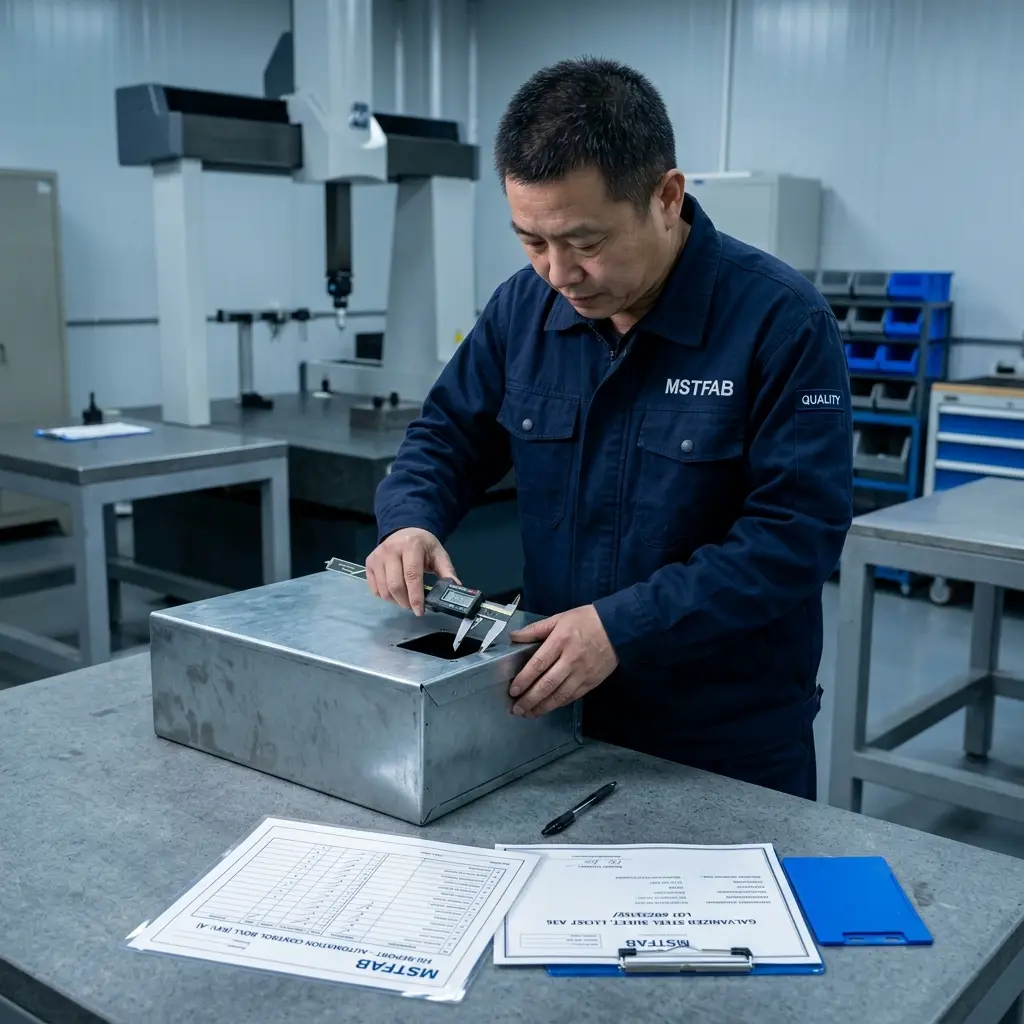
Regulated equipment builders require clear objective evidence that incoming mechanical enclosures match the approved Device Master Record drawing. Before running production quantities, we execute a comprehensive First Article Inspection (FAI) against a ballooned copy of your 2D PDF drawing.
Calibrated height gauges, digital calipers, pin gauges, and thread go/no-go gauges verify standoff heights, connector cutout pitches, diagonal frame squareness, and M3/M4/M6 thread integrity after coating.
Each production shipment includes lot-linked inspection records, material certificates, and finishing logs so your incoming quality assurance (IQA) team can clear hardware rapidly into assembly.
Learn more about MSTFAB ISO 9001 quality control and FAI workflows →
07 / Cleanroom-Ready Packing & Scope
Deliver burr-free, clean-packed enclosure shells ready for electronics integration.
Medical and laboratory assembly lines cannot tolerate shop oil, metal filings, or cardboard dust inside control box shells. After final inspection, shells are blown clean with filtered dry air, wiped down, and sealed in clean polyethylene bags with foam corner blocks before boxing.
When you source control box shells alongside custom sheet metal fabrication cart frames, monitor arms, and service panels, we label each carton with part number, drawing revision, purchase order, and batch lot number for seamless warehouse receiving.
Manufacturing scope: MSTFAB manufactures custom empty sheet metal control box shells, chassis plates, and brackets to customer drawings under an ISO 9001 quality management system. MSTFAB does not design or assemble finished medical devices; all electrical integration, system safety testing, and regulatory clearances remain the sole responsibility of the medical OEM.
08 / Ready-to-Review Medical Shell RFQ
Include eight engineering details in your automation control box RFQ.
- 3D STEP CAD assemblyInclude outer shell, covers, internal subplate, and welded brackets.
- 2D PDF drawing with revisionSpecify critical connector-to-standoff datums, tolerances, and edge-break notes.
- Substrate alloy and thicknessCall out CRS SPCC, 5052-H32 aluminum, or 304L/316L stainless steel gauges.
- Self-clinching hardware tableList exact PEM standoffs, nuts, studs, and captive screws with installation side.
- Grounding and EMI masking mapHighlight all paint-free ground studs, bonding pads, and conductive flange tracks.
- Coating or passivation specDefine RAL color, texture, chemical-resistant resin type, or ASTM A967/MIL-DTL-5541 finish.
- Cosmetic and cleanliness notesMark A/B cosmetic surfaces, burr-free harness slots, and clean-bagging requirements.
- Quality documentation packageRequest ballooned FAI reports, EN 10204 3.1 mill certs, and batch delivery schedule.
Sharing complete masking, hardware, and inspection expectations at the RFQ stage allows our engineering team to build a locked, repeatable manufacturing routing from day one.
Questions from medical and laboratory OEMs on control box shells
How does an ISO 9001 sheet metal supplier support medical automation OEMs?
Medical OEMs control their own product design and regulatory filings while qualifying ISO 9001 component suppliers to build mechanical parts strictly to print. We support your supplier quality system with locked CAD revision control, EN 10204 3.1 material traceability, documented DFM reviews, ballooned FAI reports, and formal engineering change control.
How do you prevent internal wire harnesses from chafing on sheet metal cutouts?
We mechanically deburr and radius all laser-cut edges, form 180-degree flattened safety hems on internal cable routing pass-throughs when specified on the drawing, and verify zero sharp burrs during in-process and final inspection.
How do you ensure reliable protective-earth grounding on powder-coated control boxes?
All grounding studs, threaded inserts, and chassis bonding pads specified on your masking drawing are capped with high-temperature silicone masks and base washers prior to pretreatment and powder coating, then verified for clean bare-metal contact and thread fit at inspection.
Can you maintain conductive EMI shielding tracks on painted aluminum or steel shells?
Yes. For aluminum shells, we can apply conductive trivalent chromate conversion across the whole part and mask the EMI gasket flange before powder coating the exterior. For steel shells, we mask the designated flange track or use plated/stainless subcomponents per your drawing.
What surface finishes hold up best against hospital and laboratory disinfectants?
High-crosslink epoxy, polyurethane, or medical-grade polyester powder coatings on properly pretreated metal, as well as passivated 304L/316L stainless steel, provide strong resistance against alcohol, quaternary ammonium, and peroxide wipe-downs.
Do you populate electronics or certify the completed control box?
No. MSTFAB exclusively manufactures custom empty sheet metal control box shells, chassis trays, and mechanical hardware to your CAD files. PCB population, wiring harness installation, electrical safety testing, and regulatory device submissions are performed by the OEM.
Technical references
Reference these quality, material treatment, and dimensional standards when preparing your control box shell engineering drawings.
Send your automation control box shell drawings for an ISO 9001 DFM review.
Upload your 3D STEP model, 2D PDF drawing, masking map, and quality documentation requirements. MSTFAB will review manufacturability and return a detailed quotation.
Request Medical Enclosure RFQ →
Have a question first? caroline@mstfab.com
 WeChat Contact
 WhatsApp Me Directly