
Quick Answer: What Should an Automation OEM Send for an IP67 Distribution Box Quote?
Do not send: “Need 500 pcs IP67 galvanized box. Please quote best price.” That sentence contains a rating, a material and a quantity. It does not yet contain an enclosure.
For an IP67 automation distribution box project, a better RFQ identifies the exact mechanical configuration the OEM expects to use for temporary-immersion verification: enclosure body, door or cover, removable gland plate, external penetrations, mounting interfaces, welded seams, hinge and latch arrangement, gasket system, drawing revision, test configuration, and first article requirements.
IEC 60529 is the international standard used to classify degrees of protection provided by electrical-equipment enclosures. IEC’s public IP guide distinguishes liquid-protection level 7 as protection involving temporary immersion in water.
For MSTFAB, the responsibility boundary is equally important: MSTFAB manufactures the empty sheet metal enclosure shell and drawing-defined mechanical parts. We may fabricate galvanized steel bodies, doors, removable covers, gland plates, mounting plates, brackets, welded studs, PEM hardware, sealing flanges, and cable-entry interfaces.
We do not manufacture the completed energized automation distribution system. The buyer or integrator installs PLCs, circuit protection, terminal blocks, wiring, and control electronics. The responsible OEM or testing organization owns final IP verification.
We make the metal box. We do not teach it to swim and then issue it a certificate.

Why This Page Does Not Repeat Our Existing IP67 Content
MSTFAB already publishes IP67 Galvanized Steel DIN Rail Enclosure Electrical Manufacturer. That article already covers dust-tight protection, temporary immersion, gasket groove, gasket compression, continuous welds, gland plates, clamped door construction, and IP67-related sealing principles.
This article owns a different buyer problem: Exactly what enclosure configuration should the automation OEM freeze before IP67 immersion testing? The main issue is not another generic explanation of waterproof gaskets. It is test specimen configuration control. Because a test report for one mechanical configuration should not quietly become marketing evidence for five later versions that have different holes, glands, doors or hardware.
Machine builders also need the installed-use case: the IP67 machinery distribution box guide connects the immersion baseline to machine mounting, cable paths, contaminated water, post-flood inspection and integrator responsibility.
1. IP67 Is a Complete Enclosure Configuration Question
An enclosure does not achieve an ingress-protection level because the material specification says: Galvanized Steel, 1.5 mm. IEC 60529 deals with protection provided by enclosures, not the corrosion coating of an individual metal sheet.
The first procurement rule is therefore: Identify exactly which configuration is being evaluated. Do not test Version A and sell Version C as “Basically the same IP67 box.” “Basically” is an excellent word for casual conversation. It is less useful next to a water tank.
2. Create an IP67 Test Configuration Record Before Testing
Before a prototype is submitted for immersion testing, create a controlled configuration record. At minimum, identify the Enclosure Identity (drawing revision, 3D model revision), Base Construction, Removable Parts, Mechanical Hardware, Sealing Components, and External Interfaces. Now the test report can point to a recognizable product configuration.

3. Test the Intended Installed Configuration, Not the Most Convenient Empty Box
One of the largest OEM mistakes is sending an unrealistically easy specimen for ingress testing. A blank welded box performs well. It has fewer opportunities to leak. The meaningful test specimen should represent the configuration that the responsible product team wants the resulting evidence to support. The goal is not to send the easiest box to the laboratory. The goal is to send the correct box.
4. Freeze Every External Penetration Before Immersion Testing
An IP67-oriented automation enclosure deserves an external penetration schedule. List every location where the enclosure boundary is interrupted.
| Penetration | Drawing Reference | Supplied By | Included During Test? |
|---|---|---|---|
| Cable gland holes | Bottom gland plate | Buyer/MSTFAB interface | Define |
| Vent cutout | Side wall | Buyer-installed component | Define |
| HMI cutout | Front door | Buyer-installed HMI | Define |
| Push-button hole | Door | Buyer-installed device | Define |
| External mounting hole | Rear wall | Mechanical | Define |
The table forces everyone to answer a useful question: What exactly closes this hole during testing? Because every penetration needs an actual sealing strategy. Not optimism.
5. Avoid Field-Drilled Holes After the Test Baseline Is Frozen
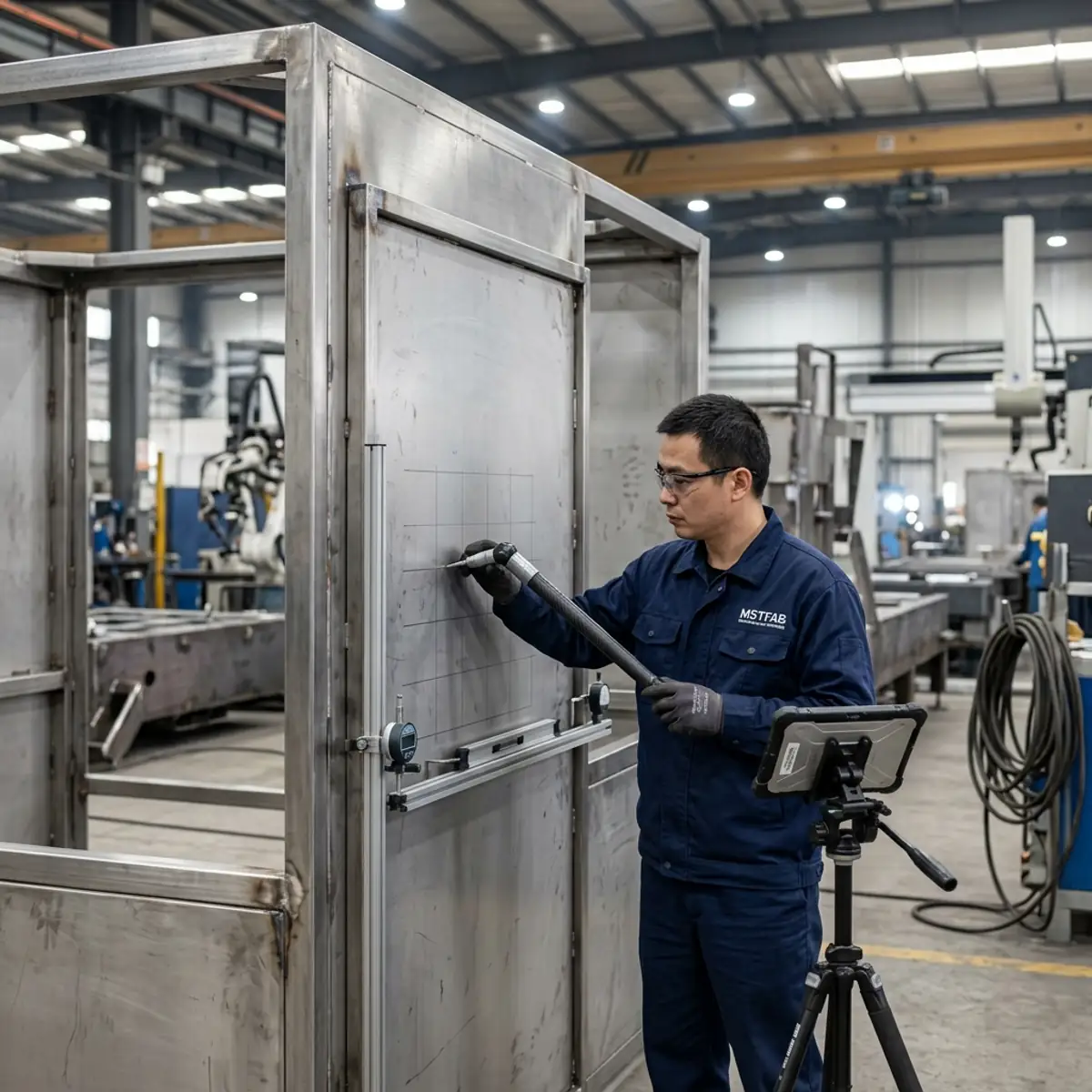
If the prototype passes, do not allow an assembly technician to drill an extra hole because installation became inconvenient. You now own a mechanically different enclosure. External penetrations belong in controlled drawings. If an additional hole is required, update the design, review the sealing strategy, and release the revision.
6. Gland Plates Should Be Tested as Gland Plates
Control gland plate part number, material, thickness, flatness, fastener pattern, sealing arrangement, and gland-hole configuration. A flat solid blank plate and a production plate containing 16 cable entries are not the same interface.
7. Temporary Immersion Creates Pressure Across the Enclosure Boundary
An immersed enclosure experiences water pressure on its external surfaces. The deeper the enclosure is submerged, the greater the hydrostatic pressure. Large flexible sheet metal panels should not be assumed to remain geometrically identical under pressure. If the approved design includes door stiffeners, internal ribs, or additional latch points, those features should remain controlled.
8. Welded Seams Need a Defined Construction
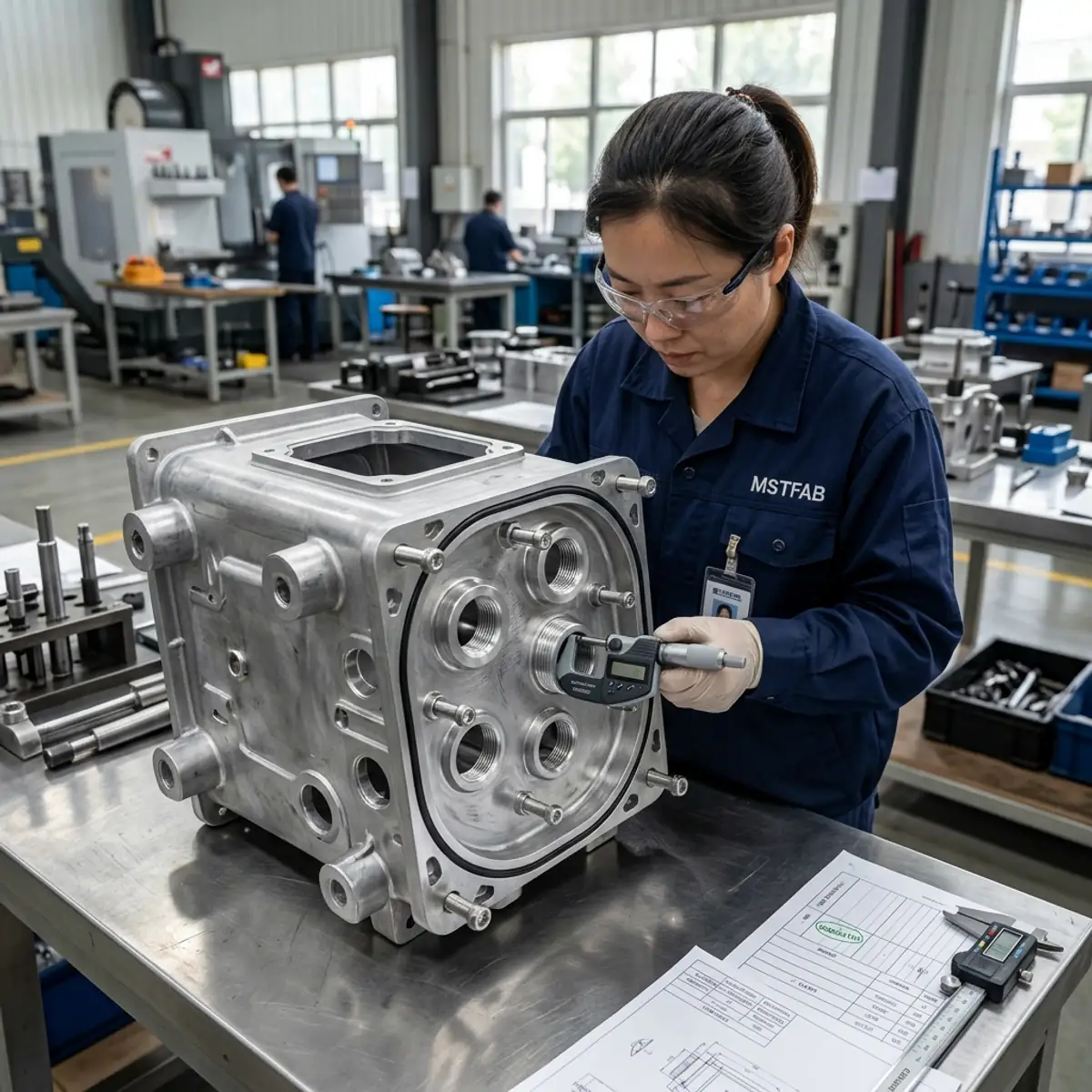
If the approved prototype uses a continuous welded external seam and a defined corner joint, do not allow production to become an intermittent weld or different corner construction without engineering review. The water does not inspect your weld cosmetically. It is more interested in paths. Very small paths.
9. A Failed Test Needs Leak-Path Investigation, Not Random Extra Silicone
If the enclosure fails: Do not immediately add sealant everywhere. First locate the probable ingress path. Then fix the underlying construction. Sealant can be part of a legitimate approved design. It should not be panic in a tube.

The 7-Dimension Supplier Scorecard
| Dim | What to verify | MSTFAB position |
|---|---|---|
| D1 Video audit | HARD GATE: real factory video walkthrough, not a stock photo | Live video audit on request; we show the line, not a brochure |
| D2 Fit gate | Are all penetrations and interfaces frozen in the test configuration? | We strictly control drawing revisions to protect your baseline |
| D3 Capability | Laser cut, CNC bent, continuous welded interfaces, FIP/gasket prep | Full in-house bare metal fabrication |
| D4 Quality + FAI | Door stiffness, gland plate flatness, FAI linked to baseline | FAI on first article; dimensional report shipped |
| D5 Material cert | HARD GATE — EN 10204 3.1 mill cert + PMI | Supplied with every order; no cert, no ship |
| D6 Certs | ISO 9001 baseline; verifiable engineering change (ECO) control | ISO 9001; strict change notification process |
| D7 Commercial | Build-to-print pricing without finished assembly assumptions | Priced from your CAD for empty metal shells only |
Final Buyer Takeaway
An IP67 automation enclosure project should not begin with: “How thick is your gasket?” It should begin with: “Exactly which enclosure configuration are we going to test?”
For MSTFAB, the responsibility stays simple:
- OEM defines the IP67 requirement and test configuration.
- Testing/certification authority evaluates the applicable enclosure assembly.
- MSTFAB manufactures the controlled empty sheet metal shell.
- Electrical integrator installs and validates the final system.
Nobody needs to pretend the laser cutter is an accredited water laboratory. The laser cutter already has enough work.
Frequently Asked Questions
Is MSTFAB an IP67 galvanized steel distribution box automation manufacturer?
MSTFAB is a custom sheet metal fabrication manufacturer producing drawing-defined galvanized distribution box shells for automation OEMs, including projects designed around buyer-defined IP67 temporary-immersion requirements. Final ingress-protection verification belongs to the defined completed enclosure configuration.
What does IP67 mean?
IEC 60529 is the standard covering degrees of protection provided by electrical-equipment enclosures, and IEC’s public IP guide identifies liquid-protection level 7 with temporary immersion in water.
Does IP67 automatically include IP66?
Do not assume this only from the numbering. IEC’s public guidance presents powerful-water-jet protection and temporary-immersion protection as distinct liquid-ingress categories.
Is IP67 the same as IP68?
No. IEC distinguishes temporary immersion from continuous immersion categories. Specify the rating required by the real environment.
Can galvanized steel be used for an IP67 enclosure project?
Galvanized steel can be used as the mechanical substrate in a properly engineered enclosure construction where the OEM has determined the material is suitable for the application’s mechanical and corrosion environment.
Should the final cable glands be installed during IP67 testing?
The responsible OEM/test organization should define the exact test configuration. The tested external interfaces should represent the configuration that the resulting test evidence is expected to support.
Can MSTFAB install cable glands and electrical connectors?
MSTFAB can fabricate drawing-defined gland plates and connector cutouts. The buyer normally selects and installs the electrical glands, connectors and internal devices unless a separate mechanical-assembly scope is expressly agreed.
Request an IP67 Automation Distribution Box Shell Quote
Send MSTFAB your STEP/STP, controlled 2D PDF, galvanized material specification, thickness, finish, quantity, external interface schedule, and IP67 test-configuration requirements.
Request a Quote WeChat Contact
 WhatsApp Me Directly