
⚡ Direct Answer: What IATF 16949 Controls Are Required for Automotive Electrical Enclosures?
Fabricating custom galvanized steel electrical enclosure shells for automotive production lines, Tier-1 robotic welding cells, and EV battery plants requires strict adherence to IATF 16949:2016 automotive quality standards. MSTFAB implements 4 essential manufacturing controls: 1) Advanced Product Quality Planning (APQP) & PPAP Level 3: Providing full Part Submission Warrants (PSW), Design & Process FMEA, Control Plans, and Gage R&R studies; 2) Statistical Process Control (SPC) on CTQ Dimensions: Demonstrating Cpk ≥ 1.67 on critical-to-quality characteristics such as door opening diagonal squareness, hinge centerlines, and sealing flange flatness; 3) IMDS Material Registration: Archiving International Material Data System (IMDS) declarations verifying zinc coating weights and heavy-metal-free passivation; and 4) Formal 8D Root Cause Discipline: Utilizing structured 8D problem-solving methodologies with poka-yoke (mistake-proofing) tooling for all bend sequences and hardware press-fits.
Automotive assembly plants operate under zero-downtime mandates. A dimensional defect in an automation control enclosure or robot junction box that halts a transfer line costs thousands of dollars per minute. MSTFAB delivers precision empty galvanized steel enclosure shells fabricated under automotive-grade quality systems.
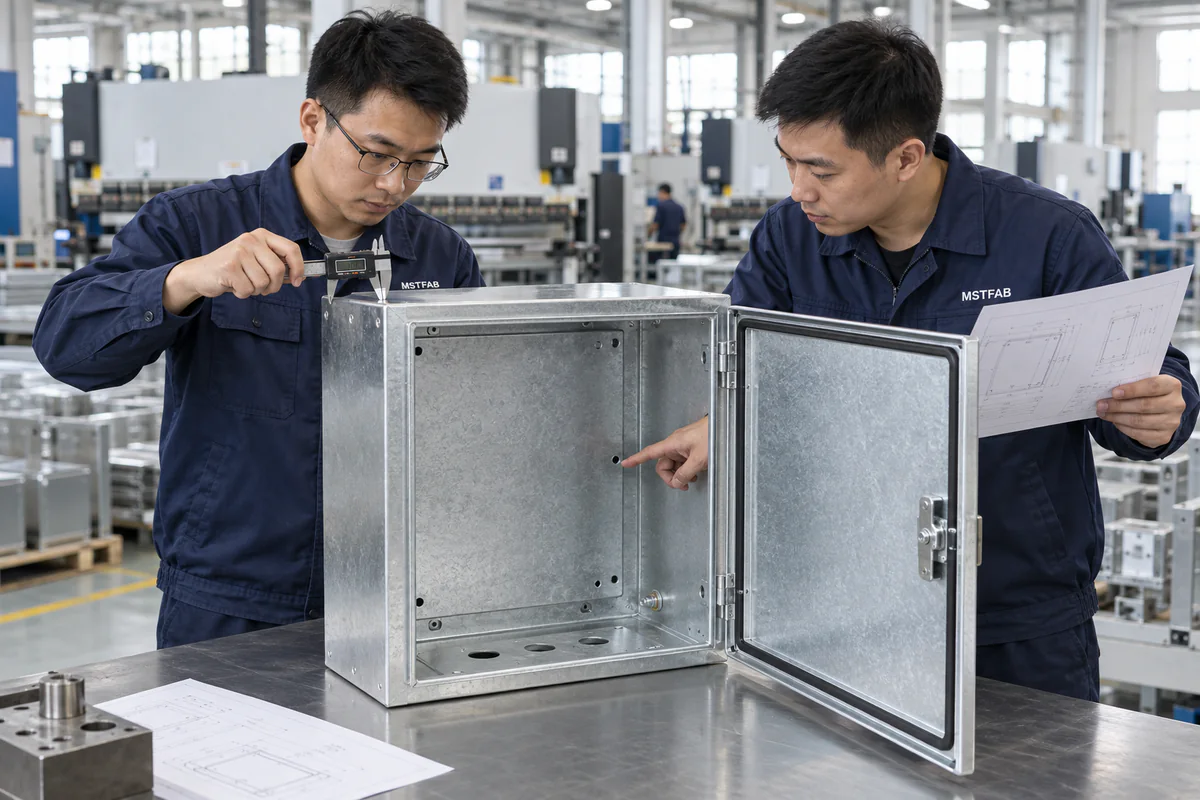
Automotive-grade galvanized enclosure shell: Monitored via SPC bend angles, laser-verified hole centers, and robotic seam welding.
Automotive IATF 16949 vs Standard Industrial Sheet Metal Fabrication
| Quality Dimension | Standard Industrial Metal Shop | MSTFAB IATF 16949 Automotive Protocol | Automotive OEM Advantage |
|---|---|---|---|
| Production Part Approval | Informal dimensional sheet or basic FAI | Full AIAG PPAP Level 3 (PFMEA, Control Plan, PSW, MSA) | Guarantees full compliance for Tier-1 automotive customer audits. |
| Dimensional Capability | Spot checks; no Cpk tracking | Real-time SPC tracking; Cpk ≥ 1.67 on CTQ features | Zero fitment drift across multi-year vehicle platform runs. |
| Material Traceability | Coil batch certs kept in vendor files | Laser-etched QR codes linking parts to coil heat numbers | Enables pinpoint containment in the event of upstream supplier issues. |
| Continuous Improvement | Reactive scrap reworking | Proactive Kaizen, error-proofed tooling, and 8D root-cause corrective action | Eliminates repeat defects and steadily drives down unit costs. |
PPAP Documentation & Fabrication Inspection
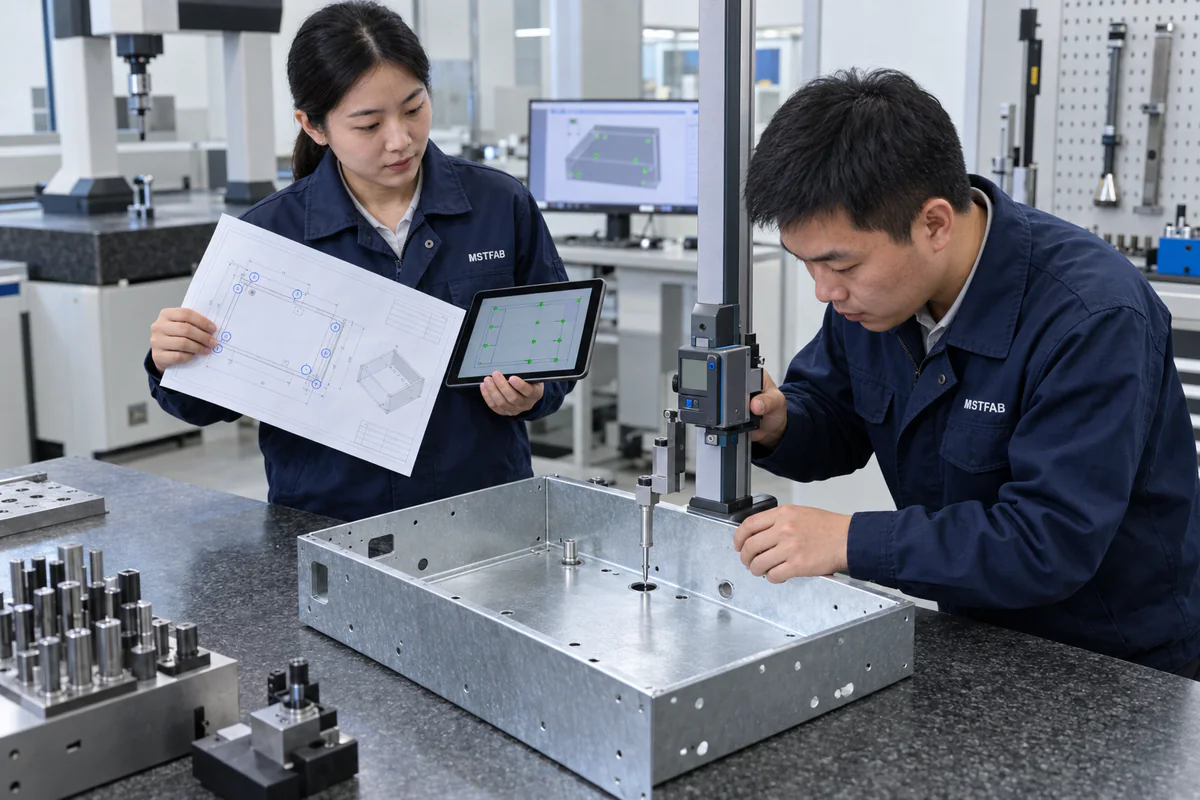
CTQ Characteristic Verification
Laser metrology arms and coordinate measuring machines verify hole-to-hole center distances (±0.15mm) and door flange squareness on every initial production trial.
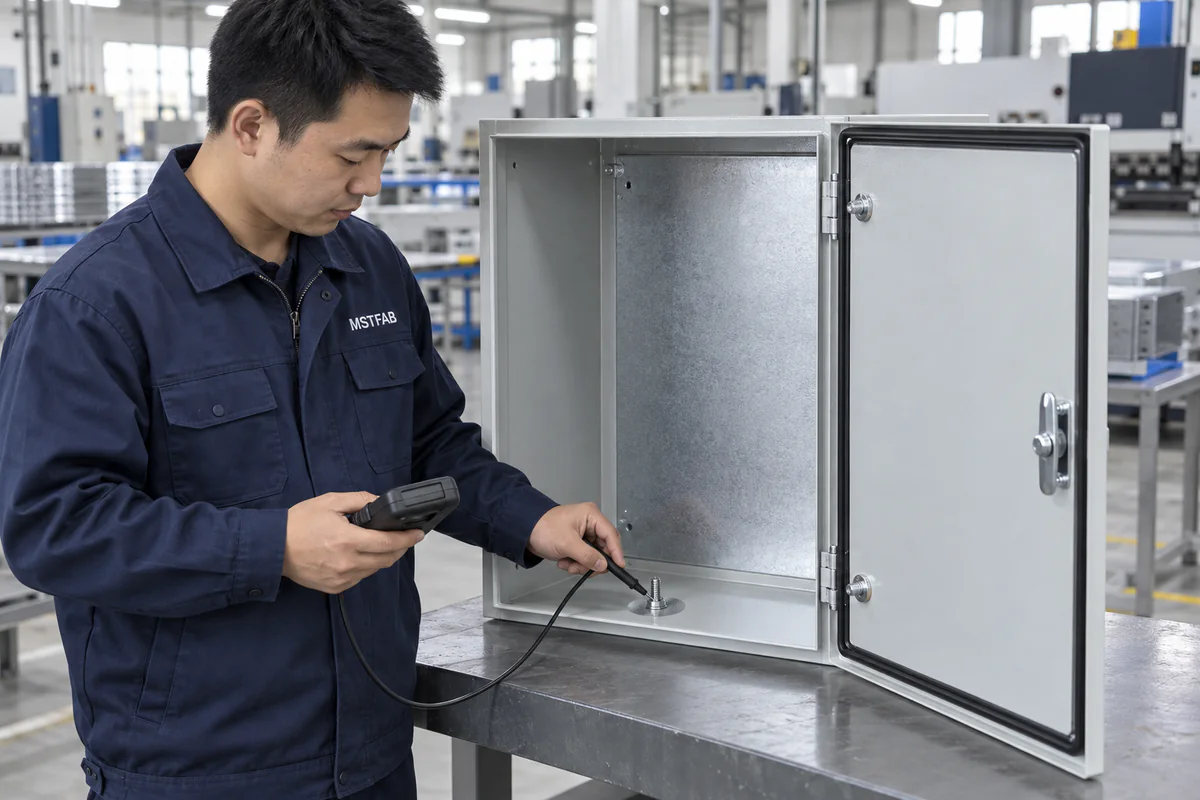
Earth Bonding & Paint Masking
Automotive safety standards mandate clean bonding interfaces. Custom die-cut heat resistant tape masks copper ground studs and bare contact pads during electrostatic powder coat.
Launch Automotive Enclosure Programs with MSTFAB
Partner with a sheet metal manufacturer fluent in PPAP Level 3, APQP, and IATF 16949 quality flowdowns. Contact our automotive engineering team today.
Frequently Asked Questions (FAQ)
Does MSTFAB supply full PPAP sample submissions?
Yes. We supply 300-piece initial capability study runs, complete ballooned drawings, material certifications, and signed Part Submission Warrants (PSW) according to AIAG guidelines.
What weld testing is performed on galvanized automotive enclosures?
We perform destructive chisel and peel testing on coupon samples, macro-etch weld cross-sections, and dye penetrant testing to confirm zero porosity and full throat penetration.
How are design changes managed after PPAP sign-off?
Post-PPAP modifications follow strict Engineering Change Notice (ECN) protocols. No tooling, material, or routing alterations are executed without customer engineering written approval.
 WeChat Contact
 WhatsApp Me Directly